
Over 50,000 militants from 21 groups are in Afghanistan: Defence Ministry

Hilaluddin Helal
ANI: More than 50,000 militants from 21 terrorist organisations are currently operating in Afghanistan, the country’s deputy Defence Minister, Hilaluddin Helal, said on Friday. Out of these 70 per cent are Pakistanis. “As much as 70 per cent of IS [members] are Pakistanis, 6 per cent are Uzbeks, 4 per cent are Chechens, 3 per cent are Arabs, 1 per cent are Chinese and 14 per cent are Afghans,” Helal pointed out. Click here to read more (external link).
Gulbuddin Hekmatyar Challenged Atta Muhammad Noor
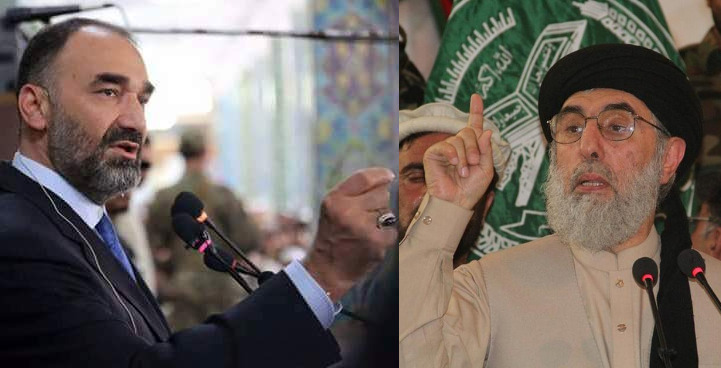
Ariana: The leader of Hezb-e Islami, Gulbuddin Hekmatyar has challenged the former Balkh governor, Atta Muhammad Noor to recapture the Chamtal district instead of seizing the Presidential Palace (ARG). Previously, Atta Mohammad Noor, Chief Executive of Jamiat-e-Islami party in an interview with Ariananews has claimed that if “foreigners” allow him he can seize the Presidential Palace (ARG) in three days. “Noor cannot capture only one district. Seizing the Presidential Palace is a big issue. Some parts of Balkh province are under the control of Taliban,” Hekmatyar told Ariananews. Click here to read more (external link).
1TV Afghanistan Dari News – October 25, 2018
Mullah Baradar’s Release Met With Mixed Reaction

Baradar is one of four men, including Mullah Omar, who founded the Taliban movement in 1994 [Screenshot Al Jazeera]
Related
Afghanistan Probes Claims That 14 Civilians Killed In Army Raid
 RFE/RL’s Radio Free Afghanistan
October 25, 2018
Afghan officials say they have launched an investigation into claims that at least 14 civilians were killed in a military ground operation in eastern Afghanistan.
Protesters temporarily blocked a major highway linking Afghanistan and Pakistan on October 24 to demand action against those responsible for the overnight raid by Afghan security forces in Nangarhar Province’s Rodat district.
Local residents and families of the victims laid the bodies of the deceased next to the highway connecting Nangarhar Province’s capital, Jalalabad, with Torkham, one of the major border crossings into Pakistan, and closed it to traffic.
Both the Taliban and Islamic State militants are active in Nangarhar.
Attaullah Khogyani, the provincial governor’s spokesman, confirmed there had been casualties in the military operation and said an official investigation was under way.
A local elder, Najibullah Amarkhil, put the death toll at 16, including women and children.
“Government forces raided several houses. They killed 14 people, including a 6-month-old baby,” Amarkhil told the AFP news agency, adding two more died from their wounds in hospital.
“We demand the government punish those responsible,” he added.
TOLOnews reported that the death toll was “at least 17.”
Civilians have borne the brunt of the 17-year conflict in Afghanistan. A total of 8,050 civilians were killed or wounded across the country in the first nine months of the year, according to a recent UN report.
The report attributed 65 percent of casualties to the Taliban, the IS group, and other antigovernment forces.
With reporting by AFP, Reuters, and TOLOnews
Copyright (c) 2018. RFE/RL, Inc. Reprinted with the permission of Radio Free Europe/Radio Liberty, 1201 Connecticut Ave NW, Ste 400, Washington DC 20036.
1TV Afghanistan Dari News – October 24, 2018
3 Endemic Countries Hold the Key to a Polio-Free World

Child getting polio drops (file photo)
Lisa Schlein
VOA News
October 24, 2018
GENEVA — As another World Polio Day comes around, the World Health Organization reports three polio endemic countries— Afghanistan, Pakistan and Nigeria — hold the key to the global eradication of this crippling disease.
About one-half million children were becoming paralyzed by polio every year when the World Health Organization began its global polio eradication campaign three decades ago. Today, that number has been reduced by more than 99 percent.
WHO reports fewer than 30 cases of the disease this year, many of them in countries that had been considered polio-free. Spokesman for the Polio Eradication Initiative Oliver Rosenbauer tells VOA outbreaks have occurred in Niger, Democratic Republic of Congo, Somalia, Kenya and Papua New Guinea.
“This really, really underscores the risk that we have this disease — that it will continue to reappear, reemerge in areas that have already eradicated this disease. We see this time and again,” said Rosenbauer. “It is not the first time that we are facing new outbreaks again and we are confident, we know what it takes to stop these outbreaks again.”
Rosenbauer says these countries are implementing emergency measures to stop the outbreak. But, he warns the risk of the wild polio virus spreading across borders will continue until the disease is eradicated in the three endemic states of Afghanistan, Pakistan and Nigeria.
“These three countries hold the key to a polio-free world,” said Rosenbauer. “They have been battling this disease so very long, but they are making actually tremendous progress this year. Never before have we seen the disease in these countries at such low levels as we are today, this year.”
Rosenbauer says Afghanistan and Pakistan have each reported six cases of polio.
He says no cases of the paralytic disease have been detected in Nigeria. But that, he says, does not mean there are no new cases of the disease there.
He notes the wild polio virus is present in parts of Borno State in northeastern Nigeria, which are under the control of Boko Haram militants. This, he says makes it too dangerous for health workers to conduct disease surveillance to see whether the virus is circulating.
Related
India, Afghanistan defy US on Iran’s Chabahar plan

A ship at Chabahar Port (file photo, Press TV)
Press TV
October 24, 2018
India and Afghanistan are pushing ahead with plans to open a new transportation corridor between the two countries via Iran’s strategic port of Chabahar despite US sanctions.
New Delhi sees the port crucial to its connectivity ambitions, including access to CIS countries – a regional organization of 10 post-Soviet republics in Eurasia.
For landlocked Afghanistan, the corridor means opening the way for billions of dollars in trade and cutting the country’s dependence on foreigners for aid as well as stemming the illicit opium trade.
The US is plainly opposed to the project, not just because of its entrenched hostility to Iran, but also its plans for a long-haul military stay in Afghanistan and its efforts to keep India and Russia as apart as possible.
US President Donald Trump has also expressed an interest in Afghanistan’s massive mineral resources which India has already won the rights to exploit, including an iron mine. New Delhi seeks to use a planned railroad to Chabahar to export iron ore from the Hajigak iron mine in central Afghanistan.
Both India and Afghanistan have signaled their commitment to the development of Chabahar.
On Tuesday, senior officials from the two countries met their counterpart in Tehran to discuss a full commissioning of the port that the three countries are jointly developing.
It was the first trilateral meeting of the Coordination Council of the Chabahar Agreement, coming in the face of fresh sanctions imposed by Washington on the Islamic Republic.
“Detailed discussions were held between the three sides on full operationalization of the trilateral agreement for international transit and transport through Chabahar port,” India’s External Affairs Ministry said in a statement.
“All sides shared the view that a full operationalization of the trilateral Chabahar initiative will promote connectivity and economic development of Afghanistan and the region,” it added.
According to the statement, a decision was also taken to form a follow-up committee that would hold its first meeting within two months in Chabahar.
It will discuss and aim to finalize a protocol to harmonize transit, roads, customs and consular matters that were shared by the Indian side at the meeting for making the route attractive, decreasing logistic costs and paving the way for a smooth implementation of the trilateral Chabahar agreement, the statement said
India has pledged to invest $500 million in Chabahar on the Gulf of Oman which is Iran’s closest port to the Indian Ocean.
Last December, Iran opened an extension of the port, carried out with an investment of $1 billion including $235 million from India. In October, India sent its first consignment of wheat to Afghanistan through Chabahar.
The port is also a key link in the International North South Transport Corridor (INSTC), a multi-modal network of ship, rail and road routes to move freight between India, Iran, Afghanistan, Armenia, Azerbaijan, Russia, Central Asia and Europe.
India is also attempting to put in place a separate corridor linking Gujarat and West Bengal to Kazakhstan, Turkmenistan and eastern Russia via Iran’s Bandar Abbas.
Indian officials say the idea is to access the markets of the landlocked region and create a corridor to import natural resources from the region in a shorter period than being done currently.
Officials from India and Kazakhstan will reportedly meet in New Delhi next week to finetune proposals for the corridor which will run parallel with INSTC and Chabahar route.
Mujeeb Ur Rehman interview: ‘Will look to use Afghanistan Premier League experience in BBL, emulate Rashid Khan’

Mujeeb Ur Rahman Zadran
First Post: With the world his oyster given his talents with the ball, the young Mujeeb Ur Rahman is looking forward to a long and rewarding career, but he remains cautious and is aware that competition in the world of cricket is tough and nothing much can be achieved without hard work. Click here to read more (external link).