
 Ariana: According to an assessment of the Public Health Ministry (MoPH), due to conflict, poverty and unemployment about half of the Afghan citizens suffer from mental illness. About 12,666 people including children aged 4 to 15 have been interviewed in the research and it took two years to get completed. According to the research, most of the mental patients are adults. Click here to read more (external link).
1TV Afghanistan Dari News – October 28, 2018
Afghanistan’s Safari secures gold at int’l jiu-jitsu championship in UAE

1TV: Afghanistan’s Hussain Bakhsh Safari won gold medal at the Al Ain International Pro Jiu-Jitsu Championship in the United Arab Emirates. Safari achieved first position in the 67kg category after beating his rivals from Russia and Jordan. Click here to read more (external link).
Other Sports News
Nasrat Haqparast gets second win in the UFC; defeats Thibault Gouti via Unanimous Decision

Gouti (left) and Haqparast (right)
Abdullah Qazi
AOPNEWS | October 27, 2018
Afghan MMA fighter Nasrat Haqparast picked up his second UFC win tonight by defeating France’s Thibault Gouti via unanimous decision. Haqparast went into the fight as a favorite to win; the Las Vegas odds were -950 for Haqparast and +575 for Gouti.
In round 1, Haqparast’s speed allowed him to get in and out of range without any issues. A big left from Haqparast at 1:45 sent Gouti backwards to the floor, but he was able to immediately crawl back to his feet. At the end of the round, Gouti was left bleeding and visibly winded. The round clearly went to Haqparast.
In round 2, Gouti came out strong, trying to put pressure on Haqparast. However, Haqparast did not give up, and successfully prevented Gouti from controlling the pace. Haqparast landed a nasty kick to the body, stunning Gouti. At the end, this round also went to Haqparast.
Haqparast dominated round 3, sending Gouti to the floor, and then, he unleashed a flurry of heavy punches. Haqparast had total control – grounding and pounding a bleeding Gouti. However, towards the end of the round, Gouti was able to break free. Unfortunately for Gouti, he wasn’t able to do much standing up, and the round ended with Haqparast as the clear winner.
Haqparast walked away with a victory, via a unanimous decision, with the judges scoring the fight: 29-27, 29-28, 30-26.

Haqparast – post fight interview
At the end of the fight, Haqparast commented that he thought he might have broken his hand in the first round, but didn’t let it stop him. Haqparast was gracious, and even commented that Gouti was a “tough guy”, and took shots like a man. When asked what is next by the commentator, Haqparast said that he did not want to “fly too high”, but by next year, he wanted a top 15 fighter.

Haqparast posing with his crew at the end of the fight.
The lightweight bout (155 lbs) was one of the preliminary cards of UFC Fight Night 138 (Volkon vs. Smith), held at Avenir Centre in Moncton, Canada. With this win, Haqparast has solidified himself as a legitimate contender in the lightweight division. His record improves to 10 wins, and only 2 losses, and Gouti adds another loss to his record, which is now 12 wins and 5 losses.
Haqparast is one of only two Afghans who are fighting in the UFC, which is the largest MMA promotion in the world, and has the best fighters. The other Afghan UFC fighter who was the first Afghan to be signed by the promotion is welterweight Siyar Bahadurzada.
Related
1TV Afghanistan Dari News – October 27, 2018
Afghans Vote In Kandahar Elections Delayed By Violence
RFE/RL’s Radio Free Afghanistan
October 27, 2018
Afghans in the country’s southern province of Kandahar voted in parliamentary elections on October 27, a week after 32 of the country’s 34 provinces went to the polls.
The Kandahar governor’s office assured voters on Twitter that serious security measures were in place to ensure their safety.
Election officials said that voting had been extended by one hour. Polls closed at 5 p.m. local time but election officials could not immediately determine the turnout in Kandahar.
Major roads throughout southern Kandahar were closed nearly 24 hours before polls opened to stop vehicle-born explosive devices from entering the province, provincial governor’s spokesman Aziz Ahmed Azizi said.
Reports suggested that dozens of polling stations opened late because staff did not show up or election materials were not readily available.
Seyed Hafizullah Hashemi, Independent Election Commission spokesman, told RFE/RL’s Radio Free Afghanistan that the issue will be investigated.
According to election commission figures, more than 500,000 people had registered to vote at the 173 polling stations across Kandahar.
Election officials said 111 candidates were vying for 11 seats in parliament from southern Kandahar in Afghanistan’s 249-seat chamber.
The delay in voting was the result of the assassination of Kandahar’s police chief General Abdul Raziq by Taliban insurgents two days before the national elections.
The killing of Raziq, who was widely credited for maintaining stability in Kandahar, the birthplace of the Taliban, sent shock waves through the country.
Officials said thousands of soldiers have been deployed to boost the morale of voters shaken by the killing. Zia Durani, a spokesman for the Kandahar police, said security forces are working to protect more than 550,000 voters expected to cast their ballots in the province.
But security officials said there could be further attacks by Taliban militants who are seeking to reimpose strict Islamic law in Afghanistan after their 2001 ouster by U.S.-led forces.
The Afghan elections have been rocked by repeated Taliban and Islamic State attacks. Both groups have warned Afghans against participating in the elections and have used violence to try to prevent people from going to the polls.
Underscoring the country’s precarious security situation, a suicide bombing outside a police compound in central Wardak Province south of the Afghan capital, Kabul, killed at least five people and wounded 15, a police spokesman said.
The October 27 bombing in Maidan Shahr, the main city of the province, happened as police officers and civilians were going inside the base, Hekmat Durrani, a spokesman for the police chief, said.
Three civilians and two policemen were among the dead, Durrani said, adding that the casualty figure could rise.
A Taliban spokesman said the insurgent group was responsible for the attack.
During two days of voting last weekend, militants launched some 250 attacks across the country, killing at least 50 people and wounding more than 100, the Interior Ministry said.
Raziq and Kandahar’s intelligence agency commander were killed on October 18 when a member of the provincial governor’s bodyguard staff opened fire on officials leaving a meeting with the U.S. commander of Afghanistan’s NATO-led force, General Scott Miller.
Miller escaped unharmed, but a U.S. general was one of two Americans wounded in the attack.
Afghan President Ashraf Ghani’s government named Raziq’s brother as his successor.
Raziq’s death could serve as a rallying point for voters, said Dawa Khan Menapal, an independent Kandahar candidate.
“People are determined to take part in the election because they want to show the Taliban that terror cannot stop the Afghans from deciding their future,” he said.
“We are willing to vote and we will come out even if it costs our lives,” registered voter Samiullah told AFP. “Afghanistan has been torn by war and that’s why we must decide our future and vote for our candidates.”
With the Taliban operating across much of the country and heavy pressure from international partners for the vote to be held, the election has been seen as a major test for the government.
Voting in the 32 provinces saw a high turnout, but the process was marred by logistical and technical glitches as well as violence.
Elections also were not held in central Ghazni Province, southwest of the capital, which is still reeling from the Taliban’s takeover in August. It was not immediately clear when they will be held.
Preliminary nationwide results are expected to be released in November. Final results will not be known until the new year.
With reporting by Reuters and AFP
Copyright (c) 2018. RFE/RL, Inc. Reprinted with the permission of Radio Free Europe/Radio Liberty, 1201 Connecticut Ave NW, Ste 400, Washington DC 20036.
Related
For Uzbekistan, teaching spells prosperity in Afghanistan
 Eurasia.net: Since moving to Termez for his studies, the strangest thing for Asadullah Azizi has been to hear Uzbek spoken everywhere. The 24-year-old is himself an ethnic Uzbek, but his mother tongue gets little public exposure in his native Afghanistan. “Uzbek for us is a language for the street and the home. We Afghan Uzbeks only talk our native language among family and friends. But we cherish it, because it is the cultural heritage of our ancestors. And here, in Uzbekistan, it’s the main language of the country,” Azizi, who has seen little beyond his hometown of Sheberghan, around 135 kilometers west of Mazar-i-Sharif, told Eurasianet. Click here to read more (external link).
Afghans becoming unprecedentedly pessimistic about future of country: Survey

Press TV
October 27, 2018
People in Afghanistan are showing unprecedented levels of pessimism about the future of their war-ravaged country, a US survey shows, as militant attacks continue to take toll on the lives of Afghans almost every day 17 years after the US invaded the country.
In a survey, whose results were published on Friday, Gallup asked Afghans of all walks of life how good they anticipate life to be in five years. It recorded a shocking average of 2.3 on a ladder scale with 10 as the best possible.
“Almost no Afghans see their economic situation improving anytime soon. This year, 4 percent say their standard of living is getting better; this is lower than or on par with the lowest figures Gallup has recorded from any country since 2006, including the most desperately poor countries in Africa and Asia,” Gallup said.
Two years ago, Afghans put their life quality in five years at 5.4.
The latest survey “reveals just how devastating the negative cycle of poverty and violence has been to Afghans’ daily experiences,” the polling organization added.
Gallup conducted the survey in July in face-to-face interviews of 1,000 Afghans.
The results of the survey were announced in the wake of last week’s legislative elections which were marred by blood and violence.
Some four million Afghans voted in the long-delayed elections amid widespread accounts of polling problems and Taliban deadly attacks.
The US invaded Afghanistan in 2001, toppling a Taliban regime in control of most of the country at the time. But the invasion has failed to restore security in the country plagued by militancy and terrorism.
The administration of US President Donald Trump is struggling to find a way out of the costly conflict as the Taliban militant group has managed to partially reassert themselves in several provinces by taking control of certain areas.
Over 8,000 people lost their lives or have been wounded in Afghanistan between January and September this year, with the country on track to be deadlier than Syria in 2018. Kabul blames the Taliban militant group for the bulk of the death toll.
Last year, Washington added thousands of additional troops to its forces in Afghanistan. The White House claims the American troops are deployed in Afghanistan to train Afghan forces and conduct counter-terrorist missions against militant groups.
Related
Football Brings Thousands Of Afghans Together
 Tolo News: As the 7th Afghan Premier League (APL) football annual tournament ended on Thursday evening, thousands of Afghans from different parts of the country appeared at Afghanistan Football Federation stadium in Kabul to watch the match. The Afghan Premier League was launched in 2012 and since then it brings thousands of Afghans together to watch matches between the eight teams every year. The final match had more than 10,000 viewers at the stadium including key guests. The thrilling match was between Shaheen Asmayee, from the capital, Kabul, the four times title holder of APL, and Toofan Harirod, from the western zone, at the Afghanistan Football Federation stadium in Kabul. Toofan Harirod had won the APL cup when the league was first launched in 2012. Click here to read more (external link).
APL 2018: Toofan Harirod VS Shaheen Asmayee
Final Full Match
Modern Voting Systems Did More Harm Than Good In Afghanistan’s Recent Elections
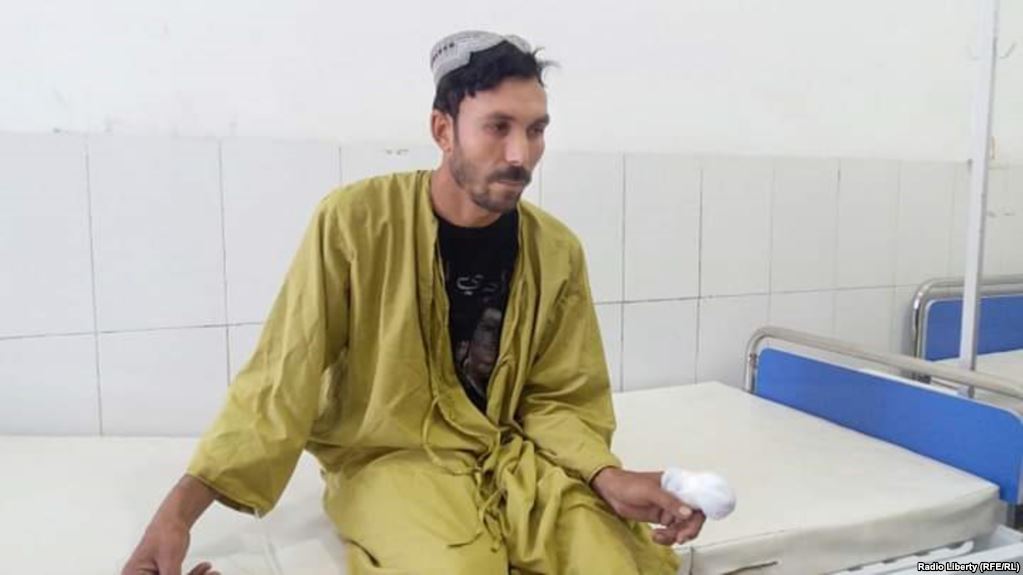
Taliban militants cut off Hafizullah’s index finger as punishment for voting in Afghanistan’s recent parliamentary elections. “We risked our lives to vote,” he says
Frud Bezhan
Radio Free Europe/Radio Liberty
October 26, 2018
Hafizullah rocks on his hospital bed in pain, an oversized bandage covering the nub where his finger used to be.
This is the price he paid for exercising his right to vote in Afghanistan’s October 20 parliamentary elections. Shortly after electoral officials in Helmand Province marked his finger with indelible blue ink — a simple way to help prevent multiple voting — Taliban fighters abducted Hafizullah and cut off his finger.
Hafizullah’s experience illustrates the difficulties of employing even the most rudimentary methods to create a transparent voting environment, let alone the new methods attempted by the Afghan authorities for this election.
In an attempt to prevent the widespread fraud that has marred previous votes, the authorities introduced computerized voter lists at each of the country’s 4,900 polling stations. At the very last minute, they launched a biometric voter-verification system.
But instead of helping transparency, the new systems added to the chaos and ultimately undermined the credibility of the vote.
If this wasn’t obvious on election day, it became crystal clear on October 23, when officials started tallying results and uncovered confusion over what votes would be counted or discarded as a result of widespread technical and organizational failures.
‘It Was A Mess’
“When I went to the polling center to vote, it was a mess,” says Ejaz Malikzada, a political activist in the capital, Kabul. “The biometric devices didn’t work. My name was also not on the voters list, even though I registered to vote.”
Malikzada, who left without voting, listed several other reported irregularities pertaining to the election: voters casting ballots multiple times, ineligible voters casting ballots, and a shortage of observers at polling stations.
More than 5,000 complaints over irregularities were lodged by voters and candidates across the country. Dozens of people were also arrested and charged with interfering in the elections, or for fraud.
Muhib Shadan, a voter living in the west of Kabul dominated by the Hazara community, said mismanagement was widespread there, too.
“At some polling stations in west Kabul, the voter lists were from other provinces,” Shadan claimed. “Biometric devices were not working in most of the polling stations. In some polling stations, the batteries of the devices were dead. The staff at the polling centers were not trained well.”
Mariam Solaimankhail, a candidate for the nomadic Kochi minority that is guaranteed 10 seats in parliament, said that, like many Kochis in Kabul, she was unable to vote because her name did not appear on the voter list.
Voting was extended by a day at 401 polling stations, including 45 in Kabul, that failed to open on October 20 because of technical issues.
But even that move appears to have harmed more than helped.
The Transparent Election Foundation of Afghanistan (TEFA), a civic action body that has been monitoring the ballot, said the decision to extend the vote opened the way for fraud when half-filled ballot boxes were left open all night in some polling centers.
Independent election observers said issues were even more widespread in the countryside, where the Taliban has clout and there is less government control and oversight of the elections.
The Independent Election Commission of Afghanistan said around 4 million people voted, less than half of the nearly 9 million voters who registered — and it is widely suspected that a significant number of the votes counted were fraudulent.
Even before the vote, analysts had raised eyebrows over suspiciously high voter registration, particularly in restive southern and eastern provinces where registration exceeded the number of eligible voters. There was also improbably high registration of women in some central and northern provinces.
Setbacks were also evident in the southern province of Kandahar, where voters went to the polls only on October 26, almost a week after the nationwide vote. The delay was caused by an attack on October 18 that left nearly the entire provincial leadership dead or wounded.
In the southeastern province of Ghazni, meanwhile, the elections were postponed indefinitely due to disagreements over the representation of different ethnic groups.
Which Votes To Count?
As the election commission began to tally the votes, confusion reigned.
Before the vote, election officials had said they would only count votes that had been verified by biometric devices and voter lists.
But observers said that at some polling stations only biometric verification or voter lists were used, while in other polling centers neither of the two systems were used.
“We have concerns regarding the management of the process and which votes will be counted,” said Muslim Shirzad, one of more than 2,500 candidates nationwide who competed for the 249 seats in the lower house of parliament.
Ahmad Shuja Jamal, an Afghan analyst who researches security and human rights issues, said many people cast their votes without following the correct procedures because of issues with biometric devices and voter rolls.
“The rule book has not been written on how to deal with these issues,” he said. “[Election authorities] have only given vague assurances to the public that they would audit these failures in a fair way without explaining the technical procedures and standards.”
As Hafizullah lies in his hospital bed after surgery in Helmand, he says he hopes his sacrifice was worth it.
“I went to vote because it was our duty and our right,” he tells RFE/RL’s Radio Free Afghanistan. “We risked our lives to vote. I hope it will count for something.”
Copyright (c) 2018. RFE/RL, Inc. Reprinted with the permission of Radio Free Europe/Radio Liberty, 1201 Connecticut Ave NW, Ste 400, Washington DC 20036.
Related