
Resistance: 300 Talibs killed
Update from the Anti-Taliban resistance – they tell me: Taliban ambushed in Andarab of Baghlan province. At least 300 Taliban fighters were killed. The group is lead by #AhmadMassoud & @AmrullahSaleh2 #Afghanistan pic.twitter.com/uJD1VEcHY1
— Yalda Hakim (@BBCYaldaHakim) August 22, 2021
Saleh: Salang closed by the resistance
Talibs have massed forces near the entrance of Panjshir a day after they got trapped in ambush zones of neighboring Andarab valley & hardly went out in one piece. Meanwhile Salang highway is closed by the forces of the Resistance. "There are terrains to be avoided". See you.
— Amrullah Saleh (@AmrullahSaleh2) August 22, 2021
Afghan ‘resistance’ in Panjshir valley says ready for anti-Taliban fight

Massoud
Press TV
August 22, 2021
Former Afghan government forces forming a resistance movement in Panjshir fortified valley northeast of Kabul are preparing for “long-term conflict” after the takeover of the war-ravaged Asian country by the militant group, an official says.
Ali Maisam Nazary, an official from Ahmad Massoud’s National Resistance Front said in an interview on Sunday that the group’s main goal was to avoid further bloodshed in Afghanistan and press for a new system of government.
But Nazary said the group is also prepared for conflict, and if the Taliban do not negotiate they will face resistance across the war-raved country.
“The conditions for a peace deal with the Taliban is decentralization — a system that ensures social justice, equality, rights, and freedom for all,” said Nazary, adding if the Taliban do not agree there will be “long-term conflict.”
Nazary also optimistically highlighted reports that local militias in some districts have already begun resisting Taliban rule and have formed links with Massoud’s NRF.
“Massoud did not give the order for these things to happen but they are all associated with us,” he said.
“The Taliban are overstretched. They cannot be everywhere at the same time. Their resources are limited. They do not have support amongst the majority.”
“War is just a byproduct of conflict in Afghanistan. What has caused the conflict is that Afghanistan is a country made up of ethnic minorities … (and) in a multi-ethnic country you cannot have one ethnic group dominate politics and others having a presence in the margins.”
Nazary went onto say that Massoud’s resistance, and others across Afghanistan, were vital in making this change happen.
“Panjshir has always been a beacon of hope.”
“If there is any aggression because our fight is only for defense; if anyone attacks us we will defend ourselves.”
Elsewhere in his remarks, he said the province has seen an influx of intellectuals, women’s and human rights activists, and politicians “who feel threatened by the Taliban”. Nazary stressed that the aim right now was to defend Panjshir and its people.
In recent days, former Vice President Amrullah Saleh and Ahmad Massoud, son of former commander Ahmad Shah Massoud, have vowed to resist the Taliban from Panjshir.
People close to Massoud say that about 9,000 fighters, made up of remnants of army and Special Forces units as well as local militia groups, have gathered in the valley.
The mountainous Panjshir valley remains the only holdout against the Taliban after the militants took control of Afghanistan.
The 32-year-old son of late Ahmad Shah Massoud has pledged to hold out against the Taliban from his stronghold in the Panjshir valley. The region is known for its natural defenses and was also held out against the Taliban when they ruled Afghanistan in 1996-2001.
In a recent Washington Post editorial, Ahmad Massoud said members of the Afghan military including some from the elite Special Forces units had rallied to his cause and he had appealed to some countries for help.
Several countries have been cautiously optimistic about the new leadership in Kabul and are seeking contact with the militants in an effort to avoid instability spilling over to neighboring ex-Soviet states.
The US messy withdraw put an end to a futile two-decade-long war the United States waged in Afghanistan.
For now, the Taliban have vowed to respect the rights of women, seek good relations with other countries, and not to exact retribution on former members of the Afghan military. Many Afghans remain skeptical, however.
Related
Exiled Afghan president’s children living luxurious lives in DC, Brooklyn

Ghani
New York Post: The Ghani family likes to live in style. Just a week after Ashraf Ghani cowardly abandoned his country for the luxury confines of Dubai (reportedly with $169 million in cash shoved in a helicopter), it turns out both of his kids live in luxury while women in their homeland live in terror about the return of the Taliban’s oppressive rule. Click here to read more (external link).
Vladimir Putin says he’s not allowing Afghan refugees into Russia

Putin
New York Post: Russian President Vladimir Putin said Sunday that his country won’t accept Afghan refugees because he doesn’t want to deal with “militants” masquerading as asylum-seekers. The Russian strongman slammed Western nations for placing Afghan refugees in countries even near his border while their US and European visas are being processed. Click here to read more (external link).
Thousands Of Afghans Jam Streets Near Kabul Airport; Foreign Countries Ramp Up Evacuation
 Radio Free Europe/Radio Liberty
August 22, 2021
Tens of thousands of Afghans again jammed the roads leading to Kabul’s airport, as Taliban fighters fired weapons in the air and sought to control the crowds trying to flee the country.
As the Taliban tried to consolidate its control over Kabul and establish law and order, the group faced a challenge in a northern district from fighters who refuse to recognize the Taliban’s claim to power.
The Al-Arabiya TV channel on August 22 cited the son of Ahmad Shah Massud, who was one of the main leaders of the country’s anti-Soviet resistance in the 1980s, as saying he will not surrender areas under his control to the Taliban.
Ahmad Massud also called on the formation of a comprehensive government to rule the country with the participation of the Taliban. And he warned that war will be “unavoidable” if the insurgents refuse dialogue, the TV channel reported.
The chaos outside the Kabul airport has resulted in the deaths of seven Afghans, the British military said August 22 — a figure that is believed to be a major undercount. The British statement did not specify when or how exactly the deaths occurred.
A NATO official said that at least 20 people have died in the past seven days in and around the airport. Some were shot and others died in stampedes.
Thousands of U.S. Marines have secured part of the airport, and struggled to keep crowds at bay and away from the tarmac as military and civilian aircraft take off carrying foreigners and Afghans alike.
Jake Sullivan, the White House national-security adviser, told CNN on August 22 that 3,900 people had been flown out of Kabul on U.S. flights over the previous 24 hours. According to the U.S. Defense Department, U.S. planes have ferried 17,000 people out of the country since the evacuation effort began a week ago.
The British Defense Ministry said nearly 4,000 people had been evacuated on U.K. flights from Afghanistan since August 13.
The Afghan Civil Aviation Authority asked people not to travel to the facility.
“There [are] no civilian and commercial flights in Hamid Karzai International Airport,” it advised on its Facebook account August 21.
Britain, the United States, and other countries have struggled to expand evacuation efforts of their own citizens, as well as Afghans who have worked for foreign embassies, NGOs, NATO forces, or other organizations that might put them at risk of retribution by Taliban fighters.
Growing security threats have prompted U.S. military planes to do rapid, diving, combat landings at the Kabul airport and other aircraft have been seen shooting off flares on takeoff, apparently in an attempt to confuse possible heat-seeking missiles.
The U.S. Embassy issued a new security alert, warning citizens not to travel to the Kabul airport without individual instruction from a U.S. government representative.
The Pentagon said it was formally seeking airlift help from commercial airlines to relocate evacuees from Afghanistan once they have gotten out of their country.
Pentagon spokesman John Kirby said the commercial aircraft will not fly into the Kabul airport, but rather will be used to move passengers from way stations once they leave Kabul, allowing the U.S. military to focus on the Afghanistan portion of the evacuation.
The Spanish government announced that the United States and Spain have agreed to use two military bases in Spain to receive Afghans who worked for the U.S. government.
Under the agreement, the bases — one near Seville, the other near Cadiz — will be used to process refugees from Afghanistan until their travel to other countries is arranged.
European Union foreign policy chief Josep Borrell said the EU has “complained” to U.S. officials that their security at Kabul airport was overly strict and was hampering attempts by Afghans who worked for the Europeans to enter.
Bahrain has said it will open up its airports to flights evacuating people from Afghanistan, and the United Arab Emirates announced it would temporarily host Afghan refugees as the United States faced overcrowding at facilities processing evacuees in Qatar.
Afghan officials familiar with talks held in the capital say the Taliban will not make announcements on their government until the August 31 deadline for the U.S. troop withdrawal passes.
With reporting by Reuters, The Wall Street Journal, dpa, AP, and AFP
Copyright (c) 2021. RFE/RL, Inc. Reprinted with the permission of Radio Free Europe/Radio Liberty, 1201 Connecticut Ave NW, Ste 400, Washington DC 20036.
Related
Nikki Haley: US surrendered $85 billion worth of weapons to the Taliban

Taliban militants are seen after seizing Zaranj, the capital of Afghanistan’s Nimroz Province, on August 6, 2021. (Photo via RT)
Press TV
August 22, 2021
Former US Ambassador to the United Nations Nikki Haley has said that the administration of President Joe Biden has surrendered Bagram Air Force Base, and $85 billion worth of equipment and weapons to the Taliban.
In an interview with CBS News on Sunday, Haley slammed the Biden administration for its execution in withdrawing troops from Afghanistan, saying it “completely surrendered to the Taliban.”
When asked how the US administration is negotiating with the Taliban, she said, “They’re not negotiating with the Taliban. They’ve completely surrendered to the Taliban. They surrendered Bagram Air Force Base, which was a major NATO hub. They surrendered $85 billion worth of equipment and weapons that we should have gotten out of there.”
“They have surrendered the American people and actually withdrew our troops before they withdrew the American people. And they’ve abandoned our Afghan allies who kept people like my husband safe,” Haley added.
The Taliban have seized billions of dollars of US weapons following the quick collapse of Afghan security forces that were armed with the American military equipment.
Black Hawk helicopters and A-29 Super Tucano attack aircraft are among the items captured by the Taliban, according to the reports published this week.
Taliban fights were seen in photos circulating on media clutching American-made M4 carbines and M16 rifles instead of their iconic AK-47s. And the militants have been spotted with American Humvees and mine-resistant ambush-protected vehicles.
However, Haley also acknowledged that the Biden administration must now do “whatever it takes to get our Americans out.”
“This is an unbelievable scenario where literally the Taliban has our Americans held hostage,” she added.
The United States claims it has spent up to $89 billion on training and equipping Afghan security forces over the last twenty years that failed to stop the Taliban onslaught on Kabul. Rather, according to reports, a significant percentage of the US-trained Afghan security forces have joined the Taliban force.
The United States handed over 75,898 vehicles, 599,690 weapons, 162,643 pieces of communications equipment, 208 aircraft, and 16,191 pieces of intelligence, surveillance and reconnaissance equipment to the Afghan forces between 2003 and 2016, according to a 2017 Government Accountability Office report.
Washington also gave Afghan forces 7,035 machine guns, 4,702 Humvees, 20,040 hand grenades, 2,520 bombs and 1,394 grenade launchers, among other equipment, from 2017 to 2019, according to a report last year from the Special Inspector General for Afghanistan Reconstruction (SIGAR).
Some 46 of those aircraft are now in Uzbekistan after more than 500 Afghan government troops used them to flee Afghanistan following the collapse of the government last week. The rest have been taken over by the Taliban.
The Biden administration has acknowledged a “fair amount” of weapons have fallen into the hands of the Taliban.
On Saturday, Trump called Biden’s handling of the retreat of US forces from Afghanistan “the greatest foreign policy humiliation” in American history.
Trump, a Republican who is considering running again for president in 2024, has repeatedly blamed Biden for Afghanistan’s fall to the Taliban.
“Biden’s botched exit from Afghanistan is the most astonishing display of gross incompetence by a nation’s leader, perhaps at any time,” Trump said at a boisterous rally packed with his supporters near Cullman, Alabama.
“This is not a withdrawal. This was a total surrender,” he said.
The Taliban are poised to run Afghanistan again 20 years after they were removed from power by American forces following the September 11, 2001 attacks on the United States.
The US invaded Afghanistan in October 2001 and removed the Taliban from power. American forces occupied the country for about 20 years on the pretext of fighting against the Taliban. But as the US forces left Afghanistan, the Taliban stormed into Kabul, weakened by foreign occupation.
Economic Crisis Looms for Afghanistan Under Taliban Rule
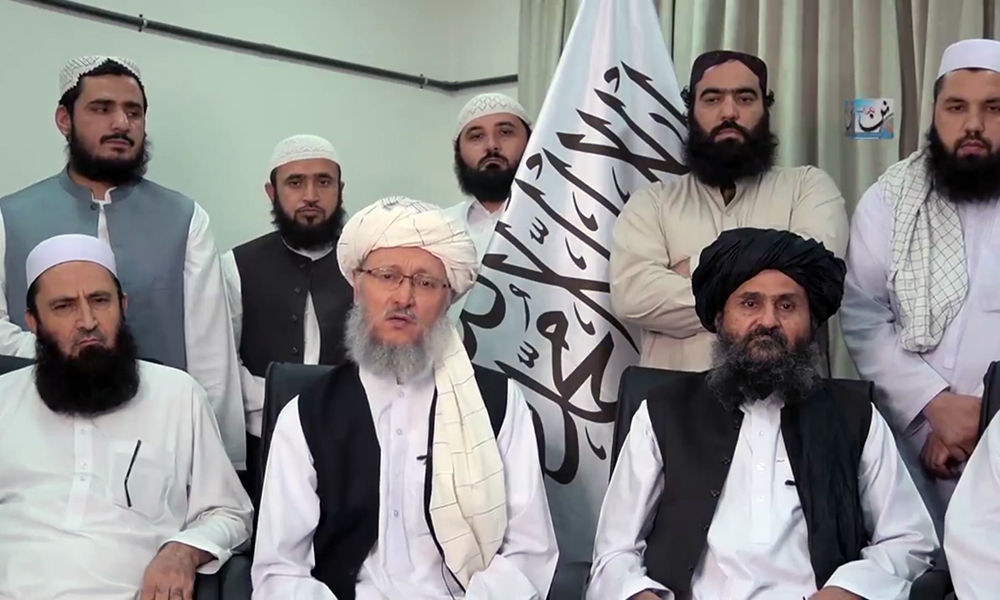
Taliban Militant Leadership
Rob Garver
VOA News
August 22, 2021
WASHINGTON – As the Taliban take power in Afghanistan for the first time in 20 years, Afghans face not only a humanitarian crisis but also an economic crisis that threatens to make an already dire situation considerably worse. But just how bad things can get, and how much potential leverage the economic situation gives the U.S. and its allies over the Taliban, is far from certain.
Asked about the future of the Afghan economy, Alex Zerden, who served as the top U.S. Treasury Department official in Afghanistan in 2018 and 2019, said, “I don’t think there is a definitive answer, and anybody who does doesn’t know the problem set very well, because there are a lot of different ways that this can shake out.”
Even before the Taliban took control, the economic situation in Afghanistan was tenuous at best. In March, the World Bank described it as “shaped by fragility and aid dependence,” with 75% of public spending funded not by the government’s own revenue generation, but from grants from international institutions and individual countries such as the United States.
Donors suspend aid
After the Taliban captured Kabul on Sunday, those donors began announcing that they would be turning off the financial spigots, at least for the near term. The U.S. announced that it would freeze billions of dollars in emergency reserves that Afghanistan’s central bank kept on deposit at the Federal Reserve Bank of New York. The International Monetary Fund said that a tranche of funding worth $450 million, set to be delivered to the Afghan government next week, would be suspended, and Germany announced that $300 million in scheduled aid would not be delivered.
President Joe Biden promised that humanitarian assistance would continue to flow to the country despite the Taliban takeover, saying, “We will continue to support the Afghan people. We will lead with our diplomacy, our international influence and our humanitarian aid.”
However, the total withdrawal of U.S. and allied troops from the country makes it unclear whether and how international aid organizations, major go-betweens for foreign aid spending, will be able to operate in the country moving forward.
Governing ‘is not easy’
Ajmal Ahmady, who served as the governor of Afghanistan’s central bank from 2019 until he fled the country last weekend, has been using his Twitter account to explain the country’s dire economic straits. Not only has the bank lost access to its reserves, he said, but shipments of physical U.S. currency, which the country’s banking system relied on to satisfy customers’ desire for a medium of exchange more stable than the government-issued afghani, have now been cut off.
A scarcity of dollars will likely make the relative value of the afghani plunge, driving up prices for goods and services that may become more scarce themselves as international aid and trade flows are disrupted.
“(The) Taliban won militarily — but now have to govern,” Ahmady wrote. “It is not easy.”
Changed economy
The economy the Taliban have taken over is vastly changed from the one they presided over from 1996 through the end of 2001. Despite its manifold problems, Afghanistan’s economy is far larger and more urbanized than it was two decades ago.
In 2002, the first full year after the Taliban’s ouster, Afghanistan’s official gross domestic product was just $4 trillion. In 2020, according to World Bank figures, the country’s GDP had nearly quintupled, to $19.8 billion. In major cities, infrastructure projects brought modern technology, such as smartphones, to ordinary Afghans.
But that enlarged economy was driven, for the most part, by foreign aid and a massive trade deficit exacerbated by the fact that 44% of the country’s workforce was occupied in low-yield agriculture and 60% of households relied on agriculture for at least some of their income.
Leverage over the Taliban
The United States still considers the Taliban a terrorist organization, and it remains on a sanctions list maintained by the Office of Foreign Assets Control. Under current U.S. policy, that makes it virtually impossible for a financial institution under Taliban control to have any meaningful participation in the global financial markets.
The Biden administration appears to believe that this may be a point of leverage that the United States can use to influence the group’s actions now that it is in power.
“I think they’re going through sort of an existential crisis. … Do they want to be recognized by the international community as being a legitimate government?” Biden said in an exclusive interview with ABC news on Thursday. “I’m not sure they do.”
He continued: “But they also care about whether they have food to eat, whether they have an income … that they can make any money and run an economy.”
Hunger in Afghanistan
Afghans are already suffering from widespread hunger, exacerbated by a severe drought that devastated wheat production. The United Nations World Food Program estimates that 1 in 3 Afghans is currently at risk of severe or acute hunger. Half of all Afghan children under five already suffer from acute malnutrition, according to the U.N.
U.N. officials say the Taliban have assured them that they will be allowed to continue food aid deliveries in the country.
Endgame not obvious
Even given the financial challenges they are facing, said Zerden, the former Treasury official, it isn’t clear how much leverage the Taliban are subject to from foreign governments.
For example, he said, Western governments may be overestimating the amount of money the Taliban actually need to keep Afghanistan running. The group, for all its human rights abuses, has traditionally been far less corrupt than the government it overthrew, meaning that less of the money it does collect will end up being siphoned off into the personal accounts of government officials.
And the Taliban are not without the ability to raise revenues internally. Zerden, who now runs Capitol Peak Strategies in Washington, said the Taliban have operated a shadow government for two decades, effectively taxing large swaths of the country by taking a share of money from opium sales, illegal mining and smuggling and using those funds to supply services to the people under their control and to fund and supply military operations.
Now, with official control of all border crossings, the group is in a position to begin extracting customs fees on exports and imports.
Economy vs. Ideology
Those trade routes are vitally important to the group’s future, said Graeme Smith, a consultant researcher for the Overseas Development Institute who has spent years studying Afghanistan. So long as regional powers such as Pakistan, China and Iran continue to trade with Afghanistan, they will provide a steady and lucrative source of revenue.
Additionally, Smith said he is deeply dubious about predictions that the Taliban will be swayed by promises of increased inclusion in the modern economy if it means abandoning their core ideology.
“I’m hearing informally from folks in D.C. that there are a lot of hopes being placed on the ability to curb Taliban behavior by applying financial leverage,” he said.
While that leverage will be important, he said, “Those expectations are wildly out of whack. We think we have more power than we do.”
Related
Biden May Order U.S. Civilian Airlines To Help Transport Afghanistan Evacuees

Joe Biden
Radio Free Europe/Radio Liberty
August 21, 2021
The administration of President Joe Biden has alerted U.S. civilian airlines that they could be utilized to help transport people who have been evacuated from Afghanistan, U.S. media are reporting.
Reuters on August 21 quoted a U.S. government official speaking on condition of anonymity as saying a “warning order” has been issued to carriers telling them they could be used but that no decision had been made.
According to the official, civilian aircraft would not fly into Afghanistan but would instead transport evacuees from air bases in other locations, including the Middle East and Germany.
The reports come as tens of thousands of people in Afghanistan waited nervously to see whether the United States would deliver on Biden’s new pledge to evacuate all Americans and all Afghans who aided the war effort amid deteriorating security conditions.
As of early August 22, thousands of people were besieging entrances to Kabul’s airport, the main route of escape for foreign citizens and Afghans seeking to flee the country following the Taliban takeover of the government.
Shots were being heard almost continuously outside the heavily armed airport compound, a witness told dpa news agency.
The agency reported that there have been numerous armed confrontations at the gates to compound.
The Afghan Civil Aviation Authority issued a statement on August 21 asking people not to travel to the facility.
“There [are] no civilian and commercial flights in Hamid Karzai International Airport,” it advised on its Facebook account.
Earlier, the U.S. Embassy told citizens not to travel to the Kabul airport without “individual instructions from a U.S. government representative.” The warning cited potential security threats outside its gates of the airport.
Footage from Britain’s Sky News showed soldiers covering three bodies with white tarpaulins outside of Kabul airport. It was not clear how they died.
A reporter for Sky News at the scene said people in the crowd were being “crushed” and that medics were rushing from casualty to casualty amid “dehydrated and terrified” Afghans who were desperate to leave the country.
European Union foreign policy chief Josep Borrell said on August 21 that is “mathematically impossible” for the United States and its allies to evacuate the tens of thousands of Afghan personnel and their families by an August 31 deadline Biden has set for the last U.S. troops to leave Afghanistan.
Borrell said the EU has “complained” to U.S. officials that their security at Kabul airport was overly strict and was hampering attempts by Afghans who worked for the Europeans to enter.
Bahrain has said it will open up its airports to flights evacuating people from Afghanistan, and the United Arab Emirates announced it would temporarily host Afghan refugees as the United States faced overcrowding at facilities processing evacuees in Qatar.
Pentagon spokesman John Kirby acknowledged the sense of urgency as the military attempts to complete the evacuations by August 31.
“We know that we’re fighting against both time and space,” he said.
Meanwhile, AP reports that U.S. authorities are concerned the Islamic State (IS) militant group could disrupt efforts to evacuate foreign citizens and Afghan allies.
A senior U.S. official said on August 21 that potential IS threats in Afghanistan are forcing the U.S. military to develop new ways to get evacuees to the Kabul airport in Kabul.
AP quoted the official as saying that small groups of Americans and possibly other civilians will be given specific instructions on what steps to take, including a list of transit points where they can be gathered by the military.
In the first known case of U.S. forces exiting Kabul’s airport to rescue Americans since the Taliban takeover, the Pentagon said it had deployed three Chinook transport helicopters to rescue 169 Americans at a hotel who were unable to reach the Kabul airport gates.
At least 12 people have been killed in and around Kabul’s airport since the Taliban retook the city on August 15, NATO and Taliban officials have said.
“The evacuation process is slow, as it is risky, for we don’t want any form of clashes with Taliban members or civilians outside the airport,” a NATO official told Reuters on August 20 on condition of anonymity.
The Taliban’s senior leadership gathered in Kabul on August 21 to map out its plans for a future government following the hard-line Islamist group’s seizure of the Afghan capital.
The gathering was taking place as the Taliban attempts to present a more moderate image after regaining control over most of the country as U.S.-led forces evacuate.
A senior Taliban figure told AFP on condition of anonymity that Taliban cofounder and political chief Mullah Abdul Ghani Baradar would meet in Kabul with Taliban military “leaders and politicians for an inclusive government set-up.”
Reuters, meanwhile, quoted an unidentified Taliban source as saying that Baradar was in Afghanistan to “delegate responsibility to commanders, meet former government leaders, local militia commanders, policymakers, and religious scholars.”
With reporting by Reuters, The Wall Street Journal, dpa, AP, and AFP
Copyright (c) 2021. RFE/RL, Inc. Reprinted with the permission of Radio Free Europe/Radio Liberty, 1201 Connecticut Ave NW, Ste 400, Washington DC 20036.
Related