
Saleh: Taliban blocking food and fuel, and using human shields
Talibs aren't allowing food & fuel to get into Andarab valley. The humanitarian situation is dire. Thousands of women & children have fled to mountains. Since the last two days Talibs abduct children & elderly and use them as shields to move around or do house search.
— Amrullah Saleh (@AmrullahSaleh2) August 23, 2021
Amrullah Saleh twitted the following today: Talibs aren’t allowing food & fuel to get into Andarab valley. The humanitarian situation is dire. Thousands of women & children have fled to mountains. Since the last two days Talibs abduct children & elderly and use them as shields to move around or do house search.
Taliban lash Uzbek woman for going to the doctor with her brother-in-law
So the Taliban have ‘reformed’, have they?
They have publicly lashed a woman in northern province of Sar-e Pol in #Afghanistan, @TOLOnews footage shows.
And her crime? She was on a motorcycle with her brother-in-law, who was taking her to the doctor. pic.twitter.com/VV24EYD4yn
— Shabnam Nasimi (@NasimiShabnam) August 23, 2021
Taliban Targets Panjshir Valley as Resistance Leaders Remain Defiant
 Jamie Dettmer
VOA News
August 23, 2021
The Taliban are dispatching hundreds of fighters to the Panjshir Valley, 150 kilometers north of the Afghan capital, Kabul, to try to stamp out an emerging resistance movement led by the son of a warlord who defied them the last time they ruled Afghanistan 20 years ago.
The deployment comes hours after forces aligned with Ahmad Massoud’s National Resistance Front, comprising remnants of regular Afghan army units and special forces and local militia fighters, clashed with the Taliban in Andarab — a southern district in Baghlan province.
Last week, in the first stirrings of serious resistance, anti-Taliban fighters secured three districts neighboring Andarab, all near the Panjshir Valley, Massoud’s redoubt. The Taliban on Monday claimed to have recaptured the three districts.
Ahmad Massoud’s father, Ahmad Shah Massoud, nicknamed the “lion of the Panjshir,” blocked Soviet forces in the 1980s and the Taliban in the 1990s from conquering the narrow and almost impenetrable valley It has in effect one main road in and out. His 32-year-old son, who was trained at Britain’s military academy Sandhurst and was taught war studies at King’s College, London, hopes to emulate his father.
“Talibs have massed forces near the entrance of Panjshir a day after they got trapped in ambush zones of neighboring Andarab valley & hardly went out in one piece,” tweeted Amrullah Saleh, Afghanistan’s former vice president, who midweek declared himself the country’s caretaker leader after President Ashraf Ghani fled the country. Saleh has thrown in with the National Resistance Front, although his status as president is not recognized by the National Resistance Front, Massoud’s advisers told VOA in a phone call.
Ready to fight
The Taliban gave Massoud four hours Sunday to surrender the Panjshir Valley, saying they were deploying forces “after local state officials refused to hand it over peacefully.” Ahmad Massoud has been holding negotiations with the Taliban since the Islamist movement seized power in Kabul a week ago, but one of his advisers told VOA that the talks were stalled and appeared unlikely to advance.
“There has been no progress,” Ali Nazari, Massoud’s spokesman said. The talks have mainly been conducted in Pakistan via emissaries, including Ahmad Massoud’s uncle. The Taliban said it will establish a centralized government and will not be holding elections. To end his nascent resistance, Massoud is demanding elections, decentralization of government, with regions and provinces allowed semi-autonomy, and for the Taliban to guarantee civil rights.
On Sunday, Massoud told Reuters that he did not want war. “We want to make the Taliban realize that the only way forward is through negotiation,” he said by telephone. He said his fighters are ready to fight. “They want to resist any totalitarian regime,” he said.
His spokesman, Nazari, talking from an undisclosed location, told VOA that the resistance movement has sufficient strength to keep the Taliban out of the valley, near the Hindu Kush and home to more than 100,000 people, including Afghanistan’s largest concentration of ethnic Tajiks. He said Massoud had opened negotiations with the Taliban much as his father did in 1995 in the hope that bloodshed could be avoided.
Fahim Dashty is in Panjshir and works closely with Ahmed Massoud.
“Peace and negotiations are a priority for us. We are serious in this regard. And we believe that the future of Afghanistan could be built only through peace and negotiations, a future that will be acceptable to all Afghans, a future that enables us to live within Afghanistan with each other and live with the rest of the world, a future in which a representative government of people from all over Afghanistan will be established, a future where the rights will be ensured such as human rights, women’s rights, and social justice.” he told VOA. “There are some messages going back and forth between Taliban and the resistance front. We have already sent this message to the Taliban. . . . We are looking forward to see some serious steps from Taliban.”
When asked what he considered serious steps he responded. “To enter into a serious negotiation and to have the intention to reach peace and stability through negotiations.”
Last week in an article in The Washington Post, Massoud appealed to the West to back his resistance. “The Taliban is not a problem for the Afghan people alone. Under Taliban control, Afghanistan will without doubt become ground zero of radical Islamist terrorism; plots against democracies will be hatched here once again,” he warned. He added that the military stores and equipment his Front has amassed could be depleted quickly without resupply from outside powers.
Massoud has been storing arms and material for the past two years, since the U.S. opened talks with the Taliban. His local militia has been boosted, his aides say, with an influx of a few thousand former Afghan army soldiers, including members of special forces units, and volunteers from other militias from northern and western Afghanistan.
The Afghan army remnants brought with them half-a-dozen helicopters and other equipment and the National Resistance Front has a dozen or so Soviet-era tanks, anti-Taliban sources say. They also have Russian BM-21 Grad rocket launchers.
Nazari told VOA Massoud is fairly confident that he can sustain the resistance until wintertime, when the fighting would decrease, and inclement seasonal weather would halt a Taliban offensive. “The Taliban will be less mobile in winter,” he said.
“So, we believe that we can sustain the resistance up to winter. But again, it’s difficult to say. It will come down to the intensity of the fighting,” he added. “If the fighting intensifies in the coming days or weeks, there might be a short window of opportunity for the West to support the National Resistance Front, and that window could shut much sooner than we expect,” he conceded.
Looking to the West
Nazari said Massoud has not asked anything from neighboring countries, including Tajikistan, which helped his father. His focus has been on Western powers. While there had been no response yet from the Western governments, U.S. lawmakers have been in contact. Last year, Massoud met in Paris French President Emmanuel Macron, a meeting arranged by the French philosopher Bernard-Henri Levy, a longtime friend of Massoud’s father.
Nazari said: “We believe that the Western countries should stay engaged because of the threat of terrorism. Terrorism still exists. International terrorism still exists, and it will strengthen itself and will be stronger compared to 2001. You’ll have an emboldened al-Qaida, you have ISIS [Islamic State]. You have other splinter groups. You have a much powerful Taliban now. So, it’s very important to keep an ally inside Afghanistan. It just doesn’t make sense for the Western world to abandon natural allies, people who could fight terrorism, who can resist the rise of terrorism.”
“This all has eerie but perhaps heartening echoes of the situation during Taliban rule before the 9/11 terror attacks,” says Toby Harnden, author of “First Casualty: The Untold Story of the Battle That Began the War in Afghanistan.”
“The Panjshir Valley was the CIA’s vital foothold in Afghanistan before 9/11. Its mountain flanks along with Ahmad Shah Massoud fighters, many veterans of the mujahideen war against the Soviet army, made it a redoubt the Taliban could not penetrate,” Harnden added.
Without outside support, military experts say it is hard to estimate how long Massoud can keep the Taliban out of the valley, and resupply will be difficult. The Panjshir has no airport and the Taliban in theory now surround the valley “Nobody can answer the question ‘how long?’ Too many variables,” a former CIA officer, who knows the valley well, told VOA. “The Soviets never really got in; and the Taliban the first time around made just a few inroads into Panjshir,” he said. And it is not clear, he added, how quickly the Taliban will be able to mount a major offensive.
Massoud’s advisers say they believe the Taliban has a lot of weaknesses. “They are not as a strong military force as we’re seeing them being portrayed in the media,” says Nazari. “They have a shortage of men and are overstretched. They lack popular support. They have 75,000 fighters to control a country of 38 million,” he adds.
“A key risk for the Taliban with the resistance in the Panjshir is the unraveling of local surrender pacts the Islamists struck with tribal elders and local warlords,” says another Western intelligence officer who served in Afghanistan. “They paved the way for the Taliban all the way to Kabul,” he adds. Many of those pacts were clinched because tribal elders and others assumed the Taliban would be victorious, and “if the impression gains ground, they can be challenged, then other groups may decide to resist. Remember the Afghan saying: you can hire me, but you can’t buy me,” he adds.
Related
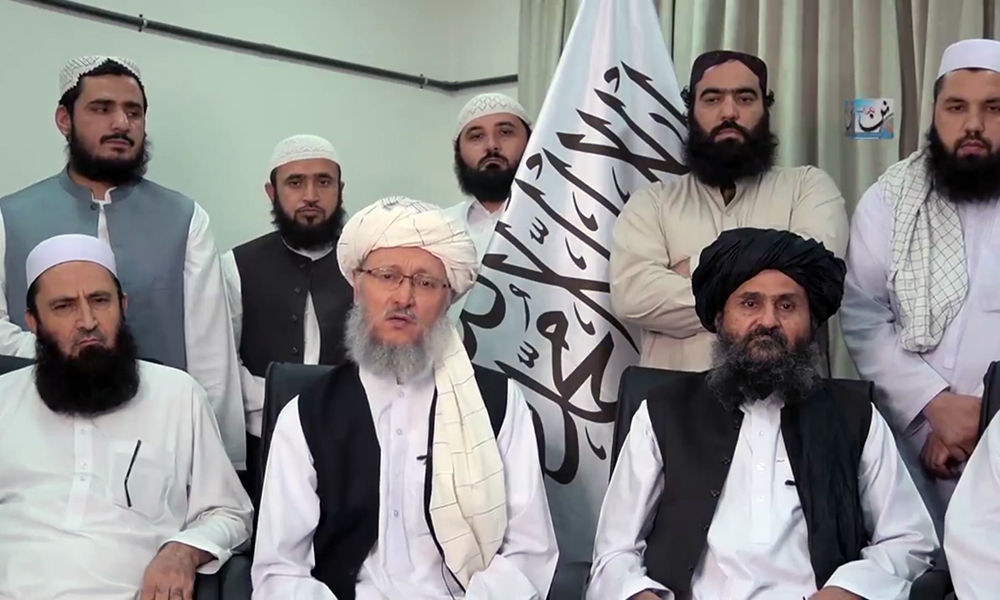
Taliban issue death sentence for brother of Afghan translator who helped US troops, according to letters obtained by CNN
Taliban Militant Leadership
CNN: The letters are just one example of how the Taliban are directly threatening Afghans who worked with the US or are family members of those who have, leaving them scrambling to flee the country in the wake of the Taliban takeover. “You have been accused of helping the Americans,” the Taliban wrote in the first of three letters to the Afghan man, adding, “You are also accused of providing security to your brother, who has been an interpreter.” Click here to read more (external link).
Afghanistan VP tells Lara Logan al Qaeda and the Taliban are like Coke and Pepsi

Amrullah Saleh
Fox News: Fox Nation host Lara Logan pressed the Taliban’s chief spokesperson on his refusal to denounce al Qaeda in an episode of Fox Nation’s “Lara Logan Has No Agenda” that aired in a Fox News special on Sunday. Logan also spoke with Amrullah Saleh, the Vice President of Afghanistan, who said the differences between ISIS, al Qaeda, and the Taliban were minuscule, and the organization is not to be trusted. Click here to read more (external link).
Azizullah Fazli returns as Afghanistan Cricket Board chairman
 Cricinfo: Azizullah Fazli is the new chairman of the Afghanistan Cricket Board. His appointment is the first major cricketing development in the country since the Taliban’s takeover of the political reins following the withdrawal of western troops and the collapse of the elected government. Click here to read more (external link).
Other Afghan Sports News
Taliban starts removing barricades from Kabul streets

Khaama: The process which started Sunday, August 22, the Kabul municipality personnel removed barriers erected in front of the defense ministry. The barricades had dramatically narrowed the streets of Kabul and were said to be the biggest cause behind bumper-to-bumper traffic in the city which had created major problems for the citizens. Click here to read more (external link).
Taliban on the way to take over the only defiant province
Khaama: The Taliban on Sunday, August 22, said that their fighters are heading towards Panjshir province, the only anti-Taliban outpost which is yet to be surrendered or toppled. They said that the fighters have seen no resistance on the way to Panjshir province and are now getting closer ever to the spot. Click here to read more (external link).
Firefight Kills Afghan Security Officer Outside Kabul Airport

Ayaz Gul
VOA News
August 23, 2021
ISLAMABAD – Germany’s military reported Monday a firefight erupted outside the north gate at Kabul’s airport, with unknown attackers killing one Afghan security officer dead and wounding three others.
The German military said its forces and those from the United States were involved in the battle.
The airport has been the site of mass evacuations by Western nations, particularly the United States, since the Taliban’s seizure of the Afghan capital a week ago.
Tens of thousands of Afghans have flooded the Kabul airport in hopes of getting a place on one of the evacuation flights, fearing a return to the harsh interpretation of Islamic law practiced when the Taliban controlled the country 20 years ago.
The United States has fallen short of evacuating 5,000 to 9,000 people per day and chaotic scenes at and around the airport have prompted criticism of the U.S. effort.
Vice President Kamala Harris, speaking during a visit Monday to Singapore, said there will be plenty of time later to analyze what has taken place, emphasizing that the primary mission is “evacuating people from that region who deserve to be evacuated.”
“We are singularly focused on evacuating American citizens, Afghans who worked with us, and Afghans who are vulnerable, including women and children,” Harris said.
Singapore Prime Minister Lee Hsien Loong offered the use of a military plane to help with the evacuation effort.
Other countries are sending aircraft, including Japan, which said it was dispatching a military plane on Monday to bring back its citizens from Afghanistan.
The Taliban on Sunday blamed the United States for the chaos around Kabul’s airport.
The British Ministry of Defense has confirmed the deaths of seven Afghans near the airport on Saturday.
“There is peace and calm all over the country,” Amir Khan Mutaqi, a top Taliban leader asserted, saying, “there is chaos only at Kabul airport.”
“America, with all its power and capabilities, and with their president paying direct attention to the evacuation process, they have failed to bring order to the airport,” Mutaqi said in an audio statement shared with media.
The U.S. and other countries have brought in troops to manage the evacuation effort at the airport.
“Conditions on the ground remain extremely challenging but we are doing everything we can to manage the situation as safely and securely as possible,” the British Defense Ministry said in a statement.
Taliban leaders stressed Afghanistan wants good relations with the U.S. and the global community, but the chaotic evacuation is hurting their goodwill among Afghans. Mutaqi said the crisis has prevented airports across the country from transporting Afghans to and from Kabul, adding to problems facing the war-ravaged nation.
Some information for this report came from the Associated Press and Reuters.
Related