
logo

Daily Updated Afghan News Service

  • Home
  • About
  • Opinion
  • Links to More News
  • Good Afghan News
  • Poll Results
  • Learn about Islam
  • Learn Dari (Afghan Persian/Farsi)

Recent Posts

  • Afghan Deportations Is Strategic Mistake, Says European Parliament Member May 6, 2026
  • Ex-MP Mohsin Dawar says Pakistan strikes avoid Taliban members May 6, 2026
  • Afghan fighter Waheedullah Nezhand to face Argentine opponent May 6, 2026
  • Tolo News in Dari – May 6, 2026 May 6, 2026
  • Rising Crime in Afghanistan: Citizens Say Taliban Are Behind Most Cases May 5, 2026
  • Local elders broker fragile ceasefire between Taliban, Pakistan in Kunar May 5, 2026
  • Catalan Parliament Voices Concern Over Hazaras Situation In Afghanistan May 5, 2026
  • Afghanistan’s powerlifting team to compete in Belarus competitions May 5, 2026
  • Tolo News in Dari – May 5, 2026 May 5, 2026
  • Taliban say three civilians killed in new Pakistan shelling in Kunar May 4, 2026

Categories

  • Afghan Children
  • Afghan Sports News
  • Afghan Women
  • Afghanistan Freedom Front
  • Al-Qaeda
  • Anti-Government Militants
  • Anti-Taliban Resistance
  • AOP Reports
  • Arab-Afghan Relations
  • Art and Culture
  • Australia-Afghanistan Relations
  • Book Review
  • Britain-Afghanistan Relations
  • Canada-Afghanistan Relations
  • Censorship
  • Central Asia
  • China-Afghanistan Relations
  • Civilian Injuries and Deaths
  • Corruption
  • Crime and Punishment
  • Drone warfare
  • Drugs
  • Economic News
  • Education
  • Elections News
  • Entertainment News
  • Environmental News
  • Ethnic Issues
  • EU-Afghanistan Relations
  • Everyday Life
  • France-Afghanistan Relations
  • Germany-Afghanistan Relations
  • Haqqani Network
  • Health News
  • Heroism
  • History
  • Human Rights
  • India-Afghanistan Relations
  • Interviews
  • Iran-Afghanistan Relations
  • ISIS/DAESH
  • Islamophobia News
  • Japan-Afghanistan Relations
  • Landmines
  • Media
  • Misc.
  • Muslims and Islam
  • NATO-Afghanistan
  • News in Dari (Persian/Farsi)
  • NRF – National Resistance Front
  • Opinion/Editorial
  • Other News
  • Pakistan-Afghanistan Relations
  • Peace Talks
  • Photos
  • Political News
  • Reconstruction and Development
  • Refugees and Migrants
  • Russia-Afghanistan Relations
  • Science and Technology
  • Security
  • Society
  • Tajikistan-Afghanistan Relations
  • Taliban
  • Traffic accidents
  • Travel
  • Turkey-Afghanistan Relations
  • UN-Afghanistan Relations
  • Uncategorized
  • US-Afghanistan Relations
  • Uzbekistan-Afghanistan Relations

Archives

Dari/Pashto Services

  • Bakhtar News Agency
  • BBC Pashto
  • BBC Persian
  • DW Dari
  • DW Pashto
  • VOA Dari
  • VOA Pashto

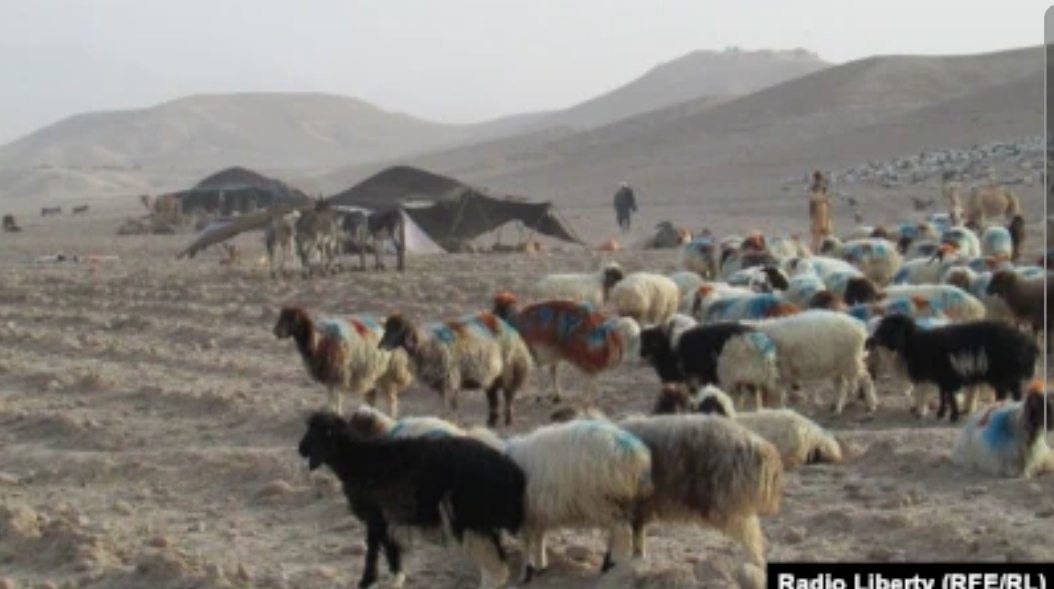
Afghan Nomads Mourn A Vanishing Way Of Life

8th April, 2021 · admin

A Kuchi camp in southern Afghanistan. (file photo)

Radio Free Afghanistan
Abubakar Siddique
April 8, 2021

Haji Abdul Manan, a tribal leader of the Afghan nomads, grows wistful recalling the wandering lifestyle his extended family gave up for a sedentary life a decade ago.

The 70-year-old patriarch, who spent his childhood and much of his adult life on the move, says he can still hear the bells around the necks of camels and goats in their caravan as it migrated between the warmer plains of southern Afghanistan in winter to the cooler green pastures of the central highlands during summer.

“I long for the freedom that defined our lives,” Manan told Radio Free Afghanistan of the difficult decision his family had to make in settling in the southeastern province of Ghazni. “Nothing could beat the sense of freedom where we could just stay anywhere that we liked and leave without worrying.”

“We are called Kuchis in Afghanistan because we were constantly on the move,” he said, referring to his community’s name by the Dari word that denotes their status as nomads. “The Kuchis were not restrained by borders, and our lives were truly free.”

Kuchis or Pawindas, terms used for Pashtun nomads hailing from more than a dozen tribes of the larger Ghilzai group, were once one of the largest nomadic communities in the world. But decades of war, forced displacement, droughts, socioeconomic and technological changes, and a push toward settlement have rendered them one of the most marginalized communities in Afghanistan.

After attempting to adapt to a sedentary life, Manan says he preferred his family’s constant travels, which saw them traverse several hundred kilometers each year between Kandahar and Helmand provinces in the south to Ghazni’s mountain meadows.

“Our lives were not defined by rivalries and feuds,” he noted, referring to the land disputes that are common in Afghan villages. “We had few possessions, but we were healthy and happy. I had never even heard of all these diseases that are so prevalent now.”

While the Afghan government has attempted to integrate the estimated 1.5 million Kuchis by granting them representation and access to government assistance programs, the group still lacks key services such as health care and education and has received little of the international aid that has helped lift other Afghan communities out of poverty.

“The previous century was one of tragedy for the Kuchis,” Manan noted. In the Afghan calendar, the 15th century began last month. “The Kuchis endured hunger and destruction, and yet no one took pity on us.”

Mohammad Siddiq, another Kuchi, agrees. He says natural disasters like droughts and manmade problems such as hard borders and insecurity have destroyed the Kuchi lifestyle.

“Wandering around the country, you will often feel that each village is ruled by its own government,” he told Radio Free Afghanistan of the widespread harassment of nomads whose cattle he says is frequently claimed by the Afghan security forces. “Nomadism was appealing because of the freedom it entailed, but that’s gone now.”

He says a typical Kuchi herd consisted of 50 camels and some 400 goats and sheep. In good years, these animals delivered enough offspring to bring their owners a sizable profit while ensuring abundant supplies of milk, cheese, meat, and wool.

Siddiq says Kuchi life was the portrait of a hardworking community that cherished its freedom and where men and women shared the burden of work. The close-knit groups loved to celebrate festivities with horseback riding, shooting competitions, music, and dancing. “Our hearts are in mourning because this has all been taken away,” he noted. “How can we now celebrate anything ever again?”

Repeated droughts, he explained, have forced Kuchis to give up their camels to buy tractors, which limits their movement to roads.

Building Fences

During the past two decades, occasional clashes between Kuchis and settled Hazara farmers have erupted with each side blaming the other for the violence. Such tensions have come to a head in other parts of Afghanistan, where rapidly increasing settled populations, some of whom were formerly nomads, see the nomads as intruders who threaten their land and resources.

Previously, Afghan nomads paid little attention to international borders, and many groups often traveled into Pakistan. But Islamabad’s efforts to regulate movement between the two countries with the construction of a fence along more than 2,500 kilometers of its border with Afghanistan have impacted major nomadic migration chains that moved to the plains around the Indus River in Pakistan in winter from their summer destination of Afghanistan’s Hindu Kush Mountains.

Haji Gulmiran, a Kuchi community leader in the eastern Afghan province of Nangarhar, which borders Pakistan, says the fencing has devastated their community as being cut off from their usual grazing lands has caused a food shortage.

“We lost access to pastures on the other side of the fence [in Pakistan] while here we have lost meadows and grasslands to housing and farming,” he told Radio Free Afghanistan.

Bor Jan, another member of the community, says the Kuchis have received little assistance from the Afghan authorities, whose actions have only served to compound their suffering.

“The government has either usurped our pastures or is keeping us from our traditional pastures,” he told Radio Free Afghanistan. “We have always lacked access to education and health care, but now we find it difficult to get our national ID cards,” he added. Afghanistan is currently issuing electronic ID cards to its estimated 35 million citizens. In addition to serving as an identity document and proof of citizenship, the cards enable holders to access government services.

Noor Jamal Kuchi, a government worker in Ghazni, says he has pleaded with Afghan officials to address his community’s problems. He says he has asked for government help with improving their livestock, employment, and access to land to little avail.

“The last century [in the Afghan calendar] saw the Kuchis lose whatever they had gained during the past 1,000 years,” he said. The last century in Afghanistan began in 1920. Since then the country has seen violent uprisings, palace and military coups, civil wars, Soviet occupation, and the ongoing war that began with a U.S.-led military attack on the Taliban regime after September 11 attacks two decades ago.

But the government in Kabul is adamant it is committed to supporting the Kuchis. The Afghan Rural Rehabilitation and Development Ministry says that under its Kuchi Development Strategy, a plan it adopted in 2019 after extensive consultations with the community, it is committed to spending $30 million on helping nomadic and seminomadic communities.

The strategy will purportedly set up 902 community development councils, who will help identify and implement water supply and renewable energy schemes.

Lawmaker Nangyalai Lawang, a representative of the Kuchis in Wolesi Jirga, says initiatives to help Afghan nomads have been slow to implement. He cited a presidential order from six months ago requiring the government to purchase meat from nomads for the Afghan security forces.

“We have held meeting after meeting on how to put this into action, and yet there’s no progress,” he told Radio Free Afghanistan.

For some Kuchi leaders, Kabul needs to take urgent practical steps to preserve their way of life.

“For Kuchis, our pastures are as vital as water is for the fish,” Gulmiran said. “Without them, our flocks and tents are unlikely to survive.”

Copyright (c) 2021. RFE/RL, Inc. Reprinted with the permission of Radio Free Europe/Radio Liberty, 1201 Connecticut Ave NW, Ste 400, Washington DC 20036
Posted in Economic News, Ethnic Issues, Everyday Life, Society | Tags: Hazaras, Kuchis |

HRW Calls For Women’s ‘Full’ Participation In Afghan Peace Talks

8th April, 2021 · admin

Radio Free Europe/Radio Liberty
April 8, 2021

Human Rights Watch (HRW) says women should be “full participants” in the upcoming conference in Turkey meant to give new impetus to the Afghan peace process.

Human rights advocates in Afghanistan have raised concerns that women and victims’ organizations will be sidelined in the talks, tentatively scheduled to begin in Istanbul on April 16.

The gathering is to be held under United Nations auspices with participation of Afghan government officials and the Taliban, with the discussion expected to touch upon proposed peace plans aimed at putting an end to decades of war in Afghanistan that include a possible interim government.

In a statement on April 7, HRW urged senior UN officials to make a public commitment to “fully include” Afghan women in the main talks, and not only in “parallel” side events devoted to civil society groups.

The United States, which has promoted the Istanbul talks in an effort to accelerate intra-Afghan peace negotiations before a U.S. troop withdrawal from Afghanistan, has an important role to play in promoting full participation by women, according to the New York-based human rights watchdog.

HRW noted that the Afghan government delegation at a meeting in Moscow last month meant to advance peace talks included only one woman.

Meanwhile, the government’s official delegation on intra-Afghan talks that have been ongoing in Qatar includes four women among its 20 members.

In both settings, the Taliban delegations have been entirely male.

The UN has repeatedly stated its commitment to ensuring the full participation of Afghan women in the peace process amid concerns among rights activists that the government in Kabul will trade away women’s rights to reach an accommodation with the Taliban.

“UN officials should make clear that women should not be relegated to side discussions but need a central role in determining Afghanistan’s future,” while the United States “should not stay silent if the Afghan government shuts women out of peace talks,” said Heather Barr, interim women’s rights co-director at HRW.

“It’s critical for the [administration of U.S. President Joe Biden] to be clear that Afghan women need to be full participants in all talks, and that women’s rights are not a bargaining chip,” Barr added.

Copyright (c) 2021. RFE/RL, Inc. Reprinted with the permission of Radio Free Europe/Radio Liberty, 1201 Connecticut Ave NW, Ste 400, Washington DC 20036
Posted in Afghan Women, Human Rights, Peace Talks, Taliban, US-Afghanistan Relations |

Tolo News in Dari – April 8, 2021

8th April, 2021 · admin

Posted in News in Dari (Persian/Farsi) |

Kabul airport reopens after explosives cause short closure

8th April, 2021 · admin

1TV: Hamid Karzai International Airport in Kabul reopened on Thursday after short closure due to discovery of unexploded ordinance during construction work, a Resolute Support official said. The closure caused plane carrying Pakistan parliament speaker, Asad Qaisar, to be diverted. Click here to read more (external link).

Posted in Pakistan-Afghanistan Relations, Security |

Rashid discusses local cricket and ‘dreams’ of playing for a home crowd

8th April, 2021 · admin

Rashid Khan

Ariana: One of Afghanistan’s star cricketers, Rashid Khan, said this week that despite the national team’s success on the international circuit, local cricket would benefit from more academies, more standardized grounds and more qualified coaches. Speaking to The Cricketer on his rise to fame as one of the world’s best bowlers, Rashid said: “Currently, our cricket relies mainly on natural talent. Click here to read more (external link).

Other Sports News

  • Football: Helmand’s Esmat Laghmani vs. Herat’s Sorkh Poshan
Posted in Afghan Sports News | Tags: Cricket, Football (Soccer), Rashid Khan |

Afghanistan: 76 New Cases of COVID-19, 5 Deaths Reported

8th April, 2021 · admin

Tolo News: The Ministry of Public Health on Thursday reported 76 new positive cases of COVID-19 out of 2,559 samples tested in the last 24 hours. The ministry reported that the cumulative total of known COVID-19 cases is 57,019, the total number of reported deaths is 2,521, and the total number of recoveries is 51,956. Click here to read more (external link).

Related

  • Afghan Gold Prices Stable Despite COVID-19 Impact
Posted in Economic News, Health News | Tags: Coronavirus (COVID-19) in Afghanistan, Gold |

UNHCR Funds Health Care for Thousands More Afghan Refugees in Iran

8th April, 2021 · admin

Lisa Schlein
VOA News
April 7, 2021

GENEVA – The U.N. refugee agency (UNHCR) reports it is covering the cost of health insurance for an additional 20,000 Afghan refugees in Iran. This boosts the number of refugees to 120,000 who will be able to access medical care for COVID-19 and other illnesses under Iran’s national health plan.

Iran hosts nearly 800,000 Afghan refugees.  Over the past year, the UNHCR has paid insurance premiums for 100,000 of the most vulnerable refugees. Given the dangers posed by the COVID-19 pandemic, it now has boosted that number by another 20,000.

UNHCR spokesman Babar Balloch says Iran is one of only a handful of countries in the world that allows refugees to sign up for its national health insurance and receive the same treatment as its nationals.

“The national insurance scheme allows for free COVID-19 treatment and hospitalization.  It also subsidizes the cost of surgeries, dialysis, radiology, laboratory tests, out-patient care and more.  However, many refugees are not able to afford the premium costs,” he said.

Balloch said the pandemic has severely affected the ability of refugees to earn a living as they usually rely on precarious and unstable jobs. The cost of health care, he said, is unaffordable for most refugees as it represents about 40% of a refugee family’s monthly expenses.

And, yet, in the time of COVID, accessing treatment could be a matter of life or death. The World Health Organization reports Iran is the most COVID-affected country in the Eastern Mediterranean region. The latest data show more than 1.9 million cases, including 63,000 deaths.

The UNHCR warns fewer refugees are likely to seek treatment for urgent health needs if they are unable to afford health insurance. The agency says it may not be able to continue subsidizing the cost of insurance premiums for the refugees due to its tight budget. The agency notes this year’s UNHCR funding appeal of $97 million is only 7% funded.

Posted in Health News, Iran-Afghanistan Relations, Refugees and Migrants, UN-Afghanistan Relations |

Taliban Claims Attack Against International Forces In Southern Afghanistan

7th April, 2021 · admin

Radio Free Europe/Radio Liberty
April 7, 2021

A Taliban spokesman says insurgents targeted an airbase in southern Afghanistan where international troops are based.

If confirmed, it would be the first attack against foreign forces that the Taliban has claimed responsibility for since the United States signed a deal with the Taliban in February 2020.

Kandahar Airfield, where international troops in NATO’s Resolute Support mission are based, was “targeted with multiple missiles” on April 7, Taliban spokesman Zabihullah wrote in a tweet.

“Missiles have hit targets, causing heavy human & material losses,” he added.

Neither the U.S. military nor NATO has commented on the claim.

According to the U.S.-Taliban agreement, reached under the administration of former U.S. President Donald Trump, the militant group agreed to end attacks against international troops.

All foreign forces are also to leave Afghanistan by May 1 in exchange for security guarantees from the militant group such as severing ties with Al-Qaeda and refusing to harbor any foreign terrorists.

But Trump’s successor, President Joe Biden, has warned the withdrawal deadline will be difficult to meet, raising the prospect the entire agreement with the Taliban will unravel.

Afghanistan has seen a nationwide spike in bombings, targeted killings, and violence on the battlefield as common ground evades peace negotiators in Qatar.

Later this month, Taliban and Afghan government representatives are expected to gather for a U.S.-backed international conference in Turkey meant to give new impetus to intra-Afghan peace talks.

Copyright (c) 2021. RFE/RL, Inc. Reprinted with the permission of Radio Free Europe/Radio Liberty, 1201 Connecticut Ave NW, Ste 400, Washington DC 20036
Posted in Peace Talks, Security, Taliban, US-Afghanistan Relations | Tags: Kandahar |

1TV Afghanistan Dari News – April 7, 2021

7th April, 2021 · admin

Posted in News in Dari (Persian/Farsi) |

Taliban cell behind killing of former TV presenter Siawash arrested: Saleh

7th April, 2021 · admin

Yama Siawash

1TV: Kabul police arrested an 11-member Taliban cell behind the killing of former TV presenter Yama Siawash, Afghan First Vice President Amrullah Saleh said Wednesday. Siawash, who formerly worked at the private TOLO News channel, was killed when the vehicle carrying him was bombed in Kabul in November last year. Click here to read more (external link).

Related

  • Siawash’s Family Rejects Saleh’s Claim of Arresting Killers
Posted in Civilian Injuries and Deaths, Crime and Punishment, Media, Security, Taliban | Tags: Afghan Journalists, Amrullah Saleh, Yama Siawash |
Previous Posts
Next Posts

Subscribe to the Afghanistan Online YouTube Channel

---

---

---

Get Yours!

Peace be with you

Afghan Dresses

© Afghan Online Press
  • About
  • Links To More News
  • Opinion
  • Poll