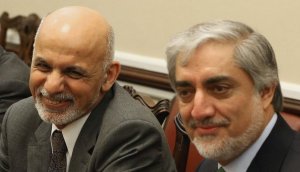
Tolo News: The Wolesi Jirga (Lower House of Afghan Parliament) on Saturday decided to impeach Foreign Minister, Salahuddin Rabbani, after he failed to attend a parliament session he had been summoned to. Rabbani and the Minister of Refugees and Repatriations Sayed Hussain Alimi Balkhi were due to appear before parliament on Saturday and answer questions over the current crisis relating to Afghan refugees in Europe. Rabbani will be plunged into a political crisis if the lawmakers finalize the impeachment. Click here to read more (external link).
Brussels terror suspect was jailed over Ahmad Shah Massoud assassination
Khaama Press: The coordinated terror attacks in Brussels has unveiled new information regarding the assassination of a key jihadi leader in Afghanistan as a terror suspect who was arrested by police in Brussels after a dramatic stand-off at a tram stop is believed to have previously been jailed for helping to assassinate an Afghan leader just days before 9/11. Click here to read more (external link).
Mohammad Shahzad secures 2nd place in Most Runs table of ICC World T20
Khaama Press: Shahzad is just one point below Bangladesh’s Tamim Iqbal, lacking only 97 runs to secure the top spot in ICC World Twenty20 ‘Most Runs’ table. He has played 6 matches and has managed to score 198 runs while Iqbal has secured 97 runs from 6 matches. Click here to read more (external link).
Former Afghan governor Salangi grabbed government land in Kabul
1TV: Former Afghan governor Abdul Basir Salangi has grabbed government land in north Kabul. The issue came to light after authorities visited the site to clear the constructed buildings and reclaim the land in Badam Bagh area. As they started operation, guards affiliated to Salangi, who was governor of Parwan during Karzai rule, arrived at the site forcing the workers to leave. Click here to read more (external link).
Afghan election chairman resigns
KABUL, March 26 (Xinhua)– The chairman of Afghan election commission has resigned, the country’s Presidential Palace said on Saturday.
“Chairman of Independent Election Commission (IEC) Ahmad Yousuf Nuristani offered his resignation to President Mohammad Ashraf Ghani and the president accepted his resignation,” the palace said in a statement.
The announcement came as the country is preparing for the upcoming parliamentary elections which is scheduled to be held on Oct. 15.
According to Afghan laws the elections for the Wolesi Jirga or Lower House of parliament had to be held in early last year. But the government failed to hold the polls due to insecurity and political issues over reforming the country’s electoral laws and election system.
Over the past year, some members of Afghan civil society, local independent election watchdogs and some political parties have urged Nuristani to quit his office before the October polls. They blamed Nuristani for his failure to curb the widespread fraud during the 2014 presidential elections.
However, the statement noted that the decision was made by the former IEC chief as he”realized the political and social situation in Afghanistan, for national interests and for restoration of stability and prosperity of the Afghan people.”
The first parliamentary election in the post-Taliban country was held on Sept. 18, 2005 while the second took place on Sept. 18, 2010.
Members of the 249-seat Wolesi Jirga will be elected to serve a five-year term.
Afghan Poll Shows Deep Dissatisfaction With Kabul Leadership
VOA News
March 25, 2016
As Afghanistan’s national unity government approaches its second anniversary, a new BBG-Gallup survey shows deep public dissatisfaction with the country’s national leadership.
Nearly 81 percent of respondents said they were somewhat or very dissatisfied with the performance of the national unity government, while 17 percent said they were somewhat or very satisfied.
The survey was conducted October 27 to November 18 among a nationally representative sample of 2,500 adults across all of the country’s 34 provinces. It found that dissatisfaction ran across Afghanistan’s ethnic and geographic spectrums.
David Sedney, a former deputy U.S. ambassador to Kabul, said public dissatisfaction with President Ashraf Ghani and CEO Abdullah Abdullah dates to the disputed 2014 Afghan presidential election.
“When President Ghani and Dr. Abdullah came in, there was huge hope for the future that things would change, and things haven’t changed,” Sedney said. “The national unity government has been essentially locked in this unending struggle over patronage and appointments, and has not made much if any improvements in people’s daily lives.”
Pessimism about future
The respondents were asked for their assessment of life today compared with a year ago, and expectations of life 12 months from today.
Nearly 69 percent said their lives have gotten somewhat worse or much worse over the past year, while 30 percent provided a more positive response.
What is more, almost 46 percent said they expected life to get even worse 12 months from now. Just over 24 percent said life would get better, while 30 percent said they didn’t know how it would fare.
Afghans favor India over Pakistan
The survey also asked respondents for their opinions of 10 selected countries and organizations. India received nearly 62 percent favorable rating while Pakistan, at 3.7 percent, was at the bottom of the list, faring even worse than Islamic State (Daesh), which received a 5.8 percent favorable rating.
Pakistan and Afghanistan have deep linguistic, ethnic and cultural links, but have had tense relations in recent years. Pakistan’s dismal rating reflects a widespread belief among Afghans that the country is the source of all their problems, Sedney said
“While I think that [view] is overblown … the bottom line is the Taliban kill Afghans and the Taliban do so from bases in Pakistan. That’s been the case for 15, 20 years now and Afghans are realists and they know who is killing them.”
VOA’s Afghan service contributed to this report.
Explosion hits Afghan capital’s diplomatic quarter
Press TV
March 25, 2016
An explosion close to the US embassy and other diplomatic missions in the Afghanistan’s capital, Kabul, injures one person.
The blast in the Macrorayan area shook almost the entire southern part of the capital on Friday.
The Kabul police chief said an improvised explosive device (IED) that was attached to a bicycle had been behind the blast.
“Explosives planted in a bicycle went off,” Kabul’s Deputy Police Chief Salem Almas said.
He, however, could not give details of the intended target.
Sirens wailed shortly after the blast.
No group or individual has so far claimed responsibility for the blast.
Afghanistan is gripped by insecurity more than 14 years after the United States and its allies attacked the country as part of Washington’s so-called war on terror. The offensive removed the Taliban from power, but insecurity continues across the country.
The country also recently came under attack by Daesh terrorists operating mostly in its eastern regions.
The Afghan Defense ministry said in a report released earlier this month that more than 600 civilians had been killed by Daesh terrorists over the past six months.
Earlier this month, Afghan forces announced victory following a long operation in Achin, Shinwar, and some other districts of Nangarhar.
US Muslims bracing for new Islamophobia wave over Brussels
Press TV
March 25, 2016
Muslims in America are preparing to bear the brunt of a new spate of Islamophobia, despite their strong condemnation of Tuesday’s deadly terrorist attacks in the Belgian capital.
After Daesh (ISIL) claimed Brussels’ bombings, Muslim leaders in California, New York, Ohio and elsewhere in the US slammed the attacks and warned of renewed Islamophobia in the US.
Yet, on social media and even in mainstream political rhetoric from US presidential hopefuls, anger over the terror attacks has been directed at Muslims who time and again condemn groups like Daesh and disavow their actions as un-Islamic.
The aftermath of an attack “is always a difficult time for Muslims in the United States,” said Nabil Shaikh, a leader of the Muslim Students Association at Princeton University, according to the USA Today.
Also, southern California Muslim leaders on Thursday strongly denounced the attacks in Brussels that killed over 30 people and injured more than 250 others.
“I don’t call them ISIS (ISIL). I call them gangsters,” said Omer Mohammed Ali, chairman of the board of directors for the Islamic Center of Temecula Valley.
“They are thugs. They are cowards,” he said. “Why’d they kill innocent people? All I see is thugs using the name of Islam.”
Ali added that his heart goes out to victims’ families and Temecula Valley Muslims intend to pray for them during Friday prayers.
According to the Muslim Public Affairs Council (MPAC) in Washington DC, Muslim communities across North America are already bracing for a backlash from the renewed Islamophobia.
MPAC spokesperson Rabiah Ahmed told National Observer that ‘this is almost business as usual.’
“It’s something we have braced ourselves for over time when there is some kind of terrorist attack, because of the impact it has on our community,” she noted. “We do have politicians who will use these opportunities to further promote fear and prejudice against Muslims at a time when the Muslim community already feels marginalized.”
On Tuesday, two explosions ripped through the international departure hall of the Zaventem Airport in Brussels. One blast hit near the American Airlines check-in desk and the other one near a coffee shop.
An hour later, another bomb went off at the Maelbeek metro station, 10 kilometers away, and close to European Union buildings.
In the aftermath of the attacks, US politicians, especially Republican presidential frontrunners Donald Trump and Ted Cruz, were quick to call for surveillance on Muslims in America.
Army General Assassinated In South Afghanistan
Radio Free Europe/Radio Liberty
March 25, 2016
Taliban militants have killed an army general in the southern province of Kandahar.
Samim Khapalwak, a spokesman for the provincial governor, said two gunmen opened fire on General Khan Agha late on March 24 in the Dand district.
Khapalwak said the general was on the way back home from a mosque.
The attackers were killed by Khan’s bodyguards, while his 17-year-old son was injured in the incident, he added.
A Taliban spokesman said the group carried out the attack.
Khan Agha is the second army general to be killed in southern Afghanistan since the beginning of February, according to the Khaama Press news website.
It said General Atamir Agha (eds: no relation to Khan Agha) died in an explosion in Helmand Province last month.
Based on reporting by dpa and Khaama Press
Copyright (c) 2016. RFE/RL, Inc. Reprinted with the permission of Radio Free Europe/Radio Liberty, 1201 Connecticut Ave NW, Ste 400, Washington DC 20036.
Related Security News
24 pieces of antiques seized from smugglers in W. Afghanistan
Xinhua: Afghan security forces have seized 24 pieces of antiques from smugglers and handed over to the Department of Information and Culture in Herat on Thursday. Click here to read more (external link).