Khaama Press: A video purportedly showing parts of an interview with the Afghan MP and Cleric Qazi Nazir Ahmad Hanafi has put him under fire as the video has rapidly gone viral on the internet. The video shows a female foreign reporter asking questions from Qazi Hanafi regarding violence against women. Hanafi harshly asks the reporter to stop and continues to his remarks saying ‘Maybe I should give you to an Afghan man to take your nose off’. Click here to read more (external link).
Strong Earthquake Shakes Central, South Asian Capitals
VOA News
April 10, 2016
A strong earthquake centered in northeast Afghanistan rattled parts of Central and South Asia on Sunday.
AFP reported one person was killed by falling debris in Pakistan’s mountainous northern region of Gilgit-Baltistan. There were no other immediate reports of fatalities or substantial damage in the four countries that felt the earthquake.
The U.S. Geological Survey measured the quake’s magnitude at 6.6. Its epicenter was in the Hindu Kush region at a depth of 210 kilometers.
The tremor was felt in the capitals of Kabul, Islamabad and New Delhi, with residents escaping into the streets as buildings rattled and swayed.
In October 2015, a 7.5-magnitude earthquake killed nearly 400 people in Pakistan and Afghanistan.
Related
Afghan Boy Smuggled In Lorry Texts For Help
Radio Free Europe/Radio Liberty
April 9, 2016
British police has rescued an Afghan boy and 14 adults who were in a sealed lorry, after the young boy texted he was suffocating.
Ahmed, who is aged six or seven, used on April 7 a mobile phone given by a British aid worker in a French migrant camp to warn her that they were running out of “oksijan” — meaning oxygen.
The aid worker was attending a conference in New York at the time and contacted a colleague in Britain who alerted police.
Officers traced the phone and stopped the lorry, taking all those inside into the care of immigration authorities.
Nobody was taken to hospital.
One man was arrested on suspicion of assisting illegal immigration.
The charity Help Refugees says it gives phones to children to help keep them safe.
Based on reporting by AFP and the BBC
Copyright (c) 2016. RFE/RL, Inc. Reprinted with the permission of Radio Free Europe/Radio Liberty, 1201 Connecticut Ave NW, Ste 400, Washington DC 20036.
Two blasts hit Kabul diplomatic area after Kerry visit
Press TV
April 9, 2016
At least two explosions have hit the diplomatic area of the Afghan capital following an unannounced visit by the US secretary of state.
The blasts occurred on Saturday night shortly after John Kerry left Kabul following meetings with Afghan officials including President Ashraf Ghani.
Gunshots were also heard but the exact cause of the explosions was not immediately clear.
No group has claimed responsibility for the blasts yet; however, Taliban militants regularly attack government and military installations in the city.
Late last month, an explosion close to diplomatic missions, including the US embassy, in Kabul wounded one person.
In February, a bomber also killed 20 people at a police headquarters in the Afghan capital.
The Taliban said they carried out the bombing in the west of the city which also left at least 29 others wounded.
Afghanistan is gripped by insecurity 15 years after the United States and its allies attacked the country as part of Washington’s so-called war on terror.
The war removed the Taliban from power but insecurity is still rampant in the country despite the presence of thousands of foreign troops.
TAPI Gas Pipeline Through Afghanistan ‘Doable’
Radio Free Europe/Radio Liberty
April 9, 2016
The Asian Development Bank is confident that it can overcome by 2020 the challenges of building a $10-billion gas pipeline through Afghanistan’s most violent areas.
Shareholders of the planned Turkmenistan, Afghanistan, Pakistan and India (TAPI) project agreed on April 7 to invest $200 million in studies and engineering for the $10 billion project.
The proposed underground pipeline will go through the southern province of Helmand, one of the most violence-hit in the country.
Sean O’Sullivan, the Central and West Asia director general of the ADB, an adviser for the project, said on April 8 that, despite the challenges, the project is “doable.”
“If it happens, it will be quite an unprecedented example of regional cooperation, particularly in a region that finds it difficult to cooperate,” he said in an interview with the Reuters news agency.
Under current timelines, the pipeline could be operational by 2020.
Based on reporting by Reuters
Copyright (c) 2016. RFE/RL, Inc. Reprinted with the permission of Radio Free Europe/Radio Liberty, 1201 Connecticut Ave NW, Ste 400, Washington DC 20036.
US, Afghanistan Call on Taliban to Return to Peace Talks
VOA News
Pamela Dockins
April 9, 2016
KABUL—The U.S. and Afghanistan are urging the Taliban to return to peace talks with the Afghan government.
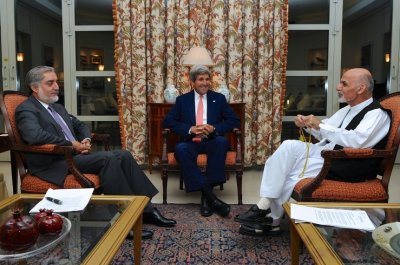
Secretary of State John Kerry, who visited Kabul Saturday for talks with Afghan leaders, said the Taliban’s participation in the peace process could help end the violence and suffering that the Afghan people have endured during years of war.
At a joint news conference in Kabul, Kerry and Afghan President Ashraf Ghani discussed a wide range of issues, looking ahead to a NATO summit in Warsaw in July that will review the status of Afghan security forces, and also a conference on development aid to be held later this year in Brussels.
More troop cuts
President Barack Obama has said he plans to reduce the number of U.S. troops in Afghanistan from 9,800 to 5,500 by next year, but other recent reports predict that goal will be delayed. Kerry said Obama will rely on input from American military commanders in Afghanistan before making a final determination about troop cuts.
Bilateral commission talks
Earlier Saturday, Kerry and Afghan Foreign Minister Salahuddin Rabbani presided at a meeting of the commission the two countries established to help Afghanistan’s post-war development into “a strong, stable, democratic and self-reliant state.”
Rabbani said the Kabul government is making every effort to advance peace and reconciliation, but that can only happen if the Taliban comes back to the negotiating table.
“We believe the international community can help encourage key actors in the region to have the Taliban group engage in direct talks with the Afghan government,” the foreign minister said.
Peace talks
The so-called Quadrilateral Coordination Group — the United States, Afghanistan, Pakistan and China — has been trying to get peace talks moving, but Taliban representatives refused to take any part in the most recent effort, shortly before it was to begin last month.
A lengthy and wide-ranging statement by the U.S.-Afghanistan Bilateral Commission stressed the two countries’ “respect for human rights, the rules of law and democratic values.” They pledged continuing cooperation and said three working groups would continue to meet on defense and security; democracy and governance; and economic and social development.
Kerry highlighted Afghanistan’s need for peace and security.
“When lasting and historic change is the goal, there are no opportunities to relax,” the top U.S. diplomat said. “When you have terrorists who are attempting to stop that work, stand in the way of that work, limit its success or even turn the clock backwards, obviously there is no time to relax.”
US support to national unity government
Another goal for Kerry’s visit was to show continued U.S. support for Afghanistan’s national unity government.
Kerry helped broker the deal that produced the power-sharing arrangement between President Ghani and Abdullah Abdullah, who is Afghanistan’s “chief executive,” with powers equal to that of the president. The unity agreement emerged after bitter disputes over results of the 2014 presidential election, which Abdullah asserted he would have won, but for electoral fraud.
The president/chief executive arrangement will continue, Kerry said, adding: “There is no end to this agreement at the end of two years, or six months from now. This is an agreement for a unity government, the duration of which is five years.”
True national unity has been an elusive goal, however, and Afghanistan’s people appear to be deeply dissatisfied with their government.
Kerry’s trip to Afghanistan was part of a week-long trip to the Middle East and Asia that also included an unannounced stop in Baghdad. He is now enroute to Japan, where he will attend a G-7 ministerial meeting and visit a World War II memorial.
Related
Taliban Get Their Orders From Pakistan: Ex-Taliban Commander
Tolo News: Faridoon Hanafi, a former Taliban commander who recently joined the peace process, said that Pakistan is mobilizing and equipping the Taliban and that the group takes its orders from Islamabad. Hanafi, who had his new-born baby wrapped in an Afghan flag, on Saturday publically announced his support for his country. He said he had been a Taliban fighter for six years. “I have seen with my own eyes that Taliban gets its orders from Pakistan and even Punjabis admired me many times for my hard work and gave me money,” said Hanafi. Click here to read more (external link).
Related News
Karzai condemns drone strikes in Paktika, claiming civilians were killed
Khaama Press: Former Afghan President Hamid Karzai condemned a drone strike in eastern Paktika province of Afghanistan, claiming that civilians were killed in the raid. According to a statement released by the Office of the Former President, the drone strike by US forces in Barmal district left a number of civilians dead. The statement further added that the former President strongly condemns the strike by US forces, calling the raid as irresponsible. Click here to read more (external link).
Afghan Parliament Approves Nominees for Interior Minister, Attorney General
VOA News
Ayaz Gul
April 9, 2016
ISLAMABAD—Afghan lawmakers Saturday approved the government’s nominees for interior minister and attorney general.
The parliamentary vote confirmed nominations of Interior Minister Taj Muhammad Jahed, a former army general, and Attorney General Mohammad Farid, formerly a member of the Afghan human rights commission.
The two slots play a central role in tackling the growing Taliban insurgency and combating endemic corruption in Afghan institutions.
Jahed was appointed as acting interior minister in February after the resignation of his predecessor, Noor-ul-Haq Olomi, in the face of heavy criticism over worsening national security.
President Ashraf Ghani’s unity government has been heavily criticized for its inability to fill key posts due to political infighting. The Defense Ministry and the intelligence agency are among the institutions being run by caretakers.
Critics say the failure to fill the two important security slots has hampered the Afghan security forces’ counter-insurgency operations.
Reconstruction efforts
The United States has spent some $68 billion to build and train the Afghan army as well as the police force. But the reconstruction effort is in a “perilous state,” according to U.S. Special Inspector General for Afghanistan Reconstruction John Sopko.
“Afghanistan has had the lead responsibility for its own security for more than a year now, and is struggling with a four-season insurgency, high attrition, and capability challenges,” said Sopko while delivering a speech at Harvard University Thursday.
He has also described corruption in Afghanistan as “an existential threat” to U.S. reconstruction efforts.
“Corruption undermined the legitimacy and viability of the Afghan state, fueled grievances that strengthened the growing insurgency, and sapped resources from the reconstruction effort,” noted Sopko.
Police rescue 17 civilians kidnapped by Taliban in Herat province
Khaama Press: At least 17 people kidnapped by Taliban militants have been rescued by police forces in western Herat province of Afghanistan. According to the local security officials, the Taliban militants abducted the civilians from Zindjan district of Herat as they were on their way for weekend break. Click here to read more (external link).