
 Huffington Post: A new female-only coding school is helping launch a quiet revolution in Afghanistan, where computers are opening up the world to women and allowing them to escape decades of repression. When Fereshteh Forough graduated with a degree in computer science from Herat University, she knew she was an exception to the rule. Click here to read more (external link).
After Taliban music ban, ‘Childhood Songs’ to be revived in Afghanistan
 Indian Express: When Louise Pascale, an American music teacher, pulled a three decade old Afghan children’s songbook from her bookcase, she realised she was likely holding a treasure lost to Afghan children following a music ban imposed by the Taliban. Click here to read more (external link).
Related
Afghan-Americans Worry About Backlash From Orlando Incident
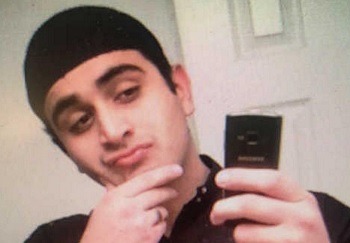
Omar Mateen
VOA News
Masood Farivar
June 13, 2016
Just hours after the deadliest mass slaying in American history, the owner of a Los Angeles-based satellite TV channel broadcasting to the Afghan diaspora took the unusual step of sitting in on a family show to talk about the tragedy.
Since authorities identified the gunman in the Orlando shooting as Afghan-American Omar Mateen, Omar Khatab’s phone had been ringing off the hook with calls from anxious Afghan-Americans.
“The show is about family issues, but I decided to join the host to address our community’s concerns,” said Khatab, owner of Payam-e-Afghan TV. “I wanted to appease the Afghan community because everyone was shocked and sad.”
Khatab and show host Temorshah Hassan fielded calls from Afghan-Americans who worried about how the biggest terror attack since 9/11 might affect their community. There were expressions of revulsion at what happened and sympathy expressed for the victims and their families. But one theme kept coming up: the fear that although Mateen was born and raised in the U.S., his Afghan heritage might inflame passions against the Afghan-American community.
“There was concern that somehow the tragic situation that happened by an Afghan would tarnish the name of Afghans, and the Afghan community would be affected,” Khatab said in an interview with VOA. “The whole media is focused on these issues and ask, ‘Why are these Afghans terrorists?’ ”
Sunday’s shooting marked the second time an Afghan-American has been implicated in a domestic act of terrorism or conspiracy to commit terror. Najibullah Zazi was arrested in 2009 for plotting to bomb the New York subway.
Shooter’s father
Khatab’s 24/7 channel airs an eclectic lineup of talk shows with a colorful roster of hosts. Among them was the Orlando shooter’s father, Seddique Mateen, who from 2012 to 2015 hosted a talk show devoted to the century-old controversy over the Afghanistan-Pakistan border known as the Durand Line.
Although seen as an eccentric character, the elder Mateen was not known as pro-Taliban, several Afghan-Americans interviewed by VOA said.
“He never had pro-Taliban views,” Khatab said. “If anything, he was against the Taliban because he knew Pakistan is behind the Taliban and motivated the Taliban to commit crimes in Afghanistan.”
In a video statement on his Facebook page Monday, Seddique Mateen called his son “a very good and educated boy” and said he was “extremely saddened” by the shooting.
“I did not know that he had a grudge in his heart,” Mateen said of his son, 29, who was born and raised in New York City before moving to Florida, where he worked as a security guard. “Why he’d do such a thing during the holy month of Ramadan, I don’t know.”
‘Individual act’
While condemning the massacre, Afghan-American community leaders sought to distance themselves from the shooter.
“This was an individual act that does not represent Afghan culture and Islamic laws,” said Hamid Nawid, a prominent Afghan-American artist and poet in Virginia.
Nawid said some politicians and media will want to capitalize on the tragedy and “turn it into Afghano-phobia, but this kind of thing will fade away as they realize that 99 percent of Afghan-Americans are decent, honest, hardworking citizens and that one individual can never represent the whole community.”
Zalmay Khalilzad, a prominent Afghan-American and former U.S. envoy to Afghanistan, Iraq and the U.N., condemned the terror attack.
“Many Afghan-Americans have contacted me to express their deep outrage over this cowardly act,” he wrote on his Twitter page shortly after the shooting.
Still, there was concern about a public backlash.
“What happened can affect the Afghan-American community in Florida and throughout the United States, and can become a source of concern,” Florida-based Afghan-American Nematullah Illahi told VOA’s Afghan service.
Global reactions
Around the world, Afghans’ reaction to the Orlando killings were mixed.
In an interview with VOA’s Ashna TV, former Afghan President Hamid Karzai emphatically said that “no Afghan, no Muslim” would condone the violence that shook Orlando on Sunday morning.
“This is utterly condemnable,” Karzai said.
Afghan President Ashraf Ghani and Abdullah Abdullah, the CEO of Afghanistan’s national unity government, were among the first world leaders to issue statements condemning the attack.
Others, however, took a completely different path online and celebrated the shooter.
“I hope for a day when U.S. and Britain fall in the same level of blood and dust that Afghanistan, Iraq, Syria and Lebanon are [in],” wrote Feroz Sherzy on VOA Dari’s Facebook page.
Another user, Mahmoodullah Hamid, who described himself as a health worker for the Agha Khan Foundation in northeastern Afghanistan, wrote in broken English, “verry brave mane. action is great.”
Of more than 500 comments users wrote under two entries on VOA Ashna TV’s Facebook page, at least 60 percent were sympathetic to the attacker and his crime. Some incendiary comments even received multiple “likes.”
“Comments of these nature point to the probability of a distorted mentality and a psychology already impacted by violence,” said Mosadeq Nademee, an Afghan psychiatrist and social media activist based in the Czech Republic. “Afghans have been deeply exposed to violence for almost 40 years, and this has impacted the way some people look at violence elsewhere.”
Nademee added that Afghans in general have very negative views of homosexuality.
VOA’s Akmal Dawi contributed to this report.
Related
Afghanistan’s Taliban Push Into New Media
 Wall Street Journal: The Taliban are active on a variety of media platforms. They recently began releasing audio files with songs and news updates, and launched a smartphone app for their Voice of Jihad website, available in multiple languages. Their videos, once grainy, are sleek and widely shared. The Taliban’s digital revamp has coincided with the rise of their rival, Islamic State. Click here to read more (external link).
Border Clashes Between Pakistan and Afghanistan Resume After Brief Cease-Fire

Torkham border area between Afghanistan and Pakistan
VOA News
Ayaz Gul
June 13, 2016
ISLAMABAD—Border clashes have resumed between security forces of Pakistan and Afghanistan after a short-lived ceasefire on Monday, officials said.
Overnight skirmishes killed at least one person wounded 18 others, according to officials, forcing around 200 Pakistani families to relocate to safer areas.
“Pakistan wanted to build new installations and Afghan border forces didn’t allow it. Pakistan went further and fired towards Afghan forces,” Chief Executive Abdullah Abdullah told a meeting of ministers in Kabul.
He confirmed the exchange of fire, which lasted seven hours, left one Afghan soldier dead and six others wounded. The Pakistani side also suffered casualties at the Torkham crossing clash.
Abdullah insists bilateral understandings bind the two countries to seek mutual consent before constructing new installations near the border.
“The Afghan security and defense forces retaliated to safeguard the territorial integrity and defend the country and its people … armed forces are always ready to defend their country and people and to react against any kind of threats,” the Afghan Foreign Ministry said in a separate statement.
But officials in Pakistan rejected Afghan assertions the construction activity was illegal and blamed Afghan security forces for resorting to “unprovoked firing” that wounded 12 people, including a Pakistani border guard.
Pakistani security forces responded to Afghan firing effectively, according to the military’s media wing. It noted Torkham is the most frequented crossing point between the two countries and terrorists have also been found using this gate for entry.
“In order to check movement of terrorists through Torkham, Pakistan is constructing a gate on its own side of the border as a necessity to check unwanted and illegal movement,” the statement noted.
Porous, disputed border
Pakistan and Afghanistan share a more than 2,500-kilometer porous frontier, but Kabul disputes the border and has opposed repeated fencing attempts by Islamabad.
Both sides say militants use the border to conduct anti-state acts in their respective countries.
“We consider these unprovoked attacks unhelpful in Pakistan-Afghan relations and expect from the Afghan government to investigate this incident immediately,” said a spokesman for Prime Minister Nawaz Sharif’s office in a separate statement, expressing Pakistan’s “deep concerns” over the incident.
Pakistan also Monday summoned the Afghan Charge d’Affaires in Islamabad to convey its “strong protest” over what it called the unprovoked firing by the Afghan forces it said wounded two soldiers and nine civilians, including women and children.
“It was further emphasized that all steps should be taken for avoiding recurrence of such incidents in the future,” the Foreign Ministry said.
Afghanistan also summoned the Pakistani ambassador in Kabul to protest the firing incident.
Related
Over dozen Daesh terrorists slain in eastern Afghanistan
 Press TV
June 13, 2016
More than a dozen members of the Takfiri Daesh terrorist group have been killed in operations by Afghan security forces against the extremists in the country’s eastern province of Nangarhar.
In a statement released on Sunday, the Afghan Ministry of Defense announced that the operations were carried out in the Achin and Dih Bala districts of the province, located some 150 kilometers (86 miles) east of the capital, Kabul.
The statement added that 13 Daesh Takfiris were killed during the operations, while seven more sustained injuries.
Daesh militants had killed six police officers, including a district police chief, in the same Afghan province a day earlier.
Attaullah Khogyani, a spokesman for the provincial governor, said the terrorists attacked the administrative headquarters in Haska Mina district early on Saturday, and shot the policemen dead.
On April 14, Afghan military aircraft carried out an airstrike and killed dozens of Daesh members in Nangarhar, which borders Pakistan. The Afghan army’s public relations directorate said 42 Daesh militants were killed in the raid and a training center was destroyed.
Nangarhar has been witnessing a rise in the number of Daesh terrorists in some of its districts in recent months.
Afghanistan faces a security challenge years after the United States and its allies invaded the country in 2001 as part of Washington’s so-called war on terror. The offensive removed the Taliban from power, but many areas in the country are still beset with insecurity.
There are currently some 10,000 foreign forces in Afghanistan despite the end of the US-led combat mission on December 31, 2014. The forces, mainly from the US, are there for what Washington calls a support mission. NATO says the forces focus mainly on counter-terrorism operations and training Afghan soldiers and policemen.
Raziq Warns Kandahar’s Rich Against Funding Taliban

Gen. Abdul Raziq
Tolo News: Kandahar police chief general Abdul Raziq on Sunday warned the wealthy in the province against paying their Zakat (charity) to the Taliban amid reports that businessmen, company owners and landholders were donating money to the Taliban and the Quetta Shura. He said that the money paid to the Taliban as charity funds the insurgents war. Click here to read more (external link).
46 militants killed in clashes with Afghan security forces, airstrikes within day: gov’t
 KABUL, June 12 (Xinhua) — Up to 46 militants had been killed in clashes with security forces and airstrikes across Afghanistan within day, the Afghan Defense Ministry said on Sunday.
“Over the past 24 hours, Afghan security and defense forces conducted several military and cleanup operations, killing 46 militants, wounding 24 and detaining four other militants,” the ministry said in a statement providing daily operational updates.
The ground forces were supported by army’s heavy artillery and air force, the statement added.
Among the killed were, a member of Haqqani network named Khalil, and 13 militants of Islamic State (IS), the statement noted.
The joint forces also found weapons, ammunition and defused several landmines during the above raids.
The statement also confirmed the loss of 11 army personnel in separate incidents over the same period.
The militant groups have yet to make comments.
Other Security News
50 killed in US nightclub shooting, gunman likely an Afghan-American
Omar Mateen
Khaama Press: The death toll in the deadly attack on a gay nightclub in Florida city of the United States has climbed to at least 50 amid reports that the attacker was an Afghan-American. The city’s mayor Buddy Dyer has said a ‘state of emergency’ has been declared following the deadly attack. The suspect has been identified as Omar Mateen who is believed to be of Afghan descent but his name was not on a terrorism watch list as reports suggest the attack was an act of terrorism. Click here to read more (external link).
Lifting restrictions on U.S. forces fighting Taliban in Afghanistan shows Rumsfeld’s strategy fails: expert

Rumsfeld
BEIJING, June 11 (Xinhua) — Washington’s decision to lift restrictions on U.S. forces fighting the Taliban in Afghanistan showed that the strategy of former U.S. Defense Secretary Donald Rumsfeld had failed, an expert said Friday.
The Obama administration has decided to give broader authority to the U.S. military commanders to “anticipate situations in which the Afghan security forces would benefit from our support,” Defense Secretary Ashton Carter told a defense conference in Washington Friday, calling the expanded authority “a good use of the combat power that we have there.”
“The debacle is yet another nail in the coffin of the Rumsfeld Doctrine with its reliance on air supremacy, high-tech weaponry, and light and nimble ground forces,” Russian news agency Sputnik quoted foreign affairs expert Dan Lazare as saying.
The Rumsfeld Doctrine was applied in Afghanistan in 2001 and in Iraq in 2003, but in both cases the U.S. armed forces failed to send enough forces to ensure security in either country, opening the way for the Taliban, al-Qaida, and the Islamic State military group to launch insurgencies, Lazare said.
Lazare also dismissed the new U.S. support policy as a minor measure almost certain to fail.
“It’s just another half-hearted measure aimed at ratcheting up the pressure and making it look (like) the U.S. military is getting somewhere, when it’s not. The long-term effect will be nil,” he concluded.