
 Khaama Press: Hailed as Canada’s first Afghan-born member of parliament, the Canadian Minister Maryam Monsef could be stripped of her citizenship or deported for misrepresentation of birth place which was earlier believed to be Afghanistan. According to the local media reports, the step could be taken without hearing under the citizenship laws brought in by the previous Conservative government. Click here to read more (external link).
Afghan Forces Struggle in Increasingly Deadly Fight
 Hasib Danish Alikozai
VOA News
September 27, 2016
WASHINGTON — Ja Jaan, a member of the Afghan national police, was traveling home from his job in the provincial capital of southern Uruzgan province to spend a few days off with his family when he came under attack from the Taliban.
“I was armed, and I knew that I was going to be killed. In a split second I decided to engage them,” Jaan said. “We exchanged fire, and I got injured a few minutes into the firefight. Luckily, my check post was not that far, and reinforcements arrived to help me. The insurgents took off after my friends arrived.”
Jaan was injured in the neck. After some emergency first aid, he was driven about two and half hours to a hospital in neighboring Kandahar province where he went through multiple surgeries. Jaan survived and returned to his job on the front lines of Afghanistan’s war.
Many of Jaan’s colleagues have not been so lucky. Afghan security forces have faced steep challenges since foreign troops disengaged from front-line fighting in 2014.
Worrying statistics
U.S. military analysts said in a report earlier this year that the government lost control or influence of nearly five percent of its territory between January and May of 2016. A top U.S. commander said Afghan forces suffered more than 900 fatalities in July of this year alone.
The Afghan government does not publish casualty numbers of its forces on a regular basis. However, the U.S. Defense Department reported a 27 percent increase in Afghan security forces casualties between January and November of 2015 compared with the same period in 2014. A more recent report published this June said the casualties continue to increase, without specifying exact figures.
The same report said that 42 percent of Afghans say that security is worse now than during the time of the Taliban.
Ali Ahmad Jalali, minister of interior during the previous administration of president Hamid Karzai’s and current professor at National Defense University in Washington, D.C., said some of this can be attributed to international forces playing a more advisory role.
“It is a complex situation. First of all, this year is the second year that Afghan forces are fighting the insurgents with very little assistance from the international forces. On the other hand, the Afghan air force capability is very limited,” Jalali said. “Taliban also increased their operations, hoping that in the absence of international forces they could make inroads into many districts and provinces.”
Insurgent groups see opportunity
Some observers say that around the same time the U.S.-led NATO forces were winding down their combat mission at the end of December 2014, others like the Islamic State group started targeting Afghanistan.
“The threats are not only posed by the insurgents who are fighting with a foreign agenda, we also have to put up with intelligence proxy warfare and terrorists from all over the world. From Africa to the Middle East, and South and Central Asia terrorists are trying their best to turn Afghanistan into their safe haven,” said General Mohammad Radmanesh, spokesperson of the Afghan Ministry of Defense. “Madrasas (religious schools) in the neighboring countries are being used as a hub for exporting terrorism to Afghanistan to destabilize the country,” he added.
The responsibility for responding to such groups has in many cases fallen to the police, forcing them to choose counter-insurgency operations over enforcing the law.
Critics like General Zalmai Wardak, a military analyst in Kabul, says the challenge is compounded by a lack of leadership.
“When leaders fail to embrace their responsibilities, and there is lack of coordination within the force, it will automatically contribute to increase in casualties,” Wardak said. “What adds to all of this is the fact that soldiers are put in the theater only after two months of training.”
General Jabar Qahraman was put in charge of the military operations in southern Afghanistan, a Taliban stronghold, by President Ashraf Ghani in the beginning of the year. But he is not leading those forces anymore. He said he stepped down from his post because he came to believe that military operations alone cannot end the fighting.
In an interview with VOA, he said he supports negotiations, in part because the current predicament is even more dangerous than the country’s brutal civil war of the 1990s, in which he fought as a commander.
“One of the reasons that this war is increasingly having a big toll on the [Afghan National Security Forces] is that the war itself is multidimensional, involving regional players. In addition to that, it’s an asymmetric warfare which, if fought with conventional means, will without doubt have casualties,” Qahraman said.
IEDs
Afghan Ministry of Defense spokesperson General Radmanesh pushes back on the criticism, saying the leadership is focused on the right problems.
“We do have an increase in casualties within our force, and we do have some problems within our ranks at the tactical levels but in general our leadership is committed to look after its forces and reinforce them on a timely basis,” Radmanesh said. “They (insurgents) have all kinds of weapons, and they have increasingly relied on IEDs which has increased our fatalities.”
Retired U.S. Marine Johnny Joseph Jones, who was an explosive ordinance disposal technician in Afghanistan in 2010, believes IEDs could be the main contributor in the rise of causalities.
“If the enemy is still using IEDs against the Afghan forces the way they were using it against us, without proper medivac you are going to lose every one of them that get the hit,” Jones said. “It is all a fatal hit unless you have the proper medical assistance in time which includes air support and we are talking 15 to 20 minutes. One amputation could mean death,” Jones said.
Afghan policeman Jaan agrees. He said he was lucky to have survived his wounds during the drive to the hospital. Several of his friends who had life threatening injuries in other IED attacks were neglected for days before they could treated. Some died while waiting.
Jaan’s colleague Abdul Bari, who serves in Uruzgan’s Deh Rawood district, told VOA that he is wounded and has yet to be treated.
“I am resident of Deh Rawood district and a member of the Afghan police force. I am wounded. The roads are blocked, and there is no medical help available,” Bari said. “I hope that they send a doctor and take care of us soon.”
Other Security News
Pakistan Steps Up Outpost Building on Afghan Border to Plug Illegal Crossings
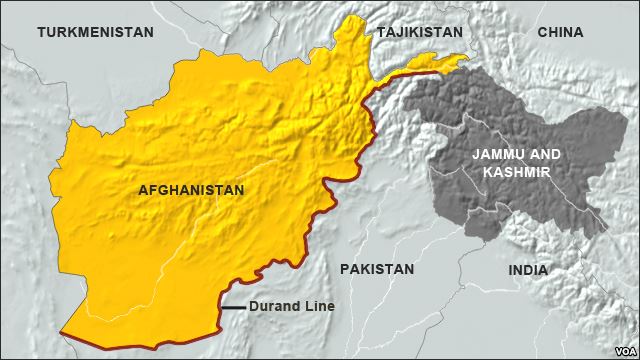
Durand Line
Ayaz Gul
VOA News
September 27, 2016
ISLAMABAD, PAKISTAN — Pakistan says it has completed construction of “20 percent” of outposts being established along a largely porous border with Afghanistan, and called for the strife-torn country to take matching steps for deterring terrorist infiltration.
The two uneasy neighbors share a nearly 2,600 kilometer rugged mountainous frontier, called the Durand Line, with several hundred irregular crossing points, facilitating movements of militants and smugglers in both directions.
Army spokesman Lt. General General Asim Bajwa, told reporters in the northwestern city of Peshawar that regular and paramilitary soldiers have also been deployed at some of the newly-built installations located in high mountain passes.
“The soldiers are now firmly positioned there, effectively blocking any movement from Afghanistan into Pakistan, and similarly no one can cross over the border from this side,” he asserted.
Afghan authorities have long alleged Taliban insurgents affiliated militant groups plot and stage cross-border attacks using sanctuaries on Pakistani soil.
Officials in Islamabad reject the charges and blame the porous border as well as decades old localities housing millions of Afghan refugees for sheltering the insurgents.
Bajwa said border management efforts are mostly underway on the Pakistani side. “They will most effective when Afghan security forces occupy positions on their side. We hope that in coming days there will be more forces deployed on the other side so both countries can benefit from these measures.”
Afghanistan disputes the Durand Line demarcation put in place by former British rulers of the Indian subcontinent and opposes Pakistani plans of building permanent structures on the border.
Islamabad dismisses those concerns and says Pakistan inherited the frontier after it gained independence from Britain in 1947. It has vowed to speedily implement its “border management” measures, saying it will also help address mutual terrorism concerns.
The determination to strengthen border security despite Kabul’s objections stems from allegations the Afghan intelligence agency is sheltering and facilitating anti-Pakistan militants to conduct terrorist attacks on Pakistani territory, charges Afghan officials deny.
General Bajwa asserted probes into this month’s terrorist attacks in Peshawar and the nearby city of Mardan have concluded they were planned in Afghanistan. He added “female facilitators”, now under detention along with several other suspects, also played a role in the violence, but gave no further details.
“Details of these incidents are being shared at all levels with (NATO’s) Resolute Support mission [in Afghanistan], with the Afghan government, with the Afghan military and with their intelligence to the extent it is possible,” Bajwa said.
Both countries regularly blame each other for supporting violent attacks on their respective territories, fueling bilateral tensions.
U.S. military commander General John Nicholson last week reiterated Washington’s concerns Islamabad is not putting “adequate pressure” on the Haqqani Network of militants fighting along side the Taliban insurgency in Afghanistan, to prevent them from staging cross-border attacks.
Afghanistan’s Tourism Generates 1bn Afs A Year
 Tolo News: Marking World Tourism Day, the Ministry of Information and Culture (MoIC) said on Tuesday that despite a five percent drop in the number of foreign tourists to Afghanistan, due to insecurity, the sector had generated an annual income of almost one billion Afghanis. MoIC spokesman Harun Hakimi said foreign tourists can travel to 12 provinces of the country that have over 200 historical sites. Click here to read more (external link).
Afghan Troops Killed In ‘Insider’ Attack
 Radio Free Europe/Radio Liberty
September 27, 2016
At least 12 Afghan Army soldiers have been killed in their sleep in an attack allegedly facilitated by fellow soldiers with suspected links to the Taliban.
A senior police official in the northern city of Kunduz said on September 27 that two soldiers fled an outpost in the city and joined insurgents in the nighttime attack on their comrades.
The Taliban issued a statement claiming responsibility for the attack and saying that all the weapons at the outpost had been captured.
The Afghan Defense Ministry is investigating the incident.
The outpost was part of a ring of positions protecting Kunduz, which was briefly taken by the Taliban last year. It was the first time the Taliban held a provincial capital since they were driven from power in 2001.
Based on reporting by Reuters and dpa
Copyright (c) 2016. RFE/RL, Inc. Reprinted with the permission of Radio Free Europe/Radio Liberty, 1201 Connecticut Ave NW, Ste 400, Washington DC 20036.
Other Security News
Hekmatyar committed a major crime by signing peace deal: Taliban
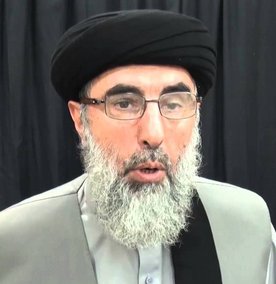
Gulbuddin Hekmatyar
Khaama Press: The Taliban militants group in Afghanistan has slammed Gulbuddin Hekmatyar for allowing his party to sign a draft peace agreement with the Afghan government, saying Hekmatyar has committed ‘a major crime’. “Not only will he face the wrath of Allah for leaving jihad, but he has committed a major crime,” the group said in an article published in its website. Click here to read more (external link).
Researchers Blame Pakistan’s ISI For Death Of Ex-President Najibullah

Najibullah Ahmadzai
Tolo News: On the 20th anniversary of the death of former Afghan president Dr. Najibullah Ahmadzai, an Afghan research center on Monday claimed the former leader was killed based on an intelligence plan, drafted by regional countries and adopted by Pakistan’s Inter-Services Intelligence Agency (ISI). Deputy chief of Afghanistan’s Strategic and Scientific Research Center, Aimal Liyan, said there is evidence to this effect. Click here to read more (external link).
Kabul Garrison bans Enlightenment Movement from further demonstrations
 Khaama Press: The Kabul Garrison has prohibited the Enlightenment Movement to organize further demonstrations in Kabul following a deadly attack that left at least 85 people dead. General Gul Nabi Ahmadzai, the commander of Kabul Garrison, told reporters in Kabul today that the decision to ban the movement from organizing further demonstrations was taken in line with the security challenges of the capital. Click here to read more (external link).
IS Retakes Control of Former Strongholds in Afghanistan
 Ayaz Gul
VOA News
September 26, 2016
ISLAMABAD — Officials and witnesses in Afghanistan say fighters linked to Islamic State have regained control of most of the militant group’s former strongholds in the country, weeks after retreating to remote mountain hideouts in the face of major Afghan security operations.
The troubled areas are located in Achin, Naziyan, Kot and Haska Meena districts of the eastern Nangarhar province, which borders Pakistan.
A reporter for VOA’s Afghan service this week traveled to Achin, the main IS base in the country, and says government security forces have relocated to positions they were occupying prior to the launching of an anti-IS “Qahr-e- Sellab” offensive in June.
Regional military spokesman Shreen Aqa confirmed to VOA that IS militants have returned to parts of the troubled districts, but said Afghan forces are preparing to undertake a fresh offensive for their eviction.
Warning not heeded
Tribal elders from the area have repeatedly warned IS was trying to return to its former bases and criticized Afghan authorities for not paying attention or establishing permanent security posts after concluding the previous operations.
IS launched its regional operations early last year in about 10 districts of Nangarhar, but stiff resistance from the rival Taliban and repeated U.S. counterterrorism drone strikes confined them to three or four districts, according to officials.
The operations in June and July were “very successful” because they eliminated IS regional chief, Hafiz Saeed Khan, along with 11 other top leaders and killed 25 percent of its fighters, General John Nicholson, the top U.S. military commander in the country, noted last week.
“We estimate there numbers are 1,200 or 1,300 fighters. They have some enclaves in (neighboring) Kunar province, but primarily they are in Nangarhar province,” Nicholson told reporters on Friday.
Primarily Pakistani ethnic Pashtun militants who were previously part of the anti-state Tehreek-i-Taliban Pakistan in the neighboring country fill Islamic State’s regional ranks, the general said.
“Their goal is to establish their caliphate, the Khorasan province, with Jalalabad as the capital and Nangarhar as their initial caliphate,” he added.
IS has declared Afghanistan, Pakistan and parts of Iran as its Khorasan province.
General Nicholson confirmed there are “linkages financial, leadership and strategic communication” between the Nangarhar militants and the main Islamic State back in Syria.
IS has also claimed responsibility for several attacks in Pakistan. But the Pakistan military earlier this month announced it has “forestalled” attempts by the group to expand influence in the country.
An army spokesman said security forces have arrested more than 300 militants linked to the Middle East-based terrorist group, including its main leadership, since it began operations in Pakistan last year.
China Planning To Help Tajikistan Protect Afghan Border
 RFE/RL’s Tajik Service
September 26, 2016
DUSHSANBE — Tajikistan says China plans to finance and build several outposts for Tajik border guards along the Tajik-Afghan border.
A Tajik government decree published on September 26 said the move would bolster Tajik security.
The decree said the government instructed the State National Security Committee to sign an agreement with China to provide for the construction of 11 outposts of various sizes, as well as a training center for border guards.
The 1,345-kilometer Tajik-Afghan border is a major concern for Dushanbe, as Afghan drug smugglers regularly clash with Tajik border guards and Afghan Taliban militants increase their activities along the border.
China, which according to official statistics sells goods worth $2.5 billion a year to Tajikistan, built one outpost on the Tajik-Afghan border, its first one, earlier this year.
With reporting by Reuters