
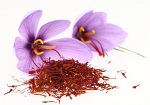
 Reuters: Saffron is the most expensive spice in the world, selling for as much as $1,200-$1,800 a kilogram, and has long been seen as an alternative crop to opium poppies for poor farmers in a country struggling with the legacy of decades of war and lawlessness. So far, it has had little impact on the opium trade which the United Nations estimates is worth some $3 billion a year in Afghanistan, source of most of the world’s opium, from which heroin is produced. Click here to read more (external link).
Land Mine Casualties Jump 75% as Funding for Their Removal Declines

New York Times: Despite a global treaty that bans land mines, casualties from those weapons and other unexploded munitions lurking in current and past war zones rose sharply last year to the highest point in a decade, a monitoring group said Tuesday in its annual report. The casualty increase was primarily from the armed conflicts in Afghanistan, Iraq, Libya, Syria, Ukraine and Yemen, according to the report, which said better availability of data on victims was also a factor. Click here to read more (external link).
To Get Back to Normal, Afghanistan Needs Private Security
 The National Interest: Security in Afghanistan is particularly weak today, especially for the commercial sector. Foreign investors will not consider Afghanistan until there is effective security available for employees and facilities. The Afghan army and police are impressively capable, but face enormous demands, from battling insurgents to protecting politicians and conducting basic traffic duties. Ultimately, international investors require reliable, professional private security. We have seen this model enable investment in places like Colombia, Angola and elsewhere, where economies grew despite ongoing conflicts. Afghanistan is held back by self-inflicted regulations. Click here to read more (external link).
Appointed Afghan Electoral Commissioners Sworn In
 Ayaz Gul
VOA News
November 22, 2016
ISLAMABAD — Afghanistan’s new electoral commissioners were sworn in Tuesday, paving the way for long-delayed parliamentary and district council elections.
President Ashraf Ghani and his governing partner in the so-called National Unity Government (NUG), Chief Executive Abdullah Abdullah, witnessed and addressed the swearing-in ceremony at Kabul’s presidential palace.
The appointments to Afghanistan’s Independent Election Commission (IEC) and Independent Election Complaints Commission (IECC) come after more than two years of political wrangling between the two leaders.
A U.S.-brokered political deal between Ghani and Abdullah led to the formation of NUG in September 2014, ending months of political chaos stemming from the fraud-marred presidential elections that could not produce a clear mandate for the Afghan election rivals.
Leadership positions
The agreement allowed Ghani to take charge as president, while Abdullah was given the newly created office of chief executive.
The political deal required the two leaders to reform the electoral system as soon as possible to ensure future parliamentary and regional elections in the war-hit country were free of controversy.
President Ghani also removed IEC and IECC members responsible for organizing the controversial 2014 presidential polls. Abdullah blamed the two panels for favoring Ghani in the electoral process.
Until now, persistent differences between Ghani and Abdullah over new appointments to the electoral commissions had blocked any progress toward much-needed electoral reforms. The stalemate forced the Afghan president to extend indefinitely the terms of national parliament and regional assemblies.
On Tuesday, both leaders asserted the new commissioners were chosen after a long and transparent process of mutual consultations, saying it has now taken their political deal forward.
To convene
The newly elected national and provincial parliaments will be required to convene a mandatory joint session known as the Constitutional Jirga (assembly) for amending the constitution to decide whether to give legal cover to Abdullah’s office and make him prime minister.
The U.N. Assistance Mission in Afghanistan (UNAMA) welcomed Tuesday’s appointments to the electoral commissions, saying they signal a new phase in the rebuilding of trust in the electoral institutions and process.
“UNAMA encourages the commissions to work with all stakeholders in an inclusive, transparent and impartial manner,” the mission’s office in Kabul said in a statement.
“The commissions have an important responsibility to establish a realistic electoral timeline in order to uphold the Afghan people’s constitutional right to participate in elections,” it added and promised more technical support to the electoral process.
Ghani and Abdullah have been under fire for taking a long time to introduce electoral reforms to end the country’s political uncertainty.
Political opponents have long blamed differences between the two Afghan leaders for recent battlefield advances by Taliban insurgents and for the rise in deadly militant violence across Afghanistan.
Rights Groups to Obama: Rescind Muslim ‘Registry’ Before Trump Takes Office
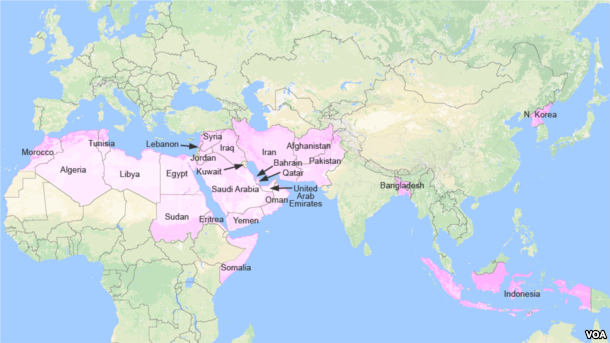
Home countries of Muslims who may be subject to Donald Trump’s “Muslim Registry”
Victoria Macchi
VOA News
November 22, 2016
Hundreds of civil rights advocacy groups have asked President Barack Obama to dismantle a program once used to register foreigners from a list of predominantly Muslim countries, in a bid to stave off efforts by Donald Trump’s incoming administration to revive the system.
In a letter addressed to Obama and posted online Tuesday, 198 local and national organizations around the U.S. called for executive action to immediately rescind the National Security Entry-Exit Registration System, known by its acronym, NSEERS.
“NSEERS was a discriminatory policy that ran counter to the fundamental American values of fairness and equal protection,” the groups wrote, adding that it was “ineffective as a counterterrorism tool, has resulted in tremendous harm for individuals who were directly affected, and has disrupted relationships with immigrant communities.”
The post-9/11 George W. Bush-era policy, created by the Department of Justice, was gutted in 2011 during Obama’s first term, but the framework remains in place. President-elect Trump and several advisers have publicly expressed interest in focusing registration and surveillance efforts broadly on Muslims, and in reviving NSEERS.
The American Civil Liberties Union, which advocated for the suspension of NSEERS, notes there were no terrorism-related convictions among the more than 90,000 entries in the database. The list included foreign visitors arriving from certain countries where there was thought to be a terrorist threat. Mostly students, the people on the list were required to register and then check in occasionally.
Framework for new registry?
A member of Trump’s transition team, Kris Kobach, played a role in crafting the registry. Kobach’s name has surfaced as a contender to lead the Department of Homeland Security (DHS), which oversaw the NSEERS program.
Kobach was seen leaving a meeting with the president-elect Sunday in New York, and carrying a paper that included a top line item of “update and reintroduce” NSEERS as part of a “Strategic Plan for first 365 days.”
The Topeka Capital-Journal in Kansas, where Kobach is secretary of state, captured the picture of Kobach leaving Trump Tower and reported on the document’s contents, much of which had been addressed publicly by Kobach in recent weeks. Kobach told Reuters last week that Trump’s policy advisers were discussing reinstatement of NSEERS.
Asked whether the Trump administration would ban Muslims from coming to the U.S., as described by Trump during his presidential campaign, Luis Quinones, a member of the Hispanic Advisory Council to the president-elect, told VOA’s Latin America division last week that it would not be a “ban,” rather it would “slow down the process.” He added that the new administration would be “dusting off” such policies already in place.
DHS effectively ended the program in 2011 by removing the countries on the list, declaring it “redundant” given immigration procedures, and adding that it “no longer provides any increase in security.” The action gutted NSEERS, but didn’t strike the program from the books, leaving the option open for a revival.
“Unless this program is rescinded, the Trump administration will come into office with a framework already in place to quickly implement a so-called Muslim registry,” National Iranian American Council Executive Director Jamal Abdi said. NIAC was one of the groups that signed the letter. “This discriminatory framework must be removed before it can be exploited and innocent people are targeted.”
Increased opposition
Trump campaigned heavily on rhetoric about Muslims, immigrants and refugees beginning in 2015 — comments that were widely seen as disparaging of those groups. That talk resonated with his base of supporters, who also rallied around his declarations to build a wall along the southern U.S. border.
Trump sometimes conflated the groups, including one exchange with a reporter in which he answered questions about a “Muslim registry” last November with a response about illegal immigration.
Then, in December 2015, Trump called for a “total and complete shutdown of Muslims entering the U.S. until our country’s representatives can figure out what is going on.” He erroneously cited a Pew Research Center study to support his claim that hundreds of millions of Muslims around the world have “great hatred towards Americans by large segments of the Muslim population.” Pew says no such study exists.
Abed Ayoub, policy director at the Washington, D.C.-based American-Arab Anti-Discrimination Committee, which spearheaded Tuesday’s request to the president, calls Trump’s interest in surveilling mosques and targeting Muslims for additional surveillance “problematic.”
“We’ll fight against whatever the next administration seeks to implement,” Ayoub said. “We’ll make sure our voice is heard.”
He’s confident the work to organize the communities that would be affected by such policies are stronger now than when NSEERS was first implemented.
“We do have strong organizations — who will fight for your rights, fight for your liberties. A lot of the things he’s suggesting will be struck down in court,” Ayoub said.
NSEERS countries
The following are the 25 home countries of Muslims subject to the National Security Entry-Exit Registration System, known by its acronym, NSEERS: Afghanistan, Algeria, Bahrain, Bangladesh, Egypt, Eritrea, Indonesia, Iran, Iraq, Jordan, Kuwait, Lebanon, Libya, Morocco, North Korea, Oman, Pakistan, Qatar, Saudi Arabia, Somalia, Sudan, Syria, Tunisia, United Arab Emirates and Yemen.
HRW Calls For ‘Security Plan’ To Protect Afghanistan’s Shi’a
 Radio Free Europe/Radio Liberty
November 22, 2016
An international rights group has urged the Afghan government to develop a “security plan” to better protect the minority Shi’a community during high-profile public events.
Human Rights Watch (HRW) made the call in a statement on November 21, a day after a suicide bomber killed at least 30 worshipers at a Shi’ite mosque in Kabul during the observance of a religious ceremony.
Militants affiliated with the extremist Islamic State (IS) group claimed responsibility for the attack — their fourth on gatherings by Afghanistan’s Shi’a community since July, according to HRW.
The New York-based group also said that sectarian suicide attacks have injured or killed more than 500 Shi’a in Afghanistan since July.
The IS group has “stepped up its horrific and unlawful attacks” on Shi’ite public gatherings, “making no place safe,” HRW researcher Patricia Gossman said.
“The government, Shi’a leaders, and civil society groups should work together to develop appropriate ways to improve security during vulnerable public and religious gatherings […] so that Shi’a community members can exercise their basic rights,” she added.
Copyright (c) 2016. RFE/RL, Inc. Reprinted with the permission of Radio Free Europe/Radio Liberty, 1201 Connecticut Ave NW, Ste 400, Washington DC 20036.
Related
Afghanistan’s own version of ‘Banksy’ takes on Kabul
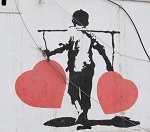 The Independent (UAE): A group of Afghan artists and activists are painting graffiti on the walls of government buildings, businesses and embassies in Kabul. They call themselves the Afghan “Banksy”. Click here to view more photos (external link).
Afghan Returnee Mothers’ Grave Need for Reproductive Health Care
 ReliefWeb: “I examined the mother, only to find out that she had carried her dead fetus for weeks,” said Alia Ayar, a UNFPA midwife providing obstetric emergency care in times of humanitarian crises around Afghanistan. “She suffered severe pains and fever and couldn’t do the chores around the house, until the family (finally) decided to allow her to see a health service provider.” Click here to read more (external link).
IS Claims Kabul Shi’ite Mosque Blast That Killed 32
 Ayaz Gul
VOA News
November 21, 2016
ISLAMABAD — Islamic State has claimed responsibility for Monday’s suicide bombing of a Shi’ite mosque in the Afghan capital that killed at least 32 people and wounded more than 80 others.
The bomber entered the crowded Baqir ul Olum Mosque in Kabul during a religious ceremony and detonated the explosives strapped to his body among the worshipers.
General Faridoon Obaidi, head of Kabul’s Criminal Investigation Department, told reporters all the victims were civilians.
A brief statement issued by IS’s media wing said it was behind the bloodshed.
President Ashraf Ghani denounced the bombing as “unforgivable” and an act of enemies of Afghanistan aimed at dividing Afghan ethnicities.
Afghan Chief Executive Abdullah Abdullah condemned the attack, saying it targeted “innocent civilians – including children – in a holy place. It is a war crime and an act against Islam.”
A Taliban spokesman in a brief statement sent to reporters denied involved in the bombing, saying the Taliban had nothing to do with it.
The United States denounced the mosque bombing as a “senseless and cowardly act” and extended its condolences to the families of the victims.
This attack is another demonstration of contempt for religious tolerance and communal harmony by the enemies of peace and progress in Afghanistan, said a U.S. embassy statement in Kabul.
‘Atrocity’
Separately, the acting head of the United Nations Mission in Afghanistan (UNAMA), Pernille Kardel, said the “appalling attack on worshipers is an atrocity.”
“UNAMA expresses its revulsion at this latest effort by extremists to stoke sectarian violence in Afghanistan,” added Kardel.
Amnesty International, while reacting to what it described as “a horrific and deliberate attack on civilians,” called for Afghan authorities to immediately investigate the crime to bring the perpetrators to justice.
“They have a duty to take effective measures to protect Shia Muslims from attacks and end impunity for previous abuses against the Shia community,” the London-based human rights defender said in a statement.
IS has recently stepped up attacks on Shi’ite worship places and gatherings in Afghanistan.
On October 11, two IS attackers wearing police uniforms and armed with grenades and machine guns stormed Kabul’s Kart-e Sakhi shrine and opened fire on Shi’ite mourners, killing 19 of them.
The Middle Eastern-based terrorist group in July of this year attacked a peaceful demonstration in Kabul in which more than 80 people, mostly members of the Shi’ite Hazara community, were killed while many more were wounded.
Karzai Hails Surgical Strikes by India, ‘Wishes’ Afghanistan to Follow Suit

PTI: Former Afghanistan president Hamid Karzai on Sunday welcomed the surgical strikes by Indian Army on terrorist camps in Pakistan-occupied-Kashmir and said for long his country has been demanding terror sanctuaries be destroyed. “We have been saying and wishing it since so long that terror sanctuaries be eliminated, and the Indian Army has done the right thing through its surgical strike,” said Karzai. He was here to attend The Mother Teresa Memorial International Award for Social Justice, 2016 program, organised by Harmony Foundation. Click here to read more (external link).