
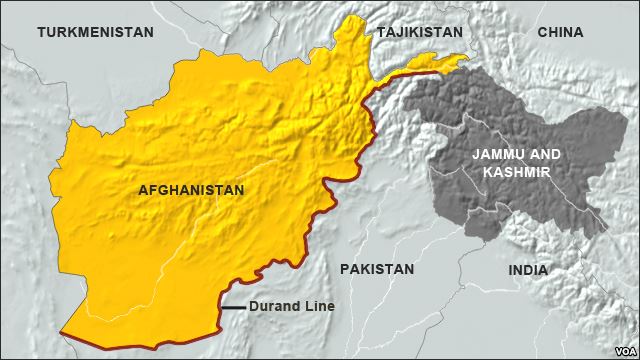
AFP: Pakistan and Afghanistan plan to use Google Maps to help settle a border dispute that led to deadly clashes last week, officials from both sides said Monday. Pakistan inherited its 2,400-kilometre (1,500-mile) border with its western neighbour when it gained independence from Britain in 1947, but Afghanistan has never formally recognised it. And while official Afghan maps reflect the so-called “Durand Line”, many nationalists believe the true border of their country ends at the River Indus that runs though Pakistan and gave India its name. “Officials from the geological survey departments of the two countries will conduct a survey, and they will also make use of Google Maps,” said a senior Pakistani security source in Islamabad who requested anonymity. Click here to read more (external link).
Afghan-US Forces Deal Critical Blows To Islamic State Terror Operations
VOA News
Ayaz Gul
May 8, 2017
ISLAMABAD — Authorities in Afghanistan say that fresh airstrikes in an eastern volatile region have killed at least 34 Islamic State militants and destroyed a radio station the terrorist group was using for extremist propaganda.
The Afghan Interior Ministry said Monday the strikes targeted IS hideouts in Naziyan and Achin districts of Nangarhar province, which borders Pakistan.
“The station was broadcasting illegally across Nangarhar, spreading the group’s extremist messages and issuing threats to the people and governmental staffs,” according to a ministry statement.
Afghan and U.S. drones have previously knocked down several IS radio stations in the region but the group always manages to resume its broadcasts in several languages from another location.
IS Afghan chief killed
On Sunday, both Afghan and U.S. military officials confirmed the head of IS in Afghanistan, Sheikh Abdul Hasib, was killed in the April 27 combined attack against a cave-and-tunnel complex in Achin.
“The raid conducted by Afghan Special Security Forces [Ktah Khas], in partnership with U.S. Forces – Afghanistan, also resulted in the deaths of several other high ranking ISIS-K leaders and 35 ISIS-K fighters,” according to the U.S. military headquarters in Kabul.
The Syrian-based terrorist group refers to its extremist operations in Afghanistan and neighboring Pakistan as Islamic State Khorasan Province, or ISK-P, while the U.S. military often refers to it as ISIS-K.
Hasib was appointed last year following the death of his predecessor, Hafiz Saeed Khan, in a U.S. drone strike in the same Afghan province.
Joint campaign
Commander of U.S. Forces in Afghanistan, General John Nicholson praised the successful joint operation as another important step in the relentless campaign to defeat IS in the country in 2017.
“This is the second ISIS-K emir [leader] we have killed in nine months, along with dozens of their leaders and hundreds of their fighters, Nicholson noted.
Islamic State has not yet commented on whether its chief for Afghanistan-Pakistan operations has been eliminated.
Afghan and U.S. officials said Hasib masterminded the March 8 attack against Kabul National Military Hospital, which killed around 50 people, including doctors.
The slain IS chief, they said, also directed fighters to behead local elders in front of their families and ordered the kidnapping of women and girls to force them to marry his loyalists.
“For more than two years, ISIS-K has waged a barbaric campaign of death, torture and violence against the Afghan people, especially those in southern Nangarhar, noted General Nicholson. “Any ISIS member that comes to Afghanistan will meet the same fate,” he vowed.
U.S. and Afghan troops had been involved in an “intense” three-hour firefight that also killed two American forces, Pentagon officials said a day after the brutal April 27 raid.
“Within a few minutes of landing, our combined force came under intense fire from multiple directions and well-prepared fighting positions,” they added.
A counter-IS operation has been under way in Nangarhar since early March, and Afghan forces, with the help of U.S. counterparts, have killed or captured hundreds of fighters and liberated over half of the districts the terrorist group controlled in the province, according to the U.S. military.
More Security News
Afghanistan, Pakistan, Dispute Death Toll In Border Clash
RFE/RL’s Radio Free Afghanistan
May 7, 2017
Afghanistan has disputed a claim by the Pakistani Army that it had killed some 50 security personnel and destroyed at least five Afghan checkpoints near the border between the two countries, saying only two border police were killed.
Pakistani Major General Nadeem Ahmad told reporters on May 7 at the Chaman border crossing that two of his soldiers were also killed and another nine were wounded.
Siddiq Siddiqi, the head of Afghanistan’s government center for media and information told RFE/RL’s Radio Free Afghanistan in an interview on May 7 that the claim “baseless” and the Afghan government “strongly dismissed” it.
The Pakistani and Afghan armies have been clashing near the crossing in southwestern Pakistan and southern Afghanistan since May 5.
Pakistan said the fighting began after the Afghan Border Police opened fire on soldiers accompanying a census team, killing nine civilians. Siddiqi blamed the Pakistani side for starting the fighting.
Afghanistan accuses Pakistan of providing sanctuaries for Afghan Taliban and the militant Haqqani network on its soil, while Pakistan accuses Afghanistan of sheltering Pakistani Taliban.
With reporting by AP and Geo.TV
Copyright (c) 2017. RFE/RL, Inc. Reprinted with the permission of Radio Free Europe/Radio Liberty, 1201 Connecticut Ave NW, Ste 400, Washington DC 20036.
Related
Pope Slams ‘Mother Of All Bombs’ Nickname
Radio Free Europe/Radio Liberty
May 7, 2017
Pope Francis has criticized the naming of the U.S. military’s biggest nonnuclear explosive as “the Mother of All Bombs,” saying motherhood should not be associated with a deadly weapon.
Speaking to students at the Vatican on May 6, the Pope said he was “ashamed” when he heard the name.
“A mother gives life and this one gives death, and we call this device a mother. What is happening?” Francis asked.
The U.S. Air Force dropped such a bomb, officially called the GBU-43 bomb, on militants from the extremist group Islamic State (IS) in eastern Afghanistan last month.
The nickname was widely used in briefings and reporting on the attack.
The Pope’s criticism comes ahead of his meeting with U.S. President Donald Trump on May 24.
Based on reporting by Reuters
Copyright (c) 2017. RFE/RL, Inc. Reprinted with the permission of Radio Free Europe/Radio Liberty, 1201 Connecticut Ave NW, Ste 400, Washington DC 20036.
Martial Arts Champion Back Home To Train Fighters
Tolo News: Siyar Bahadurzada, a world champion in free fighting and a member of the mixed martial arts national team, returned to Afghanistan on Sunday to coach the national team. The popular MMA fighter has lived in the U.S for 18 years but returned on the back of an official invitation from the Afghanistan National Olympic Committee(ANOC) to train the team for at least one week. Bahadurzada is a mixed martial art fighter who currently fights at welterweight level for the U.S-based Ultimate Fighting Championships (UFC). Click here to read more (external link).
Taliban Again Threaten Key Northern Afghan City
Ayaz Gul
VOA News
May 7, 2017
ISLAMABAD — Heavy fighting is raging in northern Afghanistan where the Taliban insurgency has overrun several districts since launching its so-called yearly “spring offensive” more than a week ago.
The battlefield advances have again brought insurgents close enough to threaten Kunduz, the strategically important city the Taliban had briefly captured in 2015.
Officials told local media Sunday that Afghan forces were battling the insurgents in Charkhab area on the outskirts of the provincial capital.
The fighting has effectively blocked the main highway linking Kunduz to the conflict-hit Khan Abad district and to the northern Takhar province. Afghan security officials say army operations to reopen the highway are underway and have killed dozens of Taliban fighters.
On Saturday, the Taliban captured nearby Qala-e-Zal district after staging a multi-prong offensive on the area that borders the former Soviet Central Asian state of Tajikistan.
Afghan Defense Ministry spokesman Dawlat Waziri, however, insisted government forces staged a “tactical” withdrawal to protect civilians and surrounding areas. He claimed a counteroffensive to retake Qala-e-Zal is underway.
But a Taliban spokesman dismissed official claims Sunday, saying there was no fighting in the district, the insurgent group was in full control, and life is returning to normalcy there.
There are no casualty details available from either side.
US drone attack
Meanwhile, a U.S. drone attack in the eastern province of Nangarhar has killed at least 27 Islamic State militants and wounded 13 others. A provincial government spokesman, Attaullah Khogyani, told VOA on Sunday the strike occurred in the mountainous Achin district.
Fighting has also been raging for days in the northeastern Badkhashan province where Taliban insurgents are said to be consolidating their hold on the recently captured Zebak district and staging attacks on nearby districts.
Possible spillover effects of the Afghan conflict has been a cause of concern for neighboring Central Asian states because some of them are already struggling to tackle domestic Islamist extremists.
In a bid to allay those fears, the Taliban reiterated Sunday its combat mission is solely directed against Afghanistan’s “foreign occupiers and their internal allies”, an apparent reference to the U.S.-led NATO military mission and the Afghan government.
“We have no intention of meddling in others’ affairs and nor will we allow others to interfere in our internal affairs,” a statement quoted Taliban spokesman Zabihullah Mujahid as reassuring Afghanistan’s neighboring countries.
“However, the liberation of our land from foreign occupation and the establishment of an Afghan-inclusive government is our natural right and we will continue our struggle until we have achieved this goal,” Mujahid added.
Afghan authorities maintain militants from Central Asian states have been spotted in Taliban ranks in recent months while U.S. military commanders allege Russia is also arming the insurgents.
Moscow denies the charges as groundless and as an attempt by the U.S.-led military mission to place blame for failing to stabilize the war-shattered country.
Afghan Defense Ministry spokesman Waziri has also accused neighboring Pakistan of helping the Taliban, charges Islamabad rejects.
In its report for the first quarter of 2017, the U.S. Inspector General for Afghanistan Reconstruction, or SIGAR noted the government controlled nearly 60 percent of 407 Afghan districts, but 11.1 percent or 45 districts were under insurgent control on influence.
The rest of the area is contested, the government watch dog said, quoting the U.S. military assessment prior to the Taliban spring offensive on April 28.
Related
Daesh is a US product: Afghanistan’s ex-president
Press TV
May 6, 2017
Former Afghan president Hamid Karzai holds the US responsible for the rise of Daesh in his homeland, saying Washington is in cahoots with the notorious terrorist group it has created.
“Daesh is a US product,” Karzai said in an exclusive interview with the US-based Fox News network published earlier this week. “Daesh — which is clearly foreign — emerged in 2015 during the US presence.”
The ex-Afghan leader further said he receives regular reports of unmarked helicopters airdropping supplies to Daesh militants active on the Afghanistan-Pakistan border, saying Washington “must explain this.”
Karzai further pointed to last month’s dropping of an American mega-bomb on Afghanistan’s eastern province of Nangarhar, saying Washington had “coordinated” the attack with Daesh militants.
The Massive Ordnance Air Blast (MOAB) — the US military’s largest non-nuclear bomb — was used against suspected Daesh positions in Nangarhar last month, killing nearly 100 people.
Karzai, who was president from 2004 to 2014, further said, “Daesh had already emptied most of their (families and militants) so this was coordinated. This group is just a US tool. This cannot be any other tool.”
“First, Daesh comes to drive people away and then the US comes and drops that big bomb,” he added, saying he was convinced that the use of the massive bomb “was a joint US-ISIS (Daesh) operation.”
The former Afghan leader also told Fox News that the US “simply wants to use Afghanistan terrain to “test” its toys.
“They [America] think this is no man’s land for testing and abuse, but they are wrong about that,” Karzai said. “We have a deeply patriotic population here that will not allow this.”
The development comes as the US military mulls the deployment of thousands more troops to Afghanistan.
US media quoted a senior senator as saying Thursday that the Pentagon plans to ask for between 3,000 and 5,000 more conventional military personnel with the stated aim of advising and assisting Afghan military and police units.
The US currently maintains nearly 8,400 soldiers in Afghanistan with nearly 5,000 more troops from NATO allies.
Washington and its allies first invaded the country in 2001 as part of the so-called war on terror. The invasion removed Taliban from power, but militancy continues to this day.
Afghan And Pakistani Officials Meet Over Border Clashes
Tolo News: Afghan and Pakistani border forces met in Spin Boldak district of southern Kandahar province on Friday evening to discuss the security situation – an hour after clashes stopped following a ceasefire. This came after border forces opened fire on each other across the Durand Line after Afghan authorities accused Pakistani officials of having breached their territory. Click here to read more (external link).
Related
Malalai Joya: Disaster in Afghanistan the result of US-NATO ‘war on terror’
Green Daily: I strongly condemn the Western governments’ anti-asylum seeker policies. Human rights values, international conventions and, most importantly, the major role they played in this crisis, oblige them to help those in need. They must follow international laws governing refugees. The so-called war on terror is the biggest lie of the century. In Afghanistan, we see how the US and NATO still directly and indirectly support and arm the most dangerous terrorists. Click here to read more (external link).
Taliban seize district near Afghanistan’s Kunduz
Press TV
May 6, 2017
Taliban militants have seized control of a district near the Afghan city of Kunduz after a day of heavy clashes with security forces there.
Police sources said the Qala-e-Zal district just outside Kunduz fell to the militants on Saturday morning after Afghan security forces pulled out of the district to avoid further civilian and military casualties in the heavy fighting.
Zabihullah Mujahid, a spokesman for the Taliban, said in a statement that the group had taken control of police headquarters, the governor’s compound, and all security checkpoints in the district.
The spokesman also claimed that several Afghan police forces and soldiers had been killed and wounded in the clashes.
Taliban militants have twice overrun Kunduz’s center for brief periods over the past 18 months. Their capture of Qala-e-Zal district on Saturday may be a sign of renewed activity to attack the city for a third time.
The Taliban increase their attacks across Afghanistan every spring, targeting government officials and the US-led foreign forces in the country, with many ordinary people also often falling victim to the attacks.
The militant group formally launched this year’s annual spring offensive last week, and heavy clashes are already underway from the northern province of Badakhshan to Helmand and Kandahar in the south.
More than 1,000 members of Afghan security forces as well as over 700 civilians have lost their lives since the start of the year, according to Afghan officials and figures cited by the US Congressional watchdog Special Inspector General for Afghanistan Reconstruction (SIGAR).
Some 75,000 people have also been forced to flee their homes in the first four months of the year, according to United Nations figures.
Security remains elusive in Afghanistan almost 16 years into a US-led invasion and occupation of the country. A Taliban regime that had been in power then was toppled in the 2001 invasion of Afghanistan. Members of the group started their militancy then.
Related


