logo

Daily Updated Afghan News Service

  • Home
  • About
  • Opinion
  • Links to More News
  • Good Afghan News
  • Poll Results
  • Learn about Islam
  • Learn Dari (Afghan Persian/Farsi)

Recent Posts

  • Akhundzada Wants Subordinates, Not Partners In Power, Say Resistance Groups November 18, 2026
  • Taliban Tighten Restrictions in Panjshir as Residents Say Their Movements Are “Under a Microscope” November 18, 2026
  • Tolo News in Dari – November 18, 2026 November 18, 2026
  • Biden says he was told Kabul would hold for six months after US troops left November 18, 2026
  • Afghanistan’s GDP Per Capita Set To Fall For Third Straight Year, Says World Bank November 18, 2026
  • The toxic aftermath of decades of war in Afghanistan November 17, 2026
  • Taliban Force Two Shia Clerics To Abandon Mourning Ceremonies In Exchange For Release November 17, 2026
  • Taliban Leader Offers Government Posts To Opponents For First Time November 17, 2026
  • Tolo News in Dari – November 17, 2026 November 17, 2026
  • Ariana Airlines to launch direct flights between Mazar-e-Sharif and Jeddah November 17, 2026

Categories

  • Afghan Children
  • Afghan Sports News
  • Afghan Women
  • Afghanistan Freedom Front
  • Afghanistan United Front
  • Al-Qaeda
  • Anti-Government Militants
  • Anti-Taliban Resistance
  • AOP Reports
  • Arab-Afghan Relations
  • Art and Culture
  • Australia-Afghanistan Relations
  • Book Review
  • Britain-Afghanistan Relations
  • Canada-Afghanistan Relations
  • Censorship
  • Central Asia
  • China-Afghanistan Relations
  • Civilian Injuries and Deaths
  • Corruption
  • Crime and Punishment
  • Drone warfare
  • Drugs
  • Economic News
  • Education
  • Elections News
  • Entertainment News
  • Environmental News
  • Ethnic Issues
  • EU-Afghanistan Relations
  • Everyday Life
  • France-Afghanistan Relations
  • Germany-Afghanistan Relations
  • Haqqani Network
  • Health News
  • Heroism
  • History
  • Human Rights
  • India-Afghanistan Relations
  • Interviews
  • Iran-Afghanistan Relations
  • ISIS/DAESH
  • Islamophobia News
  • Japan-Afghanistan Relations
  • Landmines
  • Media
  • Misc.
  • Muslims and Islam
  • NATO-Afghanistan
  • News in Dari (Persian/Farsi)
  • NRF – National Resistance Front
  • Opinion/Editorial
  • Other News
  • Pakistan-Afghanistan Relations
  • Peace Talks
  • Photos
  • Political News
  • Reconstruction and Development
  • Refugees and Migrants
  • Russia-Afghanistan Relations
  • Science and Technology
  • Security
  • Society
  • Tajikistan-Afghanistan Relations
  • Taliban
  • Traffic accidents
  • Travel
  • Turkey-Afghanistan Relations
  • UN-Afghanistan Relations
  • Uncategorized
  • US-Afghanistan Relations
  • Uzbekistan-Afghanistan Relations

Archives

Dari/Pashto Services

  • Bakhtar News Agency
  • BBC Pashto
  • BBC Persian
  • DW Dari
  • DW Pashto
  • VOA Dari
  • VOA Pashto

US Special Envoy to Afghanistan, Pakistan Steps Down

24th June, 2017 · admin

usa_flagVOA News / June 24, 2017

WASHINGTON — The U.S. special envoy for Afghanistan and Pakistan has stepped down.

Laurel Miller left the office Friday without a replacement being named.

The departure of the special envoy comes at the same time the U.S. is preparing to send thousands more troops to Afghanistan in its continued fight against the Taliban insurgency.

Politico, the news website, reported Friday that diplomats thought the special envoy’s office was closing Friday, with its responsibilities being folded into the State Department’s South and Central Asian Affairs Bureau.

Later Friday, Secretary of State Rex Tillerson said in a statement that he had not yet made a decision about the future of the office. Tillerson has indicated he plans to reduce the number of special envoys in the State Department, which is facing potential budget cuts of up to 30 percent.

Related

  • Reports: U.S. Eliminating Post Of Special Envoy On Afghanistan-Pakistan
  • The Trump Doctrine in Afghanistan: Let the Generals Handle It
  • Pentagon: Pakistan ‘Single Greatest’ Factor That Could Cause US Failure in Afghanistan
Posted in Pakistan-Afghanistan Relations, US-Afghanistan Relations |

Taliban Chief: US Troop Surge a ‘Mistake’

23rd June, 2017 · admin
Haibatullah Akhundzada

Haibatullah Akhundzada

Ayaz Gul
VOA News
June 23, 2017

ISLAMABAD — The leader of Afghanistan’s Taliban says the United States will be “making a mistake” by increasing its troop numbers to combat the insurgents, who have vowed to fight until the end of the “illegitimate [foreign] occupation” of the country.

Maulavi Haibatullah Akhunzadah made the remarks Friday in a message ahead of the annual Muslim festival of Eid ul Fitr that marks the end of the holy month of Ramadan.

“If you think that you may break our determination with your military presence and surge of troops, you are making a mistake! This is not the solution of the issue to continue your occupation on the request of the inept administration of Kabul,” said the fugitive insurgent chief, who also warned that the U.S. troop surge would further destabilize the country.

He went on to blame foreign forces for being “the main obstacle in the way of peace in Afghanistan.” The Taliban wants NATO forces to leave the country before it engages in any peace talks.

President Donald Trump recently authorized his defense secretary, Jim Mattis, to add several thousand more U.S. troops to the 8,400 currently deployed to Afghanistan, primarily tasked to train and advise Afghan forces, which are struggling to halt Taliban battlefield advances.

The U.S. military estimates that the government in Kabul controls only 60 percent of Afghanistan.

Suicide blast kills dozens

Akhunzadah’s message came a day after a Taliban suicide car bomber killed at least 34 people and wounded dozens of others in the southern province of Helmand.

The expected U.S. troop surge and the Taliban’s determination to continue its violent campaign, analysts say, are bound to escalate Afghan hostilities in the coming weeks and months.

The chief Afghan government peace negotiator Friday called on all sides to find a solution to the war through peaceful means and urged the international community to assist those efforts.

“I have said it in the past and say it again that war is not the option for any side to resolve the conflict; neither for the Afghan government nor for the armed opposition. The only way to achieve peace is to promote the peace process,” said Karim Khalili while addressing a gathering in Kabul.

Khalili is the head of Afghanistan’s High Peace Council, which is tasked with engaging insurgents in a political reconciliation process.

While the Taliban has long maintained it has been waging the insurgency to free Afghanistan of U.S.-led NATO forces, Friday’s statement by its top leader indicates the Taliban expects to regain power to re-impose its brand of harsh Islamic rule in the country.

“Whenever your illegitimate occupation of Afghanistan comes to an end, the Islamic Emirate [the Taliban] has a comprehensive policy to maintain constructive and good relations with you and the world including the neighbors as per the principles,” said the insurgent leader.

In an apparent reference to growing contacts that Russia, Iran and China lately have established with his group, Akhunzadah said, “The mainstream entities of the world admit its [Taliban’s] effectiveness, legitimacy and success.”

Moscow, Tehran and Beijing have expressed concern that deteriorating security is creating “ungoverned areas” in Afghanistan, where loyalists of Islamic State could set up bases to threaten their regional and national security interests.

Related

  • HPC Chief Says Taliban’s Fight Is A Mistake
Posted in Security, Taliban, US-Afghanistan Relations | Tags: Hibatullah Akhundzada, Karim Khalili |

UN: Treatment, Not Prison, Way to Deal With Global Drug Epidemic

23rd June, 2017 · admin

unitednationsLisa Schlein
VOA News
June 22, 2017

GENEVA — The United Nations reports about 250 million people, or 5 percent of the global adult population, used drugs in 2015, and of those, about 29.5 million suffered from drug-use disorders, including addiction.

The World Drug Report 2017 launched Thursday by the U.N. Office on Drugs and Crime (UNODC) said that opioids were the most harmful drug type, accounting for 70 percent of drug-linked health problems worldwide.

It said opioids, including heroin, legal painkillers, such as morphine, and synthetic drugs like fentanyl were responsible for many premature drug deaths.

“In many parts of the world, we observe an increasingly complex relationship between the use of heroin and synthetic opioids,” Aldo Lale-Demoz, deputy executive director of UNODC, said.

Lale-Demoz said that poly drug use — the use of two or more psychoactive drugs — a common feature of both recreational and regular drug users, “as well as the cross-over between synthetic and traditional drugs pose increasing public health challenges and produce highly negative health and social consequences.”

Injecting drugs

Of the 12 million people who inject drugs worldwide, the report found that 1-in-8, or 1.6 million people, is living with HIV and more than half or just over 6 million are living with hepatitis C, while around 1.3 million are suffering from both diseases.

Despite the many health problems afflicting drug users, the report noted that only 1-in-6 people seeking help have access to drug treatment programs.

Lale-Demoz observed that many countries preferred to deal with drug problems by throwing users in prison, which he said exposed them to many infectious diseases.

“The standard of care, which is provided to those who are incarcerated should be equivalent to the care received by those outside the prison system, with appropriate continuity of care between prison and the wider community,” he said.

“Most importantly, we know that alternatives to incarceration for drug offenses of a minor nature actually help reduce the spread and burden of infectious diseases in prison and ultimately within the wider community,” Lale-Demoz added.

Luiz Loures, deputy executive director of UNAIDS, agreed with this assessment noting that “criminalization and health do not go together.”

Loures warned that an injecting drug user who is on the police radar would be reluctant to seek treatment for HIV or another illness for fear of being caught. He said this drives the disease underground, which is dangerous.

“It does not help for the person and it does not help for society. There is plenty of evidence that when you criminalize, the impact on health is negative,” he said. “In my view, one of the major problems today is exactly this confusion between criminalization and access to health. I think that is really not helping, in fact that is fueling the drug use epidemic globally.”

Among its other key findings, the report notes amphetamine use accounts for a large share of the disease burden globally. It said the cocaine market has expanded with the largest number of consumers found in North America and Europe.

The report said global opium production had increased by one-third in 2016 mainly due to higher opium poppy yields in Afghanistan.

Thriving business

Chloe Carpentier, chief of the Drug Research Section at UNODC, told VOA that the Taliban was behind this thriving business.

“We estimate that about $150 million were made by them only in terms of taxing the drug business in 2016, and their revenue would be between $150 and $200 million per year and the drug business would account for about half of what they make per year,” Carpentier said.

Authors of the report concluded that “without the proceeds of drug production and trafficking … the reach and impact of the Taliban would probably not be what it is today.”

The report noted that organized crime groups were reaping huge profits from the multi-billion-dollar drug trade, generating between one-fifth and one-third of their revenues from these illicit sales.

One of the aims of the United Nations’ Sustainable Development Goals is to significantly reduce such illicit financial flows.

“Drug profits is what drives traffickers and, therefore, identifying the flows related to these profits and the channels where they are invested and laundered can effectively counteract them,” the UNODC’s Lale-Demoz said.

Ultimately, however, he said drug control was less a law and order issue, and more a matter of personal and public health.

“Sending people to jail, punishing people for minor drug offenses has not worked,” he said. “In fact, it is highly detrimental. It only increases the possibility of all sorts of social dislocations — violence, crimes, stigma and also the spread of diseases.”

Posted in Drugs, Taliban | Tags: Drug Addiction |

Afghanistan’s Belated Elections Scheduled For Next Year

23rd June, 2017 · admin

ballot_boxRadio Free Europe/Radio Liberty
June 22, 2017

Afghanistan has set July 7, 2018 as the date for holding long-delayed parliamentary and provincial elections.

Najibullah Ahmadzai, the head of the Independent Election Commission (IEC), said in Kabul on June 22 that the new date was fixed after discussions with the government.

The elections were supposed to be held in June 2015 but were postponed due to disagreements between President Ashraf Ghani and Chief Executive Officer Abdullah Abdullah over electoral reforms.

Ghani has issued a decree to extend the terms of parliament members, though that move’s legality has been questioned.

“The people of Afghanistan have made clear their desire for credible, inclusive elections,” said Tadamichi Yamamoto, the UN secretary-general’s special representative for Afghanistan. “We welcome the IEC’s commitment to a realistic date for holding parliamentary and district council elections, and to an improved and transparent electoral process.”

Security in Afghanistan has become increasingly fragile and a growing insurgency could jeopardize the elections, particularly in areas where fighting is ongoing or are under the control of Taliban militants.

Based on reporting by dpa

Copyright (c) 2017. RFE/RL, Inc. Reprinted with the permission of Radio Free Europe/Radio Liberty, 1201 Connecticut Ave NW, Ste 400, Washington DC 20036.
Posted in Elections News, Political News | Tags: Najibullah Ahmadzai - IEC |

Afghanistan Promoted To Elite Status Of International Cricket

23rd June, 2017 · admin

afghanistan_cricket_boardRadio Free Europe/Radio Liberty
June 22, 2017

Afghanistan has joined an elite list of countries eligible to compete at the highest level of test cricket after it was voted a full member of the International Cricket Council (ICC).

The ICC voted unanimously on June 22 to allow Afghanistan and Ireland to become the 11th and 12th countries to be allowed to face other world powers in five-day test cricket matches, considered the sport’s ultimate honor.

Afghanistan Cricket Board Chief Executive Shafiq Stanikzai called it a “huge and remarkable achievement” for his country.

“The entire nation will be celebrating,” he added. “We dared to dream that this would happen, and today it has become a reality.”

Cricket gained popularity in the country during the 1980s and 1990s, brought back by refugees who had fled to Pakistan after the Soviet invasion of Afghanistan.

ICC chief David Richardson said Afghanistan and Ireland deserved full membership based on “their dedication to improving performance both off and on the field, resulting in the significant development and growth of cricket in their respective countries.”

The last country to be bestowed the honor was Bangladesh in 2000.

Other countries in the elite group are founder members Australia and England, along with South Africa, New Zealand, the West Indies, India, Pakistan, Sri Lanka, and Zimbabwe.

Based on reporting by AFP, Reuters, and AP

Copyright (c) 2017. RFE/RL, Inc. Reprinted with the permission of Radio Free Europe/Radio Liberty, 1201 Connecticut Ave NW, Ste 400, Washington DC 20036.

Related

  • What Does Cricket’s Test Status Mean For Afghanistan
Posted in Afghan Sports News | Tags: Afghanistan Cricket Board, Cricket, Shafiq Stanikzai |

British Government Accused of Failing to Tackle Extreme Right Terror Threat

22nd June, 2017 · admin

british_flagHenry Ridgwell
VOA News
June 22, 2017

The British government is being urged to do more to tackle violence by right-wing extremists, following the attack outside London’s Finsbury Park mosque in the early hours of Monday morning.

One person died and at least 11 were injured when 47-year-old Darren Osborne from Wales drove his van into a crowd of worshippers, reportedly shouting, “I want to kill all Muslims.” He was pulled from the vehicle and held by members of the public until police arrived.

Just two days earlier, activist Fiyaz Mughal had addressed worshippers at the same mosque warning them of the dangers of attacks. He told VOA that authorities are failing to recognize the danger.

“I think the government has been slow in seeing the threat that is also emanating from some of those sources, which repeatedly daily pump out anti-Muslim rhetoric, which in a way creates the environment for the potential for violence,” he said.

Mughal founded the organization Tell Mama, which collates and reports attacks on Muslims. The website lists recent incidents: physical violence, windows smashed, bacon left on cars, a bag of vomit thrown at a Muslim driver. It says anti-Muslim hate crimes have increased fivefold since the Islamist terror attack in Manchester last month.

“It has social impacts, it certainly has mental health and emotional impacts, and it creates this ‘them and us’ thinking, which is particularly problematic and in some cases dangerous because extremists play on that,” said Mughal.

The London mosque attack came almost exactly one year after a terrorist with extreme right views killed British MP Jo Cox. The number of right-wing extremists flagged to the government’s anti-terror ‘Prevent’ program has soared by 30 percent, according to British media reports. Terror expert Paul Jackson of the University of Northampton said Islamist and extreme right terrorism must be addressed in different ways.

“Especially the way the Prevent agenda in the UK is very focused on tackling Islamist extremism and is using that as a way to tackle the far-right and the extreme right and the issues that it poses — I think it still needs to be looked at.”

Critics blame conservative media and politicians for stoking tensions against Muslim communities. Jackson said the link is difficult to pin down.

“My sense is that there’s got to be some sort of relationship between wider mainstream perspectives that seem to be normalizing very extreme attitudes towards Muslim people.”

The opposition Labour party has called for an overhaul of the Prevent program — while the government insists it is committed to tackling all forms of terror.

Related

  • Why The FBI Usually Doesn’t Label Attacks By Non-Muslims Terrorism
  • Nabra Hassanen’s Death Sparks Discussion Of Islamophobia Among Latinos
  • Police Say Fire At DC Memorial For Slain Muslim Teen Was ‘Not A Hate Crime’
  • Psychologists Open a Window on Brutal C.I.A. Interrogations
  • Supreme Court Delivers ‘Dangerous Message’: Immunity for Former Bush Officials Over 9/11 Detentions


Posted in Human Rights, Islamophobia News, Muslims and Islam | Tags: Hate Crime, War on Islam, White terror |

German deportations to Afghanistan to restart next week: reports

22nd June, 2017 · admin

germanyDW: Just weeks after a spate of attacks in Kabul forced Germany to halt deportations to Afghanistan, plans for more flights are reportedly afoot. Failed Afghan asylum-seekers could be forced home as early as next week. Click here to read more (external link).

Posted in Germany-Afghanistan Relations, Human Rights, Refugees and Migrants | Tags: Asylum, deportations |

34 killed, dozens injured in Afghanistan car bomb

22nd June, 2017 · admin

helmand_aq_mapPress TV
June 22, 2017

At least 34 people have been killed and dozens wounded after a powerful blast hit a bank in Lashkar Gah, the capital of the southern Afghan province of Helmand.

The Thursday blast targeted the New Kabul Bank branch, where members of Afghan security forces had gathered to collect their pay.

Omar Zwak, spokesman for the provincial governor, said the fatalities include members of the police and army, civilians and staff of the bank.

No group has immediately claimed responsibility for the attack.

In a similar incident last month, at least three people lost their lives and more than 30 others sustained injuries in the eastern city of Gardez, the capital of Paktia Province.

Afghanistan has been gripped by insecurity since the United States and its allies invaded the country in 2001. Many parts of the country remain plagued by militancy despite the presence of foreign troops.

During the past 16 years, the Taliban militants have been conducting attacks across the country, killing, wounding, and displacing civilians.

The Takfiri Daesh terrorist group, which is mainly active in Syria and Iraq, has also more recently managed to gain a foothold in Afghanistan. Daesh militants are now launching attacks of their own on Afghan soil.

More Security News

  • Taliban claims responsibility for suicide car bomb attack
  • Security Situation Worsening In Afghanistan, UN, Pentagon Warn
  • Pentagon: Islamic State Problem ‘Not Getting Better’ in Afghanistan
  • Taliban Releases New Video of US, Australian Hostages
  • ANSF Ends Taliban’s Siege In Takhar But Threat Lingers
  • Ramadan on the Afghan frontline: after heavy fighting, hunger and boredom
Posted in Civilian Injuries and Deaths, ISIS/DAESH, Security, Taliban, US-Afghanistan Relations | Tags: Afghan Army, Displaced, Helmand, Kabul Bank, Ramadan |

India and Afghanistan Open Air Freight Corridor to Bypass Pakistan

21st June, 2017 · admin
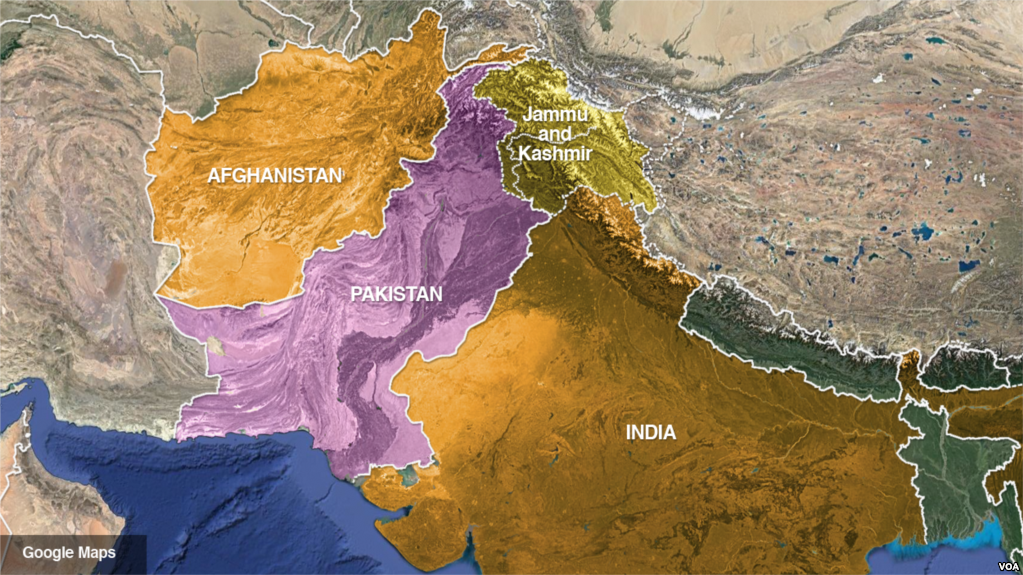
Pakistan, Afghanistan and India

Pakistan, Afghanistan and India

Anjana Pasricha
VOA News
June 21, 2017

NEW DELHI — Although Afghan businesses have long wanted to exploit the potential of India’s huge market, trade between the two countries has been hampered due to their tense relations with Pakistan.

But a plane loaded in Kabul with 60 tons of medicinal plants landed in New Delhi this week, raising hopes of giving a major boost to commerce between landlocked Afghanistan and India.

The flight flagged off the establishment of a new air cargo corridor between the two countries. Along with another, more long-term initiative to develop the Iranian port of Chabahar, India hopes to ease access to conflict-ridden Afghanistan and eventually to Central Asian countries.

Pakistan is a barrier

Pakistan allows Afghanistan to send a limited amount of perishable goods over its territory to India, through which the shortest and most cost effective land routes lie. However, India is not allowed to send any imports through Pakistani territory.

Indian Prime Minister Narendra Modi and Afghan President Ashraf Ghani decided to establish the air corridor last September after Pakistan rejected fresh calls by the Afghan leader to allow his country to engage in direct trade with India over its territory.

Although India is the second largest destination for exports from Afghanistan, this lack of easy access has been a dampener.

Air corridor trade

In New Delhi, officials hope the new corridor will boost annual trade between the two countries from $700 million to $1 billion in three years and give a lift to exports of Afghanistan’s agricultural and carpet industries.

A second flight is scheduled to land in New Delhi next week, bringing 40 tons of dried fruit from Kandahar.

At a ceremony marking the inaugural flight in Kabul on Monday, Afghan President Ashraf Ghani said he wants to make Afghanistan an exporter country.

“As long as we are not an exporter country, then poverty and instability will not be eliminated,” he said.

Indian foreign ministry officials say the connectivity will allow Afghan businessmen to leverage India’s economic growth and trade networks for its benefit and give farmers quick access to sell perishable products.

Does the air corridor trade have a viable future?

A prominent trader in New Delhi, Shyam Sunder Bansal, said he stopped trading with Afghan businesses several years ago due to the challenges such as transit routes, banking and currency facilities.

India is hoping to eventually extend air cargo flights to other cities.

But Bansal is skeptical whether it will be commercially viable to sustain imports via air. “They cannot continue it forever because that will be unconventional, uneconomical,” he said.

However, a South Asia expert with the Indian Institute of Defense Studies and Analyses in New Delhi, Sukh Deo Muni, said since the distance involved is not too long, the air freight corridor could be viable.

He said New Delhi is committed to the project as it will open up access for India to not just Afghanistan but also Central Asian markets. According to Muni, “broader significance is to give two messages. We are committed to Afghanistan and we want to tell Pakistan, you cannot obstruct our access to Afghanistan and Central Asia. This is the long term view.”

Afghanistan mainly sends fresh and dried fruits, vegetables and oilseeds to India. It also takes a host of products from India — a flight from New Delhi has carried pharmaceuticals, water purifiers and medical equipment to Kabul as part of the initiative.

Indian foreign ministry spokesperson Gopal Baglay said the frequency of the air service would depend on demand. “It is, at the end of the day, a commercial venture which is supported very heavily, very strongly and very purposefully by both the governments.”

Land corridor through Iran

India has also initiated another key project to develop the Iranian port of Chabahar and open a direct transport corridor to Central Asia and Afghanistan bypassing Pakistan. This would also give Kabul an alternate route to the Indian Ocean, which currently uses the Pakistani port of Karachi for sea trade.

There was optimism last year that the project would take off, but it is barely making headway amid fresh worries that the U.S. administration under President Donald Trump may reimpose sanctions on Iran.

Related

  • Pakistan Begins Fencing Border With Afghanistan
Posted in Economic News, India-Afghanistan Relations, Iran-Afghanistan Relations, Pakistan-Afghanistan Relations | Tags: Chabahar |

Afghan Forces Recapture Tora Bora Hideout From IS

21st June, 2017 · admin


Radio Free Europe/Radio Liberty
June 21, 2017

Afghan security forces have recaptured Tora Bora, a former fortress of Al-Qaeda leader Osama bin Laden, from Islamic State (IS) militants, officials confirmed.

IS had taken the tunnel and cave complex in Nangarhar Province from the Taliban five days ago. The two militant groups are enemies.

The legendary complex of tunnels and caves once served as a hideout for Bin Laden, who escaped from the mountains into Pakistan after U.S. bombings and subsequent operations in 2001 failed to kill or capture him.

The “Tora Bora area of Pachiragam district is completely Daesh free,” the Nangarhar governor’s office said on June 20, using an Arabic acronym for IS. The recapture was confirmed by officials in Kabul, who said at least 22 militants were killed in the clearing operation.

Afghan security forces are now advancing toward the villages of Alif Khel and Meerkhany to push IS further back, the governor’s office said.

U.S. and Afghan forces have been battling IS in Nangarhar Province since its emergence there in January 2015.

In April, the U.S. dropped a massive bomb on an IS complex in Nangarhar, which the Afghan Defense Ministry said killed more than 90 militants.

Based on reporting by AP, dpa, and RFE/RL’s Radio Free Afghanistan

Copyright (c) 2017. RFE/RL, Inc. Reprinted with the permission of Radio Free Europe/Radio Liberty, 1201 Connecticut Ave NW, Ste 400, Washington DC 20036.

More Security News

  • Pentagon Report Says Afghanistan ‘Faces Continuing Threat’
  • Pentagon’s report paints grim picture of Afghanistan in 2017
Posted in Al-Qaeda, ISIS/DAESH, Security, Taliban, US-Afghanistan Relations | Tags: Nangarhar, Tora Bora |
Previous Posts
Next Posts

Subscribe to the Afghanistan Online YouTube Channel

---

---

---

Get Yours!

Peace be with you

Afghan Dresses

© Afghan Online Press
  • About
  • Links To More News
  • Opinion
  • Poll