logo

Daily Updated Afghan News Service

  • Home
  • About
  • Opinion
  • Links to More News
  • Good Afghan News
  • Poll Results
  • Learn about Islam
  • Learn Dari (Afghan Persian/Farsi)

Recent Posts

  • Zimbabwe beat Afghanistan by 57 runs in second Test November 17, 2026
  • ICC Must Reconsider Closure Of Afghanistan War Crimes Case, Say Afghan Rights Groups November 16, 2026
  • Tolo News in Dari – November 16, 2026 November 16, 2026
  • Nangarhar: Poverty and Unemployment Drive Women and Children to Beg November 16, 2026
  • Taliban Bans Cricket Coverage On Radio Stations In Kandahar November 16, 2026
  • Barred By The Taliban, Afghan Girls And Women Now Shut Out Of School In Iran And Pakistan Too November 15, 2026
  • Tolo News in Dari – November 15, 2026 November 15, 2026
  • France agrees to receive Taliban diplomats, source says November 15, 2026
  • Turkey detains 35 Afghan migrants attempting to reach Greece November 15, 2026
  • Afghanistan Freedom Front Reports Killing and Wounding Three Taliban Fighters in Kabul November 14, 2026

Categories

  • Afghan Children
  • Afghan Sports News
  • Afghan Women
  • Afghanistan Freedom Front
  • Afghanistan United Front
  • Al-Qaeda
  • Anti-Government Militants
  • Anti-Taliban Resistance
  • AOP Reports
  • Arab-Afghan Relations
  • Art and Culture
  • Australia-Afghanistan Relations
  • Book Review
  • Britain-Afghanistan Relations
  • Canada-Afghanistan Relations
  • Censorship
  • Central Asia
  • China-Afghanistan Relations
  • Civilian Injuries and Deaths
  • Corruption
  • Crime and Punishment
  • Drone warfare
  • Drugs
  • Economic News
  • Education
  • Elections News
  • Entertainment News
  • Environmental News
  • Ethnic Issues
  • EU-Afghanistan Relations
  • Everyday Life
  • France-Afghanistan Relations
  • Germany-Afghanistan Relations
  • Haqqani Network
  • Health News
  • Heroism
  • History
  • Human Rights
  • India-Afghanistan Relations
  • Interviews
  • Iran-Afghanistan Relations
  • ISIS/DAESH
  • Islamophobia News
  • Japan-Afghanistan Relations
  • Landmines
  • Media
  • Misc.
  • Muslims and Islam
  • NATO-Afghanistan
  • News in Dari (Persian/Farsi)
  • NRF – National Resistance Front
  • Opinion/Editorial
  • Other News
  • Pakistan-Afghanistan Relations
  • Peace Talks
  • Photos
  • Political News
  • Reconstruction and Development
  • Refugees and Migrants
  • Russia-Afghanistan Relations
  • Science and Technology
  • Security
  • Society
  • Tajikistan-Afghanistan Relations
  • Taliban
  • Traffic accidents
  • Travel
  • Turkey-Afghanistan Relations
  • UN-Afghanistan Relations
  • Uncategorized
  • US-Afghanistan Relations
  • Uzbekistan-Afghanistan Relations

Archives

Dari/Pashto Services

  • Bakhtar News Agency
  • BBC Pashto
  • BBC Persian
  • DW Dari
  • DW Pashto
  • VOA Dari
  • VOA Pashto

Ghani Accuses Pakistan of Treating Wounded Taliban Fighters

17th August, 2018 · admin
Ghani

Ghani

Ayaz Gul
VOA News
August 17, 2018

ISLAMABAD — Afghanistan has alleged hospitals in neighboring Pakistan are receiving and treating Taliban insurgents who had been injured in recent fighting with Afghan forces in the southeastern Ghazni city.

President Ashraf Ghani, while speaking to a gathering of officials, clerics and residents in Ghazni Friday, also said that militants came from the Pakistani side of the border to participate in the fighting.

Ghani visited the embattled city just days after Afghan forces, backed by U.S. airpower, evicted insurgents from Ghazni to prevent it from falling to the Taliban, though clashes were still continuing in the surrounding districts.

Ghani asserted that Pakistan’s military chief, General Qamar Javed Bajwa, had assured him cross-border insurgent activity would not be allowed.

“Gen. Bajwa, you signed a document with us and told me repeatedly in our conversations over the phone that when the elections (in Pakistan) are over you will pay attention to it. I need answers now….From where they came and why are they receiving treatment in your hospitals?” Ghani asked.

There was no immediate reaction available from the Pakistan military to Ghani’s allegations. Pakistan held parliamentary elections on July 25 and the democratic transition is due to conclude on Saturday when Prime Minister-elect Imran Khan take oath of office.

On Thursday, Foreign Ministry spokesman, Mohammad Faisal, denied as baseless reports circulating in social media linking Pakistan to the Ghazni conflict, including allegations that insurgents were being brought to Pakistani hospitals.

“We have not received any evidence to back up these spurious accusations and we reject these baseless allegations,” Faisal told reporters in Islamabad.

Ghazni attack 

The Taliban assaulted Ghazni, the capital of the province also called Ghazni, a week ago and the subsequent several days of clashes reportedly killed around 500 people, including government forces, insurgents and civilians.

The Afghan military at the time alleged foreign militants, including Arabs, Chechens and Pakistanis participated in the fighting, though no proof has been offered to media so far.

Current and ex-Afghan officials twitted a video showing villagers receiving a body of a fighter allegedly killed in the Ghazni fighting and being buried in the middle of the night on the Pakistani side of the border. However, it was not clear from the footage exactly when and where it was filmed.

Speaking Thursday, Faisal explained the steps Pakistan is taking to promote peace and stability to the neighboring country and underscored the need for finding a negotiated end to the Afghan war.

“Pakistan is fencing the Afghanistan-Pakistan border with the objective of regulating the movement of men and material, including narcotics, as part of our counterterrorism efforts,” Faisal noted.

The effort, he said, will be important for the long term regional stability and improvement of bilateral relations. The unilateral fencing of the nearly 2,600-kilometer Afghan frontier will be completed by the end of 2018, according to military officials who are supervising the construction effort.

Bilateral dialogue

Pakistan and Afghanistan have recently launched a wide-ranging bilateral dialogue to improve cooperation between their military and intelligence institutions to help counter terrorism on both sides of the border.

Pakistani officials say both sides in meetings under the mutual engagement process, called Afghanistan-Pakistan Action Plan for Peace and Solidarity (APAPPS), have emphasized the need for sharing proof of any illegal cross-border activities instead of indulging in a blame game through media.

The discussions had significantly eased mutual tensions between Islamabad and Kabul and decreased allegations against each other until the Ghazni fighting broke out last week.

Faisal said his country together with Afghanistan is also developing a “time-bound” plan for an early and complete repatriation of nearly three million Afghan refugees still living in Pakistan.

Pakistani military officials maintain security forces in recent years have eliminated all militant sanctuaries on their soil but they blame the Afghan refugee camps for serving as hiding places for “facilitators and abettors” of the insurgents fighting in Afghanistan.

Related
  • Mattis: Ghazni Attack to ‘Grab … Attention,’ More Violence Likely
  • President Ghani Vows To Probe Ghazni ‘Plot’
  • Afghan President Visits Ghazni After Taliban Assault On City
  • Dream of a Better Life in Afghanistan Ends in a Hilltop Grave for Students
Posted in Pakistan-Afghanistan Relations, Security, Taliban, US-Afghanistan Relations | Tags: Ashraf Ghani, Ghazni |

Afghanistan, Pakistan at Odds Over Ghazni Assault Claims

16th August, 2018 · admin
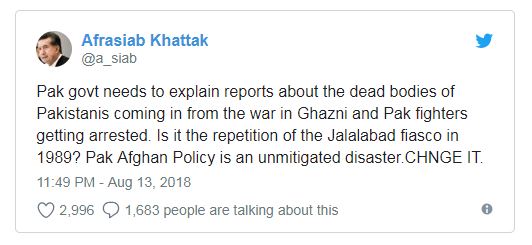
khattak_quote

Click on image to enlarge

Mohammad Habibzada
VOA News | August 16, 2018

Afghan officials claim that dozens of Pakistani nationals were among more than 400 militants killed in fierce battles in southeastern Ghazni province in the past several days.

“During the Taliban attack in Ghazni province, over 400 terrorists were killed, including 70 Pakistani nationals whose bodies are ready to be transferred to Pakistan in Jahangir Bazar, a local market located between Muqur and Gelan districts [Ghazni province],” said Wahidullah Kalimzai, governor of Ghazni province.

Kalimzai added that other foreign nationals were among the dead militants during battles. He also said at least 100 Afghan national security forces and dozens of civilians were killed.

“Some of the dead bodies of Chechens remain in the battlefield. Documents found in their position prove they were Chechen nationals,” the governor said.

The Afghan Ministry of Defense also said it confirmed the presence of Pakistani nationals fighting in Ghazni province, but did not give details pending an investigation.

“Pakistanis are involved in the southeastern Ghazni battle. The clearing operation is still underway, and we are investigating this issue,” Sayed Ghafoor Ahmad Jawid, a spokesperson for the Afghan Ministry of Defense, told VOA.

Afghan authorities have long accused Pakistan’s spy agency of backing militant fighters in the region, which Pakistani authorities have denied. But the Ghazni attack has revived the issue.

Last week, the Afghan army chief of general staff, General Mohammad Sharif Yaftali, said Pakistan’s Inter-Services Intelligence (ISI) was behind the five-day siege of Ghazni.

“Pakistan is the springboard of international terrorism. All terrorists first land in Pakistan, where they get armed, equipped and then sent to Afghanistan to fight,” Yaftali told reporters in Kabul.

He also said many members of Lashkar-e-Taiba, a U.S.-designated terror group, were among those killed in Ghazni province.

Pakistan’s reaction

Pakistani officials reject the Afghan government’s allegations that Pakistani nationals were fighting alongside the Taliban against Afghan government forces.

“We have no evidence to back up these comments, hence we reject the reports of Pakistanis killed in Ghazni attacks,” Muhammad Faisal, a spokesperson for Pakistan’s Ministry of Foreign Affairs, told VOA.

“We condemn the heinous attacks in Ghazni and want to reiterate that Pakistan wants a peaceful and stable Afghanistan,” Faisal added.

Jawid, the Afghan Ministry of Defense spokesperson, said, “We will share all the evidence with the Pakistani government and our international allies, including the U.N., once they are complete.”

Bodies returned to Pakistan?

Reports from Pakistan’s border region in recent days have cited local officials and social media photos and videos appearing to indicate that militant groups have transported dead fighters from the Ghazni battle back to Pakistan for burial.

Afrasiab Khattak, a former senator and current senior member of the Awami National Party, asked his own government to explain the bodies when authorities insist no Pakistani nationals were involved.

“The dead bodies from the southeastern Ghazni battle that were shifted to Pakistan — some Pakistani groups have posted photos of the dead bodies and have invited people to attend funeral ceremonies of their members on social media. These groups have proudly stated that those men were killed there [in Ghazni],” Khattak told VOA.

Pakistan’s Foreign Ministry spokesman said Islamabad has not received any evidence to back up the claims.

Local accounts

Local sources in Pakistan told VOA that bodies have been transported to different provinces of Pakistan, including Khyber Pakhtunkhwa, Punjab and Baluchistan, from across the border.

According to these sources, Usman, a militant commander; Haq Nawaz, a militant from Hangu district; and Rashid Badini, a militant from southwestern Baluchistan province, were among those killed in Ghazni, and people were visiting their families to offer condolences.

Local Pakistani officials, who spoke on condition of anonymity because of the sensitivity of the issue, told VOA that many Pakistani militants killed in Afghanistan allegedly belonged to Mullah Nazir, an allegedly pro-government militant group.

They also said dozens of dead bodies were taken to Punjab’s Multan, Dera Ghazi Khan, Bahawalpur and Khara areas. The dead bodies allegedly were brought from Wana from Afghanistan, where they were transported to southern parts of Punjab province.

VOA could not independently verify these claims.

Sanctuaries

Relations between Pakistan and the U.S. have deteriorated over allegations that Taliban insurgents fighting local and international forces in Afghanistan use sanctuaries on Pakistani soil to plan attacks.

U.S. and Afghan officials have long accused Pakistan of being selective in its campaign against militant groups operating in the country.

In January, U.S. President Donald Trump charged that Islamabad had failed to take action against terror safe havens in Pakistan and suspended military aid to the country.

Pakistani officials deny the charges and maintain that the country has equally targeted all militant groups and suffered enormous losses.

Aizaz Ahmad Chaudhry, Pakistan’s outgoing ambassador to the United States, told VOA in an interview in May that his country had done the most against terrorism in the region and that no country could accuse it of not doing enough.

“Al-Qaida, if you don’t hear about it today, it is because Pakistan and the U.S. were cooperating. Al-Qaida is the organization that caused 9/11, and therefore, we think that no country can tell us that Pakistan has not done enough. In fact, Pakistan has done the most,” Chaudhry said.

VOA’s Madeeha Anwar contributed to this report from Washington.


Posted in Pakistan-Afghanistan Relations, Security, Taliban | Tags: Ghazni |

1TV Afghanistan Dari News – August 16, 2018

16th August, 2018 · admin

Posted in News in Dari (Persian/Farsi) |

Afghan Ethnopolitics Jeopardizes US National Security

16th August, 2018 · admin · 1 Comment
Ashraf Ghani (left) and Zalmay Khalilzad (right)

Ashraf Ghani (left) and Zalmay Khalilzad (right)

Eisa Ayoobi via The Globe Post:  Ashraf Ghani and Zalmay Khalilzad have been the most influential Afghan-Americans to impact U.S.-Afghanistan relations over the decades. Their education and Washington-based experience have earned them rhetoric sway and a vastly influential network of friends. However, their ethnonationalism-aspired Afghanistan “vision” has cost the U.S. thousands of lives and “trillions of dollars.” The perplexing “Afghan war” has also resulted in a severe damage to the U.S. image as the world’s mightiest military. Since his “capture” of the presidency in 2014, Ghani’s vision has revealed to be that of a Pashtun “nation-state,” an old mirage pursued by a British India client-king, Abd al-Rahman Khan, known as “The Iron Amir” (1880-1901). That king did not only leave a patron-client legacy but also a delusion for his tribal heirs who have been failing to deliver for centuries. Click here to read more (external link).

Posted in Ethnic Issues, History, Opinion/Editorial, Political News, US-Afghanistan Relations | Tags: Ashraf Ghani, Ethnonationalist, Pashtunization, Zalmay Khalilzad |

Ghani’s government slammed over inability to provide security to the people

16th August, 2018 · admin
Ashraf Ghani

Ashraf Ghani

Tolo News:  Raising their voices against government, analysts and residents alike have called on the heads of the security agencies to resign.   “Unfortunately they (government leadership) are engaged in small political games, gang games and other very matters but government leaders are using even the current crises for its strategic goals to  its benefit. It is actually painful,” said Ahmad Wali Massoud, a former diplomat and head of Massoud Foundation. “The incumbent government signed a security pact with US when it was first established. How much safety has it provided to the people of Afghanistan?” asked a Kabul resident. Click here to read more (external link).

Related

  • More Than 250 Afghan Troops, 100 Civilians Killed During Last Week in Afghanistan
Posted in Political News, Security, US-Afghanistan Relations | Tags: Ahmad Wali Massoud, Ashraf Ghani Government |

Gunmen Attack Afghan Intelligence Center in Kabul

16th August, 2018 · admin

fireAyesha Tanzeem
VOA News
August 16, 2018

ISLAMABAD — Gunmen launched an attack on a training center on the grounds of Afghanistan’s intelligence service in Kabul, a day after a dozens of people were killed in assault on an education institution in the capital.

Bahar Mehr, an advisor to minister of interior told VOA that four suicide attackers were involved in the latest attack on Thursday. He said one bomber exploded himself and three others were killed in fighting with security forces. He said three Afghan security personal were also wounded in cleanup operations but no civilians were harmed.

On Wednesday, at least 34 people were killed in a suicide bombing attack on Mowoud Academy, in a Shi’ite-dominated part of town. The blast happened when students were taking a university entrance examination. The Afghan Taliban has denied any role in the attack. Islamic State, which has carried out previous attacks on Shi’ites in Kabul, has claimed responsibility.

Elsewhere in Afghanistan

Earlier in the day, the Taliban raided a military base in Baghlan, in northern Afghanistan, killing 40 security personnel.

Almost simultaneously, a group of armed Taliban stormed a police check post near Qalat city in Zabul province, killing several policemen. Several Taliban also died in the fighting.

A day before, Taliban managed to seize another army base in nearby Faryab province after two days of heavy fighting. Officials said 40 of the 70 soldiers at the base surrendered to the Taliban.

Ghazni situation dire

Meanwhile, the United Nations Assistance Mission in Afghanistan warned of dire humanitarian consequences for residents of Afghanistan’s second most populous city, Ghazni, after five days of fighting. Taliban had launched an attack last Friday and managed to make their way to the city center.

Fighting continued in densely populated areas, causing as many as 150 civilian deaths, along with hundreds of Taliban fighters and security personnel, according to UNAMA.

The city, about 150 kilometers southwest of Kabul, lost power and faced shortages of food and water. The U.N. Office for Coordination of Humanitarian Affairs said 270,000 people were trapped in the city even as many residents fled town. Hospitals were overwhelmed with the wounded. The fighting has subsided and Ghazni seems to be back under government control.

The Afghan news site Pajhwok reported that 70 security personnel have been under siege in central Uruzgan province’s Dehraud district for the past 20 days and likely were to surrender to the Taliban if they did not receive help urgently. Militants apparently have shut down all supply routes to the area, blocking access to both food and weapons.

Dim hopes for a cease-fire

The attacks have dimmed hopes for a cease-fire for the Muslim holy festival of Eid-al-Adha later this month. In June, both the Afghan government and the Taliban announced a three-day cease-fire to mark the end of Ramadan — the first one in almost two decades of war.

The flare-up in violence also has occurred after news broke that the United States had started talking to the Taliban directly in order to jump-start a peace process.

According to UNAMA, the first half of 2018 was the deadliest for Afghan civilians since the U.N. mission starting tracking civilian casualties in 2009.

More Security News

  • Islamic State ‘Well-Positioned’ to Rebuild Caliphate
  • Islamic State Claims Kabul Shi’ite Attack
  • Ghazni Family Claim 16 Killed In Airstrikes
Posted in Anti-Government Militants, Civilian Injuries and Deaths, ISIS/DAESH, Security, Taliban | Tags: Baghlan, Ghazni, Kabul, Zabul |

Tolo News in Dari – August 15, 2018

15th August, 2018 · admin

Posted in News in Dari (Persian/Farsi) |

‘System of Greed, Control’ Drives US’ Relentless Occupation of Afghanistan

15th August, 2018 · admin
US Marine (file photo)

US Marine (file photo)

Sputnik | August 15, 2018:  Despite the US’ claims that they’re staying in Afghanistan to improve the country, Kathy Kelly, the co-coordinator for Voices for Creative Nonviolence, tells Sputnik that it’s really more about Washington trying to send a message to other countries in the region.

The US-led coalition in Afghanistan finished its combat mission in December 2014, marking the formal end of the longest war in American history. Since then, US troops have remained in the country acting in a supervisory role, training Afghan soldiers and offering their military assistance whenever requested.

But the people of Afghanistan aren’t the ones benefiting from the US acting as the world police, Kelly told Sputnik Radio’s By Any Means Necessary on Tuesday.

​”The beneficiaries are the people selling the weapons,” she told hosts Eugene Puryear and Sean Blackmon. “They are still running to the banks with their portfolios stuffed so they can sell warplanes and drone surveillance and all manner of bombs.”

“It certainly hasn’t in any way created a safer place for people to live in Afghanistan,” Kelly stressed.

Since early Friday, Taliban militants and Afghan security forces have been stuck in a deadly battle in the country’s Ghazni province. At least 90 soldiers and some 200 militants have been killed, according to Afghanistan’s Ministry of Defense. Offering their aid in the matter, the US carried out multiple airstrikes and dispatched military advisers to assist Afghan officials.

Citing the NGO Transparency International, Kelly told Puryear that projects established by the US to help Afghan residents fleeing from Taliban-occupied areas aren’t actually helping said locals.

“It’s a curious situation, because four times a year a report is filed… and they have listed through plenty of documentation… the corruption and mismanagement of the United States’ presence in Afghanistan… where money has gone into projects that have lined the pockets of contractors and not even produced what they were meant to,” she said.

Although locals are also enduring one of the worst droughts in recent years, Washington has focused its millions of dollars in funding on its approximately 18,000-strong troop presence and on airstrikes. “The United States every day is spending millions of dollars to maintain its troop presence, its special operation forces and constant bombing. And you’ve got people who are increasingly facing the terror of death by starvation or thirst.”

According to Toby Lanzer, the United Nations’ humanitarian coordinator in Afghanistan, the war-torn country could “face a calamity” if the international officials don’t step in and offer drought aid, Al Jazeera reported. The last major drought ended after the region was hit with major snowfall.

At the end of the day, Kelly said that “the United States’ desire to remain in the country has nothing to do with humanitarian concern to protect people from the Taliban.”

“It’s a maintenance of a system of greed and control and a desire to send other signals to other countries in the region that the United States isn’t going to go away,” she said.

Related

  • Afghan government and military are more corrupt and incompetent than ever…
Posted in Corruption, Security, US-Afghanistan Relations | Tags: Ashraf Ghani Government |

The Taliban’s weaponization of moral authority in Afghanistan

15th August, 2018 · admin
Taliban fighters (file photo)

Taliban fighters (file photo)

SWJ: Taliban have successfully subjugated villages and regions to their narco-Salafi credendum…We must now come to terms with the fact that both US/NATO forces and traditional Afghan warrior codes (local moral authorities) have been defeated by a Taliban who now promiscuously commingle Salafism and gangsterism (drug-guns-human smuggling, extortion, kidnapping, etc..). Their success is the result of their ability to undermine and largely replace traditional moral authority throughout a country that have deliberately returned to the shatterzone. Click here to read more (external link).

Posted in Society, Taliban |

Ayrana Sayeed: ‘I Am Very Aware of the Danger’

15th August, 2018 · admin
Aryana Sayeed

Aryana Sayeed

Spiegel: Aryana Sayeed, 33, is the only internationally known pop act in Afghanistan. She is adored by youth — and hunted by the Taliban. / Sayeed: “The extremists play with the sexual frustration of young men. On the streets of Afghanistan, 99 percent of the passersby are men. When a woman in burka walks down the street, men stare at her bare hands and feet because the only women they usually deal with are their mothers and sisters. The young people are so hungry, so thirsty to catch even a glimpse of a woman.” Click here to read more (external link).

Posted in Afghan Women, Entertainment News, Interviews, Society | Tags: Aryana Sayeed |
Previous Posts
Next Posts

Subscribe to the Afghanistan Online YouTube Channel

---

---

---

Get Yours!

Peace be with you

Afghan Dresses

© Afghan Online Press
  • About
  • Links To More News
  • Opinion
  • Poll