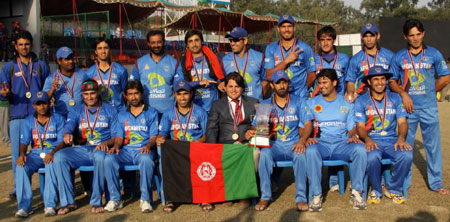
Khaama Press: Here is another breakthrough by the Afghanistan national cricket on international level following a series of back to back victories and achievements during the past few weeks. Click here to read more (external link).

UNICEF Finds 40 Percent Of Afghan Kids Out Of School
Radio Free Europe/Radio Liberty
January 12, 2016
Nearly one in four children growing up in conflict zones are missing out on education, with Afghanistan among the four worst-affected countries, the United Nations children’s agency (UNICEF) said on January 12.
An estimated 24 million children of school age are not in school in 22 countries affected by conflict, the agency found.
South Sudan has the largest proportion of children out of school, 51 percent, followed by 47 percent in Niger, 41 percent in Sudan, and 40 percent in Afghanistan.
“When children are not in school, they are at an increased danger of abuse, exploitation, and recruitment into armed groups,” said Jo Bourne, UNICEF’s head of education.
“School equips children with the knowledge and skills they need to rebuild their communities once the conflict is over, and in the short-term it provides them with the stability and structure required to cope with the trauma they have experienced,” said Bourne.
Education is one of the least funded sectors by humanitarian agencies. In 2014, it received 2 percent of humanitarian aid. The UN said 10 times as much is needed for education in conflict zones.
Based on reporting by Reuters and Newsweek
Copyright (c) 2016. RFE/RL, Inc. Reprinted with the permission of Radio Free Europe/Radio Liberty, 1201 Connecticut Ave NW, Ste 400, Washington DC 20036.
US spending billions of dollars on Afghan ‘ghost soldiers’
Press TV / January 12, 2016
The United States is spending billions of dollars on Afghanistan’s “ghost soldiers,” who only exist only on paper, a report says.
One reason the Afghan National Army is struggling against Taliban is because nearly 40 percent of its force is constituted on “ghost soldiers,” The Associated Press reported.
“At checkpoints where 20 soldiers should be present, there are only eight or 10,” Karim Atal, the head of the provincial council in Helmand, told AP.
“It’s because some people are getting paid a salary but not doing the job because they are related to someone important, like a local warlord,” he added.
In Helmand province, the Taliban has captured large areas of land since the US-led NATO forces handed over control to Afghan troops a year ago.
Atal said, in some cases, dead soldiers and policemen remain listed among active force, while senior Afghan officials receive their salaries.
Meanwhile, Pacha Gul Bakhtiar, Helmand’s former deputy police chief, said the province has 31,000 policemen on paper, “but in reality it is nowhere near that.”
The US and its allies invaded Afghanistan on October 7, 2001 as part of Washington’s so-called war on terror. The offensive removed the Taliban regime from power, but after more than 14 years, the foreign troops have still not been able to establish security in the country.
In October, US President Barack Obama announced plans to keep 9,800 US troops in Afghanistan through 2016 and 5,500 in 2017, reneging on his promise to end the war there and bring home most American forces from the Asian country before he leaves office.
According to US officials, Washington would also maintain a large counterterrorism capability of terror drones and Special Operations forces to fight militants in Afghanistan.
Afghan Air Force to receive 12 warrior helicopters from US
Khaama Press : Amid efforts to bolster the capabilities of the Afghan Air Force (AAF), the MD Helicopters announced Monday that 12 additional MD-530F helicopters will be manufactured and delivered to the Afghan armed forces. Click here to read more (external link).
Germany Turning Back More Afghan Migrants At Border
Radio Free Europe/Radio Liberty
January 12, 2016
Germany is turning back more migrants at its border with Austria, particularly those from Afghanistan who Germany insists do not qualify for asylum, Austrian authorities said January 11.
Attacks on German women, allegedly by migrants, during the New Year’s holiday have put pressure on German Chancellor Angela Merkel and her open-door migrant policy
The number of migrants turned back has risen from about 60 per day in December to 200 since the start of the year, authorities said, adding that Germany’s tighter border control could be a knock-on effect from Sweden and Denmark tightening their borders.
Most of the rejected migrants have been Afghans who did not want to apply for asylum in Germany but in Scandinavia, they said. Others are from Iraq, Iran, Morocco, and Algeria.
Last week, Sweden, a favored destination for many migrants, started imposing controls on travellers from Denmark. Denmark in turn introduced spot checks on arrivals from Germany.
Austria meanwhile has tightened controls on its border with Slovenia, sending back 1,652 migrants since January 1, police said.
Based on reporting by Reuters and AFP
Copyright (c) 2016. RFE/RL, Inc. Reprinted with the permission of Radio Free Europe/Radio Liberty, 1201 Connecticut Ave NW, Ste 400, Washington DC 20036.
Ex-soldier will plead guilty to attempting to smuggle Afghan child into Britain
RT: While building shelters in the Jungle refugee camp in Calais, Rob Lawrie was approached by Bahar Ahmadi’s father and asked if he would deliver the child to relatives in West Yorkshire. Lawrie, a father of four himself, eventually relented, but was caught by border officers with sniffer dogs, which had detected two Eritrean men hiding in the back of his van. Lawrie was arrested, at which point he made authorities aware of the child also hidden in the van. Click here to read more (external link).
Afghan VP voices concerns for risking massive 500kV power project through Salang
Khaama Press: Vice President Mohammad Sarwar Danish has voiced concerns regarding the implementation of a massive power project through Salang pass, insisting that the multi-million dollar project could be jeopardized. He also warned that a small incident involving a destruction of a single transmission tower due to avalanche or other disaster could lead to long term suspension of power. Click here to read more (external link).
Canadian Held Captive for 5 Years by Taliban Freed in Afghanistan
VOA News
January 11, 2016
The Taliban has freed a Canadian it held hostage in Afghanistan for at least five years.
“Canada is very pleased that efforts undertaken to secure the release of Colin Rutherford from captivity have been successful,” Canadian Foreign Affairs Minister Stephane Dion said Monday. “We look forward to Mr. Rutherford being able to return to Canada and reunite with his family and loved ones.”
Dion said Canada sends its “heartfelt thanks” to the government of Qatar, which helped secure Rutherford’s freedom.
Details on how and where Rutherford was released are unavailable. It is also unclear where Rutherford is now.
Rutherford went to Afghanistan in 2010, and the Taliban released a video of him in captivity in 2011.
The Taliban accused Rutherford of spying. But in the video, Rutherford said he was a tourist interested in “history and historical sites, old buildings, shrines.”
6th Winter Music Academy Launched
Tolo News: The sixth winter music academy of the National Music Institute of Afghanistan launched on Monday and within eight months, students will host concerts. Naser Sarmast, head of the institute, hoped that 2016 would be a good year for them and said that soon a group of 50 girls will be introducing Afghan music to the world. Click here to read more (external link).

Differences Plague Afghanistan Peace Talks
VOA News
Ayesha Tanzeem
January 11, 2016
ISLAMABAD, PAKISTAN –Even as representatives of the United States, China, Pakistan and Afghanistan met Monday to try to work together to bring peace to Afghanistan, officials from Afghanistan and Pakistan continued to publicly differ on the way forward.
The Pakistani prime minister’s adviser on foreign affairs, Sartaj Aziz, addressed the first meeting of the newly formed Quadrilateral Coordination Group (QCG) by insisting that any “preconditions” to talks would be counterproductive and that threats of “military action against irreconcilables [factions that refuse to enter into peace negotiations] cannot precede the offer of talks to all the groups and their response to such offers.”
He also dismissed impressions that Pakistan had promised the use of force against Taliban factions that were unwilling to come to the negotiation table by saying that irreconcilables could be identified once avenues for talks had been exhausted.
This provoked an almost immediate reaction from Afghanistan. Sayed Zafar Hashemi, the deputy spokesman of President Ashraf Ghani, told VOA that it was essential to distinguish which factions of the Taliban were willing to talk and which were not.
“Otherwise it’s a waste of time,” he said.
Javid Faisal, deputy spokesman for CEO Abdullah Abdullah, said that the meeting did focus on which groups were willing to talk and which ones wanted to continue fighting, adding that the latter groups would be dealt with “militarily.”
Faisal had said Sunday that Pakistan, during Monday’s meeting, would provide a list of Taliban groups willing to engage in dialogue.
Courting Pakistani military
While the marathon meeting continued in Islamabad, Richard Olsen, the U.S. special envoy for Afghanistan and Pakistan, left for Rawalpindi to meet Gen. Raheel Sharif, the head of Pakistan army. Many in Afghanistan and the U.S. think the real power to help resolve the security issues in Afghanistan and bring the Taliban to the table lies with the Pakistani military.
“Pakistan has a vital role in these talks and it [Pakistan] must play its role now as the Afghan government doesn’t have the capacity to bring the Afghan Taliban to the table for talks,” Pakistan-based defense analyst Saad M. Khan told VOA Deewa Radio.
But Pakistan says its influence with the Taliban is overrated.
Afghan Taliban have not yet indicated their willingness to come back to the negotiation table after an earlier round failed in July. Some Taliban officials, requesting anonymity, told VOA that Monday’s meeting was useless and a failed attempt.
Critics say there are not enough incentives for Taliban factions to participate since they control more territory today than they did at any time since they were ousted from power in 2001.
Unlike in July, Taliban representatives were not present in Monday’s meeting. However, a meeting might soon be held in Islamabad between representatives of the Taliban, Pakistan and China to discuss the possibility of returning to the negotiation table.
Taliban groups have indicated that they would like the talks with Afghan government to be held somewhere outside Pakistan to avoid the impression that their leaders are under Pakistan’s control. Possible venues include Qatar and China.
Defining peace process
The next meeting of the QCG will be held Monday in Kabul.
The expansion of the Taliban insurgency in Afghanistan during the past year has fueled regional and international concerns that the upcoming spring fighting season may lead to even more bloodshed and instability in the war-shattered country.
The four countries involved in the peace process are trying to define the overall direction of the Afghan reconciliation process, along with setting goals and targets aimed at creating a conducive environment for holding direct talks between the Afghan government and Taliban groups.
Talks with the Taliban have been on hold since July, when they collapsed after just one meeting following Pakistan’s announcement that longtime Taliban leader Mullah Mohammad Omar had been dead for more than two years. The Taliban called off its participation, and a second meeting was canceled.
A subsequent power struggle within the Taliban has raised questions about who would represent the insurgents if the talks with Kabul are revived.
Analysts have cautioned that any substantive peace talks are still months off. Taliban demands have consistently focused on an end to the international military presence in the country. The U.S. and NATO have 13,000 troops stationed in Afghanistan, mostly in a training capacity. They include 9,800 Americans.
Ayaz Gul contributed to this report from Islamabad.
Related