
Intra-Afghan Talks May Be Doomed by Differences Over Future Political System
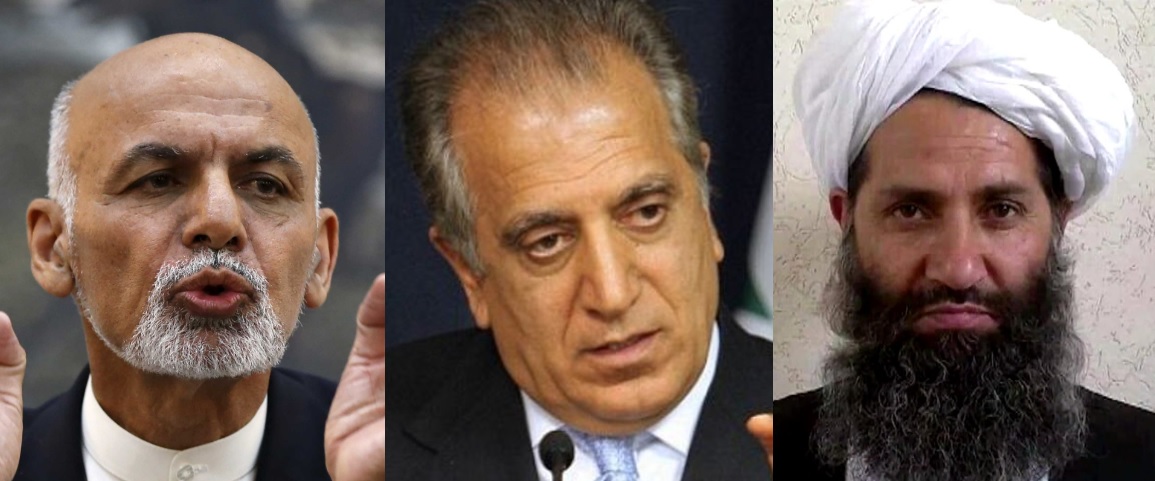
Afghan President Ghani (left), US Envoy Khalilzad (center), Taliban leader Hibatullah (right)
Michael Hughes: Members of the Taliban and Afghan government are supposedly set to begin negotiations within the next two weeks but it is hard to imagine how they will overcome what appear to be irreconcilable differences over the very nature and structure of the country’s future political system.
Taliban officials have openly stated they refuse to recognize the results of the September 28 presidential election despite Washington’s claims that the insurgents have agreed to negotiate with Kabul. U.S. envoy Zalmay Khalilzad, who is leading the U.S. side of talks with the Taliban, said engaging the Afghan government is one of the conditions of any deal to end the war.
Afghan civilian casualties decline in first half of 2019: report
 1TV: The war in Afghanistan caused less civilian casualties in the first six month of this year than during the same period last year, an advocacy group said on Monday. A total of 1,981 civilians were killed and injured between January and June of 2019, The Civilian Protection Advocacy Group said in a report. The number was 2,639 during the same period last year, it said. Click here to read more (external link).
Afghanistan A cricket team leaves for Bangladesh
 1TV: Afghanistan A cricket team left for Bangladesh on Monday to play seven matches against the hosts. The tour includes two four-day matches and five One-Day Internationals, which will be played between 5th and 29th July. Click here to read more (external link).
Other Cricket News
Scores injured after powerful blast, clashes rock Kabul
 Press TV
July 1, 2019
Scores of people have been wounded with fatalities feared after a bomb-laden truck rocked Kabul, followed by gunmen battling special forces in an area housing military and government buildings.
The Taliban claimed responsibility for the rush-hour explosion early Monday, which sent a plume of smoke into the air above the Puli Mahmood Khan neighborhood of the Afghan capital.
Health ministry officials said at least 100 people were wounded, including 35 children, who were taken to hospital, but the casualties were likely to rise.
Taliban spokesman Zabiullah Mujahid said the insurgents had targeted a defense ministry building in the area,.
A government security official said at least three gunmen entered the building after the explosives were detonated near the ministry’s engineering and logistics department.
The explosion came as the US was about to begin a third day of negotiations with the Taliban in Doha.
In the previous round of US-Taliban peace talks earlier this year, the two sides “agreed in draft” on the withdrawal of foreign troops from Afghanistan in return for a Taliban guarantee that the group’s elements would not attack US forces.
The US and its allies invaded Afghanistan under the pretext of the global war on terror. Some 18 years on, the Taliban have only boosted their presence across the country, and Washington is seeking truce with the militants.
Related
- 51 Students Injured in Taliban’s Kabul Attack: MoE
- Doha Talks Continue Amid Taliban’s Attack In Kabul
- Taliban ‘Won’t Talk With Kabul Administration’ As Government
- Taliban pushing to ‘rewrite’ draft agreement for US withdrawal from Afghanistan: report
- Security Agencies Under Harsh Criticism Following Kabul Attack
Afghanistan’s Hassan emotional after ending career with injury

Hamid Hassan
AFP: Afghanistan’s Hamid Hassan felt he could have stopped Pakistan from getting over the line in a thrilling World Cup match if his one-day career hadn’t come to an end with a painful injury. Click here to read more (external link).
US Army to equip 1st contingent of Afghanistan-bound troops with mini drones

Pvt. Kelsey Darnell, B. Co., 1st Battalion, 508th Parachute Infantry Regiment, 3rd Brigade Combat Team, 82nd Airborne Division, let’s go of the air vehicle as it takes off during the systems fielding at Fort Bragg, NC on May 2, 2019. (US Army photo)
Press TV
June 30, 2019
American forces in Afghanistan tied to the 82nd US Airborne Division will become the first infantry Army battalion to employ pocket-sized drones on their impending deployment to the war-torn country.
Soldiers with the Division’s 3rd Brigade Combat team were issued Black Hornet Personal Reconnaissance System in the spring and received training on how to use the small drones that resemble miniature helicopters, US-based pro-military news outlet Stars and Stripes reported Friday.
“This kind of technology will be a life-saver for us because it takes us out of harm’s way while enhancing our ability to execute whatever combat mission we’re on,” said Sgt. Ryan Subers, who received the training, as quoted in an Army statement. “I’m very grateful for technology like this and to be a part of the first unit to use it.”
The Army initially purchased Black Hornets, made by Oregon-based FLIR Systems Inc., for testing with its Special Forces units in 2016. The company’s website describes the drones as extremely light, nearly silent and with a flight time of up to 25 minutes.
According to a FLIR official who spoke at a demonstration during a NATO military drill in Norway last fall, the drone — which weighs less than two ounces — can be deployed in less than one minute and has a range of over a mile.
The tiny device is intended to eliminate battlefield blind spots with the aim of saving troop’s lives and avoiding unintentional damage or deaths.
“With this system, you can [positively identify] enemies, you can look for [improvised explosive devices] on your route,” said an FLIR supervisor and operator, Kristian Molander, as quoted in the report. “If you’re taking fire from areas you can’t see, you can use this system to identify stuff before you move into the line of fire.”
The basic configuration of a Black Hornet system includes one drone for day and one for night, a base station that connects to a handheld controller, and a display about the size of a tablet computer, but it varies from customer to customer, said FLIR spokesman Joe Ailinger, adding: “The configuration is flexible and can be customized as needed,” he said.
According to an Army statement issued last May, Wireless commands and data sent between the drone and its controller are encrypted to protect it against hacking.
In addition to a $2.6 million contract awarded to FLIR last spring, the report adds, the US Army awarded the company nearly $40 million in January of this year to provide Black Hornets for the Army’s Soldier Borne Sensor program.
The deal would provide the Army with 9,000 systems, each with two drones, it noted.
The 1st Battalion, 508th Parachute Infantry Regiment, is planning to employ the drones next month in Afghanistan, while other elements of the brigade wait to see how best to employ the system, said a brigade spokesman cited in the report.
The hand-held devices are expected to become standard kit for units across the Army, providing near-real time video that will allow soldiers to better survey their surroundings and detect enemies in combat.
Elements of the US Army’s 3rd Brigade Combat Team – based in Fort Bragg, North Carolina — including the drone-equipped battalion, will be deploying to Kandahar in southern Afghanistan next month, according to the report.
The 1st Security Force Assistance Brigade, which was deployed to Afghanistan last year, is set to become the second Army unit to receive Black Hornet drones later this year, it added.
1TV Afghanistan Dari News – June 30, 2019
New Round Of Afghan Peace Talks Under Way Amid Deadly Attacks
 By RFE/RL’s Radio Free Afghanistan
June 30, 2019
KABUL — U.S. and Taliban negotiators are holding a new round of talks in Qatar to try to put an end to the war in Afghanistan, amid continued attacks by the militant group on Afghan officials and security forces.
The seventh round of talks with Zalmay Khalilzad, the U.S. peace envoy for Afghanistan, is “critical,” Taliban spokesman Suhail Shaheen said on June 30, the second day of meetings in the Qatari capital, Doha, where the militant group maintains a political office.
Shaheen told AP that the two sides were looking for “tangible results” as they try to finalize agreements to end the nearly 18-year Afghan conflict — the longest war in U.S. history.
The Taliban negotiating team is led by Mullah Abdul Ghani Baradar, who co-founded the movement with the late Mullah Mohammad Omar.
The negotiations are expected to focus on working out a timeline for the withdrawal of foreign troops from Afghanistan and on a Taliban guarantee that militants will not plot attacks from Afghan soil.
The Taliban, driven from power by the U.S.-led invasion in 2001, now controls large swaths of Afghanistan’s territory.
The militant group has so far refused to talk directly to the Afghan government in Kabul, calling it a puppet of the West, and has continued to carry out nearly daily attacks across Afghanistan.
Late on June 29, a bomb attack in the southern province of Kandahar killed eight employees of the Independent Election Commission (IEC), according to Afghan officials.
They said the IEC employees were stationed at the government office in the Maruf district to register voters ahead of presidential polls set for September when the attack occurred.
Police said members of the security forces also suffered some casualties in the bombing, which was claimed by the Taliban.
Separately, an attack on a military checkpoint in Farah Province’s Bala Buluk district left at least eight Afghan soldiers dead and eight more injured, local officials said.
On June 29, it was reported that Taliban militants attacked security posts in the northern province of Baghlan, killing at least 26 pro-government militiamen.
A Defense Ministry official in Kabul said the attack in Baghlan indicated that the Taliban wanted to negotiate from a position of strength.
The previous round of peace talks between the United States and the Taliban took place in May.
During an unannounced visit to Kabul on June 25, U.S. Secretary of State Mike Pompeo said he hoped for a peace deal with the Taliban “before September 1.”
With reporting by AP, Reuters, dpa, and AFP
Copyright (c) 2019. RFE/RL, Inc. Reprinted with the permission of Radio Free Europe/Radio Liberty, 1201 Connecticut Ave NW, Ste 400, Washington DC 20036.
Related
Figures On Cancer Diseases Shocking: Ghani
 Tolo News: Figures by the Ministry of Public Health show that 20,000 people are suffering from cancer diseases every year, of which 15,000 lose their lives. Breast cancer is the most common type of cancer among Afghans, the statistics show. Click here to read more (external link).