
 NPR: Even in wealthy, developed nations with advanced technologies, heavy machinery and readily available protective equipment, mining can be a dangerous and sometimes deadly job. In Afghanistan, where much of the coal is mined by hand, every descent into the bowels of this mountain is a gamble. Click here to read more (external link).
Taliban Support for Kuchi Land Grabbers Could Bolster Resistance
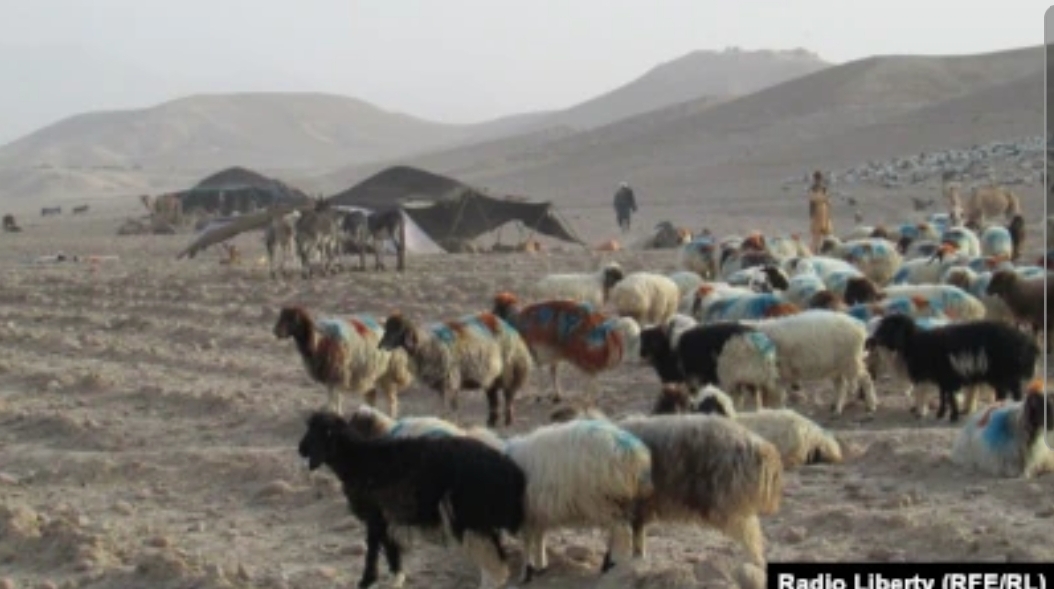
A Kuchi camp (file photo)
Michael Hughes: The Taliban have much to gain – both economically and militarily – by enabling the Kuchis, Pashtun nomads, to seize land and build homes within sedentary communities in Hazarajat and other areas in the country’s northeast. However, the strategy is also pregnant with risk: for land disputes have historically been known to spark insurgencies, a development that would offset much of the benefit derived. Click here to read more.
Afghan Educator Who Tore Up His Degrees Vows To Fight Taliban Ban On Women
 AFP: Ismail Mashal, a lecturer in journalism for more than a decade at three universities in Kabul, shred his qualifications and resigned from the institutions after the ban was issued this month. “I’m raising my voice. I’m standing with my sisters…. My protest will continue even if it costs my life,” Mashal, 35, told AFP at his office in the Afghan capital. Click here to read more (external link).
Related
Afghan war orphan remains with Marine accused of abduction

Joshua Mast
AP: Yet two months after an AP report on the high-stakes legal fight over the child raised alarms at the highest levels of government, from the White House to the Taliban, the baby remains with U.S. Marine Corps Major Joshua Mast and his family. The Masts claim in court documents that they legally adopted the child and that the Afghan couple’s accusations are “outrageous” and “unmerited.” Click here to read more (external link).
Tolo News in Dari – December 31, 2022
Calling Off Ceasefire, TTP to Launch Attacks Across Pakistan

TTP chief Noor Wali Mehsud
Khaama: Tehreek-e-Taliban Pakistan (TTP) has ordered its top commanders to resume attacks across the country on Pakistani security forces after calling off their months-long ceasefire with the government of Pakistan. The peace talks suffered several deadlocks as Pakistan’s government refused to fulfill TTP’s demand, which included the release of TTP’s key operators in major terrorist attacks in Pakistan, and the withdrawal of Pakistani forces from former tribal areas. Click here to read more (external link).
International Aid Money Pillaging by Taliban Goes Unnoticed, Reports FP

Taliban militants dancing (file photo)
8am: “Tens of millions of dollars are flown into Kabul every week by the United States and the United Nations for distribution across the country as humanitarian catastrophe grips tighter with winter closing in. Sources inside and outside the country say much of the money never reaches those who need it,” according to a Foreign Policy report on Friday. Instead, “unknown quantities are stolen by the Taliban and diverted to their own causes, keeping supporters onside with handouts of cash and food and funding the private operations of senior leaders,” FP detailed. Click here to read more (external link).
Related
Security Remains at Top of China’s Afghanistan Policy
 Roshan Noorzai
VOA News
December 30, 2022
WASHINGTON — Security concerns continue to dominate China’s policy toward Afghanistan more than a year after the United States and NATO pulled out of the Central Asian country.
China has stepped in and engaged with the new Taliban government, promising trade and investment. But Beijing has concerns over the potential spillover of militants from Afghanistan into China’s western Xinjiang region, the security of its infrastructure projects in the region and its citizens in Afghanistan.
On December 12, the Islamic State Khorasan Province, an affiliate of Islamic State, claimed an attack at a Kabul hotel frequented by Chinese nationals.
The Chinese government responded by advising its citizens and companies “to leave and evacuate the country as soon as possible.” During a regular press conference, Chinese foreign ministry spokesperson Wang Wenbin said China was “deeply shocked” and called on the “Afghan interim government to take strong and resolute measures to ensure the security of Chinese nationals, institutions and projects in Afghanistan.”
One day before the attack, Taliban spokesperson Abdul Qahar Balkhi, in a tweet, said providing security to the foreign embassies in Kabul is “the priority” for the Taliban.
Balkhi said the Chinese ambassador had called on the Taliban “to pay attention” to the security of Beijing’s diplomatic mission in Kabul.
The Taliban reassured the Chinese that the Taliban “will not allow anyone to use Afghanistan’s soil against another country,” Balkhi added.
Security concerns
“Primarily Chinese interests in Afghanistan are still security issues and specifically preventing any breach of militancy into the Uyghur areas of China,” said Vanda Felbab-Brown, a senior fellow at the Washington-based Brookings Institution, a nonprofit public policy organization.
During the Taliban’s first rule in Afghanistan, from 1996 to 2001, the group harbored a number of foreign extremist groups, including Uyghur militants.
A 2021 U.N. report assessing threats in Afghanistan found that Uyghur militants of the Turkistan Islamic Party, widely accepted as an alias of the Eastern Turkistan Islamic Movement (ETIM), have been active in both Afghanistan and Syria.
“Many Member States assess that it seeks to establish a Uighur state in Xinjiang, China, and towards that goal, facilitates the movement of fighters from Afghanistan to China,” the report noted.
Felbab-Brown told VOA that China is concerned not only about Uyghur militancy but about “the safety of BRI investments” in Central Asia and Pakistan.
BRI refers to China’s Belt and Road Initiative. Launched in 2013, it is an infrastructure and investment vision, aimed at expanding China’s trade routes globally by land and sea.
Chinese officials, who met the Taliban on a number of occasions, said Afghanistan should take “resolute” measures to crack down on “all terrorist forces, including the East Turkestan Islamic Movement” (ETIM).
The ETIM was founded in Pakistan by a Uyghur religious figure, Hasan Mahsum, in 1997. The leader reportedly led a few dozen Uyghur militants in the border region around Afghanistan and Pakistan before being killed by a Pakistani army drone in 2003. The U.S. removed the ETIM from its terror list in 2020, but China continues to say the ETIM is a threat.
Relationship but not recognition
Beijing had been cultivating a relationship with the Taliban for years before the fall of Kabul, and China is one of the few countries that has kept its embassy open since the Taliban’s takeover in August 2021.
But the former Afghan ambassador to China, Javid Ahmad Qaem, said he “has not seen any major developments in the China-Taliban relations in the past year.”
“China has not recognized the Taliban, and there is no major change in the diplomatic or economic relations between the two,” Qaem added.
No country has recognized the Taliban as the legitimate government of Afghanistan since it seized control 16 months ago.
BRI and trade
“China wants to have its influence in the region,” said Qaem. “Absolutely, it is part of their BRI policy to have its influence in the region and to have friendly governments [in the region].”
After a June 22 earthquake in southeast Afghanistan killed more than 1,000 people, China announced $8 million in aid. Beijing’s ambassador to Kabul, Wang Yu, said in July that his country has “long-term reconstruction plans” for Afghanistan, prioritizing trade followed by investment and agriculture.
In September, a new corridor between China and Afghanistan, running through Kyrgyzstan and Uzbekistan, was opened.
“Today, the first shipment of commercial goods through the new economic corridor from China to Afghanistan via Uzbekistan & Kyrgyzstan reached Hairatan on the Afghanistan Railway. It took less than 10 days, which shortens our distance,” wrote the Chinese ambassador on social media.
Khan Jan Alokozai, vice president of the Afghan Chamber of Commerce, told VOA that the new corridor will provide alternate routes to the existing land corridor, via Kazakhstan and Uzbekistan.
In October, an air corridor was opened via UAE to transport Afghan pine nuts to China.
Alokozai, however, said, “The main issue is not having the routes, but it is finding a market for our products.”
Chinese Foreign Minister Wang Yi, in a meeting with the Taliban’s foreign minister, Amir Khan Muttaqi, in July, said China is prepared to extend the China-Pakistan Economic Corridor to Afghanistan, as a part the BRI.
“China hopes to push the alignment of the Belt and Road Initiative with the development strategies of Afghanistan, support the extension of the China-Pakistan Economic Corridor to Afghanistan, and share China’s development opportunities,” said a Chinese foreign ministry statement issued on July 29.
The China-Pakistan Economic Corridor (CPEC), is a part of the BRI and was launched in 2013. It is a corridor linking Pakistan’s Gwadar port to Kashgar, in Xinjiang, China.
Because of insecurity, said Qaem, Afghanistan was “not part of the plan though its location is important for regional connectivity.”
As security concerns continue to plague Afghanistan, “I do not think that the environment would be ready in the near future,” he said in reference to a sobering outlook for future Chinese investments.
Frustration
Raffaello Pantucci, a senior fellow at Britain’s Royal United Services Institute and a visiting senior fellow at the S. Rajaratnam School of International Studies in Singapore, told VOA while China is concerned about the threats emanating from Afghanistan, the Taliban are “frustrated” by Chinese economic and development promises.
“On the one hand, the Taliban are frustrated that they’re finding themselves caught in the same situation that the republic government was caught in with the Chinese which is basically talk of big investments, but nothing actually materialized from a Chinese perspective,” said Pantucci.
In 2016, China signed a BRI agreement with the former Afghan government and promised to fund $100 million in projects, but no BRI projects have been implemented in Afghanistan.
While China has provided humanitarian aid, such as the help after this year’s earthquake, “Chinese assistance cannot be compared to billions of dollars of U.S. and European aid in the past 20 years,” said Hamidullah Farooqi, a former Afghan minister and chancellor of Kabul University.
“If the Taliban think that China will provide aid or invest in Afghanistan’s infrastructure as the Western countries did in the 20 years, then they are mistaken,” Farooqi added.
Afghanistan: Woman protests Taliban’s education ban with single word of God
 BBC News: Angered at the prospect of seeing her future disappear, the woman (whose name we have changed for her safety) staged an extraordinary solo protest in front of Kabul University, invoking words from the Quran. On Sunday 25 December, Adela stood in front of the entrance holding up a board with a particularly powerful word written on it in Arabic – iqra, or ‘read’. Muslims believe this was the first word revealed to the Prophet Muhammad by God. “God has given us the right to education. We need to be afraid of God, not the Taliban who want to take away our rights,” she told the BBC Afghan service. Click here to read (external link).
Related