
The Taliban’s Rampage And The People’s Apathy

Taliban militants (file photo)
8am: Since the Taliban’s takeover on August 15, 2021, the group has become increasingly audacious and confident in its assaults on the fundamental rights of the citizens of Afghanistan. From the severe suppression of women’s protests and widespread violations of their rights to imposing severe restrictions on the rights of ethnic and religious minorities, the Taliban have pursued a form of exclusivist tribal politics favoring Pashtun chauvinism, showing no tolerance or flexibility. This indicates that the Taliban’s policy of repression and intimidation grows harsher and more brazen with each passing day. They seem to have no fear of the possibility of igniting popular rebellion and insurrection. The Taliban are so reliant on and assured of the destructive power of their regime of fear that they believe no one can stop them and that they can remove any obstacle in their path. Click here to read more (external link).
Taliban shuts down Kabul telecom network during Ashura

Khaama: Simultaneous with the observance of Ashura ceremonies, reports indicate that the Taliban have completely shut down all telecommunications networks in Kabul, the capital city. According to the reports, Taliban forces have also blocked all roads in western Kabul, claiming to ensure security. The telecommunications networks have been down in Kabul since Tuesday morning, according to sources. Click here to read more (external link).
Related
40 Dead, Hundreds Injured After Heavy Rain, Storms In Eastern Afghanistan
 By RFE/RL’s Radio Azadi
July 15, 2024
Thirty-five people have died and more than 230 others have been injured in heavy rains and storms in Nangarhar Province in eastern Afghanistan, the provincial administration of the Taliban-led government said on July 15 in a statement. Earlier on July 15, five people died in heavy rain and floods in the eastern province of Kunar. The statement on the situation in Nangarhar Province said that heavy rain and strong winds contributed to the deaths there and said the number of victims is expected to increase. Officials also said financial losses and telecommunication interruptions are expected. The Meteorological Department of Afghanistan’s Taliban-led government predicted heavy rains and floods in 12 Afghan provinces.
Copyright (c) 2024. RFE/RL, Inc. Reprinted with the permission of Radio Free Europe/Radio Liberty, 1201 Connecticut Ave NW, Ste 400, Washington DC 20036.
Taliban leaders filmed in Afghanistan dancing despite ban
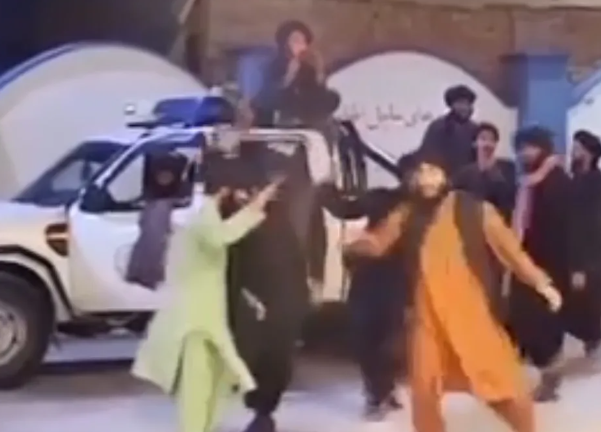
The Telegraph (UK): Taliban officials in Afghanistan have been filmed dancing to music – both of which they immediately banned in a draconian crackdown when they returned to power. The militant group – who outlawed music, dance, and any form of public celebration – were caught on video swaying and twirling with guns slung over their shoulders in a park in western Herat. Shortly after seizing power in Afghanistan, the Taliban not only banned music but also publicly beat and humiliated musicians, the custodians of rapidly disappearing Afghan cultural traditions. Click here to read more (external link).
Taliban Sexual Assaults: Fighters Rape Three Members Of A Family In Baghlan Province
 8am: Local sources in Khost district, Baghlan province, claim that four Taliban fighters sexually assaulted three members of a family, including two women and a 13-year-old girl. According to the sources, this incident happened Tuesday night last week in the village of “Dehkhiri Faroz” in Khost district. One source said, “Four Taliban fighters entered the house of Ghulam Hazrat and sexually assaulted his wife, daughter-in-law, and 13-year-old daughter.” According to the sources, the Taliban fighters were detained by the locals after the assault but were later released under pressure and threats from the Taliban unit commander. Click here to read more (external link).
Tolo News in Dari – July 15, 2024
Taliban Official Killed In Badghis, Claims NRF
 Afghanistan International: The National Resistance Front of Afghanistan (NRF) has announced that in an attack on the Badghis provincial building, the Taliban’s finance and administrative head for the province was killed along with three of his companions. The Taliban police command in Badghis and local residents have confirmed that the explosion was caused by a grenade. Click here to read more (external link).
The Push To Recognize ‘Gender Apartheid’ As A Crime
 By RFE/RL’s Radio Azadi
July 14, 2024
The world has long been aware of the scourge of apartheid — the systemic segregation or discrimination of people based on their race. But what about the institutionalized practice of singling people out for ill-treatment due to their gender?
The push to recognize “gender apartheid” under international law is gaining steam, with oppression against women and girls in Afghanistan and Iran fueling calls for immediate action, but tremendous obstacles remain.
What Do They Want?
Advocates want to clearly define gender apartheid as a crime under international law. Currently, only “persecution” on the basis of gender is recognized as a crime against humanity. But rights groups and activists say the concept of persecution does not fully capture the scope of the abuses committed under a system of institutionalized gender apartheid.
The goal is for the United Nations to make up for this gap by legally shielding women and girls from systemic abuse and violence.
Afghan women’s rights defenders are credited with being the first to articulate the concept of gender apartheid in the 1990s, during the Taliban’s first regime.
Since the Taliban returned to power in 2021, the hard-line Islamist group has reimposed its oppressive policies against women and girls, including severe restrictions on their appearances, freedom of movement, and right to work and study.
Hoda Khamosh, an Afghan women’s rights activist, says the recognition of gender apartheid would greatly benefit women’s rights in the country.
“We would be able to hold accountable the authorities and perpetrators of gender-based violence and discrimination against women,” Khamosh told RFE/RL’s Radio Azadi.
Meanwhile, Iranian women’s rights activists have said the institutionalized discrimination against women in the Islamic republic amounts to gender apartheid.
UN experts have said the violent enforcement of the hijab law and punishments on women and girls who fail to wear the head scarf could be described as a form of gender apartheid.
When Do They Want It?
Today. The United Nations has been considering the adoption of a major treaty that would unite signatories against crimes against humanity.
Dozens of rights groups and hundreds of individuals signed a statement in March calling for gender apartheid to be included on the draft list of such crimes.
The hope is that the UN General Assembly will adopt procedures to begin negotiations on the treaty when it next meets in September.
Tough Going
While the concept of gender apartheid has increasingly been used by the United Nations and international organizations, particularly in connection with abuses against women and girls in Afghanistan and Iran, there have also been missed opportunities.
During UN-hosted talks in Doha with the Taliban in early July, for example, women did not have a seat at the table.
Rights activists calling for the recognition of gender apartheid and for sanctions to be imposed on those responsible accused the UN of giving legitimacy to the Taliban’s rule and of betraying its commitment to women’s rights.
“The international community has a moral obligation to ensure the protection of Afghan women’s rights and uphold the principles of justice and equality in any engagement with the Taliban,” Sima Samar, former chairperson of the Afghan Independent Human Rights Commission (AIHRC), told CIVICUS, a global alliance of civil society organizations.
Imprisonment And Death In Iran
Like the Taliban in Afghanistan, Iran’s clerical regime has been labeled a “gender apartheid regime” by rights watchdogs.
Nobel Peace Prize laureate Shirin Ebadi, an Iranian human rights activist who lives in exile, is among the key signatories of a global effort to End Gender Apartheid Today.
The movement, highlighting the international community’s successful effort to end apartheid in South Africa decades ago, noted that women in Iran are banned from many fields of study, sporting events, and from obtaining a passport or traveling outside the country without their husband’s consent.
The Iranian authorities’ goal is to maintain women’s subjugation to men and the state through a system of laws, the movement said. Violations can lead to “violence, imprisonment, and death.”
“The situations in the Islamic Republic of Iran and under the Taliban in Afghanistan are not simply cases of gender discrimination,” the movement concluded in its call for support.
“Rather, these systems are perpetuating a more extreme, systematic, and structural war against women designed to dehumanize and repress them for purposes of entrenching power.”
Written by Michael Scollon with reporting by RFE/RL’s Radio Azadi