
 1TV: Groundwater levels have declined in Afghan capital Kabul by meters, officials said Monday. Mohammad Naeem Tokhi, the director of hydrology department at Ministry of Energy and Water, said that the rate of decline in groundwater levels is between 1 and 22 meters. Apart from quantity, the quality of ground water in the city is also deteriorating. Click here to read more (external link).
Afghanistan Wins Its 9th Bronze Medal At Asian Games

Tolo News: Noor Ahmad Ahmadi, Afghan freestyle wrestler, won a bronze medal in the 5th Asian Indoor and Martial Arts Games in Ashgabat late Monday. Afghanistan has so far won one gold, one silver and nine bronze medals and is placed 24th on the medal list – out of 65 countries. Click here to read more (external link).
Other Sports News
N Korea, Venezuela added to Trump’s banned states, Sudan removed

Donald Trump
Press TV / September 25, 2017
Citizens of Chad, Iran, Libya, North Korea, Somalia, Syria, Venezuela and Yemen will face new restrictions in travelling to the United States based on the latest proclamation signed by President Donald Trump.
The new rules, announced on Sunday, will go into effect on October 18.
The range of restrictions imposed on each state is different, for example in the case of Venezuela, only certain government officials and their families are affected.
They range from an indefinite ban on visas for citizens from countries such as Syria to more targeted restrictions.
The Republican president’s ban has been challenged in courts and censured by human rights activists on multiple occasions.
“Making America Safe is my number one priority. We will not admit those into our country we cannot safely vet,” Trump said in a tweet shortly after the proclamation was released.
On Friday, the president received policy recommendations from acting Secretary of Homeland Security Elaine Duke and was briefed by other administration officials, including Attorney General Jeff Sessions and Secretary of State Rex Tillerson, a White House aide told Reuters earlier in the day.
His former ban on travelers from Iran, Libya, Somalia, Syria and Yemen, which was enacted in March, expired on Sunday evening.
It was supposed to target those who lacked a “credible claim of a bona fide relationship with a person or entity in the United States.”
‘Same Muslim ban with cosmetic adjustments ’
The new proclamation removes Sudan but adds Venezuela and North Korea, which have been engaged in bitter rows with the Trump administration recently.
“North Korea does not cooperate with the United States government in any respect and fails to satisfy all information-sharing requirements,” the proclamation said.
Johnathan Smith, the legal director of the advocacy group Muslim Advocates, dismissed the new move as the “same Muslim ban” and an effort “to undermine our Constitution.”
“Let us not be fooled by the administration’s attempted tricks and semantics, this is still the same Muslim ban,” he told the Associated Press. “The administration is once again making cosmetic adjustments to the Muslim ban in hopes that it will pass the barest possible definition of anything else; but they’ve failed again.”
People from the six Muslim majority countries were banned from entering into the US for 90 days in the expiring ban.
Revised a few times, the ban originally followed 2016 campaign pledge by Trump for a “complete” shutdown of Muslims entering the US on the pretext of the so-called war on terror.
Related
Taliban target NATO convoy in Afghanistan
 Press TV / September 24, 2017
Taliban militants have targeted a military convoy of Danish NATO forces in the Afghan capital of Kabul. There have been no reports of casualties among the foreign forces but at least three civilians have sustained injuries.
Afghan officials said the incident took place early on Sunday when a bomber attacked a NATO convoy in the fifth district of Kabul.
“Around 11:02 am, a suicide car bomber detonated himself, targeted a convoy of foreign forces near Afshar neighborhood of Kabul city,” Najib Danish, the interior ministry spokesman, told AFP. “Unfortunately as a result of the attack, three Afghan civilians were wounded.”
The Afghan Tolo News television channel and Reuters, however, put the number of civilian casualties at five.
Captain William Salvin, a spokesman for the NATO-led mission in Afghanistan, confirmed the attack on the military convoy and said that there had been no victims among the servicemen.
In a message posted on Twitter, the Taliban claimed to have killed and injured up to 16 American soldiers in Sunday’s bomb attack.
More than 16 years after a US-led invasion of Afghanistan, security remains fragile. The US-led forces transferred security responsibilities to Afghan forces in 2014, although some 13,000 NATO soldiers, most of them from the US, are still stationed in Afghanistan.
The Taliban, which ruled the country before the 2001 invasion, are reportedly overrunning territory in the south and north.
The Takfiri terrorist group Daesh has also recently emerged in Afghanistan.
US President Donald Trump has allowed the deployment of another 4,000 US troops in Afghanistan and has repeatedly urged other NATO members to contribute more.
Other Security News
- Mattis Visits South Asia Amid US Shakeup of Afghanistan Policy
- Taliban Assassinate Afghan District Police Chief
- Pakistan Plans to Regulate Weekly Sermons to Prevent Extremism
US training mission in Afghanistan failure from onset: SIGAR
 Press TV
September 23, 2017
An American government watchdog has found several serious flaws in the fifteen-year-old US training mission in Afghanistan that has ultimately designed a force unable to provide security in the Asian country.
The Special Inspector General for Afghanistan Reconstruction (SIGAR) issued a 283-page report, which concluded that the mission was a failure from the onset.
The report outlined several key problems with the Pentagon mission, which was plagued by a failure to understand the full “complexities and scale of the mission.”
The SIGAR report explained that Washington has failed to help Afghanistan in building proper security forces that could protect the country from “internal and external threats and prevent the country from becoming a terrorist safe haven.”
“Providing advanced Western weapons and management systems to a largely illiterate and uneducated force without appropriate training and institutional infrastructure created long-term dependencies, required increased US fiscal support, and extended sustainability timelines,” it added.
Among other key problems listed in the report was that US authorities had no initial plans to construct any security institutions.
The establishment of the national army and police was “ultimately undermined” by “partnerships with independent militias,” it found.
The SIGAR report further said that American and NATO instructors sent to the Afghanistan were themselves undertrained and undermanned. SIGAR inspector general John Sopko said that one US officer watched TV shows “to learn what he should teach.”
At one point, according to the report, training for police officials used Power Point slides from US and NATO operations in the Balkans.
“Such cut-and-paste activities, lifted from one country and slapped onto another like a decal, are not likely to boost the prospects for overall success,” Sopko said.
“In eastern Afghanistan, we met a US Army helicopter pilot assigned to teach policing,” he said.
More than 100,000 Afghan police were trained by US Army pilots, infantry officers, and civilian contractors, according to the report.
The mission, which still continues, has cost the US some $70 billion since 2002, according to SIGAR, which said Washington is still spending more than $4 billion a year.
The report, however, warned that tens of billions of dollars could be wasted unless changes are made in the training of local security forces.
The US started sending its troops to Afghanistan about 16 years ago to defeat the Taliban terrorists. The combat operations against the Taliban officially ended in 2014, but more than 8,000 US Special Forces still remain in the country.
US President Donald Trump, who repeatedly called for the withdrawal of US troops from Afghanistan during the administration of former president Barack Obama, modified his stance during his 2016 presidential campaign. Last month, he even decided to send more than 3,000 extra troops to the country.
Sixteen years after the US-led invasion in to the country, which ousted the Taliban terrorist group, security is still deteriorating. While the Afghan government only controls half of the country, the Taliban has made significant gains and is said to control more territory now than at any other time.
Related
Herat Man Arrested After Throwing Shoes At Hekmatyar
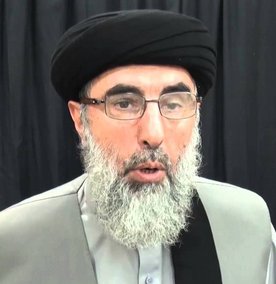
Gulbuddin Hekmatyar
Tolo News: Ulema council members said using a mosque for political campaigns was unacceptable and that mosques were to be used only for praying. The young man who threw his shoes at Hizb-e-Islami leader Gulbuddin Hekmatyar in Herat on Friday, during an event at a mosque, was arrested by security forces on Saturday. Click here to read more (external link).
Other Political News
Band-e-Amir Dragons win SCL 2017 title
 1TV: Band-e-Amir Dragons defeated Mis Ainak Knights in a thrilling final to win the Shpageeza Cricket League season 5 in Kabul on Friday. Band-e-Amir registered four-run victory in front of a packed crowd at Alokozay Kabul International Cricket Ground to lift SCL trophy for the first time. Click here to read more (external link).
SIGAR report puts Afghan security deficiencies in focus
 Al Jazeera: Trump and Ghani hold talks in New York as report says US approach to Afghanistan lacked ‘whole of government approach’. Deficiencies in Afghanistan’s security forces, including the military and police, are getting renewed attention as the US administration considers sending more than 3,000 additional troops to the country. Click here to read more (external link).
Related
Pakistan’s New Leader Criticizes U.S. Policy While Praising China In UN Speech

Shahid Khaqan Abbasi
Radio Free Europe/Radio Liberty
September 22, 2017
Pakistan’s new prime minister, Shahid Khaqan Abbasi, in his first address before the UN General Assembly, rejected the new U.S. war strategy in neighboring Afghanistan while praising China’s growing economic role in the region.
An important component of the White House’s recently unveiled strategy to try to win the war against the Taliban in Afghanistan is a threat to withdraw aid and other support for Pakistan if Islamabad does not shut down what U.S. officials say are Afghan Taliban “safe havens” on its territory.
“Taliban ‘safe havens’ are located not in Pakistan, but in the large tracts of territory controlled by the Taliban in Afghanistan,” Abassi said on September 21, repeating Islamabad’s warning that Pakistani was “not prepared to be anyone’s scapegoat.”
Abassi said Islamabad was ready to work with Kabul to “end all cross-border attacks,” and it will continue pursuing its domestic war against terrorists, which he claimed had “cleared out tribal areas of almost all militant groups” at the cost of thousands of civilian and military lives.
“What Pakistan is not prepared to do is to fight the Afghan war on Pakistan’s soil. Nor can we endorse any failed strategy that will prolong and intensify the suffering of the people of Afghanistan and Pakistan,” he said.
“Apart from the people of Afghanistan, Pakistan and its people have suffered the most from four decades of foreign intervention and civil wars in Afghanistan,” he said. “These wars have blighted our country with the flow of extremists and terrorists, guns and drugs as well as an influx of millions of refugees.”
“Having suffered and sacrificed so much,” he said, “it is especially galling for Pakistan to be blamed for the military or political stalemate in Afghanistan.”
Abassi asserted that neither side of the Afghan conflict will be able to win the war through military might, making peace negotiations the only way to end the 16-year conflict.
“No one desires peace in Afghanistan more than Pakistan,” he said, noting that his country currently hosts over 3 million refugees from Afghanistan.
While criticizing White House policies in his speech without specifically naming the United States or U.S. President Donald Trump, Abassi spoke with warmth about China’s leader and Beijing’s growing role fostering economic growth in his country and the South Asian region.
“The vision of shared growth spelled out in Chinese President Xi Jinping’s Belt and Road initiative offers a solid path to prosperity and a model of South-South cooperation worthy of emulation,” he said.
“Pakistan’s economy has recorded a remarkable revival in the past four years. The China-Pakistan Economic Corridor will further contribute to our economic upsurge,” he said.
“This will expand exponentially as the Pakistan-China partnership extends beyond energy and transportation to many other sectors,” he said. “Pakistan’s integration into the Eurasian Belt and Road network will provide a firm foundation for Pakistan’s rapid economic development.”
Copyright (c) 2017. RFE/RL, Inc. Reprinted with the permission of Radio Free Europe/Radio Liberty, 1201 Connecticut Ave NW, Ste 400, Washington DC 20036.
Related
Afghanistan Beats Uzbekistan 4-2 In Ashgabat Futsal Match
Tolo News: Afghanistan’s National Futsal Team beat Uzbekistan 4-2 in their third match in the fifth Asian Indoor Martial Arts Games in Ashgabat on Wednesday. Uzbekistan, a fierce opponent, had been listed as among the top two winners at last year’s games. Afghanistan will play the United Arab Emirates on Friday in the last of their group match. The Afghan squad has so far beaten China 6-1 and Maldives 6-1. Click here to read more (external link).
Other Sports News