
 Tolo News: President Ashraf Ghani and CEO Abdullah Abdullah on Monday overturned a recent decision to ban two social media chat groups, WhatsApp and Telegram. The two leaders met to discuss the issue which caused widespread anger in the country – particularly among civil society activists. The two leaders have described the ban on the social media platforms as being against the law and ordered WhatsApp and Telegram to work as normal in Afghanistan. Click here to read more (external link).
The Afghan diaspora – in pictures
 The Guardian (UK): For the past four years, Dutch photographer Joël van Houdt has been documenting the journeys of Afghan refugees around the world. In Afghanistan, there is a dearth of information about the reality of the refugee experience. Van Houdt moved to Kabul in 2010 and witnessed the soaring optimism created by the US surge in which money and human resources were pumped into the beleaguered state. By the time he left in 2015, the optimism had turned to utter hopelessness. The question his Afghan friends most routinely asked him was how to leave the country. Click here to view photos (external link).
Powerful Ex-Warlord: Even ‘Centuries’ Of Foreign Presence Cannot Fix Afghanistan
Frud Bezhan
Radio Free Europe/Radio Liberty
November 4, 2017
HERAT, Afghanistan — Ismail Khan stares into a gold-framed mirror, fidgeting for a long time with the checkered keffiyeh tied around his head. He then combs his long white beard before sitting on an ornamented armchair in his glittering guestroom.
Khan, one of Afghanistan’s most powerful former warlords, is a man conscious of his image. For decades, he has been among a group of influential warlords and former mujahedin commanders shaping modern Afghan history in defeating the Soviet Union, battling the Taliban, and turning on one another in a devastating civil war — all before being given senior roles within a UN-backed government in a nod to national unity after the U.S.-led invasion in 2001.
But having accumulated vast power and wealth for over a decade, many of those same strongmen find themselves sidelined by the national unity government led by President Ashraf Ghani, a Western-educated technocrat who assumed power after a flawed presidential election in 2014.
“One of the things that the Americans and the current government have tried to do is to keep the mujahedin out of power,” Khan told RFE/RL in a recent interview at his home in Herat, a city of strategic, commercial, and cultural significance located in western Afghanistan.
Mujahedin is a reference to former Islamist groups who fought the Soviets in the 1980s and the Taliban in the 1990s.
“The government is weak. A weak government cannot share power with powerful figures,” added the 71-year-old, a stern, stocky man with piercing eyes.
Khan has been one of the most vocal critics of the central government in Kabul despite serving in several key posts. Under former President Hamid Karzai he was minister of electricity and water and governor of Herat Province, titles that fail to adequately capture the power that Khan wielded in western Afghanistan.
Many here address Khan as emir, or king. His many titles include “Emir of western Afghanistan” and “Lion of Herat,” labels that speak to the enormous influence he wields in this part of Afghanistan, an economically thriving, relatively peaceful region surrounded by lawlessness and poverty and abutting the Iranian border.
Khan has been accused in the past of running Herat and surrounding regions as a personal fiefdom and withholding from the government millions of dollars in customs revenues from the lucrative cross-border trade with Iran.
His wealth is on display at his three-story marble palace in central Herat. On the grounds of his grand residence, Khan has a garden of exotic birds. His home is heavily guarded by towering concrete blast walls and a dozen soldiers carrying automatic rifles.
United States ‘Must Leave’
“The Americans should leave,” Khan said. “There can only be peace and security in Afghanistan if there is a just government in place that is backed by the majority of the people and is chosen through elections or a loya jirga (national council). It cannot be reliant on a foreign military.”
He added: “If foreign forces want to stay in this country for decades or even centuries and keep a friendly government in place [in Kabul], there will never be peace and security. Freedom, independence, and religion is in the blood of our people.”
Many military experts predict the Kabul government could collapse and the Taliban would reconquer large parts of the country if all Western forces left Afghanistan. Since the pullout of most NATO forces in 2014, Afghan security forces have failed to fend off the Taliban and are suffering record casualties. The Taliban are now thought to control or contest more territory than at any time since 2001.
Khan acknowledged that a complete pullout would “create problems.” But he argued that a more legitimate government in Kabul could “stand up to the Taliban.”
“The Taliban wouldn’t have any other option but to side with the people,” he said.
Sporadic peace talks with Taliban representatives over the past decade have failed to yield any breakthroughs, with the militant group claiming it will not negotiate until all foreign forces withdraw from the country.
Khan suggested that former mujahedin could fill the vacuum left by departing foreign troops.
In 2012, he called on former fighters to reorganize and defend the country. He said foreign forces, which he described as “girls,” had failed in their fight against the Taliban.
Khan maintained he was still “ready” to remobilize his militias if given the green light from Kabul.
Afghan Divisions
Khan argued that Taliban members should form part of an inclusive government representing all the country’s long-warring ethnic groups and political factions, including the Taliban.
“I think we need a new government before this one collapses,” Khan said. “We need fresh elections or an interim administration. We need a new president that is supported by the people. People don’t support the current government.”
Ethnic tensions have escalated in the country and Ghani has been accused of fueling the frictions by surrounding himself with Pashtun politicians and sidelining Chief Executive Abdullah Abdullah, the number two in the national unity government and an ethnic Tajik.
Khan said fresh elections should be held to elect a new president. Those calls have been mirrored by other former warlords and political figures who have lost their influence in the current administration.
But analysts say the factors underlying the faulty elections in 2014 — systemic corruption, widespread insecurity, and a problematic electoral system — have yet to be addressed, suggesting any new elections could simply mean repeating the same mistakes. Reforms have been delayed due to bickering between Ghani and Abdullah’s rival camps, they say.
Despite growing insecurity, woeful economic conditions, and political infighting, Khan said “Afghanistan cannot live in the dark forever” and hoped the country can stand up on its own feet soon.
Afghanistan’s economy is heavily dependent on international aid, its security apparatus has yet to prove they are a force capable of defending the country without the support of NATO, and its weak, deeply divided government is engulfed in a long-running political crisis.
“When the Soviet Union invaded, nobody thought we could overcome such a brutal force,” he said. “But we did, with God’s help. Who would have thought that Eastern Europe would be free of the Russians? But they got their freedom after 70 years. We also have hope that we can overcome our problems.”
Copyright (c) 2017. RFE/RL, Inc. Reprinted with the permission of Radio Free Europe/Radio Liberty, 1201 Connecticut Ave NW, Ste 400, Washington DC 20036.
US Calls for ‘Equal Diligence’ in Efforts to Combat Terror Groups in Pakistan
 Ayaz Gul
VOA News
November 6, 2017
ISLAMABAD, PAKISTAN — The United States has called on Pakistan to show “equal diligence” in fighting all terrorist groups operating in the country, including the Haqqani network, and cautioned bilateral relations are at a “critical juncture.”
U.S. Ambassador David Hale spoke at a seminar in Islamabad Monday as he discussed U.S. policy in relation to neighbors Pakistan and Afghanistan. Hale said that while the Trump administration’s recently announced South Asia strategy seeks a secure and stable Afghanistan, it looks to Pakistan for decisive action against all terrorist groups operating on its soil.
The American diplomat praised Pakistan’s efforts against anti-state terrorist groups, saying the country has been on the frontline in the effort to defeat al-Qaida and Islamic State in South Asia.
“We ask for equal diligence in decimating all the groups operating in Pakistan which threaten the region’s stability, including the Haqqani network. We seek a sustained and irreversible effort to achieve an aspiration and commitment that was made public by Pakistani officials themselves, and end to the use of Pakistan soil for attacks on its neighbors,” Hale noted.
Afghan and U.S. officials have alleged the Taliban and its Haqqani allies are directing the insurgency in Afghanistan from sanctuaries on Pakistani soil. The allegations have been at the center of Islamabad’s tensions with both Kabul and Washington.
Hale reiterated the U.S. is committed to denying the Taliban a military victory in Afghanistan and urged Pakistani leaders to assist in advancing a negotiated settlement to the conflict.
“Pakistani leaders have made clear that they share our goals for a peaceful and stable Afghanistan. It is now time to join in our efforts and create a context in which terrorist groups can no longer launch cross-border attacks and see no alternative to negotiations,” said the ambassador.
He repeated U.S. Secretary of State Rex Tillerson’s warning that Washington “will act accordingly” if Pakistan’s leaders choose “not to take advantage of this opportunity.”
Pakistan’s foreign minister, Khawaja Asif addressed the seminar and in responding to Hale’s comments, said security forces have dismantled terrorist networks on its soil and established government authority across the country.
Asif went on to say there may be remnants of these groups in Pakistan because of its porous border with Afghanistan and called for enacted U.S. intelligence cooperation to deal with them.
“Pakistan is committed to respond effectively to any actionable intelligence provided by the U.S. This is the only way forward to test each other’s resolve and commitment to combat terrorism,” Asif noted.
The foreign minister also said Trump’s Afghan strategy has created “needless divergence” in bilateral relations and cast doubts on whether it will promote peace in Afghanistan.
“Ladies and gentlemen, a conditions-based approach is primarily a strategy of denial and a strategic stalemate. It would more likely lead to further fragmentation and divisions within an already fractured society, making it that much more difficult to build peace mechanism and related structures,” Asif said.
He blamed “internal factors,” including rivalries within the Afghan government, for fueling war in the neighboring country, and called on both Kabul and Washington to pay attention to them rather than blaming Pakistan.
“Today, Afghanistan faces huge challenges with respect to corruption, building state institutions, transitioning from a war economy, record drugs production, ethnic and tribal divisions and expanding ungoverned areas; all these are monumental tasks and all are internal to Afghanistan,” Asif added.
The minister said Pakistan will do all it can to further an Afghan peace and reconciliation process, saying Islamabad has intensified interactions with Kabul and proposed working groups and mechanisms to build mutual trust and cooperation.
Asif blamed rival India for facilitating terrorist actions in the region but said U.S. officials have noted Pakistan’s concerns about giving New Delhi a wider role in the new Afghan strategy. India maintains it is helping Afghanistan in reconstruction efforts and dismisses Pakistani allegations.
“The U.S. assured us that India’s role in Afghanistan is limited to economic assistance and that the U.S. would not tolerate Afghan soil to be used against Pakistan,” said Asif.
Asif also said his government believes repatriation of around 3 million Afghan refugees from Pakistan will address the issue of terrorism facing both countries. Pakistani officials say anti-state militants operating on both sides of the border use the refugee population for sheltering and planning terrorist attacks.
BBC name change stirs language row in Afghanistan
 Reuters: The BBC is facing an angry reaction in Afghanistan after it changed the name of one of its local language Facebook pages to BBC Dari, the official name of the Afghan version of Persian or Farsi but one rejected by many local Persian speakers. Click here to read more (external link).
Related
U.S., Afghanistan Investigating Reports Of Civilian Casualties In Kunduz
 Radio Free Europe/Radio Liberty
November 5, 2017
The U.S. military and Afghan authorities are investigating reports of civilian casualties caused by deadly air strikes in northern Afghanistan.
The U.S. military said it had launched a probe into what it described as a combined U.S.-Afghan operation in the northern province of Kunduz on November 3 and was assessing the facts surrounding the incident.
The Afghan Defense Ministry said it had tasked security commanders to probe reports of civilian casualties in the Chardara district in Kunduz, where the government said it had inflicted heavy losses on Taliban militants.
Defense Ministry spokesman Dawlat Waziri said the ministry had not yet confirmed the death of any civilians in the air strikes.
Khosh Mohammad Nasratyar, a provincial council member, said 14 civilians were killed in the air strikes.
Another council member, Saifullah Amiri, a provincial council member, put the number even higher, at 22 civilians dead.
U.S. air strikes have intensified since U.S. President Donald Trump announced a new strategy for Afghanistan in August, which relaxed U.S. rules of engagement.
Civilian casualties from air strikes conducted by U.S. and Afghan forces increased by 52 percent in the first nine months of 2017, compared to 2016.
Based on reporting by dpa, Reuters, and Tolo News
Copyright (c) 2017. RFE/RL, Inc. Reprinted with the permission of Radio Free Europe/Radio Liberty, 1201 Connecticut Ave NW, Ste 400, Washington DC 20036.
U.S. Soldier Killed In Afghanistan’s Logar Province
 Radio Free Europe/Radio Liberty
November 5, 2017
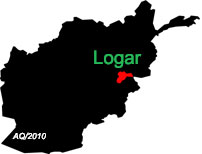
The U.S. military says an American soldier has died as a result of wounds suffered in the eastern province of Logar.
In a statement on November 4, General John Nicholson, the commander of U.S. military operations in Afghanistan, did not identify the victim or provide details of the operation.
“Despite this tragic event, we remain steadfast in our commitment to the Afghan people and to support them in our mutual fight against terrorism,” he said.
It was the second death of a U.S. soldier in Logar Province in the past week.
On October 28, the military said a soldier died a day earlier after sustaining injuries in a helicopter crash in Kharwar district, although it added the incident was not a result of enemy action.
Separately, the U.S. military said that it is investigating reports of civilian casualties caused by air strikes in the Chahardara district of the northern province of Kunduz late on November 3.
With reporting by Reuters and dpa
Copyright (c) 2017. RFE/RL, Inc. Reprinted with the permission of Radio Free Europe/Radio Liberty, 1201 Connecticut Ave NW, Ste 400, Washington DC 20036.
Two Afghan Athletes To Make History At Winter Olympics
 Tolo News: For the first time in history, two Afghan athletes will take part in the 2018 Winter Olympics, officially known as the XXIII Olympic Winter Games and commonly known as Pyeong Chang 2018, in February. Alishah Farhang and Sajjad Hussaini will be the country’s first skiers to represent Afghanistan at a winter Olympics. Click here to read more (external link).
Seven guards of Afghan VP Dostum sentenced to imprisonment over abuse case

Dostum
1TV: They were sentenced to imprisonment in absentia by a primary court in Police District 2 of Kabul three days ago, sources told 1TV. Ahmad Ishchi, who made accusations that Dostum ordered his men to rape and torture him, however, said that he is not satisfied with the progress over the case. Click here to read more (external link).
Afghanistan Orders Temporary Ban On WhatsApp, Telegram Messaging Apps
RFE/RL’s Radio Free Afghanistan
November 4, 2017
Afghanistan has ordered a temporary ban on the popular encrypted-messaging services WhatApp and Telegram, citing “technical problems” and the need for greater oversight.
The two mobile apps are popular among smart-phone users in Afghanistan — including Taliban militants.
Sayed Najib Nangyal, a spokesman for the Afghan Communications and Information Technology Ministry, confirmed to RFE/RL on November 4 that the order had been issued but did not elaborate on the reasons for the decision.
“Because of some technical problems and for better supervision, we have decided to stop services of these two applications,” Nangyal said.
“It is a temporary decision and ban. It will be effective from today and will be for 20 days,” he added, saying that other apps — such as Facebook, Twitter, and YouTube — are not affected.
The move has triggered a wave of criticism on social media, where users have assailed the ban as an attack on free speech.
Afghanistan’s acting minister for telecommunications, Shahzad Aryobee, rejected that criticism. He said in Facebook post that the regulator was responding to complaints from citizens about the functionality of the apps.
“The government is committed to freedom of expression,” he wrote.
Earlier media reports citing unidentified sources had reported that the ban was ordered by Afghan security officials in order to stymie the use of encrypted messaging by Taliban militants and other extremist groups.
With reporting by AFP, Reuters, and VOA