
 1TV: Afghanistan lost to Ireland by 4 runs in their third match of Under-19 World Cup in New Zealand on Saturday. The loss was Afghanistan’s first in the tournament in which they previously defeated Pakistan and Sri Lanka. Afghanistan have already qualified for Super League quarter-finals. Click here to read more (external link).
US-led invasion worsened Afghan security situation: Iran diplomat
 Press TV
January 20, 2018
A senior Iranian diplomat says the US-led invasion of Afghanistan has merely led to the deterioration of the security situation in the Asian country, urging enhanced economic ties with Kabul to pave the way for an international fight against terrorism there.
Iranian Deputy Ambassador to the United Nations Es’haq Al-e Habib made the remarks on Friday at a Security Council meeting on the issue of Afghanistan’s relations with its Central Asia neighbors and the link between peace and security.
“Afghanistan has not become more secure in the wake of the US invasion,” he said. “The fact is that the invasion of Afghanistan, and basically any invasion in our region, has failed to improve the security situation.”
The Islamic Republic believes that Afghanistan should be turned into a place for international cooperation rather than rivalry, he added.
“In the world today, peace, security and development cannot not be bound to a single country’s borders and can only be achieved within all-inclusive regional frameworks,” the Iranian envoy said.
Al-e Habib further stressed that increasing economic cooperation with Afghanistan promotes the fight against terrorism.
Over the past decade, Iran has stressed the need for reinforcing economic ties with Afghanistan as an approach towards restoring regional peace, the official noted.
Iran has implemented more than 300 infrastructure projects in Afghanistan, worth about $500 million in total, and hosted millions of Afghan refugees over the past three decades, he pointed out.
The US and its allies invaded Afghanistan under the guise of the so-called war on terror. Some 17 years on, the local Taliban militant group has only boosted its campaign of violence across the country, targeting both civilians and security forces in bloody assaults.
More recently, Daesh terror group has also taken advantage of the chaos and established a foothold in eastern and northern Afghanistan.
The Takfiri outfit has stepped up its terror attacks in the war-torn country after losing its bases in Iraq and Syria despite the presence of thousands of foreign troops on Afghan soil.
Daesh elements heading to Afghanistan: Russia
During Friday’s meeting, Russian Foreign Minister Sergei Lavrov warned that surviving Daesh militants are fleeing from Syria to Central Asia and Afghanistan.
“Northern Afghanistan is turning into a foothold of international terrorism with the Afghan wing of ISIS (Daesh) in the lead,” Lavrov said, adding that the terror outfit is “forming a staging ground to carry out destructive plans in the region.”
The Russian foreign minister further raised concerns about drug production in Afghanistan that “saw an unprecedented growth” last year.
“Urgent measures are necessary to cut off this threat which fuels international terrorism, undermines countries’ stability, the health of the younger generation, triggers crime and corruption,” he said.
US, Pakistan trade barbs
The American and Pakistani officials engaged in a war of words during Friday’s meeting.
US Deputy Secretary of State John Sullivan said Washington can’t work with Pakistan if it continues to give sanctuary to “terrorist organizations.”
In response, Pakistan’s UN Ambassador Maleeha Lodi said that Afghanistan and its partners, especially the US, need to address “challenges inside Afghanistan rather than shift the onus for ending the conflict onto others.”
Washington-Islamabad ties sourced last August after the US accused Pakistan of providing a haven for extremist groups that carry out attacks in Afghanistan; an allegation rejected by Islamabad.
Related
- US Rejects Accusations It Gave Rise to IS in Afghanistan
- US Official Urges Afghan Taliban to Engage in Peace Talks with Government
- Pakistan: Security, Intelligence Cooperation With US Non-Existent
Rashid Khan named ICC Associate Cricketer of the Year 2017

Rashid Khan
1TV: Afghanistan’s leg-spinner Rashid Khan has been named Associate Cricketer of the Year by the International Cricket Council. Rashid claimed 60 wickets during the year in international matches – a record for an Associate player in a calendar. The total includes 43 in ODIS – another record for a player from outside the Full Member nations. Click here to read more (external link).
Other Cricket News
Farah City ‘On Verge Of Collapse’, Locals Call for Action

Tolo News: Officials state at least 100 security force members have been killed in fighting in Farah in the past week. Members of Farah provincial council on Thursday reported that the Taliban are pushing to capture Farah City after a week of clashes with security forces. Click here to read more (external link).
US Warns Afghans against Violence to End Rift over Ousted Governor
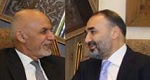
Ghani (left) and Noor (right)
Ayaz Gul
VOA News
January 18, 2018
ISLAMABAD, PAKISTAN — The United States again has called on leaders in Afghanistan to resolve peacefully and expeditiously an ongoing dispute over the leadership transition in a northern province, where the powerful governor is refusing to relinquish control despite being ousted by the country’s president.
The political crisis started a month ago when Afghan President Ashraf Ghani removed longtime governor of Balkh province, Atta Mohammad Noor, and appointed his successor.
But Noor, who has governed the relatively peaceful and prosperous Afghan province since 2004, has since refused to leave the post unless the central government met certain conditions his Jamiat-e-Islami party has put forward. His party is a vital partner in the Ghani-led national unity government.
Speaking to reporters in Kabul, U.S. ambassador John Bass noted the Afghan constitution empowered the president to appoint provincial governors and urged both sides to respect the rule of law while finding a solution to the crisis.
“We believe it’s essential that this dispute and the transition from former governor Atta to a new governor occur peacefully. There is no place for additional violence in this society, and particularly violence that would flow from a political dispute about who the governor of the province is,” said Bass.
Ousted governor Noor has been demanding, among other things, the authority to appoint his successor and the provincial police chief.
While addressing supporters Wednesday in the provincial capital of Mazar-e-Sharif, Noor threatened that if his party’s ongoing negotiations with President Ghani’s office failed to produce an agreement, he would launch a nationwide “rebellion” to “smash the walls of hostility and anger.”
Noor was responding to reports the central government might resort to use military force to break the stalemate, and he did not elaborate. But in a public speech earlier his month, the controversial governor claimed that “70 to 80 percent” of Afghan soldiers would not fight him if the government were to proceed with the use of military power.
“There is enough violence, there is too much violence in this society and there are too many conflicts that this government and provincial authorities and citizens are already dealing with. The last thing Afghanistan needs right now is more violence,” the U.S. ambassador noted while speaking Thursday.
Bass went on to say the political tensions are only benefiting terrorists and enemies of Afghanistan.
Earlier this week, U.S. Vice President Mike Pence also telephoned Ghani and emphasized Washington’s support for the Afghan government to engage with Noor and peacefully negotiate the leadership transition in Balkh.
Observers say the political confrontation could refuel traditional ethnic rivalries in Afghanistan, undermining national counterinsurgency efforts and posing challenges for next year’s presidential election .
Noor’s party mainly draws its support from Dari-speaking ethnic Tajiks, while Ghani represents the majority Pashtun community. The Afghan president is accused of favoring his own ethnic group, charges Ghani’s advisers reject.
Afghan Chief Executive Abdullah Abdullah and Foreign Minister Salahuddin Rabbani represent Noor’s party in the central government in Kabul.
Party sources have confirmed that political tensions prompted Rabbani not to travel to New York for Friday’s U.N. Security Council meeting on Afghanistan and stay in the country to try to resolve the dispute.
Afghan forces in partnership with U.S.-led international troops have intensified operations against the Taliban and other militant groups since President Donald Trump announced his new South Asia strategy in August seeking to contain insurgent gains
Related
German Authorities Charge Afghan Suspected In Taliban Killing
 Radio Free Europe/Radio Liberty
January 18, 2018
German prosecutors have filed terrorism and murder charges against a suspected member of Afghanistan’s Taliban accused of participating in the killing of an Afghan police officer.
Federal prosecutors said on January 18 that they filed the indictment against the Afghan national, identified as 20-year-old Omaid N., at the Munich state court.
He was charged with membership in a terrorist organization, war crimes, and violation of war-weapons-control laws.
Prosecutors say the suspect joined the Taliban in early 2013, underwent training, recruited new members, and helped transport weapons for the Islamist militant group on at least one occasion.
He is also accused of savagely beating a captured police officer and then shooting him.
The suspect, who arrived in Germany in November 2013, was arrested in May last year.
He is now in detention pending trial.
Based on reporting by AP and dpa
Copyright (c) 2018. RFE/RL, Inc. Reprinted with the permission of Radio Free Europe/Radio Liberty, 1201 Connecticut Ave NW, Ste 400, Washington DC 20036.
U.S. Says Afghanistan Closer To Holding Peace Talks With Taliban
 Radio Free Europe/Radio Liberty
January 18, 2018
The U.S. ambassador to the United Nations says that Afghanistan is getting closer to holding peace talks with the Taliban as a result of a new Afghan strategy put in place by the United States last year.
The remarks by Ambassador Nikki Haley at the UN in New York on January 17 came amid reports that Taliban negotiators held exploratory talks on resuming peace negotiations during a visit to the Pakistani capital Islamabad this week.
“We are seeing that we’re closer to talks with the Taliban and the peace process than we’ve seen before,” Haley said, briefingreporters after taking part in a weekend visit to Kabul by 15 members of the UN Security Council.
Haley said Afghan officials told the UN envoys that “they’re starting to see the Taliban concede, they are starting to see them move towards coming to the table” as a result of a new strategy the United States put in place last summer that has given the U.S. military a freer hand to work with Afghan forces to defeat the Taliban.
“They feel confident that the Taliban will be coming to the table,” Haley said.”The U.S. policy on Afghanistan is working.”
“We really are going to work toward a peace process, with the goal being that we do not want Afghanistan to be a safe haven for terrorism anymore,” she said.
Haley said Afghanistan’s leaders asked the UN council members to support the peace process and military gains in Afghanistan by putting more pressure on Pakistan to stop providing what they said were sanctuaries for the Afghan Taliban on its territory.
“They did ask us for consensus to put further pressure on Pakistan to come to the table and change their behavior,” Haley said.
“As long as they are supporting terrorism in Pakistan, the Afghan community is continuing to feel it is not safe,” she said. Pakistan denies providing sanctuary for the Taliban.
Haley did not specify what measures the UN council could take to pressure Pakistan, but it does have the power to impose sanctions. The United States recently froze payments of military aid to Pakistan, citing its alleged failure to act against militants.
Kazakhstan’s UN Ambassador Kairat Umarov, the current UN council president who led the visit to Kabul, said members expressed concerned about “the persistence of insecurity, especially with the intensification of terrorist activities in the north and east of Afghanistan, and the regrouping of foreign terrorist fighters coming out of Syria and Iraq in Afghanistan.”
But he said “the message of the Afghan government was very reassuring from the point of view of continuing efforts to find the peaceful resolution to all the outstanding issues.”
The UN visit to Kabul came as a delegation of Taliban negotiators based in Qatar visited Islamabad to discuss restarting peace negotiations, media reported on January 17.
Reuters reported that a second back-channel meeting occurred over the weekend in Turkey, where it said individuals with Taliban connections met with representatives of Hizb-i-Islami, the party of a former Taliban-allied commander who last year laid down arms to join Afghan politics.
Both sides officially denied holding any talks. But Reuters reported that the Taliban’s supreme leader Haibatullah Akhundzada, who it said is widely believed to be hiding in Pakistan, ordered the exploratory talks in both Turkey and Islamabad.
Reuters reported that the Taliban’s Haqqani Network last week released 14 captured Afghan army soldiers in the eastern province of Paktia as a goodwill gesture ahead of the talks.
With reporting by AP, AFP, dpa, and Reuters
Copyright (c) 2018. RFE/RL, Inc. Reprinted with the permission of Radio Free Europe/Radio Liberty, 1201 Connecticut Ave NW, Ste 400, Washington DC 20036.
Related
Afghan President Criticizes Pakistan’s Anti-Terror Islamic ‘Fatwa’

Ghani
Ayaz Gul
VOA News
January 17, 2018
ISLAMABAD — Afghan President Ashraf Ghani says he believes an anti-terrorism Islamic edict, or fatwa, issued by Pakistan, should have covered the entire Muslim world, including Ghani’s war-torn nation.
Ghani spoke Wednesday, a day after more than 1,800 Pakistani clerics unveiled the edict at a government-sponsored event in Islamabad. The directive declared as un-Islamic acts that include suicide bombings, sectarianism, and calls for jihad in the name of religion without the consent of the state.
He told a gathering in Kabul of Afghan youths, women, civil society activists and clerics that fatwas issued under Islam have never been confined to geographical boundaries of a single nation. Clerics in the audience voiced their agreement when the Afghan leader asked for their opinion.
“If they [Islamic principles] extend to all [of the world] of Islam, then it [the Pakistani edict] should first and foremost be implemented in relation to Afghanistan,” Ghani said.
‘Astonishing’ comments
There was no immediate official reaction in Pakistan to Ghani’s comments, but privately, authorities dismissed them as “astonishing,” citing long-running accusations of Pakistani interference in Afghanistan’s internal affairs.
Analysts viewed Ghani’s criticism as another indication of deep mistrust and tension in relations between the neighboring countries.
Relations between Pakistan and Afghanistan have deteriorated over Kabul’s allegations that Taliban insurgents and their allies are using Pakistani soil for sustaining and expanding insurgent activities.
In turn, Islamabad alleges Afghanistan’s intelligence agency — the National Directorate of Security, with the help of Indian counterparts — is sheltering fugitive Pakistani militants and helping them to plot terrorist attacks against the country.
“It would be inappropriate for Pakistan to pressure or to press upon their clerics to give a statement regarding any other country,” said Zahid Hussain, a Pakistani columnist and author of books on extremism.
Instead of taking “a narrow view” of the edict, President Ghani should have appreciated Pakistan’s effort rather criticizing it,” Hussain said.
Doing all it can
Afghan officials say that during a visit to Kabul last October, Pakistani military chief General Qamar Javed Bajwa had assured Ghani he would seek a fatwa from Pakistani clerics with regard to the Afghan conflict. Pakistani officials have not confirmed those assertions.
Pakistani Interior Minister Ahsan Iqbal, while addressing Tuesday’s ceremony where the edict in question was announced, reiterated that his country is doing all it can to fight terrorism and has suffered tens of thousands of casualties in the process, in addition to massive economic losses.
“Terrorism has no place in Islam, whether against our own people or against other people. Pakistan is committed to not allowing any group to use its territory to carry out any act of terrorism against anybody. What is not good for us is not good for others also,” Iqbal said.
Government under fire
The government itself has been under fire since issuing the fatwa. Critics, such as rights activist Tahira Abdullah, raised objections about the participation of certain clerics at Tuesday’s event.
She said the list of those invited to the conference, held in the office of President Mamnoon Hussainin Islamabad, contained names of clerics with ties to banned Islamic organizations.
“We strongly protest and condemn this blatantly obvious — but failed —attempt to confer respectability and legitimacy on religious-political organizations, individuals, and groups, which are either proscribed themselves, or have very close links with such entities,” Abdullah said.
The activist said she saw the participation of controversial clerics as part of alleged official efforts to mainstream extremist groups in national politics.
“This is a monster, which will boomerang back at us all,” she said.
The Pakistani fatwa was ratified by, among others, Muhammad Ahmed Ludhianvi, who is known for his ties to the outlawed Sunni-based sectarian group, Ahle Sunnat Wal Jamaat (ASWJ). Authorities accuse the group of being behind attacks on Pakistan’s minority Shiite community.
Another signatory was Hamid-ul-Haq, the son of the Pakistani cleric Sami-ul-Haq, who is widely referred to as the “Father of the Afghan Taliban.” The cleric’s Islamic seminary, near the northwestern city of Peshawar, is where prominent radical leaders, including Taliban founder Mullah Mohammed Omar, received an education.
Constitution Gives President ‘Extraordinary Power’

Ghani
Tolo News: NUG commission head says the Constitution allows the country’s president to have too much power and likened the amount to that of a Sultan. Mohammad Natiqi, the head of the commission overseeing the implementation of the political agreement of the National Unity Government (NUG), reiterated a call on Wednesday for radical reforms to be implemented in the Constitution of Afghanistan so as to curb the president’s power. Click here to read more (external link).
Other political news
Public Group In Balkh To End Ghani-Noor Standoff
Ghani (left) and Noor (right)
Tolo News: A group of 45 people from tribal elders, civil society activists and university lecturers have landed in Balkh province, in the north of Afghanistan, to end the ongoing rift between Presidential Palace and Atta Mohammad Noor by mediating between the two sides. Members of the group called on the two sides to consider the national interests of Afghanistan and avoid giving a chance to anti-government armed militants to use the tension in their favor and further destabilize the war-torn country. Click here to read more (external link).
Related