
Taliban Kill At Least 20 Afghan Troops In Badghis Province
 Radio Free Europe/Radio Liberty
April 4, 2019
Afghan officials say a Taliban attack in the northwestern province of Badghis has killed at least 20 government soldiers and police.
Abdul Aziz Baig, head of the Badghis Provincial Council, said Taliban fighters stormed several security checkpoints outside the government headquarters in the district of Bala Murghab during the early morning hours of April 4.
Baig said Taliban fighters seized most of the district. He said only the district police headquarters and a base of the Afghan National Army remained in the control of the government.
Jamshid Shahabhi, the spokesman for the Badghis governor, said after midday on April 4 that intense fighting was continuing in the district. He said there were fears that the death toll for government forces could rise.
The Taliban claimed responsibility for the attack.
Mohammad Nasir Nazari, a provincial council member, said the Afghan Army base and police headquarters in the district also could fall to the militants if the government did not send reinforcements.
The attack comes less than three weeks after 50 government soldiers were killed during a week-long battle in Bala Murghab.
Nazari said 100 Afghan soldiers fled their posts and tried to cross into neighboring Turkmenistan during the battle in mid March.
Many were captured by Taliban fighters after Turkmen government forces prevented them from crossing the border safely into Turkmenistan’s territory.
Based on reporting by AP and dpa
Copyright (c) 2019. RFE/RL, Inc. Reprinted with the permission of Radio Free Europe/Radio Liberty, 1201 Connecticut Ave NW, Ste 400, Washington DC 20036.
Other Security News
Left Out: Afghanistan Watches Its Own Peace Process From The Sidelines
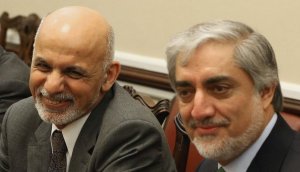
Ghani (left) and Abdulllah (right) – File photo
By Frud Bezhan
Radio Free Europe/Radio Liberty
April 3, 2019
When the United States’ special representative for Afghan reconciliation arrived in Kabul this week amid ongoing peace talks with the Taliban, the country’s national-unity government was in disarray.
Zalmay Khalilzad met with the leaders of the government, President Ashraf Ghani and Chief Executive Abdullah Abdullah, separately on April 1: Ghani with his running mate in the upcoming elections; and Abdullah, the de facto prime minister, with the country’s foreign minister, an electoral ally.
Meanwhile, Ghani’s national-security adviser — who is overseeing Kabul’s ongoing war effort and recently had a much-publicized falling out with Washington — was not in Kabul at all, but in the remote province of Nuristan.
The developments, analysts say, highlighted stark divisions within the government in Kabul that have been laid bare as the United States and the Taliban carry on negotiations aimed at ending the nearly 18-year war. The Afghan government, with no seat at the table, has essentially been shut out of its own peace process, relegated to lame-duck status as Washington talks of a military withdrawal and presidential elections approach in September.
Peace Requires Broader ‘Buy-In’
The Taliban has refused to negotiate with Ghani’s administration, calling it a U.S. “puppet.” Adding to the ignominy of being left out of the U.S.-Taliban negotiations in Qatar, some of the president’s rivals held high-profile meetings with Taliban negotiators in Moscow in February. Those talks marked the most significant contact between senior Afghan political figures and the militant group since the U.S.-led invasion in 2001. The sides are expected to meet again this month.
Meanwhile, Ghani has alienated much of the country’s political elite, including influential ex-President Hamid Karzai and former warlords who attended the Moscow meeting, by failing to consult with them over the government’s national peace plan and denying them a spot on the government’s negotiating team.
“The current isolation of the Afghan government from the peace process is the result of its own failed policies and internal divisions,” says Haroun Mir, a Kabul-based political analyst.
Ghani is expected to convene a consultative Loya Jirga, a traditional assembly of tribal, ethnic, and religious leaders, in the coming weeks to reach national consensus on peace talks with the Taliban. But is unclear who will be invited and whether he will actually carry out the gathering’s suggestions.
“Peace cannot be concluded by the executive office of the president or his appointees,” says Barnett Rubin, a former U.S. State Department official and leading expert on Afghanistan. “It requires much broader participation and buy-in.”
His administration already considered by many Afghans to be weak and ineffective, Ghani’s position and leverage have been further eroded as the clock winds down on his first term in office. While he will run in the upcoming elections — postponed until September — he is not expected to win. And there is a possibility that the vote could be canceled altogether in the event of a peace settlement and the formation of an interim government that the Taliban would join.
The idea has been floated by Khalilzad and has been supported by the Taliban and Afghan opposition figures, although Ghani has rejected it.
‘No Negotiations At All’
The United States long refused to hold direct talks with the Taliban unless the Afghan government was involved. But that changed under President Donald Trump, who has expressed a desire to end the war and withdraw U.S. troops.
One of the Taliban’s conditions for negotiations was that the Afghan government not be involved, and while NATO has said it is “no way possible” to have a lasting peace without the full involvement of the Afghan government, the United States has been less declarative. U.S. Secretary of State Mike Pompeo has stressed the need for the government to be involved, while Khalilzad has suggested that a formula for bringing the government into an Afghan-owned peace process was still being developed.
“The choice the U.S. faced was between direct negotiations with the Taliban and no negotiations at all,” Rubin says. “I am sure that the U.S. government would have much preferred direct Taliban-government talks or a trilateral format, but the Taliban refused.”
Khalilzad has held several rounds of talks with the Taliban, culminating in a draft agreement on two of the four core components of a settlement: a Taliban guarantee to prevent international terrorist groups from basing themselves in Afghanistan, and conditions for the withdrawal of U.S. forces.
A cease-fire and intra-Afghan talks over a political settlement with the Taliban, which will likely be part of a new government, would involve the Afghan government, Khalilzad said.
Significantly, Washington appears to view the Kabul government as one of three Afghan stakeholders in any political settlement, not the central player.
Pompeo suggested as much when he said in February that the “Afghan government, other Afghan leaders, and the Taliban” needed “to sit together and negotiate a political settlement.”
Deal That ‘Doesn’t End In Peace’
The Ghani administration’s simmering anger at being left out the peace negotiations boiled over on March 14, when his national-security adviser, Hambullah Mohib, launched a blistering attack on Khalilzad.
In remarks that stunned U.S. officials, Mohib said the U.S.-Taliban talks were “decreasing the legitimacy of the Afghan government” and suggested that Khalilzad had sidelined Afghan leaders because of his ambitions to be a “viceroy” in an interim government if the negotiations succeed.
Reports in the U.S. media said U.S. officials had since ended contacts with Mohib, jeopardizing a key relationship at a time when Kabul is running out of time and friends.
Copyright (c) 2019. RFE/RL, Inc. Reprinted with the permission of Radio Free Europe/Radio Liberty, 1201 Connecticut Ave NW, Ste 400, Washington DC 20036.
Related
Trump calls Afghanistan war ‘unfortunate’ and ‘ridiculous’

Donald Trump
1TV: US President Donald Trump said that the war in Afghanistan was “unfortunate” and “ridiculous” as he met with NATO Secretary-General Jens Stoltenberg at the White House on Tuesday. Trump, however, said that a lot of positive things are happening in Afghanistan recently. Click here to read more (external link).
Related
A Key To Peace In Afghanistan? Consider Conservation, Says One Scientist

NPR: Snow leopards and Marco Polo sheep have not been on the agenda for peace talks involving the Taliban, U.S. officials and Afghan opposition figures. But going forward, should they be? “If you’re not managing the natural resources well in Afghanistan, you are undermining the very national security and human security of the people,” says former State Department official Alex Dehgan, an evolutionary biologist and co-founder and CEO of Conservation X Labs, which works to develop innovative technology to address the human causes of extinction. “So thinking about this as part of our national security calculus is important.” Conservation and protecting wildlife, he says, can provide common ground, even among enemies. Click here to read more (external link).
1TV Afghanistan Dari News – April 3, 2019
Afghanistan’s economic growth will pick up in 2019 to 2.5%: ADB
 1TV: In 2018, the country’s economic growth was 2.2 percent. ADB said that focusing on infrastructure development will help bring about long-term growth in Afghanistan and address persistent issues affecting the country’s economic prospects, apart from security, including poor connectivity, poor access to limited energy supply, and low agriculture productivity. Click here to read more (external link).
Viceroy Khalilzad’s Faustian Bargain Spells Doom for Afghanistan

Khalilzad
Michael Hughes: The peace-in-name-only agreement U.S. special envoy Zalmay Khalilzad has been negotiating with Pakistan’s foot soldiers if implemented could accomplish the miraculous by potentially making Afghanistan even more unstable – a notion supported by risks highlighted in a newly-released U.S. inspector general’s report. The risks, however, might be understated given Khalilzad wants to play the role of kingmaker – as he did after 9/11. In fact, some suspect the special envoy may even attempt an act of self-anointment. The question is: Who will stop him? Click here to read more.
Interview: U.S. Envoy Plays Down Tensions With Kabul, Hopes For Peace This Year
By RFE/RL’s Radio Free Afghanistan
April 2, 2019
KABUL — The U.S. envoy seeking a peace deal with the Taliban has played down recent tensions with the Western-backed Kabul government, telling RFE/RL that he hopes 2019 will be the “year of peace.”
In an interview in the Afghan capital on April 1, Zalmay Khalilzad said there was a “chance and readiness for peace.”
Khalilzad has held several rounds of peace talks with the militant group in Qatar. But the Afghan government has complained it is being left out of the negotiations, with the Taliban refusing to deal with what they call a “U.S. puppet.”
A rift between Kabul and Washington over the talks with the Taliban erupted into public view in March, when Afghan President Ashraf Ghani’s national-security adviser harshly criticized Khalilzad, an Afghan-born veteran U.S. diplomat.
Khalilzad said relations with Kabul remained “good” and he was doing his “best” to keep the government informed of progress in U.S.-Taliban negotiations.
“I have always told the president that he has my phone number, that I’m at his service, and I can address any questions or issues he has,” Khalilzad told RFE/RL’s Radio Free Afghanistan in the interview.
Hamdullah Mohib, Ghani’s national-security adviser, on March 14 accused the U.S. envoy of “delegitimizing” the government by excluding it from the negotiations, acting like a “viceroy,” and harboring personal ambitions in Afghanistan.
Reports in the U.S. media said American officials have ended contacts with Mohib, who did not meet Khalilzad during his trip to Kabul on April 1.
The U.S. envoy met with Ghani, Chief Executive Officer Abdullah Abdullah, and key power brokers during his trip.
“I don’t want to say anything about the issue with Mr. Mohib,” said Khalilzad. “America has made its decision about this.”
Khalilzad said it was “time” to end the nearly 18-year war.
“I hope this year will be the year for peace in Afghanistan,” he said. “Afghans are tired of the war. So, too, is the world. The war has raged for a long time.”
He added: “The Taliban says it cannot win the war and is ready for a political settlement. America says war is not the solution and a political solution is needed. And the [Afghan] government says the same thing. Eventually, there will have to be some give and takes so the sides can come to an agreement and end the war.”
Basic Framework
During a round of talks in Doha in January, U.S. and Taliban negotiators reached the basic framework of a potential peace deal in which the militants would prevent international terrorist groups from basing themselves in Afghanistan in exchange for a withdrawal of American forces from Afghanistan.
After a round of talks that ended in early March, Khalilzad said “real strides” were made on those two issues.
Less progress has been made on two other core issues — a cease-fire in Afghanistan and an intra-Afghan dialogue that would include the Taliban and government representatives.
“The Taliban says the issue of a cease-fire will only be addressed when talks among Afghans begin,” he said. “But we are hopeful that intra-Afghan talks will start as soon as possible and that we can agree to de-escalate the war.”
Khalilzad said it would be ideal if a peace agreement could be clinched before Afghanistan’s presidential election slated for September. But he said preparations should be made for holding the election in which Ghani is seeking re-election.
“It would be good if there was a [peace] agreement between the Taliban and Afghanistan before the election,” he said. “And whatever [deal] is agreed among Afghans, including the government, should be applied.”
Khalilzad’s trip to Afghanistan came ahead of an expected new round of talks with the Taliban in Qatar’s capital, Doha, reportedly due to begin in mid-April.
Before his Kabul trip, Khalilzad visited Britain and Belgium. He is expected to travel to Pakistan, Uzbekistan, and Jordan before ending his trip in Qatar.
The State Department said that Khalilzad’s March 25-April 10 trip was “part of the overall effort to facilitate a peace process that brings all Afghan parties together in inclusive intra-Afghan negotiations.”
Despite being engaged in talks with the United States, the Taliban continues to stage major attacks on Afghan security forces.
At least 19 Afghan soldiers were killed in a series of Taliban attacks in the Badghis and Sar-e Pul provinces, officials said on April 1.
The militant group’s military success has given them considerable leverage in political talks.
Copyright (c) 2019. RFE/RL, Inc. Reprinted with the permission of Radio Free Europe/Radio Liberty, 1201 Connecticut Ave NW, Ste 400, Washington DC 20036.
Related
- Govt Will Invite Taliban To Attend Peace Jirga: Daudzai
- Presidential Candidates Prefer Peace Over Election
- NATO Chief Insists On Afghan Govt’s Inclusion In Peace Process
- Women Must Be At The Table In All Negotiations: Khalilzad
- U.S. Is Not Willing to Monopolize Afghan Peace Process Diplomacy: Khalilzad
1TV Afghanistan Dari News – April 2, 2019