
 The New York Times: … 2017 graduating class saw 60 of 65 graduates accepted to Afghanistan’s public universities, a 92 percent college entrance rate. Two-thirds of those accepted were girls. A couple of years earlier, 97 percent of the graduates went to college. Click here to read more (external link).
How Band-e-Amir National Park became Afghanistan’s oasis of peace

CNN: You can camp. You can picnic. You can even rent swan-shaped paddle boats to navigate one of six deep blue lakes that shimmer high in the Hindu Kush mountains, amid picturesque red-hued cliffs and rocky natural dams. Sounds like an idyllic vacation destination, until you consider that Band-e Amir National Park lies in the heart of Afghanistan, a nation still firmly under “do not travel” advisories from the United States and other countries. Click here to read more (external link).
Two Leading Candidates To Run For Parliament Speaker
 Ariana: On the third round of election over the seat of parliament speaker, none of the candidates were able to secure the fifty plus one vote. Sediq Ahmad Osmani, Khan Agha Rezaee, Khan Mohammad Wardak, and Abdul Sattar Hussaini were the four lawmakers who nominated themselves for the seat. “I promise that I will represent from Pashtun, Tajik, Hazara and Uzbak tribes and I want to serve you as a Muslim for the people of Afghanistan,” MP Rezaee said. “If we don’t have a competent administrative board we will fail to perform our tasks. There is a need for an experienced House Speaker,” MP Sediq Ahmad Osmani said. Click here to read more (external link).
Khalili Says Islamic Emirate Not Acceptable For Afghans
 Tolo News: Amid optimism by the Afghan government and the United States on a potential peace deal ahead of the upcoming polls in Afghanistan, the head of the High Peace Council, Mohammad Karim Khalili said he supports the efforts for the reconciliation process but added that an Islamic emirate will not be a responsive system for Afghanistan, which he says has seen a major change – compared to the Taliban era back in 1996-2001. “Peace under the shadow of an Islamic emirate is not peace; rather, it is surrendering of one party to another. Meanwhile, it is also not peace when the [Afghan government] asks the Taliban to surrender. It means surrendering. Neither the Taliban will surrender nor the people of Afghanistan are ready to accept an Islamic emirate,” Khalili stated. Click here to read more (external link).
1TV Afghanistan Dari News – June 26, 2019
NATO Ministers Gather In Brussels To Address Security Challenges
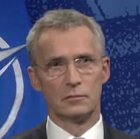
Jens Stoltenberg
Radio Free Europe/Radio Liberty
June 26, 2019
BRUSSELS — NATO defense ministers will gather in Brussels on June 26 for two days of talks that will include defense spending within the alliance, its mission in Afghanistan, and Russia’s alleged violation of a Cold War-era nuclear-arms-control agreement, Secretary-General Jens Stoltenberg said.
Meanwhile, acting U.S. Defense Secretary Mark Esper said he planned to bring up Iran in the talks, hoping to gather support for Washington’s efforts to deter conflict with Tehran and “open the door to diplomacy.”
Outlining the key topics for discussion, Stoltenberg said on June 25 that the ministers will discuss progress on “burden-sharing” among NATO allies, amid persistent calls by U.S. President Donald Trump for increased defense spending to the agreed level of 2 percent of gross domestic product (GDP).
Eight member states are expected to spend at least 2 percent of GDP on defense this year — up from three allies in 2014, he said.
“Today, we are releasing for the first time figures for 2019 defense spending, and I can announce that the real increase for 2019 is 3.9 percent across European allies and Canada,” he said. “So we now have five consecutive years of growth in defense spending.”
By the end of 2020, European allies and Canada “will have added a cumulative total of well over $100 billion since 2016,” the NATO chief added.
Nuclear Forces Treaty
Stoltenberg said that on June 26 ministers will address Russia’s “continuing violation” of the 1987 Intermediate-Range Nuclear Forces (INF) Treaty.
The agreement banned the United States and Russia from developing, producing, and deploying ground-launched cruise or ballistic missiles with ranges of between 500 and 5,500 kilometers.
But in February, the United States suspended its participation in the treaty, with Washington and its allies accusing Russia of deploying a missile system that violates the pact.
Russia, which denies the accusation, later followed suit. Moscow accuses the United States of breaking the accord itself, an allegation rejected by Washington.
“We call on Russia to take the responsible path,” Stoltenberg said, adding that allies were planning to hold a meeting of the NATO-Russia Council next week to raise the matter again.
On June 26, the alliance’s defense ministers will “decide on NATO’s next steps in the event Russia does not comply,” he said, adding that the alliance’s response will be “defensive, measured, and coordinated.”
“We do not intend to deploy new land-based nuclear missiles in Europe. We do not want a new arms race. But, as Russia is deploying new missiles, we must ensure that our deterrence and defense remains credible and effective,” Stoltenberg said.
On June 27, the ministers are due to address the implementation of NATO’s “strengthened deterrence and defense posture,” including the NATO Readiness Initiative.
The initiative aims to enhance the readiness of national forces and their ability to move within Europe and across the Atlantic, as the alliance looks to counter the growing threat from Russia.
In recent years, Russia’s military actions in Ukraine have increased concerns about Moscow’s intentions in NATO nations, particularly former Soviet republics or Warsaw Pact satellites of the Soviet Union.
Russia seized Ukraine’s Crimean Peninsula in March 2014 and backs separatists whose war against Kyiv’s forces has killed some 13,000 people in eastern Ukraine since April of that year.
‘First-Ever Space Policy’
Ministers are also expected to approve NATO’s “first-ever space policy creating a framework for how NATO should deal with the opportunities and challenges in space,” Stoltenberg said.
The secretary-general said that space was “part of our daily lives and while it can be used for peaceful purposes, it can also be used for aggression.”
Afghanistan will also be “an important point” on the ministers’ agenda, with a meeting of all nations contributing to NATO’s Resolute Support Mission, according to Stoltenberg.
“While the security situation remains serious, we see a unique opportunity for peace. Allies fully support U.S. efforts to reach a peaceful settlement in Afghanistan, and our continued commitment — both with forces and funding — is key to creating the conditions for peace,” he said.
U.S. and Taliban negotiators have held several rounds in Qatar to end the nearly 18-year war in Afghanistan. The sides have made progress, but the Taliban has so far rejected direct negotiations with the Western-backed government in Kabul.
The two-day NATO meeting is also expected to include talks on the heightened tensions between Iran and the United States and its Persian Gulf allies.
Last week, Trump approved military retaliation for the shooting down of a U.S. surveillance drone over the Strait of Hormuz but withdrew the order at the last minute.
Iran says the aircraft violated its airspace, while the United States insists it was shot down over international waters.
The United States has also accused Iran of being behind explosions that have damaged six oil tankers in the region over the past weeks. Iran has rejected the accusation.
Esper, who took over this week as U.S. acting defense secretary, told reporters traveling with him to Brussels: “This is not Iran versus the United States. This is Iran certainly versus the region, and arguably the broader global environment.”
He said he wants allies to support “any range of activities” to help deter conflict with Iran.
“This is the reason why we need to internationalize this issue and have our allies and partners work with us to get Iran to come back to the negotiating table and talk about the way ahead,” Esper said.
Tensions between Tehran and Washington have increased since May 2018 when the United States withdrew from a 2015 nuclear deal between Iran and world powers that sought to curb the country’s nuclear program in exchange for an easing of sanctions.
Since the withdrawal, Washington has begun reinstating sanctions to force the Tehran to renegotiate the accord.
With reporting by AP and Rikard Jozwiak in Brussels
Copyright (c) 2019. RFE/RL, Inc. Reprinted with the permission of Radio Free Europe/Radio Liberty, 1201 Connecticut Ave NW, Ste 400, Washington DC 20036.
Related
U.S. Military Says Two Service Members Killed In Afghanistan

A file photo of American soldiers at an unknown location in Afghanistan.
Radio Free Europe/Radio Liberty
June 26, 2019
The U.S. military says two of its service members were killed in Afghanistan on June 26, a day after U.S. Secretary of State Mike Pompeo made a quick visit to Kabul where he said Washington was hopeful of a peace deal “before September 1.”
A statement by the military did not provide any details surrounding the circumstances of the deaths, which bring the tally of U.S. service member fatalities in Afghanistan to at least six this year.
The statement also said the identities of the soldiers would not be released until their families had been notified.
The United States began a fresh push last September to bring the militant group to the negotiating table to end the nearly 18-year Afghan conflict — the longest war in U.S. history.
The U.S. envoy seeking a peace deal, Zalmay Khalilzad, has held six rounds of talks with the Taliban in the Qatari capital, Doha.
The next round is scheduled to begin on June 29.
The talks are expected to focus on working out a timeline for the withdrawal of foreign troops from Afghanistan and on a Taliban guarantee that militants will not plot attacks from Afghan soil.
Before leaving Afghanistan for India, Pompeo on June 25 underscored Khalilzad’s strategy in the talks, which involves four interconnected issues: counterterrorism, the presence of foreign troops, inter-Afghan dialogue and a permanent cease-fire.
“All sides agree that finalizing a U.S.-Taliban understanding on terrorism and foreign troop presence will open the door to intra-Afghan dialogue and negotiation,” Pompeo said.
About 20,000 foreign troops, most of them American, are deployed in Afghanistan.
The Taliban has refused to hold direct talks with the Afghan government, which it calls a “U.S. puppet,” but has said it would talk with government officials if they attend the meetings as ordinary Afghans.
Based on reporting by AP, Reuters, and AFP
Copyright (c) 2019. RFE/RL, Inc. Reprinted with the permission of Radio Free Europe/Radio Liberty, 1201 Connecticut Ave NW, Ste 400, Washington DC 20036.
U.S. Secretary Of State Makes Unannounced Visit To Afghanistan
Radio Free Europe/Radio Liberty
June 25, 2019
U.S. Secretary of State Mike Pompeo said he hopes for a peace deal with the Taliban “before September 1,” as he spoke to reporters in Kabul during an unannounced visit to the Afghan capital on June 25.
Pompeo met with Afghan President Ashraf Ghani and other high-level Afghan officials as well as General Scott Miller, who leads NATO’s Resolute Support Mission and U.S. Forces-Afghanistan.
Pompeo said peace was Washington’s “highest priority” in Afghanistan.
“I hope we have a peace deal before September 1, that’s certainly our mission set,” Pompeo said.
The United States began a fresh push last September to bring the Taliban to the negotiating table to end the Afghan war.
Pompeo’s visit to Kabul comes ahead of a seventh round of peace talks between Taliban leaders and U.S. officials. The next round of talks is scheduled to begin on June 29 in Doha.
The talks will focus on working out a timeline for the withdrawal of U.S.-led troops from Afghanistan and on a Taliban guarantee that militants will not plot attacks from Afghan soil.
“All sides agree that finalizing a U.S.-Taliban understanding on terrorism and foreign troop presence will open the door to intra-Afghan dialogue and negotiation,” Pompeo said.
Pompeo stopped over on his way to New Delhi for meetings with Indian Prime Minister Narendra Modi and other officials. He arrived in Kabul from the Middle East where he held talks with Saudi and United Arab Emirates leaders on the ongoing Iran crisis.
Based on reporting by AFP, Reuters, and RFE/RL’s Radio Free Afghanistan
Copyright (c) 2019. RFE/RL, Inc. Reprinted with the permission of Radio Free Europe/Radio Liberty, 1201 Connecticut Ave NW, Ste 400, Washington DC 20036.
1TV Afghanistan Dari News – June 25, 2019
Afghan forces retake Faryab’s Bilchiragh district from Taliban
 1TV: Afghan force reclaimed Bilchiragh district in northern Faryab province from the Taliban, Defense Ministry said in a statement on Tuesday. Bilchiragh had fallen to insurgents more than 10 months ago. Click here to read more (external link).