
Polls Close In Afghan Election Marred By Attacks, Voting Problems
By RFE/RL’s Radio Free Afghanistan
September 28, 2019
KABUL — Polls have closed in Afghanistan’s presidential election with voting marred by several attacks and reports of problems at polling stations.
Fifteen candidates were on the ballot, but the race was widely seen as a two-horse race between President Ashraf Ghani, who is seeking another five-year term, and Chief Executive Officer Abdullah Abdullah.
Soon after polls opened across the country earlier on September 28, officials in the southern city of Kandahar reported an explosion at a mosque serving as a polling station. Local hospital officials later said at least 15 people had been wounded in the blast, three seriously.
In response to a spate of Taliban attacks in recent weeks, the government has bolstered security to try to ensure what could be the second-ever democratic transition of power in the war-wracked country of 35 million people.
Some 72,000 security personnel were deployed to secure polling centers across the country, which opened at 7 a.m. and were originally scheduled to close at 3 p.m., but the Independent Election Commission later extended voting by two hours until 5 p.m.
Election officials did not immediately share the details on turnout but observers from the Afghanistan Independent Human Rights Commission said turnout appeared to be low, especially among women.
More than 2,000 out of 7,000 polling stations were closed due to the threat of militant attacks. In the past, the Taliban has bombed polling centers and targeted voters, and in recent weeks has warned of more bloodshed if the election takes place.
Besides the attack in Kanadahar, there were also reports of sporadic rocket attacks elsewhere in the country on September 28.
And Reuters reported that explosions also hit the Afghan cities of Kabul, Ghazni and Jalalabad.
Later reports spoke of insurgents firing mortars on the northern city of Kunduz.
Ghulam Rabani Rabani, a council member for Kunduz Province, said Taliban militants had also attacked Afghan security forces in two locations outside the city, in running gun battles.
Voting Issues
Officials said five security officials had been killed in the attacks and 37 civilians wounded.
“The enemy carried out 68 attacks against election sites across the country… but security forces repelled most of the attacks,” Acting Defense Minister Asadullah Khalid said.
Around 9.6 million Afghans were registered to vote in the election, the fourth presidential vote since the U.S.-led invasion toppled the Taliban in 2001.
Yousef Rashid, the head of the Free and Fair Election Forum of Afghanistan, said earlier in the day that voting was generally smoother than in the past, but difficulties had been reported across the country, including problems with the biometric voting devices that are meant to combat voter fraud.
“At some polling stations the voting process has started late, and the biometric system still has a problem, but if we compare it with the previous election these problems are less,” Rashid told RFE/RL’s Radio Free Afghanistan.
Mohammad, a voter in the capital Kabul, complained his name was not on the local voter list.
“I have come here [polling station] with my original national ID card, but they cannot find my name in the voter registration list. I do not know what to do,” he said.
Ghani, 70, and Abdullah, 59, have led a deeply unpopular and fractured national-unity government since a U.S.-brokered power-sharing agreement following a disputed, fraud-marred presidential election in 2014.
A Pashtun, Ghani is from the largest ethnic group. He is a Western-educated technocrat who has served as finance minister. Abdullah, a trained ophthalmologist, was a senior member of the anti-Taliban Northern Alliance and has support among ethnic Tajiks, the country’s second-largest group.
Other high-profile candidates include former intelligence chief Rahmatullah Nabil and Gulbuddin Hekmatyar, the notorious former warlord and militant leader.
The factors underlying the fraudulent elections in 2014 — systemic corruption, widespread political and economic insecurity, and a problematic electoral system — have not been addressed and many observers have warned of another potential dispute.
That scenario could ignite a protracted political crisis and raise the threat of civil war in the multiethnic country.
Observers say the fear of violence and the potential of another disputed election have sapped enthusiasm for the vote, with some expecting record-low turnout.
In 2014, turnout was nearly 60 percent, while only 38 percent of eligible voters cast ballots in chaotic parliamentary elections in October last year that were marred by technical and organizational issues.
If no candidate receives a majority in the first-round vote, a second round will be held on November 23 between the top two finishers.
Preliminary results for the September 28 vote are expected on October 19, allowing electoral bodies to process complaints and tally votes sent to Kabul from remote areas of the mountainous country.
The final results are expected to be announced on November 7.
Copyright (c) 2019. RFE/RL, Inc. Reprinted with the permission of Radio Free Europe/Radio Liberty, 1201 Connecticut Ave NW, Ste 400, Washington DC 20036.
More Election News
- Five Takeaways From Afghanistan’s Presidential Election
- Afghan Polls End, Vote Counting Gets Underway
- Abdullah Calls on Electoral Commissions to Stay Independent
- Hekmatyar: Elections were marked with “widespread fraud” and there would be no Kerry this time to save the day
- Hekmatyar Casts Vote without Having Sticker on His ID Card
Afghan Election: She Can Vote, But Her Husband Decides
Radio Free Europe/Radio Liberty: More than 3 million women are registered to vote in Afghanistan’s September 28 presidential election. But some women are expected to vote for their husband’s choice of candidate.
Related
1TV Afghanistan Dari News – September 27, 2019
Who’s Who Among The Afghan Presidential Candidates
 By Frud Bezhan
Radio Free Europe/Radio Liberty
September 27, 2019
Fifteen men will contest Afghanistan’s presidential election on September 28 in a race among old power brokers — ex-government officials, prominent technocrats, and a notorious former warlord.
The twice-delayed September 28 election is slated to be only the second-ever democratic transition of power in the war-wracked country of 35 million people.
The candidates include some controversial figures from the last four decades of conflict in the country — former cadres of the Soviet-backed communist regime of the 1980s, mujahedin from the civil war that erupted in the early 1990s, as well as members of the Taliban regime that ruled from 1996 until 2001.
Each candidate has entered the race on tickets that include first- and second- vice presidential running mates. These are often the result of political horse-trading that can forge unlikely unions. In a country where no ethnic group can dominate the political scene on its own, candidates cross ethnic lines to choose high-profile running mates who can marshal votes from specific ethnic communities. The results can defy logic and assumptions based on previous electoral alliances and coalitions.
If no candidate receives a majority in the first round of the election on September 28, a second round will be held between the top two finishers.
The Front-Runner
Ashraf Ghani
A Pashtun, President Ashraf Ghani is from the country’s largest ethnic group. He has picked Amrullah Saleh, an ex-intelligence chief and one of the president’s fiercest critics, as one of two running mates. Saleh is a prominent ethnic Tajik, the second-largest ethnic group, with grassroots support among the youth. Ghani did not have a Tajik running mate in 2014.
Ghani controversially chose Abdul Rashid Dostum, a former ethnic Uzbek militia leader who has been accused of serious human rights violations, as his running mate in 2014.
But the two have fallen out since then and Dostum has left the country amid a criminal case launched against him.
Ghani has gained the support of Alem Sa’i, an ethnic Uzbek and a former governor of Jawzjan Province, to tap into the Uzbek voter base usually dominated by Dostum.
Dostum is now backing Abdullah.
Ghani’s other running mate is Sarwar Danish, an ethnic Hazara and a current vice president. The Hazara are the third-largest ethnic group in Afghanistan.
Abdullah Abdullah
Chief Executive Officer Abdullah Abdullah has attempted to seal two important voting blocs — the Hazaras and Uzbeks that together constitute some 20 percent of the population — by courting two longtime ethnic leaders.
Abdullah has gained the support of Mohammad Karim Khalili and Mohammad Mohaqeq, two powerful but controversial former Hazara warlords.
Abdullah’s running mates are Enayatullah Babur Farahmand, an ethnic Uzbek ally of Dostum, and Asadullah Sadati, a Hazara who is backed by Khalili, a former vice president.
Abdullah also has support from Anwar ul-Haq Ahadi, a Pashtun and former finance minister. Ahadi supported Ghani in the 2014 vote but has since established his own party.
Abdullah’s standing among his own ethnic Tajik community has taken a hit. A prominent member of the Tajik-dominated Jamiat-e Islami, Abdullah’s influence in the party has waned and he has lost the support of several party stalwarts.
The Outsiders
Rahmatullah Nabil
The two-time head of Afghanistan’s National Directorate of Security (NDS), the country’s main intelligence agency, Rahmatullah Nabil is a Pashtun from the central province of Maidan Wardak.
Nabil, 51, is an outspoken opponent of the Taliban and its chief backer, Pakistan. He has also been fiercely critical of Ghani’s administration, blaming him for the growing insecurity and endemic government corruption.
His vice presidential running mates are Murad Ali Murad, a Hazara who was the deputy interior minister and an army commander, and Massuda Jalal, an ethnic Tajik who was the former minister of women’s affairs.
Gulbuddin Hekmatyar
Afghanistan’s most notorious former warlord and militant leader, Gulbuddin Hekmatyar, is the head of the Hezb-e Islami militant group that signed a controversial peace deal with the government in 2016.
He has since taken over the leadership of the Hezb-e Islami political party.
Hekmatyar, 70, lives in a government-funded residence in Kabul and is widely despised for his role in the brutal civil war.
His vice-presidential running mates are Fazl ul-Hadi Wazin and Hafiz ul-Rahman Naqi, both ethnic Tajiks who are members of Hezb-e Islami.
Ahmad Wali Massud
Ahmad Wali Massud is the younger brother of Ahmad Shah Masud, the legendary anti-Soviet and anti-Taliban resistance commander who was assassinated by Al-Qaeda two days before September 11. An ethnic Tajik and a prominent member of the Jamiat-e Islami, he served as ambassador to Britain.
Massud, who is 54 years old, has chosen Farida Mohmand, a Pashtun who was a former higher education minister, and Latif Nazari, a Hazara who was educated in Iran and unsuccessfully ran for parliament in 2018, as his vice presidential candidates.
Nur ul-Haq Ulumi
Former General Nur ul-Haq Ulumi, a Pashtun, is a former interior minister.
A former Communist Party member, he was a major figure in the 1980s, when he was a general in the Afghan Army. His running mates are Bashir Bezhan, an ethnic Tajik who is a former journalist who founded a cultural magazine, and Mohammad Naim Ghayur, a former intelligence official hailing from the western city of Herat.
Abdul Latif Pedram
An ethnic Tajik from the northeastern province of Badakhshan, Abdul Latif Pedram heads the National Congress party.
A former lawmaker, he has been accused of being an ethnonationalist. His vice-presidential mates are Ehsanullah Haidari, a Hazara who worked for several international organizations in Kabul; and Mohammad Sadeq Wardak, a Pashtun and former member of the mujahedin.
Nurullah Jalili
A former official in the Taliban regime’s Foreign Ministry, Nurullah Jalili is a wealthy businessman who owns a construction company in Kabul.
His vice presidential candidates are Khalil Roman, an ethnic Tajik communist-era official who served as former President Mohammad Najibullah’s chief of staff; and Cheragh Ali Cheragh, a health official who headed a university in northern Afghanistan.
Faramarz Tamana
Educated in India and Iran, Faramarz Tamana is a former Foreign Ministry official and university lecturer.
His vice presidential candidates are Sayyed Qias Saidi, a Pashtun who worked for UNICEF; and Mohammad Amin Reshadat, a Hazara who is the chancellor of a private university in Kabul.
Hakim Tursan
An ethnic Uzbek, Hakim Tursan was an intelligence official under Soviet-era ruler Najibullah.
He graduated from Kabul University with a degree in Persian literature. His running mates are Nader Shah Ahmadzai, a Pashtun who heads a Kabul-based think tank; and Mohammad Shafi Qaisari, another ethnic Uzbek and former communist.
Mohammad Ibrahim Alekozai
A Pashtun who is a tribal elder in Kandahar, Mohammad Ibrahim Alekozai has chosen Khadija Ghaznawi, a Hazara who owns her own logistics company; and Sayyed Same Kayani, from the minority Shi’ite Ismailis in northern Afghanistan, as his vice presidential candidates.
Ghulam Faruq Nejrabi
An ethnic Tajik, Ghulam Faruq Nejrabi is a surgeon from Kapisa Province. His running mates are Sharifullah and Mohammad Sharif Babakarkhel.
Nur Rahman Liwal
A Pashtun, Nur Rahman Liwal is the owner of a software company in Kabul. His vice presidential candidates are Abdul Hadi Zul-Hekmat and medical doctor Mohammad Yahya Wyar.
Enayatullah Hafiz
A Hazara who has a literature degree, Enayatullah Hafiz’s running mates are Jannat Khan Fahim Chakari, an ex-army officer; and Abdul Jamil Shirani, a former employee of the Afghan Independent Human Rights Commission.
Mohammad Shahab Hakimi
A Pashtun from the Maidan Wardak Province, Hakimi worked as a university lecturer in Kabul and most recently as the director of the Mine Detection Center. His running mates are Nur ul-Habib Hasir and Abdul Ali Sarabi.
NOTE: An earlier version of this article was published on August 7
Copyright (c) 2019. RFE/RL, Inc. Reprinted with the permission of Radio Free Europe/Radio Liberty, 1201 Connecticut Ave NW, Ste 400, Washington DC 20036.
Related
- Only Biometric-Confirmed Votes Will Be Counted: IEC
- 445 Polling Centers Will Remain Closed On Election Day
- Badghis Residents On Election: No Ideas, No Candidates Showed Up
- Gen. Waziri To Taliban: Election Is Step Towards Peace Talks
- Afghan Security Officials Assure Full Preparation For the Election Day
- Pakistan Shuts Border With Afghanistan Ahead Of Presidential Poll
- Ignoring UNAMA, Taliban Threaten Afghan Elections Again
- US Sec. Pompeo To Ghani: We Expect A Legitimate Election
Ghani Rules Out Forming Another Unity Government, Rejects Threat Of Civil War
By RFE/RL’s Radio Free Afghanistan
September 26, 2019
Afghan President Ashraf Ghani says his country needs “one president, not two,” telling RFE/RL that if he wins a presidential election on September 28 he won’t accept another national unity government.
The 70-year-old Ghani and Chief Executive Abdullah Abdullah have ruled through a deeply unpopular and fractured power-sharing arrangement since a disputed presidential election in 2014.
“Afghanistan will have one president, not two,” Ghani told RFE/RL’s Radio Free Afghanistan in an interview in the capital Kabul on September 25. “A national unity government is no longer acceptable.”
Ghani and Abdullah, 59, are again front-runners in the vote, which could potentially be the country’s only second democratic transfer of power.
Campaigning has been marred by deadly Taliban attacks, accusations against Ghani of abuse of authority, and fears of mass fraud and vote-rigging.
The factors underlying the elections in 2014 — systemic corruption, widespread insecurity, and a problematic electoral system — have not been addressed and many observers have predicted another potential dispute.
The bitter, fraud-marred 2014 vote pushed Afghanistan to the brink of civil war before the power-sharing deal was brokered by U.S. Secretary of State John Kerry.
“Our national security forces are completely impartial, they are the protectors of the law, and the dangers and threats that existed then don’t exist now,” Ghani said.
After Ghani was declared the winner of the runoff in 2014, Abdullah alleged mass-scale vote-rigging and his supporters threatened violence.
Confident He Will Win
Ghani said U.S. mediation would not be necessary, adding that he was confident he would win the election.
“The use of armed forces is completely out of the question,” he said. “The people of Afghanistan will defend their free and fair votes.”
Ghani’s rivals, including Abdullah, have accused the president of abuse of power and using government resources for his personal gain.
For his part, Abdullah alleged in an interview with the Associated Press on September 26 that the vote is threatened by widespread abuses of power by Ghani.
“My main concern will be that massively fraudulent elections…will have an impact on the mentality of the people, on the views of the people, the democratic process, whether it is functioning or not,” Abdullah said. “If it is not functioning, what’s the other way to go ahead with your goals?”
Ghani responded by saying a “special court” should try his challengers for making corruption claims against him and “if they can’t prove their claims, they should be tried and sent to jail.”
Earlier this month, Ghani used a police training center in the northern province of Parwan as the venue of a rally, a violation of electoral rules.
“So, where should we have held it?” he said, adding the site was selected to protect peoples’ lives.
Even then, a Taliban suicide bomber killed 26 people after detonating his explosives near the crowd on September 17.
Observers say the fear of violence and the potential of another fraudulent election have sapped enthusiasm for the vote, with some expecting a record-low turnout.
Turnout for the 2014 election was nearly 60 percent, while only 38 percent of eligible voters cast ballots in chaotic parliamentary elections in October last year that were marred by technical and organizational issues.
More than 2,000 out of 7,000 polling stations will be closed due to the threat of militant attacks. In the past, the Taliban has bombed polling centers and targeted voters.
If no candidate receives a majority in the first-round vote — a scenario considered unlikely — a second round will be held on November 23 between the top two finishers.
Copyright (c) 2019. RFE/RL, Inc. Reprinted with the permission of Radio Free Europe/Radio Liberty, 1201 Connecticut Ave NW, Ste 400, Washington DC 20036.
Related
Other Election News
Taliban Lifts Ban On WHO Vaccine Operations In Occupied Afghan Territories
 Radio Free Europe/Radio Liberty
September 25, 2019
Taliban militants in Afghanistan have lifted a ban on World Health Organization (WHO) activities in areas they control, another apparent move by the extremist group to improve their image following the collapse of peace talks with the United States.
The move announced on September 25 reversed a decision made in April when the extremist group barred the WHO and the International Committee of the Red Cross (ICRC) from operating in its occupied territories, accusing the groups of carrying out “suspicious” activities associated with polio-vaccination campaigns.
“After realizing its shortcomings and following constant contact and meetings with our representatives, the WHO received permission for their activities,” Zabihullah Mujahid, a spokesman for the Taliban, said in a statement.
The ban had threatened to intensify a major humanitarian crisis in Afghanistan, one of three countries in the world where the disease is endemic.
The Taliban on September 15 revoked its ban on the ICRC and restored its guarantee for the security of Red Cross staff doing humanitarian work in Afghanistan, but it did not mention the WHO.
At the time, Schaerer Juan-Pedro, who leads the ICRC delegation in Afghanistan, wrote on Twitter that “we welcome the acknowledgment of our humanitarian principles and renewal of security guarantees to enable us [to] work in Afghanistan.”
In its September 25 statement, the Taliban offered a guarantee of safety for WHO staff. But the group also insisted that the WHO conduct only health-related work, get the extremists’ permission before hiring workers, and carry out vaccine campaigns only in health centers.
The UN health agency did not immediately respond to an e-mailed request for comment.
The Taliban controls or is active in more than half of Afghanistan’s 410 districts.
The Western-backed central government in Kabul is battling the resurgent Taliban for control of the country.
Zalmay Khalilzad, the U.S. special envoy to Afghanistan, has conducted at least nine rounds of talks in Qatar with the Taliban, which has so far refused to negotiate directly with the government in Kabul, calling them “puppets.”
Khalilzad reported that he had reached an agreement in principle with the Taliban in which Washington would pull out troops and the militants would promise to break with Al-Qaeda and prevent Afghanistan from becoming a haven for terrorists.
However, the peace talks collapsed in early September after President Donald Trump cited an attack that killed an American soldier as his reason for calling off negotiations.
Trump proclaimed the negotiations “dead” and he scrapped planned secret talks with the group at Camp David.
The Taliban on September 18 said “doors are open” to resuming talks with the United States despite continuing violence ahead of a presidential election on September 28.
The Taliban’s chief negotiator, Mohammad Abbas Stanikzai, made the statement after two recent attacks claimed by the militants killed at least 48 people in Afghanistan.
With reporting by Reuters and Tolo News
Copyright (c) 2019. RFE/RL, Inc. Reprinted with the permission of Radio Free Europe/Radio Liberty, 1201 Connecticut Ave NW, Ste 400, Washington DC 20036.
Ghani, Abdullah Facing Off In Two-Horse Afghan Presidential Race

Abdullah (left) and Ghani (right)
By Frud Bezhan
Radio Free Europe/Radio Liberty
September 25, 2019
A bitter, fraud-marred presidential election in 2014 pushed Afghanistan to the brink of civil war before a power-sharing deal was reached between Ashraf Ghani and Abdullah Abdullah, who became president and chief executive officer.
Five years on, even as 13 other candidates vie for the presidency, the race is shaping up again as a two-horse race between Ghani, a Western-educated technocrat, and Abdullah, a trained ophthalmologist who was a senior member of the anti-Taliban Northern Alliance before the U.S.-led invasion of Afghanistan in late 2001.
As leaders of the deeply unpopular and fractured national-unity government, both men’s reputations have been tarnished.
But with no viable challengers, they are front-runners in an election that features former mujahedin fighters, warlords, and communists.
With so much at stake in a two-way contest, observers warn of a possible repeat of the large-scale vote-rigging and fraud that marred the last presidential poll.
It’s a scenario that could ignite a protracted political crisis and potential intercommunal violence.
No ‘Viable Challenger’
Ghani and Abdullah’s weak and unwieldly national-unity government (NUG) has proved unable to curb soaring violence, alleviate entrenched poverty, or tackle rampant government corruption since coming to power.
Under their watch, ethnic tensions and political infighting have spiraled while unemployment and militant violence have soared.
The withdrawal of most foreign combat troops at the end of 2014, decreasing economic aid and investment, and the rise of Islamic State (IS) extremists in Afghanistan in 2015 have been destabilizing factors. But both are in a weaker position than in 2014.
“Both candidates have a more difficult run with the electorate because of the fatigue with the NUG, the worsening security and economic situations, and also the lack of credibility of the elections in 2014 and the dismal outcomes from the last parliamentary elections [in 2018],” says Hameed Hakimi, a research associate at the London-based Chatham House think tank.
The absence of a credible challenger has propelled Ghani and Abdullah as front-runners.
Ghani and Abdullah were expected to face a stiff challenge from Hanif Atmar, the president’s powerful former national-security adviser. But his electoral ticket unraveled amid political infighting, clearing the path for a two-horse race. Atmar has said he will not support any other candidate.
“The political elites were unable to come up with a viable challenger,” says Thomas Ruttig, co-director of the independent Kabul-based Afghanistan Analysts Network.
As a result, Ruttig says, Afghanistan’s political system has become “stagnant.”
As incumbents, Ghani and Abdullah have the added advantage of wielding power for five years, says Graeme Smith, an Afghanistan analyst and a consultant for the International Crisis Group.
“Both of them have installed allies in key positions across the government, although Ghani has been significantly more successful than Abdullah and now enjoys a high degree of control over the state apparatus,” Smith says.
Many of the presidential candidates have alleged that Ghani is manipulating the electoral process in his favor and using state resources for personal gain.
‘Ethnic Politics’
Ghani, 70, and Abdullah, 59, have sought new allies to help propel them to victory.
In a country where no ethnic group can dominate the political scene on its own, candidates cross ethnic lines to choose high-profile running mates who can marshal votes from different ethnic communities
A Pashtun, Ghani is from the country’s largest ethnic group. He has picked Amrullah Saleh, an ex-intelligence chief and one of the president’s fiercest critics, as one of two running mates. Saleh is a prominent ethnic Tajik, the second-largest ethnic group, with grassroots support among the youth. Ghani did not have a Tajik running mate in 2014.
Ghani controversially chose Abdul Rashid Dostum, the former ethnic Uzbek militia leader who has been accused of serious human rights violations, as his running mate in 2014.
But the two have fallen out since then and Dostum has left the country amid a criminal case launched against him.
Ghani has gained the support of Alem Sa’i, an ethnic Uzbek and a former governor of Jawzjan Province, to tap into the Uzbek voter base usually dominated by Dostum.
Dostum is now backing Abdullah.
Ghani’s other running mate is Sarwar Danish, an ethnic Hazara and a current vice president. The Hazara constitute the third-largest ethnic group in Afghanistan.
Meanwhile, Abdullah has attempted to seal two important voting blocs — the Hazaras and Uzbeks that together constitute some 20 percent of the population — by courting two longtime ethnic leaders.
Abdullah has gained the support of Mohammad Karim Khalili and Mohammad Mohaqeq, two powerful but controversial former Hazara warlords.
Abdullah’s running mates are Enayatullah Babur Farahmand, an ethnic Uzbek ally of Dostum, and Asadullah Sadati, a Hazara who is backed by Khalili, a former vice president.
Abdullah also has support from Anwar ul-Haq Ahadi, a Pashtun and former finance minister. Ahadi supported Ghani in the 2014 vote but has since established his own party.
Abdullah’s standing among his own ethnic Tajik community has taken a hit. A prominent member of the Tajik-dominated Jamiat-e Islami, Abdullah influence in the party has waned and he has lost the support of several party stalwarts.
“Ghani is targeting two key groups, the youth, through a social-media campaign, and community leaders,” says Ruttig. “Abdullah has concentrated on the usual ethno-political alliance building, mainly in the mujahedin camp.”
Hakimi says there has been a “regravitation” towards ethnic politics.
“Abdullah is trying to win the typical constituencies that are not going to vote a Pashtun candidate into office while Ghani has done the same by focusing almost entirely on reconnecting with the Pashtun voter base,” he says.
Problems ‘Worse Than Ever’
The bitter experience of 2014 has taught Ghani and Abdullah that the election does not end when the ballots have been cast.
“Both sides are bracing for a turbulent postelection period,” says Smith.
The factors underlying the fraudulent elections in 2014 — systemic corruption, widespread insecurity, and a problematic electoral system — have not been addressed. Many see another potential dispute. Other observers are expecting a record-low turnout.
“Some of the systemic problems are now worse than ever — especially security, which appears to be putting greater pressure on the electoral process than during previous years,” says Smith.
More than 2,000 out of 7,000 polling stations will be closed due to the threat of militant attacks. In the past, the Taliban has bombed polling centers and targeted voters.
The September 28 vote will be the second time Afghanistan goes to the polls using biometric voter verification, a system that caused chaos during last October’s parliamentary elections when devices malfunctioned, went missing, or were not used by untrained electoral staff.
After Ghani was declared the winner of the runoff in 2014, Abdullah alleged mass-scale vote-rigging and his supporters threatened violence.
A recount was launched and hundreds of thousands of allegedly rigged votes were thrown out. But the final results were never published after the rivals reached an agreement brokered by the United States.
If no candidate receives a majority in the first-round vote — a scenario considered unlikely — a second round will be held on November 23 between the top two finishers.
“My biggest fear is who is going to do mediation if there is a serious dispute this time,” says Hakimi. “Can we expect any interest, or indeed constructive involvement, from the Trump administration?”
Other observers say another postelection crisis is less likely.
“Although the problems persist, it’s unlikely to lead to a repeat of 2014,” says Javid Ahmad, a senior fellow at the Washington-based Atlantic Council. “All sides realize that given the shrinking U.S. presence, Afghanistan cannot afford more chaos.”
Other Election News
- IEC Assures ‘Fully Prepared’ for Presidential Elections
- UN Urges Safe Environment For Afghan Election
- Hekmatyar threatens violence if election results unacceptable
- Politicians Warn That Election Could Deepen Afghan Crisis
- Afghanistan Elections: Ghani Pledges Accountability
- Abdullah Confident He Will Win On Election Day
- Election Will Plunge Afghanistan Deeper Into Violence: Karzai
1TV Afghanistan Dari News – September 25, 2019
Afghan Reporter Dies From Blast Wounds, Seventh Journalist Killed In Country This Year
Abdul Hamid Hotaki
Radio Free Europe/Radio Liberty
September 25, 2019
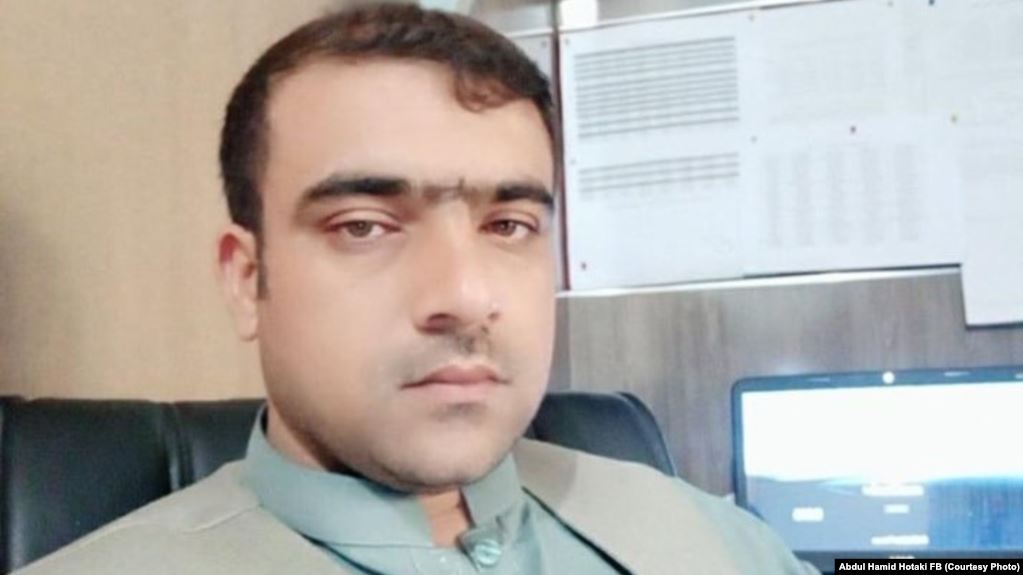
An Afghan reporter has died from injuries suffered in an explosion near the election campaign headquarters of President Ashraf Ghani in the city of Kandahar.
Hewad TV said in a Facebook post on September 25 that Abdul Hamid Hotaki died in hospital from “heavy wounds” suffered in the blast, which killed three others, including a child, and wounded at least seven.
“Hotaki is the seventh journalist to be killed in #Afghanistan in 2019,” the Afghanistan Journalists Center said in a tweet noting Hotaki’s death.
The Interior Ministry has blamed the attack on Taliban militants, though no one has taken responsibility for the explosion, which comes just days before a presidential election on September 28.
Afghanistan is the world’s deadliest conflict, and security fears have been a hallmark of the campaign, even in the heavily guarded capital, Kabul.
Ghani, the incumbent, has mostly campaigned remotely, addressing small gatherings outside the heavily militarized capital via Skype or telephone.
Ghani and his leading rival, Abdullah Abdullah, are expected to place first and second respectively among the 16 candidates in the election. The top two vote getters will then head to a runoff election.
A suicide bombing that killed 26 people last week near an election rally in Parwan Province, north of Kabul, where Ghani was due to speak, came as a sharp reminder of the dangers.
The Taliban group that ruled much of the country until 2001 and opposes Afghanistan’s central government is estimated to control or contest nearly half of Afghanistan’s 400 districts, depriving many in rural regions of the right to vote.
The Taliban considers the Afghan government a U.S. puppet and has warned Afghans not to vote, saying that polling stations will be targeted by militant attacks.