
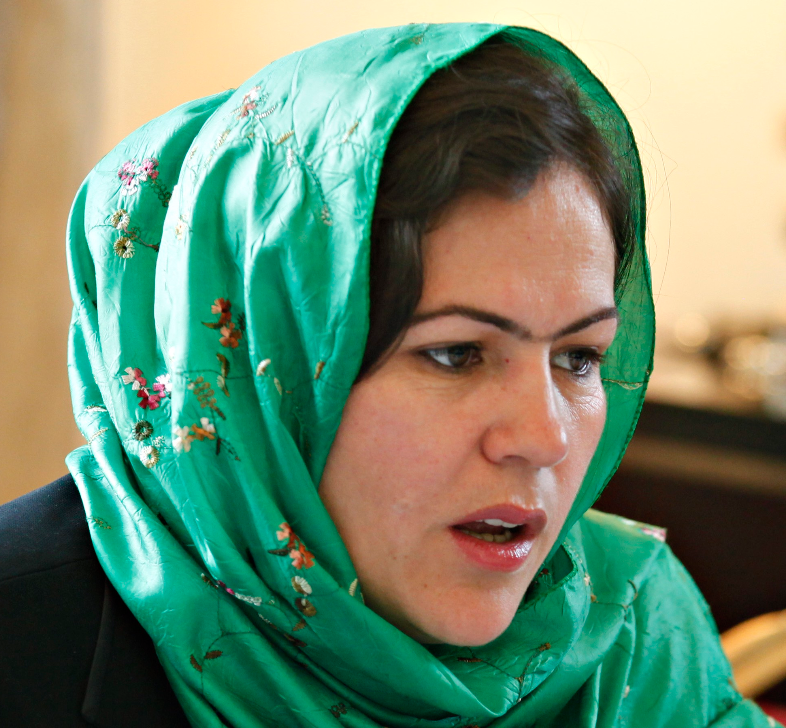
Reuters: The first female founder of an Afghan political party has urged the country to rethink the use of facial recognition technology in elections amid concerns it stopped large numbers of women from voting this year. Authorities photographed all voters in September’s presidential election and used facial recognition software, a measure designed to combat fraud that women’s rights activists say deterred female voters from participating. “Women should be able to vote – it is their right. So anything that impedes that right is a problem,” the politician and women’s rights campaigner Fawzia Koofi told the Thomson Reuters Foundation in Kabul. Click here to read more (external link).
Pakistan Prefers Weak Gov’t in Kabul, Says US Congressional Report
Ariana: Pakistan prefers a weak government in Kabul and has played an active, and by many accounts, a negative role in Afghan affairs for decades, a U.S. Congressional report has said. In its latest report on Afghanistan, the independent and bipartisan Congressional Research Service (CRS) identified Pakistan, the most important neighbor of Afghanistan. However, it said, Pakistan continuously had friendly relations with terrorist groups operating in Afghanistan such as the Taliban and the Haqqani Network. Click here to read more (external link).

Related
1TV Afghanistan Dari News – November 7, 2019
Afghanistan remains world’s least safe country: Gallup poll
1TV: Afghanistan has been ranked as the least safe country in the world in 2018, according to a new global poll. The annual survey by Gallup asked if people felt safe walking at night and whether they had been victims of crime. Singapore, Tajikistan and the United Arab Emirates scored highest, respectively for law and order. Singapore, Norway and UAE were most safe countries. Click here to read more (external link).
IS in Afghanistan seeking to expand to Central Asia: Russia
1TV: “We have recorded a surge in activity of ISIS units in Afghanistan, united in the so-called Wilayah Khorasan,” Alexander Bortnikov said at the Council of the Heads of Security Agencies and Intelligence Services of the Central Asian states. Due to their looming defeat in Syria and Iraq, international terrorist organizations are hastily withdrawing their remaining forces from the Middle East and are creating new zones of instability in Asia and Africa, as well as creating a network of sleeper cells in Europe. Click here to read more (external link).
A Clean Break: Afghan Women Make Soap To Recover From Opium Addiction
AFP via Radio Free Europe/Radio Liberty: Afghanistan has a drug problem from the abundant poppies that get made into opium. A group of Afghan women has found a way out of their addiction through a different crop.
Three Afghan Judges Killed In ‘Taliban’ Ambush
RFE/RL’s Radio Free Afghanistan
November 7, 2019
KABUL — Three Afghan judges and an administrative officer have been ambushed and shot dead while they were traveling from the southeastern province of Paktia to Kabul, officials say.
The spokesman for Paktia Province’s governor told RFE/RL that the ambush took place on November 6 in the Mohammad Agha district of neighboring Logar Province, south of the country’s capital.
Taliban militants stopped the vehicle the four victims were travelling in and shot them, the spokesman said.
The incident was confirmed by Logar police chief Rahm Khoda Mokhlis.
The militant group, which has been blamed for previous ambushes on the highway linking Logar Province to Kabul, did not confirm it was behind the latest attack.
Copyright (c) 2019. RFE/RL, Inc. Reprinted with the permission of Radio Free Europe/Radio Liberty, 1201 Connecticut Ave NW, Ste 400, Washington DC 20036.
Reported Attack In Tajikistan Could Have Broad Implications For Central Asia
By Bruce Pannier
Radio Free Europe/Radio Liberty
November 6, 2019
A deadly attack on a Tajik border post reported early on November 6 is disturbing for many reasons, including the fact Tajik officials are blaming the so-called Islamic State (IS) militant group for the assault that authorities say left at least two security servicemen and 15 militants dead.
The alleged attack has raised alarms across the southern parts of Central Asia and will no doubt be duly noted by the Kremlin, where officials have long warned of such a possibility. Tashkent, the Uzbek capital, is also sure to take notice.
Tajik security officials have given few details about the attack — just a few kilometers from Uzbekistan and 60 kilometers west of Dushanbe — but said in a quickly released statement by the Border Guard Service that 20 people crossed from the Qala-e Zal district in Afghanistan’s northern Kunduz Province on November 3 into Tajikistan’s Qubodiyon district.
The group — which reportedly included at least one woman, according to the Interior Ministry — apparently acquired four vehicles and drove to the Ishkobod border post in the Rudaki region. Some of the attackers are said to have acquired five weapons before they were surrounded after a chase and 15 of them were killed. Five others were allegedly caught a few kilometers away after fleeing and were detained, the statement said.
Photos released by Tajik officials showed several severely burned bodies surrounding two badly damaged vehicles, one completely burnt-out. The pictures — which included what appeared to be a deceased attacker with his hands bound by plastic handcuffs — were deleted later on November 6 from the Interior Ministry’s website.
Until now there has been no evidence of militants having crossed from Afghanistan into a Central Asian country. It is also noteworthy that the northeastern part of Afghanistan bordering the area near where the attack occurred is known to be under the control of the Taliban, not IS.
Several observers have also pointed to the scant details of the attack and question why the militants would raid a border post to seize weapons when arms are so plentiful in Afghanistan.
Officials in Russia’s Federal Security Service (FSB) and the Defense and Foreign ministries have said for several years that the IS presence in Afghanistan is growing and could threaten Central Asia.
Russian Security Council Secretary Nikolai Patrushev made such points during a two-day visit to Dushanbe and Tashkent on October 30-31, warning of “challenges and threats to security” in the region.
Russian officials have estimated there are thousands of IS militants in northern Afghanistan near Central Asia.
But before this attack there was no evidence of an incursion into Central Asia by Islamic militants from Afghanistan, though there was a deadly assault on foreign bicyclists near the town of Danghara in July 2018.
A small group of men who had recently sworn allegiance to IS used a car to ram into the bicyclists and then attack them with axes and knives, killing four. Security forces killed four of the assailants and captured a few others, all of whom had been living in Tajikistan.
Watchful Eyes On The Frontier
The identities of those involved in this latest attack have not been revealed by Tajik authorities but the assertion they came from Afghanistan heightens security concerns not only on the Tajik-Afghan border, but also along Uzbekistan and Turkmenistan’s borders with war-torn Afghanistan.
Neither of those latter countries is a member of the Russia-led Collective Security Treaty Organization, where Russian officials have been ringing the alarm bell about IS in northern Afghanistan for several years.
Coincidentally, there was a meeting on November 6 in Tashkent involving officials from the Russia-led Commonwealth of Independent States (CIS) and the Shanghai Cooperation Organization (SCO) discussing how best to combat terrorism.
Russian officials have increasingly referred to Central Asia’s border with Afghanistan as the “CIS southern border” and chided Turkmenistan for not cooperating with the organization’s security efforts.
SCO member China has also helped Tajikistan shore up security in its sparsely inhabited, eastern mountainous regions to prevent militants in Afghanistan from penetrating Tajikistan and crossing into China.
Beijing will likely follow the progress of Dushanbe’s investigation into the November 6 attack with great interest.
The day of the attack is also notable as it comes on Tajikistan’s Constitution Day, with November 6 being the day, 25 years ago, when Tajiks approved a new constitution and Emomali Rahmon was elected president for the first time.
Whatever the motive for the reported attack and whomever the alleged attackers were, the problem is that IS is being blamed for an attack in Central Asia that was carried out by people who allegedly came from Afghanistan.
If no compelling evidence surfaces to refute the Tajik government’s version of events, then the Central Asian countries, Russia, and China may have to reformulate their strategies based on real — not hypothetical — threats in Central Asia.
The views expressed in this blog post do not necessarily reflect those of RFE/RL
Copyright (c) 2019. RFE/RL, Inc. Reprinted with the permission of Radio Free Europe/Radio Liberty, 1201 Connecticut Ave NW, Ste 400, Washington DC 20036.
Related
Too Early to Judge Panipat: Afghan Film
Ariana: Officials in the Afghan Film, a state-owned institution, said Wednesday that it is too early to have a judgement about Panipat. Panipat is an upcoming 2019 Indian historical film that portrays the “Third Battle of Panipat” fought between Indian army and forces of King Ahmad Shah Abdali, who is regarded as founder of modern state of Afghanistan. Indian famous actor Sanjay Dutt has played the role of King Abdali. The film, which is directed by Ashutosh Gowariker, is scheduled to release on 6 December 2019. Click here to read more (external link).
1TV Afghanistan Dari News – November 6, 2019


