
 Tolo News: So far, the details of Abdullah’s proposed plan have not been made public, but sources told TOLOnews recently that Abdullah has accepted the leadership of the High Council of Peace and Reconciliation but he has asked for 50 percent share in the cabinet and executive authorities in the appointment of governors and police chiefs in some provinces. Click here to read more (external link).
Afghan authorities investigate claims Iranian forces threw migrants into river
 1TV: An Afghan delegation will investigate claims that Iranian guards threw a group of migrants crossing the border into river, an official told 1TV on Saturday. Preliminary reports suggest the migrants were thrown into river after crossing the border from Gulran district of Herat province. Click here to read more (external link).
Related
Pashtun Rights Activist Dies After Shooting Attack In Pakistan’s Tribal Areas

Sardar Arif Wazir
By RFE/RL’s Radio Mashaal
May 2, 2020
Pashtun rights activist and political leader Sardar Arif Wazir has died of injuries sustained in a shooting attack in Pakistan’s South Waziristan tribal district.
The Pashtun Tahaffuz Movement (PTM), a rights group that Wazir helped lead, confirmed to RFE/RL’s Radio Mashaal that Wazir died in Islamabad on May 2.
Wazir was injured when the vehicle he was traveling in came under fire in the city of Wanna.
The attackers, who fired from another vehicle, have not been identified.
Police officials have confirmed that a search operation is under way to find the perpetrators of the attack, for which no group has claimed responsibility.
The rights watchdog Amnesty International on May 2 called on “the Pakistani authorities to carry out an independent and effective investigation.”
The attack came after Pakistani police arrested Wazir on April 17 for delivering an “anti-Pakistan” speech during a recent visit to Afghanistan. He was released on bail this week.
Mohsin Dawar, a member of Pakistan’s lower house of parliament and prominent figure in the PTM, earlier accused “state-sponsored militants” of carrying out the attack.
“The masters of the attackers should know that bullets, injuries, and prisons can’t weaken our resolve,” he wrote on Twitter.
There was no immediate response from the government.
The PTM has campaigned for civil rights for Pashtuns, the country’s largest ethnic minority, since 2018.
The group has attracted tens of thousands of people to public rallies to denounce the powerful Pakistani Army’s heavy-handed operations against militants in tribal regions that have killed thousands of Pashtun civilians and forced millions more to abandon their homes since 2003.
The PTM has been calling for the removal of military checkpoints in tribal areas and an end to “enforced disappearances,” in which suspects are detained by security forces without due process.
Pakistan’s government rejects allegations that its security forces and intelligence agents are responsible for forced disappearances.
Since the movement was formed in January 2018, international rights groups say authorities have banned peaceful rallies organized by the PTM and some of its leading members have been arbitrarily detained and prevented from traveling within the country. Some members have also faced charges of sedition and cybercrimes.
The Human Rights Commission of Pakistan (HRCP) has said the authorities have made allegations of anti-state activities “an expedient label for human rights defenders, particularly those associated with the PTM.”
Copyright (c) 2020. RFE/RL, Inc. Reprinted with the permission of Radio Free Europe/Radio Liberty, 1201 Connecticut Ave NW, Ste 400, Washington DC 20036.
Hundreds of Nations, Entities Endorse UN Global Ceasefire as Afghan War Escalates
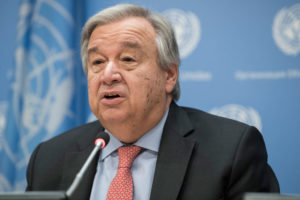
Antonio Guterres
Michael Hughes: The Taliban continuing attacks amid the coronavirus outbreak reveals not only a total disregard for life but a suicidal mentality given all of humanity’s real enemy is an invisible indiscriminate killer – it chooses no sides, sees no jersey colors.
An escalation in Taliban attacks comes just as the rest of the world is at least toying with the idea of reducing violence. On Thursday, April 30, UN Secretary-General Antonio Guterres announced that hundreds of entities – from nation-states to rebel groups – have agreed to adhere to an international cessation of hostilities to help contain a pandemic that has killed over 233,000.
US Troop Reduction Plan on Track in Afghanistan

A file photo of American soldiers at an unknown location in Afghanistan.
By Ayaz Gul
VOA News
May 1, 2020
ISLAMABAD – The U.S. military said Friday its withdrawal from Afghanistan is continuing and that it expects troop levels to drop to 8,600 by mid-July under terms of a peace-building deal with the Taliban.
The “conditions-based” military withdrawal began within days after the signing of the landmark agreement with the Islamist insurgency on February 29, when the number of total American troops in the country stood at around 13,000.
The agreement also calls for the withdrawal of all American personnel from Afghanistan, along with coalition partners, by July 2021.
“We are not providing updates on current troop levels primarily due to operational security concerns associated with the drawdown,” a U.S. military spokesman told VOA when asked for a reaction to media reports the number of service members had already fallen to fewer than 10,000.
“U.S. Forces Afghanistan (USFOR-A) continues to reduce force levels and expects to be at 8,600 U.S. troops within 135 days (mid-July) as stipulated by the U.S.-Taliban agreement,” the spokesman noted in the statement.
The Islamist insurgent group is obliged under the accord to prevent terrorist groups from using Afghan soil for international terrorism and halt attacks on U.S.-led international forces.
Increase in Taliban attacks
Meanwhile, the Taliban has continued to wage deadly attacks against Afghan forces in Afghanistan. Officials told VOA an early Friday bomb and gun insurgent raid on a military base in southern Helmand province killed at least 10 soldiers.
A regional Afghan military spokesman confirmed the killing of a soldier in adjoining Kandahar province in a Taliban attack that also wounded three security personnel.
Insurgent attacks have escalated in Afghanistan as the annual spring fighting season arrives amid concerns the U.S. military drawdown is encouraging the Taliban to intensify its violent campaign against the Kabul government.
“USFOR-A remains committed to supporting our Afghan partners throughout the process and maintains the capabilities and authorities necessary to accomplish our train, advise and assist and counterterrorism objectives,” said the U.S. military spokesman, apparently responding to the concerns.
Stalled Afghan peace talks
The U.S.-Taliban agreement binds the insurgents to engage in a political reconciliation dialogue with other Afghan groups, including the government in Kabul, to negotiate a permanent cease-fire and power-sharing arrangement in the post-war Afghanistan.
But the proposed intra-Afghan negotiations, which were supposed to begin on March 10, have stalled because of an extremely slow-moving prisoner swap between the Taliban and Afghan government, which was not part of the agreement.
The peace building deal called for the release of up to 5,000 insurgent prisoners from Afghan jails in exchange for 1,000 government personnel being held by the Taliban.
Around 550 Taliban inmates have so far been released while the insurgents have set free more than 100 prisoners. The Taliban has ruled out peace talks until all of the insurgent inmates are released.
Another obstacle in the way of implementation of the agreement is the lingering political crisis stemming from the disputed presidential election in Afghanistan.
Incumbent President Ashraf Ghani was officially declared the winner of the September 28 polls, but runner-up Abdullah Abdullah rejected the outcome, paralyzing governance in the turmoil-hit country.
The two rivals held competing inauguration ceremonies in March, ignoring U.S. calls for ending the dispute in favor of an “inclusive” government to help move the peace process with the Taliban to end decades of deadly hostilities in Afghanistan.
Abdullah, however, tweeted Friday his team has made progress in negotiations with the Ghani camp to resolve the political crisis, saying the two sides have “reached a tentative agreement on a range of principles.”
He did not elaborate, saying details of the proposed agreement are still being finalized as soon as possible.
Looming COVID-19 threat
The slow progress in the U.S.-Taliban deal and the political crisis come amid the threat of the coronavirus, which causes the COVID-19 disease.
Taliban political spokesman Suhail Shaheen, while announcing the release of a fresh batch of dozens of government prisoners on Thursday, maintained it “is trying to speed up prisoners’ release process in order to save lives of the prisoners from the risk of the coronavirus disease.”
A U.S. government agency in a report submitted to the U.S. Congress this week has warned Afghanistan is likely facing a “health disaster” from COVID-19.
The warning from the Special Inspector General for Afghanistan Reconstruction, also known as SIGAR, comes as Afghan officials say the pandemic has killed 68 people and infected close to 2,400 others.
“Afghanistan’s numerous and, in some cases, unique vulnerabilities – a weak health-care system, widespread malnutrition, porous borders, massive internal displacement, contiguity with Iran, and ongoing conflict – make it likely the country will confront a health disaster in the coming months,” SIGAR said.
1TV Afghanistan Dari News – May 1, 2020
Afghan President, Chief Rival Reach ‘Tentative Agreement’ To End Months-Long Feud

Abdullah (left) and Ghani (right)
Radio Free Europe/Radio Liberty
May 1, 2020
Afghan President Ashraf Ghani and his rival, Abdullah Abdullah, appeared close to ending a months-long political crisis that has undermined peace talks with the Taliban and the country’s response to the COVID-19 pandemic.
Abdullah said in a series of tweets on May 1 that progress in negotiations with Ghani to end the political impasse “reached tentative agreement on a range of principles.”
Glad to assure the people of AFG that efforts by respected national personalities to resolve the political crisis have borne fruit. We have made progress in negotiations & reached tentative agreement on a range of principles. Work on details is underway to finalize the agreement.
— Dr. Abdullah Abdullah (@DrabdullahCE) May 1, 2020
He did not provide details of the agreement.
Abdullah, who previously served as Afghanistan’s chief executive under a U.S.-brokered power-sharing deal with Ghani, has refused to recognize the results of last year’s September presidential election, which was marred by low voter turnout and allegations of fraud.
After much delay, the Afghan election commission in December announced that Ghani had won the election with just over 50 percent of the votes needed to avoid a runoff. Abdullah secured 39 percent.
Instead of recognizing the results, Abdullah declared himself president, although the international community recognizes Ghani.
The political crisis has undermined Kabul’s position ahead of planned intra-Afghan peace talks at a time when the Taliban is increasing attacks despite a deal it signed with the United States in February.
It also comes as Afghanistan struggles to slow the spread of the coronavirus, which according to official numbers has infected 2,335 people and killed another 69. The real number of infections is believed to be much higher.
“We hope to finalize the political agreement at the earliest so that we can pay undivided attention to tackling [the] COVID-19 pandemic, ensuring a just, dignified & lasting peace, & confronting the security & economic challenges in a spirit of national unity & solidarity,” Abdullah said on Twitter.
To apply pressure on Ghani and Abdullah, the United States announced in March that it was cutting $1 billion in aid to Afghanistan. The European Union has also said the lack of progress to end the two rivals’ feud could lead to aid cuts.
Meanwhile, NBC News reported this week that the combination of the coronavirus and U.S. frustration over the slow pace of Afghan peace talks has hastened calls by President Donald Trump to pull troops out of Afghanistan or consolidate forces on bases.
With reporting by AFP and dpa
Copyright (c) 2020. RFE/RL, Inc. Reprinted with the permission of Radio Free Europe/Radio Liberty, 1201 Connecticut Ave NW, Ste 400, Washington DC 20036.
Gunmen Critically Injure Pashtun Rights Activist In Pakistan’s Tribal Areas
Sardar Arif Wazir
RFE/RL’s Radio Mashaal
May 1, 2020
Unidentified gunmen have critically injured a prominent ethnic Pashtun rights activist in an attack in Pakistan’s South Waziristan tribal district.
Sardar Arif Wazir, one of the leaders of the Pashtun Tahafuz Movement (PTM), was traveling by car in the city of Wanna when gunmen opened fire from another vehicle, RFE/RL’s Radio Mashaal reported late on May 1.
He was rushed to the hospital in the city of Dera Ismail Khan.
The attack comes after Pakistani police arrested Wazir on April 17 for delivering an “anti-Pakistan” speech during a recent visit to Afghanistan. He was released on bail two days before the attack.
Mohsin Dawar, a member of Pakistan’s lower house of parliament and a prominent figure in the PTM, accused “state-sponsored militants” of carrying out the attack.
“The masters of the attackers should know that bullets, injuries, and prisons can’t weaken our resolve,” he wrote on Twitter.
There was no immediate response from the government. No group has claimed responsibility for the attack.
The PTM has campaigned for civil rights for Pashtuns, the country’s largest ethnic minority, since 2018.
The group has attracted tens of thousands of people to public rallies to denounce the powerful Pakistani Army’s heavy-handed operations against militants in tribal regions that have killed thousands of Pashtun civilians and forced millions more to abandon their homes since 2003.
The PTM has been calling for the removal of military checkpoints in tribal areas and an end to “enforced disappearances,” in which suspects are detained by security forces without due process.
Pakistan’s government rejects allegations that its security forces and intelligence agents are responsible for forced disappearances.
Since the movement was formed in January 2018, international rights groups say authorities have banned peaceful rallies organized by the PTM and some of its leading members have been arbitrarily detained and prevented from traveling within the country. Some members have also faced charges of sedition and cybercrimes.
The Human Rights Commission of Pakistan (HRCP) has said the authorities have made allegations of anti-state activities “an expedient label for human rights defenders, particularly those associated with the PTM.”
Copyright (c) 2020. RFE/RL, Inc. Reprinted with the permission of Radio Free Europe/Radio Liberty, 1201 Connecticut Ave NW, Ste 400, Washington DC 20036.
U.S. Watchdog Warns Of Pending Coronavirus Disaster In Afghanistan
 Radio Free Europe/Radio Liberty
May 1, 2020
A watchdog report to the U.S. Congress has warned that Afghanistan is likely to face a health disaster in the coming months brought on by the coronavirus pandemic.
The April 30 report by the U.S. Special Inspector-General for Afghanistan Reconstruction (SIGAR) has heightened concerns that the pandemic could derail stalled peace efforts brokered by the United States.
The spread of COVID-19, the disease caused by the coronavirus, has significantly impacted Afghanistan.
“Afghanistan’s numerous and, in some cases, unique vulnerabilities — a weak health-care system, widespread malnutrition, porous borders, massive internal displacement, contiguity with Iran, and ongoing conflict — make it likely the country will confront a health disaster in the coming months,” the report concludes.
The pandemic has forced the closure of border crossings, disrupting commercial and humanitarian deliveries.
SIGAR, which monitors billions of dollars spent in Afghanistan by the United States, warns that rising food prices are likely to worsen as the crisis continues.
Afghanistan has confirmed nearly 2,200 coronavirus cases and 64 deaths, according to local news reports quoting the Afghan Health Ministry.
Taliban militants fighting U.S.-led coalition forces in Afghanistan signed a deal with Washington in February — raising hopes that formal peace talks between the militants and Afghanistan’s central government could start soon.
The Taliban committed to severing ties with terrorists and preventing terrorists from using territory under its control to launch attacks against the United States or its allies, including the Afghan government.
In exchange for those guarantees, the United States agreed to withdraw all of its troops from Afghanistan by July 2021.
Since signing the deal, Taliban militants have escalated attacks on Afghan security forces.
Last week, the Taliban rejected a proposal by the Afghan government for a cease-fire during the holy month of Ramadan.
The latest SIGAR report said the international coalition has declined to make data available for public release about the number of Taliban attacks launched during the first three months of 2020.
It was the first time publication of the data has been held back since 2018 when SIGAR began using the information to track levels and locations of violence, the report said.
SIGAR said the coalition justified holding back the information because it is now part of internal U.S. government deliberations on negotiations with the Taliban.
Peace talks are supposed to begin after the Afghan government releases some 5,000 Taliban prisoners from custody.
In return, the Taliban also is supposed to release about 1,000 Afghan troops and civilian government employees it is holding.
As of April 27, the Afghan government had freed nearly 500 Taliban prisoners, while the militant group had released about 60 of its captives.
With reporting by Reuters, AFP, and dpa
Copyright (c) 2020. RFE/RL, Inc. Reprinted with the permission of Radio Free Europe/Radio Liberty, 1201 Connecticut Ave NW, Ste 400, Washington DC 20036.
Related
US-Led Mission in Afghanistan Accused of Withholding Key Security Data
 By Jeff Seldin
VOA News
May 1, 2020
WASHINGTON – Assessing the security situation in Afghanistan is getting increasingly difficult now that Western military officials have started withholding some data on militant attacks across the country, according to a key U.S. government watchdog.
The warning from the Special Inspector General for Afghanistan Reconstruction, also known as SIGAR, comes as hopes for an end to decades of war appear to be fading following February’s agreement between the United States and the Taliban, due to political infighting in Kabul and a steady increase in Taliban-initiated violence since the deal was signed.
Only according to SIGAR, the full extent of the Taliban’s offensive remains something of a mystery because coalition forces monitoring the violence are keeping the intelligence to themselves.
“NATO Resolute Support (RS) restricted from public release data on the number of enemy-initiated attacks (EIA) that took place this quarter,” Inspector General John Sopko wrote in the quarterly report issued Friday.
“This EIA data was one of the last remaining metrics SIGAR was able to use to report publicly on the security situation in Afghanistan,” he added, noting it was the first time the NATO-led mission had refused to provide the figures since 2018.
NATO officials defended their decision, telling SIGAR data on enemy-initiated attacks “are now a critical part of deliberative interagency discussions regarding ongoing political negotiations between the U.S. and the Taliban.”
However, they also said that while the Taliban generally refrained from attacking coalition forces after signing the agreement with the U.S. in late February, “they increased attacks against ANDSF [Afghan National Defense and Security Forces] to levels above seasonal norms” during March.
The last available data for enemy attacks, covering the last three months of 2019, before the U.S.-Taliban deal was signed, showed enemy attacks trending significantly higher.
“Both overall enemy-initiated attacks and effective enemy-initiated attacks [resulting in casualties] during the fourth quarter of 2019 exceeded same-period levels in every year since recording began in 2010,” SIGAR’s January report said.
This is not the first time SIGAR has criticized the U.S.-led mission in Afghanistan for hiding or manipulating data.
SIGAR also chastised U.S. defense officials in May 2019 after Resolute Support stopped providing so-called district-level stability assessments, which showed Afghan forces losing ground to the Taliban.
At the time, SIGAR said Resolute Support officials claimed the assessments, showing which districts were under government or insurgent control, were “of limited decision-making value.”
U.S. defense officials also said the assessments were “not indicative of effectiveness of the South Asia strategy or of progress toward security and stability.”
“We have incentivized lying to Congress,” SIGAR’s John Sopko told lawmakers this past January. “The whole incentive is to show success and to ignore the failure. And when there’s too much failure, classify it or don’t report it.”
For now, the security situation remains murky.
Officials with the U.S.-led Resolute Support mission told SIGAR the Afghan government maintains control of Kabul, provincial capitals, major population centers and most district centers but that Taliban forces are vying for control in some areas even while reducing attacks against Afghan forces in provincial capitals.
But Afghan officials have accused the Taliban of killing more than 100 Afghan security forces, while also killing or wounding up to 800 civilians, since signing the February peace-building deal with the U.S.
And while both U.S. officials and the United Nations found overall civilian casualties decreased during the first three months of 2020, the United Nations said civilian deaths due to anti-government forces, mainly the Taliban, rose by 22 percent, including the deaths of 150 children.
Late last month, the Taliban also rejected calls for a cease-fire for the Muslim holy month of Ramadan.
There is also growing uncertainty about the impact the coronavirus pandemic will have on Afghanistan.
So far, the government has reported just under 2,200 confirmed cases and 64 deaths, but the SIGAR report warns the worst is yet to come.
“Afghanistan’s numerous unique vulnerabilities — a weak health care system, widespread malnutrition, porous borders, massive internal displacement, proximity to Iran (where the disease has spread widely), and ongoing conflict — raise the possibility of significant social and economic disruption in the coming months,” it said.
Afghanistan & Pakistan Bureau Chief Ayesha Tanzeem contributed to this story.