
Taliban’s Seizure Of Key Cities A ‘Game-Changing Event’ In Afghan War
 Frud Bezhan
Radio Free Europe/Radio Liberty
August 13, 2021
The Taliban’s capture of two crucial cities in Afghanistan — Kandahar and Herat — marks a major turning point in the 20-year war between the internationally backed Afghan government and the Taliban insurgency, observers say.
Kandahar, the nation’s second-largest city, is the economic hub of southern Afghanistan. It also served as the capital of the brutal Taliban regime that ruled the country from 1996-2001.
The ancient city of Herat, the country’s third-biggest urban center, is a major cultural and commercial hub in western Afghanistan.
Analysts say the fall of the cities in the space of just hours on August 12 has decisively shifted the balance of power in Afghanistan in the Taliban’s favor.
After effectively seizing control of Afghanistan’s west, south-central, and most of the north, the insurgents are expected to advance on Kabul, directly threatening the survival of the Western-backed central government.
“The fall of Kandahar feels like a game-changing event,” says Jonathan Schroden, a former adviser to the U.S. military and a security expert with the U.S.-based nonprofit research and analysis organization CNA.
“As a former capital of the Islamic Emirate [of Afghanistan], the Taliban’s seizure of it feels like the reestablishment of the emirate inside Afghanistan,” he adds, referring to the official name of Taliban’s regime that ruled from 1996-2001.
‘Balance Of Power In Favor Of The Taliban’
The Taliban had captured 16 of Afghanistan’s 34 provincial capitals as of August 13 and seized control of over half of the country’s roughly 400 districts in a blistering offensive since the start of the final withdrawal of foreign troops on May 1.
The Taliban seized Kandahar and Herat after weeks of heavy fighting in and around those cities. Regular government troops, special forces, and civilian militias were increasingly overrun in recent days. Many government forces retreated, surrendered, or deserted, with some even joining the militants.
Ismail Khan, one of Afghanistan’s most powerful former warlords, was captured by Taliban fighters on August 13 shortly after the fall of Herat. The elderly Khan had been leading a pro-government civilian militia in defense of Herat.
In another blow, Lashkar Gah, the provincial capital of the southern province of Helmand, fell to the Taliban the same day, further consolidating the militant group’s grip on the country’s southern Pashtun heartland.
The region is a stronghold of the Taliban, a predominately Pashtun group.
Two other southern provincial capitals, Tarin Kowt, in neighboring Uruzgan Province, and Qalat, the capital of Zabul Province, also collapsed on August 13.
Having largely sewn up the south, the Taliban is marching on Kabul, the nation’s capital and home to around 5 million people. Tens of thousands of people fleeing the militants’ advance have taken refuge in the overcrowded city in recent weeks.
Closing In On Kabul
On August 12, the insurgents took over Ghazni, a strategic city in southeastern Afghanistan, directly threatening Kabul. The city is located on the main highway connecting Kabul and Kandahar and is located just 150 kilometers from the capital.
In a further sign that the Taliban was turning its focus on Kabul, the militants on August 13 seized Pul-e Alam, the provincial capital of Logar Province. The city is just 70 kilometers from Kabul. Logar is also the home province of President Ashraf Ghani.
“The simultaneous fall of Ghazni, Herat, and Kandahar has definitely shifted the balance of power in favor of the Taliban,” says Ali Adili, a researcher at the Afghanistan Analysts Network, an independent think tank in Kabul.
“Residents of Kabul feel the inevitability of the city being the next possible target,” he adds.
‘Politicking’
The speed and scale of the Afghan military’s collapse has shocked observers. The Taliban has gained control of 16 provincial capitals in just a single week.
Some observers have likened the capitulation to the Islamic State (IS) extremist group’s capture of large swaths of Iraq and Syria in 2014, when it declared a so-called “caliphate.”
As of August 13, the government controls only three major cities — Kabul, Jalalabad, and Mazar-e Sharif. The latter is a major commercial hub and the largest city in northern Afghanistan. The city, a rare island of government control in the north, has been under siege for weeks.
Afghan forces are now focused on defending Kabul, where a major Taliban assault could cause a humanitarian disaster. It is unclear if the militants will attempt to forcibly take over the city or try to negotiate its surrender. Afghan officials have vowed to resist the insurgents.
U.S. defense officials say that Taliban fighters could isolate Afghanistan’s capital in a month and possibly take it over within 90 days.
In response to the Taliban’s swift advances, the U.S. military said on August 12 that it would send about 3,000 extra troops to Afghanistan within 48 hours to help evacuate U.S. Embassy staff from Kabul. Other embassies and aid groups said they also were getting their people out.
Washington has declared August 31 as the date when all of its forces will have been withdrawn from Afghanistan — nearly 20 years after a U.S.-led invasion overthrew the Taliban government.
“While there is a lot of politicking that could yet take place to save Kabul from Taliban military capture, the deck now appears to be stacked against the government,” says Schroden.
Copyright (c) 2021. RFE/RL, Inc. Reprinted with the permission of Radio Free Europe/Radio Liberty, 1201 Connecticut Ave NW, Ste 400, Washington DC 20036.
Related
Commander Ismail Khan captured as Taliban seize Herat
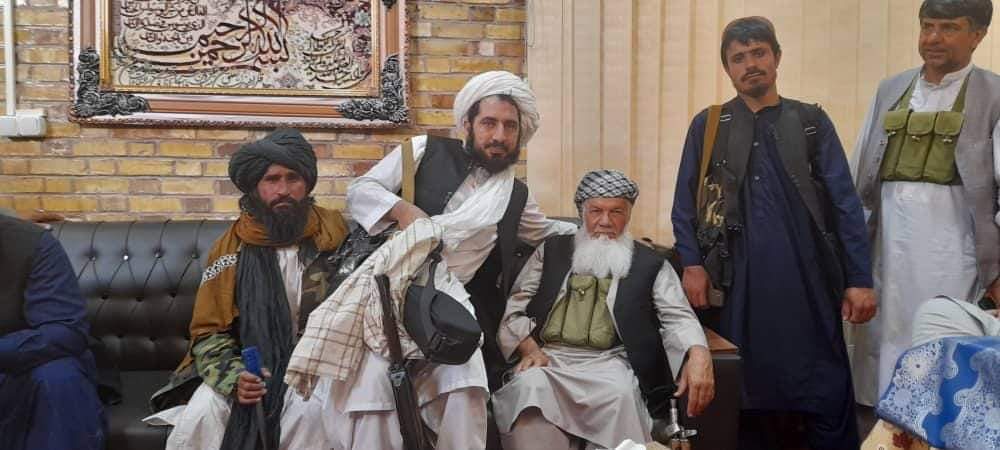
İsmail Khan captured by Taliban
Ariana: Taliban insurgents have seized most of Herat, Afghanistan‘s third-largest city, and also captured Ismail Khan, the veteran local commander leading militia resistance there, local officials said on Friday. The fall of Herat, the latest in a series of major provincial cities to be taken by the Taliban in the past few days, has dealt a shocking blow to the government of President Ashraf Ghani only weeks after the withdrawal of U.S. forces. Click here to read more (external link).
Taliban ‘In Control’ Of Kandahar, Seize Herat As Lightning Offensive Continues

Radio Free Europe/Radio Liberty
August 13, 2021
The Taliban has captured Afghanistan’s second-largest city, Kandahar, local government officials said on August 13, giving the militant group its most significant victory since the launch of a new offensive as U.S. forces withdraw.
“Following heavy clashes late last night, the Taliban took control of Kandahar city,” a local government official told Reuters.
Government forces were still in control of Kandahar’s airport, which was the U.S. military’s second-largest base in Afghanistan.
Taliban militants also seem on the verge of capturing Lashkar Gah, the capital of Helmand Province and a key southern city. Two regional lawmakers were quoted by the dpa news agency as saying militants had captured the governor’s office in the city.
The seizures of Kandahar and Herat — the country’s third-largest city captured on August 12 — represent the Taliban’s most significant victories since the broad offensive started in May as U.S.-led foreign forces began withdrawing.
In response to the Taliban’s swift advances, the U.S. military said it would send about 3,000 extra troops within 48 hours to help evacuate U.S. Embassy staff.
Britain said it would deploy around 600 troops to help its citizens leave, while other embassies and aid groups said they also were getting their people out.
The Taliban on August 12 also seized the central city of Ghazni, 150 kilometers southwest of Kabul, according to the Taliban and media.
The Taliban also claimed to have captured Qala-e-Naw in the northwest.
The government still holds the main city in the north — Mazar-e-Sharif — and Jalalabad, near the Pakistani border in the east, as well as Kabul.
The United Nations has warned that a Taliban offensive reaching the capital would have a “catastrophic impact on civilians,” but there appeared to be little hope for negotiations to end the fighting.
In a deal struck with former U.S. President Donald Trump’s administration last year, the insurgents made a commitment to discuss peace, but negotiations thus far have proved fruitless.
International envoys to Afghan negotiations in Qatar this week called for an accelerated peace process as a “matter of great urgency” and for a halt to attacks on cities.
The UN Security Council is discussing a draft statement that would condemn the Taliban attacks, threaten sanctions, and affirm the nonrecognition of an Islamic Emirate of Afghanistan, diplomats said, according to Reuters.
With reporting by Reuters, AFP, dpa, and AP
Copyright (c) 2021. RFE/RL, Inc. Reprinted with the permission of Radio Free Europe/Radio Liberty, 1201 Connecticut Ave NW, Ste 400, Washington DC 20036.
Related
US Deploys 3,000 Troops to Afghanistan After Claiming Kabul Would Not Fall

Kirby
Michael Hughes
AOPNEWS
August 12, 2021
The US military is moving around 3,000 personnel to Afghanistan to evacuate diplomats and ensure the drawdown of forces is secure, Pentagon spokesperson John Kirby told reporters on Thursday.
The announcement comes in the wake of reports that U.S. intelligence has predicted that Kabul would fall within a few months. The Biden administration all week had refuted the report and the very notion that the Afghan government was at any risk of being toppled.
“The first movement will consist of three infantry battalions that are currently in the Central Command Area of Responsibility… Those three infantry battalions will comprise approximately 3,000 personnel, and they will be in addition to those troops that are already in Kabul,” Kirby said at a press conference.
Kirby said the first three battalions will deploy to Kabul International Airport within the next 24 to 48 hours, but reassured that the United States would not use the airport as a base to launch airstrikes.
The State Department said the U.S. embassy in Kabul remains open at its current location despite the call to evacuate. The U.S., spokesperson Ned Price said, is in “no way abandoning the people in Afghanistan.”
According to Kirby, once diplomats are extracted the U.S. plans to leave about 1,000 boots on the ground to protect the remaining diplomatic presence in Kabul.
However, Kirby also claimed Washington was not delaying the deadline to remove all troops by August 31. He also vowed that the United States is not considering adding more troops if the situation in Afghanistan continues to deteriorate.
In addition, the Pentagon spokesperson said the U.S. will send 1,000 Air Force troops to Qatar to accelerate the processing of Afghan immigrant special visas.
The U.S. move contradicts assurances the White House and State Department delivered this week that Washington was maintaining its current approach. President Joe Biden said on Tuesday that he does not regret his decision to withdraw U.S. forces from Afghanistan despite the Taliban gains. The White House also said the fall of Kabul is “not inevitable.”
On Tuesday, State Department spokesperson Ned Price said the idea that the Taliban’s ongoing offensive in Afghanistan is unstoppable is not the reality on the ground. Price observed that Afghanistan’s government security forces still total roughly 300,000 strong, greatly outnumbering the Taliban in addition to having U.S. and other international support.
Meanwhile, UN Secretary-General Antonio Guterres is following with deep concern the ongoing hostilities in the Afghan provinces of Herat and Kandahar, and is particularly worried about the shift of fighting to urban areas, his spokesman said on Thursday.
As the U.S. was claiming that the fall of Kabul was not inevitable, Afghanistan’s neighbors have been bracing for the worst scenario. Russia’s defense ministry sounded the alarm that the border with Uzbekistan and Tajikistan is controlled by the Taliban movement and it is important for the Collective Security Treaty Organization (CSTO) to be ready for possible infiltration of terrorists.
After talks in Doha on Thursday, envoys from several countries including from the UN in a joint statement warned that they would not recognize any government in Kabul that is taken through military force. The statement was signed by representatives from China, Uzbekistan, Pakistan, the UK, the UN, EU, U.S., Germany, India, Norway, Tajikistan, Turkey and Turkmenistan.
“Participants agreed that the peace process needs to be accelerated as a matter of great urgency on the basis of the negotiations of concrete proposals from both sides,” the joint statement said.
They also expressed concerned about reports of continued civilian casualties, extra-judicial killings and other human rights violations.
The British defense ministry said the UK will send 600 troops to Afghanistan to assist in the evacuation of its citizens and former Afghan employees.
Turkey in the meantime has been vowing to step up its presence to protect the people of Afghanistan, which has been met with violent threats from Taliban leadership.
For some, the situation invokes memories of the fall of Saigon when American diplomats jumped from the embassy roof into helicopters as the Viet Cong finished conquering Vietnam.
Shafie Ayar: Ghani and Karzai setup Afghanistan’s collapse to Taliban and Pakistan
France, Switzerland Latest European Countries To Suspend Deportations Of Afghans
 Radio Free Europe/Radio Liberty
August 12, 2021
France and Switzerland have joined other European countries in announcing a suspension of deportations to Afghanistan due to the deteriorating security situation in the country as the Taliban presses its offensive across Afghanistan.
The French Interior Ministry told news agencies on August 12 that the policy has been in place since early July.
“We are watching the situation closely alongside our European partners,” AFP quoted the ministry as saying.
Afghans last year accounted for the most asylum requests in France, with nearly 8,900 applications.
Switzerland also announced late on August 11 that the expulsion of rejected asylum seekers was suspended “until further notice due to the changed situation in the country.”
“Preparations for repatriation will only be continued in the case of persons who have committed a criminal offence,” the State Secretariat for Migration tweeted.
Earlier this week, Germany and the Netherlands announced that they would also no longer deport rejected asylum seekers to Afghanistan, reversing their previous position on the controversial issue.
Officials in the two countries had joined several other EU members as early as last week in saying they should be allowed to continue expulsions of Afghan migrants if their asylum bids fail.
The European Union on August 10 said that it was considering more support for countries neighboring Afghanistan in anticipation of potentially hundreds of thousands of refugees fleeing to neighboring countries.
There are growing concerns in Europe of a repeat of the migrant crisis in 2015 when well over 1 million migrants, including many from war-torn Syria, arrived in the EU and sparked ongoing political divisions in the bloc.
In a letter dated August 5 and disclosed only this week, the interior ministers of Austria, Belgium, Denmark, Germany, Greece, and the Netherlands urged the EU’s executive arm to “intensify talks” with the Afghan government after Kabul said it was suspending “nonvoluntary returns” of Afghans fleeing the violence for three months.
“We would like to highlight the urgent need to perform returns, both voluntary and nonvoluntary, to Afghanistan,” the ministers wrote to the European Commission, which confirmed receipt of the letter.
“Stopping returns sends the wrong signal and is likely to motivate even more Afghan citizens to leave their home for the EU.”
The Taliban has captured 10 of Afghanistan’s 34 provincial capitals in the past week and now controls about two-thirds of the country.
A U.S. defense official cited intelligence as saying this week that Taliban fighters could isolate Afghanistan’s capital in 30 days and possibly take it over within 90.
The Taliban’s lightening offensive began in May when U.S.-led international forces began the final stage of a troop withdrawal due to end later this month following a 20-year presence.
With reporting by AFP, dpa, and Reuters
Copyright (c) 2021. RFE/RL, Inc. Reprinted with the permission of Radio Free Europe/Radio Liberty, 1201 Connecticut Ave NW, Ste 400, Washington DC 20036.
Related
US Embassy in Kabul Urges Americans to Leave Afghanistan Immediately
 VOA News
August 12, 2021
The United States Thursday urged Americans to leave Afghanistan immediately as the Taliban continued their advance across the country with the seizure of a strategic city near the capital of Kabul.
The U.S. embassy in Kabul said in a notice on its website that U.S. citizens should “leave Afghanistan immediately using available commercial flight options.”
The embassy offered help to citizens unable to leave immediately for financial or other reasons but warned, “Given the security conditions and reduced staffing, the Embassy’s ability to assist U.S. citizens in Afghanistan is extremely limited even within Kabul.”
On Thursday, the Taliban captured the key city of Ghazni, about 150 kilometers southwest of Kabul, its latest seizure since the U.S. began withdrawing troops from the country in May. U.S. troops are expected to be out by the end of this month.
The pullout is leaving the Afghan government to fight the Islamist group without the support of U.S. troops.
The U.S. ordered American government employees on April 27 to work outside the embassy if possible, noting an escalation of violence in Kabul.
State Department spokesman Ned Price said earlier this week the embassy’s status had not changed but added that the U.S. government was evaluating threats around the diplomatic mission daily.
Related
Afghanistan’s Anti-Taliban Stronghold Gears Up For New Fight Against Militants
 By Frud Bezhan
RFE/RL’s Radio Azadi
August 12, 2021
PANJSHIR VALLEY, Afghanistan — With its soaring cliffs and steep gorges, this famed region has never been conquered by invading forces during more than 40 years of war.
It was a bastion of resistance to occupying Soviet troops in the 1980s and later the Taliban, until that fundamentalist group’s brutal regime was toppled by the U.S.-led invasion in 2001.
Now, residents of the Panjshir Valley, which spills from the Hindu Kush Mountains to within about 150 kilometers of Kabul to the south, are gearing up for a new fight against their old nemesis.
The Taliban has captured around half of Afghanistan’s roughly 400 districts and 10 of the country’s 34 provincial capitals in a blistering offensive since the final pullout of foreign forces began on May 1.
The insurgents have seized control of large swaths of territory bordering Panjshir, including nearly all of the northern provinces of Badakhshan, Takhar, and Baghlan, and parts of the eastern province of Laghman.
With the Taliban threatening outside their gates, hundreds of residents have taken up arms to help government forces repel the militants. Former combatants are also training a new generation of fighters.
‘Defend Their Homeland’
“We have started to give combat training to our young men,” says Abdul Ahad Mujahid, one of the instructors.
The 58-year-old is a former member of the mujahedin, the U.S.-backed Islamist guerrilla fighters who battled Soviet forces during Moscow’s 1979-89 occupation. He later joined the Northern Alliance, a coalition of anti-Taliban groups that resisted Taliban rule from 1996-2001.
“We train them for five weeks during which they learn to handle weapons and land mines,” Mujahid says. “Then they are ready to defend their homeland.”
Among the young men receiving training is Yusef Ahmadi.
“We are being trained so we have the skills that we need to fight the enemy. We have done physical fitness and drills. We are currently learning how to handle Kalashnikovs,” he says in reference to the Soviet-designed AK-47 assault rifle, the weapon of choice for guerrillas and militants around the world.
The Panjshir Valley, located in the province of the same name, has so far been largely shielded from Taliban attacks. But recently, the militants have encroached on the valley.
Taliban militants attacked government forces in Panjshir’s Abshar district on August 8, sparking clashes.
Nearly a year ago, the insurgents attacked the same district in an attempt to seize the government headquarters before they were pushed back. Police said 20 villagers were taken hostage by the Taliban but later released.
Abdul Basit, a 26-year-old, says scores of young men from his home district of Rokha are receiving military training.
“We don’t want to go to war without knowing anything,” he says. “We are getting valuable lessons from our instructors. They have experience of fighting the Soviets and the Taliban.”
When their training is completed, the young men will be tasked with defending their villages and districts alongside troops from the Afghan National Army and Afghan National Police.
Second Resistance
The trained fighters are part of the Second Resistance, a civilian militia led by the son of Ahmad Shah Masud, the legendary guerrilla commander who was killed by Al-Qaeda militants posing as journalists just days before the September 11 attacks nearly 10,000 kilometers away in the United States.
The militia headed by the younger Ahmad Masud, a 32-year-old who received his military education in Britain, numbers several thousand men. His fighters have vowed to protect Panjshir and have already been deployed to districts in neighboring provinces to fight alongside government troops.
The Second Resistance is among dozens of loosely formed pro-government militias known collectively as the Public Uprising Forces (PUF).
Kabul has hailed the creation of the militias as a bulwark against advancing Taliban militants. But many of them are loyal to powerful former warlords who hold significant sway in the provinces.
Afghan President Ashraf Ghani, a Western-educated technocrat who has been in office since 2014, has spent years sidelining the country’s key power brokers, many of them ex-warlords who view Kabul with suspicion and resentment.
Regional strongmen have been remobilizing their old militias lately in anticipation of what many expect to be a bloody new chapter in a decades-old conflict.
Armed groups loyal to regional and local warlords have rearmed and reappeared in the country’s northern, western, and central regions.
Their resurgence coincides with waning confidence in the weak Afghan government and beleaguered Afghan security forces ahead of the complete withdrawal of foreign forces from Afghanistan by August 31.
There are fears that the return of the private militias — many organized along ethnic lines — could further undermine support for the central government and drag Afghanistan back into the chaos of the 1990s.
During its brutal civil war from 1992-96, Afghanistan descended into lawlessness as warlords and the Taliban essentially carved up the country into fiefdoms. Rival ethnic militias fought pitched battles for control of Kabul, killing some 100,000 people and leaving the capital in tatters.
More than two decades later, it is unclear what the Taliban’s new push toward Kabul — and its defense by a second generation of “lions” like those mobilizing to meet the Taliban threat in Panjshir — means for a population still desperate for an end to the fighting.
Written by Frud Bezhan in Prague based on reporting by RFE/RL’s Radio Azadi correspondents in Afghanistan. Their names are being withheld for their protection.
Copyright (c) 2021. RFE/RL, Inc. Reprinted with the permission of Radio Free Europe/Radio Liberty, 1201 Connecticut Ave NW, Ste 400, Washington DC 20036.
Witnesses say Afghanistan’s third-largest city, Herat, falls to Taliban; militants hold 11 of 34 provincial capitals
AP: Witnesses say Afghanistan’s third-largest city, Herat, falls to Taliban; militants hold 11 of 34 provincial capitals.
Related