
Kabul’s Young Professionals Fret About Their Future Under The Taliban
 Farangis Najibullah
Radio Free Europe/Radio Liberty
August 28, 2021
Ahmad Dawood has barely left his house on a quiet backstreet in Kabul’s Khairkhana neighborhood since Taliban militants marched triumphantly into the Afghan capital on August 15, the same day that President Ashraf Ghani fled abroad.
Just two days later, a gun-wielding militant ordered the 24-year-old tailor to close his dress shop on Lycee-Maryam street, a normally bustling retail area.
“He said men aren’t allowed to make dresses for women,” Dawood says.
It effectively spells the end of his popular business, as most of its clients are women.
Dawood must now look for another job. His aging parents and younger siblings depend on his job, which he first took up as an apprentice at the age of 15 to support his impoverished family.
“We’re now cutting down on food. We have just enough money to see us through a month or so,” Dawood tells RFE/RL. “My brother, a policeman, lost his job, too, and my two sisters are at home because their universities are closed. So many changes in just a matter of days.”
Bazaars and bakeries remain open in the sprawling city of more than 4.4 million, although food prices have jumped and there are considerably fewer customers than before.
Many local media outlets continue their work, and some office workers — mostly men — are returning to their workplaces. Some public transport has resumed, albeit with a severely reduced number of vehicles.
But despite those signs of normality, life in Kabul “has come to a halt” to residents like Dawood and his siblings, who are waiting to see what direction the hard-line group intends to take their battle-scarred country.
“Our school is still closed, and we don’t have any official instruction yet about when to reopen it or what kind of changes the education sector will see,” says 25-year-old teacher Bashir Forogh.
Forogh’s school, in central Kabul, closed abruptly the day the UN-backed government collapsed and the Taliban reentered the city, nearly two decades after they were ousted by U.S.-led international forces in a response to the 9/11 attacks, planned and coordinated by Al-Qaeda leader Osama bin Laden from Afghan territory.
Students Eager To Return To School
Forogh recalls classes being halted midday as Taliban fighters took over this month, parents rushing to school in panic to collect their children and everyone dialing frantically to check on family members. But the phone lines “were dead,” he says, and the school building was deserted within an hour.
“Nobody has told us what happens to the school curriculum, students’ uniforms, or the future of mixed girls and boys classes once we reopen,” Forogh says.
He says he often gets phone calls from the parents of female students who “are eager to go back to school, even with a new, stricter dress code.”
The Taliban has said it doesn’t oppose girls’ education and women returning to work as long as they wear Islamic clothing, although eyewitness accounts from around the country appear to belie the pledge.
A senior Taliban official even gave an interview to a female television presenter in Kabul as the ultraconservative Islamist group seeks to rebrand itself as a more moderate force than it was two decades ago.
Taliban officials insist they will respect women’s rights within the norms of Islam, but they don’t elaborate.
Multiple female journalists and office workers say they were sent home by Taliban militants.
“Nothing is clear. The Taliban doesn’t say anything clearly, and it worries young people,” says Razma Saad, a university student from Kabul’s Macroyan 3 neighborhood.
Less than two months ago, Saad was more optimistic about the prospect of living under Taliban rule, saying the group “might have changed.”
Speaking to RFE/RL in mid-July, Saad said she hoped she could continue her studies and that “the situation won’t be as bad as many people fear.”
Saad now says she is worried by the Taliban’s “vague language” and worries that it is not providing “open and honest” assurances to the public.
She says many of her close friends have left Afghanistan in recent weeks.
Saad is staying in Kabul. She still hopes the Taliban softens some of its hard-line views and respects people’s wishes if it hopes to govern them effectively.
Brain Drain
Many Afghans are skeptical the Taliban has changed its oppressive policies from when it ruled most of Afghanistan between 1996 and 2001, imposing a strict form of Islamic law.
A young generation of Afghans grew up under the UN-backed government accustomed to relative freedoms, such as attending secular schools, listening to music, wearing modern clothes, and sporting trendy hairstyles.
Fearful of their future, tens of thousands of Afghans have flocked to the capital’s international airport since August 15, desperately seeking to get out of the country.
Facing the prospect of a brain drain, the Taliban is urging Afghans to stay in the country and serve their own nation.
But Afghanistan’s most acute crisis of human capital might be artificially created by the Taliban itself, if it confines working women — millions of teachers, medics, police officers, and other specialists — to their homes.
“The Taliban cannot develop the country if half of the population — the women — disappear from public life,” says Mahjabin Ramz, a Kabul university graduate.
With a degree in journalism, Ramz got a job offer from a local media outlet just days before the fall of Kabul.
This week, Ramz got a phone call from the same publication saying it has indefinitely suspended hiring.
Money Isn’t Everything
It looks more like business as usual for Shapoor, who runs two successful pharmacies in Kabul and lives a comfortable life with his young family in a newly built house in an affluent quarter of the Khairkhana neighborhood.
Both his shops remain open.
Although there are fewer customers these days, Shapoor is confident that business will take off again soon.
But, Shapoor says, money isn’t everything.
He doesn’t want his family to lose what he describes as the “small details” of their freedom: eating out with his wife, buying her flowers for Valentine’s Day, or his wife’s opportunity to go to a beauty salon.
Shapoor also worries about his younger brother, who served as a policeman until last month.
The Taliban has ostensibly offered an “amnesty” for all former soldiers, police officers, and government workers.
But multiple reports suggest that Taliban militants have been searching door-to-door for those who worked for police forces or government agencies.
“We’re living in constant fear and worry,” Shapoor says.
On the opposite end of Khairkhana, Dawood is reluctantly adapting to Kabul’s new realities.
Once a self-described fan of Bollywood-style haircuts, tight black jeans, and crisp white shirts, Dawood now wears traditional Afghan clothes. He has shaved his head and is growing a beard.
“I had to work hard since childhood. There were many nights that I went hungry to bed. But I’ve never felt so hopeless before,” Dawood says. “What an utterly misfortunate nation we are.”
Copyright (c) 2021. RFE/RL, Inc. Reprinted with the permission of Radio Free Europe/Radio Liberty, 1201 Connecticut Ave NW, Ste 400, Washington DC 20036.
Related
Tajik Group Offers To Fight Alongside Anti-Taliban Militias In Afghanistan
Hundreds of Tajiks from the southern town of Kulob say they’re prepared to join anti-Taliban militias in Afghanistan. The Afghan fighters are based in the Panjshir Valley, a predominantly ethnic Tajik region that has repelled Taliban incursions in the past. Some Tajik officials say it would be illegal for volunteers to cross the border to join the fight — but others say the call to arms nevertheless sends a message to the Taliban.
Taliban kill squad hunting down Afghans — using US biometric data

Taliban Militants in Kabul
New York Post: The Taliban has mobilized a special unit, called Al Isha, to hunt down Afghans who helped US and allied forces — and it’s using US equipment and data to do it. Nawazuddin Haqqani, one of the brigade commanders over the Al Isha unit, bragged in an interview with Zenger News that his unit is using US-made hand-held scanners to tap into a massive US-built biometric database and positively identify any person who helped the NATO allies or worked with Indian intelligence. Afghans who try to deny or minimize their role will find themselves contradicted by the detailed computer records that the US left behind in its frenzied withdrawal. Click here to read more (external link).
Pentagon: US Airstrike Targets Islamic State in Afghanistan in Retaliation for Deadly Kabul Airport Attack

US MQ-9 Reaper drone (file photo)
AP: U.S. Central Command said the U.S. conducted a drone strike against an Islamic State member in Nangahar believed to be involved in planning attacks against the U.S. in Kabul. The strike killed one individual, and spokesman Navy Capt. William Urban said they knew of no civilian casualties. Click here to read more (external link).
Related
Taliban ‘planning to establish inclusive caretaker government’ in Afghanistan
Taliban Militant Leadership
Press TV
August 27, 2021
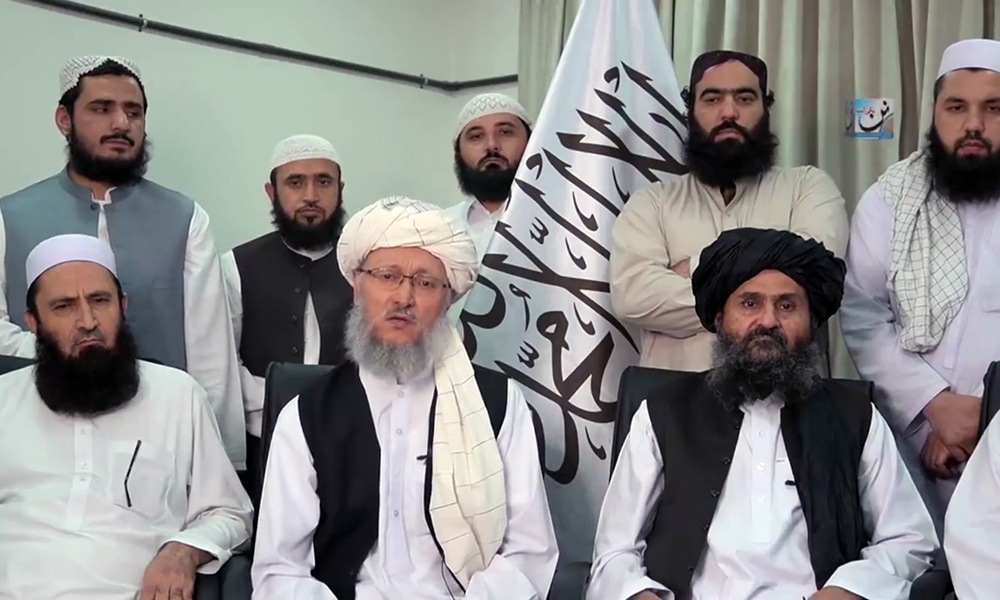
The Taliban say they are planning to establish an inclusive caretaker government in Afghanistan that would include leaders from all ethnicities and tribal backgrounds, following their takeover of the country earlier this month.
Taliban sources told Al Jazeera about the group’s plan on Friday, adding that nearly a dozen names were being considered to be part of the new government, without mentioning the duration of the caretaker government’s term.
The unnamed sources further said a supreme leadership council had been convened to decide the form of the future government and nominate ministers, particularly for the judiciary, internal security, defense, foreign affairs, finance, and information portfolios as well as a special assignment for Kabul’s affairs.
They added that the group wanted to bring new faces to the government, including the sons of Tajik and Uzbek tribal leaders.
The Taliban have reportedly already appointed senior veterans to the positions of Afghanistan’s finance minister, interior minister, and defense minister, but the appointments have not been formally announced. A Taliban official in Kabul confirmed the key ministerial appointments this week.
The Taliban have also included Afghanistan’s former President Hamid Karzai and former peace negotiator Abdullah Abdullah in a 12-member council that would govern Afghanistan during the transition period, according to a source.
The latest development comes as Afghanistan is reeling from two terrorist explosions outside the Hamid Karzai International Airport in Kabul on Thursday, which claimed over 100 lives, including those of 12 US service members. The attacks came amidst chaos and commotion at the airport, which has been taken over by the US troops to evacuate American civilians and diplomats following the Taliban takeover. The blasts were claimed by an offshoot of the Daesh terrorist group in Afghanistan.
Another Taliban source told Al Jazeera that the group remained committed to the 2020 deal reached with the United States in the Qatari capital, Doha, adding that it would not allow Afghan soil to be used to launch terror attacks.
The source also said special courts would be set up at local levels to fight corruption in Afghanistan, adding that the Taliban caretaker government was planning a single tariff to be applicable to imported goods.
Pakistani Haqqani assailant arrested after Kabul blasts
A Pakistani assailant belonging to the Haqqani network has reportedly been arrested after the deadly terrorist attacks outside the Kabul airport on Thursday. Top sources in Afghanistan told CNN-News18 that the Taliban were aware of the connection between the Haqqani network and Pakistan in the Kabul blast.
They said a third blast had been planned at the Turkmenistan Embassy. However, the sources said, two people had been detained before that attack could take place, and that they were in custody of the Taliban.
According to the sources, both of them are Pakistanis.
An unnamed Taliban official told Reuters news agency on Friday that at least 28 members of the group had died in the bombings, vowing to beef up security at the Kabul airport to prevent future terrorist attacks.
Kremlin condemns deadly Kabul attacks
Meanwhile, Russia has strongly condemned the twin bombings on crowds of Afghans trying to flee Afghanistan.
“Of course, it is very sad news about the large number of deaths,” Kremlin spokesman Dmitry Peskov told a briefing on Friday, adding that unfortunately, the pessimistic forecasts that entrenched terrorist groups, especially Daesh, would not fail to take advantage of the chaos in Afghanistan were being confirmed.
Peskov further said that the incident would further escalate the tensions in Afghanistan, which continues to be “a cause of our grave concern.”
On Wednesday, four Russian military planes evacuated Russian and other nationals from Kabul on the orders of President Vladimir Putin, as Moscow held military exercises involving its tank forces in neighboring Tajikistan.
UN Preparing for Exodus of Half-Million Afghan Refugees

Lisa Schlein
VOA News
August 27, 2021
GENEVA – U.N. agencies are appealing for nearly $300 million in preparation for the possible exodus of hundreds of thousands of Afghan refugees, seeking safety and protection from conflict and persecution under Taliban rule.
The U.N. refugee agency and partners are planning for what they call a worst-case scenario of more than 515,000 newly displaced refugees fleeing to countries neighboring Afghanistan.
UNHCR Deputy High Commissioner Kelly Clements says preparations are underway to assist host governments in the region with financial and material support to care for a large influx of refugees.
She says discussions with national authorities are underway on scaling up the humanitarian response. She notes the proposed regional response plan is a critical part of that process.
“While we have not seen large outflows of Afghans at this point, the situation inside Afghanistan has evolved more rapidly than anyone expected. We need therefore to be prepared for any number of eventualities. That takes resources, preparation and a reasonable amount of lead time,” Clements said.
Most of the support is likely to go to Iran and Pakistan, countries that are already hosting 2.2 million Afghans, many of whom have been living there for decades.
Clements says the generosity shown by these governments in sheltering Afghan refugees for nearly 40 years cannot be taken for granted.
“Increased and immediate funding will allow us to preposition core relief items and be ready for emergency interventions…. Given the critical COVID situation, especially in Iran, we have an unusually high ask in regard to health assistance. It is critical that both refugees and hosts are protected and that vaccines are made available to all,” she said.
Money from the appeal will support the humanitarian operations of 11 U.N. and non-governmental organizations on behalf of the Afghan refugees until the end of the year. The agencies will provide food, shelter, health care, education, protection, and other vital humanitarian assistance.
Related
Waltz, Graham Call on Biden to Recognize Opposition Forces in the Panjshir Valley
Press Release
August 27, 2021
WASHINGTON, D.C. – On Friday, U.S. Congressman Mike Waltz (FL-6) and U.S. Senator Lindsey Graham (SC) released the following joint statement:
“After speaking with Afghan Vice President Amrullah Saleh and representatives of Ahmad Massoud, we are calling on the Biden Administration to recognize these leaders as the legitimate government representatives of Afghanistan. We ask the Biden Administration to recognize that the Afghan Constitution is still intact, and the Afghan Taliban takeover is illegal.
“These leaders chose to stay and fight for the freedoms of the Afghan people and oppose extremism. They have established a safe haven in the Panjshir Valley for Americans left behind, our allies, and those seeking freedom from Afghan Taliban rule. They will also be on the front lines in the fight against global Islamic Extremism, which will continue to plot attacks against the West in the wake of our withdrawal from the region.
“We call on President Biden to designate the Afghan Taliban as a Foreign Terrorist Organization, and we urge him to publicly support Congressional efforts to stand with our friends in the Panjshir Valley who will serve as a bulwark against regional terror.”
Tolo News in Dari – August 27, 2021
Afghanistan Faces Complex Web of Economic Crises
Rob Garver
VOA News
August 27, 2021
WASHINGTON – Steering Afghanistan’s economy would be a formidable task for anyone, which is why economists and other experts expressed dismay this week when the country’s Taliban leaders named Mohammad Idris, a relatively obscure figure from within the movement, to head Da Afghanistan Bank, the country’s central bank.
Taliban spokesman Zabihullah Mujahid said on Twitter that Idris would “address the looming banking issues and the problems of the people.” But experts said it is unclear whether Idris, or any of the Taliban leadership, appreciates the economic peril that the country now faces.
Ajmal Ahmady, the former governor of the central bank, who fled the country a day ahead of the Taliban’s entry into Kabul, told Bloomberg that the Taliban have not articulated any coherent approach to dealing with the country’s economy.
“They never once talked about … what their economic policy (will be), what their macroeconomic stance is,” he said. “Those types of questions were never asked and … never considered.”
He added, “I’ve never heard of an economist on their team.”
Interwoven economic crises
“They will have a problem managing the economy,” agreed Gul Maqsood Sabit, who has served in multiple roles in Afghanistan’s Ministry of Finance, most recently as deputy finance minister for customs and revenue from 2013 to 2015.
Sabit, who is now a lecturer at Ohlone College in California, told VOA this is especially true “if they appoint people who do not have the right skills and expertise.”
What the Taliban now face is a complex web of economic crises that could interact and become worse.
International aid money, which accounted for 75% of public spending in the country, has dried up, including a $440 million installment due this week from the International Monetary Fund that the institution refused to disburse to the Taliban. But that is far from the only challenge facing the country.
Another major source of funds, remittances from Afghans living and working abroad, amounted to an average of nearly $800 million per year before the Taliban took over. However, the two largest money transmitters operating in the country, Western Union and MoneyGram International, have both suspended operations in Afghanistan, cutting off that source of funds as well.
Further complicating matters is that the foreign governments and nongovernmental organizations now fleeing Afghanistan employed many thousands of local people and purchased goods and services. Their disappearance blocks yet another route by which money flowed into the Afghan economy.
Currency crisis expected
Banks, which have largely been closed since the Taliban took over, are slowly beginning to reopen, but as they do, Afghans are rushing to convert money they hold in the local currency, afghanis, into U.S. dollars. This is driving the value of the afghani down and pushing the prices of everyday goods higher.
In the years before the Taliban’s takeover, the Afghan central bank managed a carefully choreographed dance with the currency markets to keep the afghani stable.
Every week, the bank would auction off about $20 million U.S. dollars in cash. The goal was to create a public understanding of what the afghani was worth relative to the dollar. Because Afghans understood that their country’s paper money could be reliably exchanged for dollars at a predictable rate, the afghani retained a stable value.
Impact on trade
The steady flow of dollars into the Afghan economy also allowed merchants who imported goods from abroad to settle their purchases in dollars, as many of their suppliers were unwilling to accept afghanis as payment.
Now, however, the shipments of physical U.S. dollars that helped keep the wheels of the Afghan economy spinning have stopped, and the results, said Sabit, are predictable.
“Many people are going to start converting their afs (afghanis) into dollars as soon as possible because they know afghani values will depreciate significantly, and then they’re going to hold on to dollars,” he said.
Dollars remaining in circulation will likely be scooped up by merchants who need them to pay foreign suppliers, further reducing supply and driving down the value of the afghani. And eventually, people holding dollars will be forced to spend them, Sabit said.
Reduced government revenue
“I think dollars will disappear from the market, mostly,” Sabit said. “And then that is going to affect the trade too, because … banks will not have that much money, in terms of dollars, to pay internationally on behalf of the traders.”
Most of the Taliban’s revenue, now that the group has taken over the country, will come from taxes and customs duties. However, with so much foreign money suddenly disappearing from the country, there will be far less economic activity to tax. And as inflation rises and dollars disappear from the economy, imports are likely to decline drastically as well.
“Overall, I think both customs and tax revenues will significantly decline for them,” Sabit said. “And that’s the only source they will have for now.”
‘An incentive to cooperate’
One variable that could ameliorate some of the problems facing Afghanistan is the ultimate shape of the country’s new government. The Taliban have been meeting with some officials of the former government, and there have been suggestions that the group is interested in some sort of power-sharing arrangement that might make it possible for foreign nations to recognize the country’s leadership as legitimate.
International recognition could restart some of the aid flow into Afghanistan and might give Western Union, MoneyGram and other companies enough comfort to resume operations there.
“The stakes are high, but the fact that the stakes are high for this new government is a reason to be optimistic, because it gives them an incentive to cooperate,” said Darryl McLeod, a Fordham University professor of economics who has studied economies in crisis.
“The potential adjustment costs are high, and that makes it more likely that the government will try to cooperate and do things … not to be ejected from the community of nations.”
Common people hurt
Some experts are urging the international community to hold back on punitive action if the Taliban cannot secure widespread recognition.
“I think it would be very important for the world to recognize the needs and the pains of the people when they impose sanctions on the country,” Sabit said.
“I understand the political aspect of it. And I understand the pressure they want to apply to the Taliban,” he said. “But this fight between the international community and the Taliban — this economic war — will affect common people.”