
Taliban Accused Of Slaying Afghan Folk Singer
 Radio Free Europe/Radio Liberty
August 29 2021
The family of an Afghan folk singer and musician says he has been shot dead by a Taliban fighter in a mountain province north of Kabul.
The alleged slaying of Fawad Andarabi comes amid growing concerns that the hard-line Islamist group will return war-torn Afghanistan to the repressive rule it imposed when last in power from 1996-2001.
“Fawad Andarabi, a local artist, was dragged out of his home yesterday and killed by the Taliban in Kishnabad village of Andarab [district]. He was a famous folk singer in the valley. His son has confirmed the incident,” Afghan journalist Sami Mahdi tweeted on August 28.
“He was innocent, a singer who only was entertaining people,” his son Jawad told AP. “They shot him in the head on the farm.”
The son said that a local Taliban council promised to punish his father’s killer.
AP quoted a Taliban spokesman as saying that the militants will investigate the matter.
The Andarab Valley is located in Baghlan Province, some 100 kilometers north of Kabul.
The neighboring Panjshir remains the only Afghan province not under the control of the Taliban after its blitz offensive toppled the Western-backed government.
Karima Bennoune, the United Nations special rapporteur on cultural rights, wrote on Twitter that she had “grave concern” over the reports of Andarabi’s killing.
“We call on governments to demand the Taliban respect the #humanrights of #artists,” she said.
Agnes Callamard, the secretary-general of Amnesty International, also decried the killing, saying on Twitter: “There is mounting evidence that the Taliban of 2021 is the same as the intolerant, violent, repressive Taliban of 2001. 20 years later. Nothing has changed on that front.”
Along with his tweet, Mahdi posted a video showing Andarabi singing and playing the ghichak, a bowed lute.
“There is no country in the world like my homeland, a proud nation,” he sang. “Our beautiful valley, our great-grandparents’ homeland.”
With reporting by AP
Copyright (c) 2021. RFE/RL, Inc. Reprinted with the permission of Radio Free Europe/Radio Liberty, 1201 Connecticut Ave NW, Ste 400, Washington DC 20036.
Related
Afghans See More Checkpoints as Taliban Widen Airport Security Cordon
 Jamie Dettmer
VOA News
August 29, 2021
The Taliban have widened a security cordon around Kabul airport, at American request, but the move means Afghans heading for the last evacuation flights encounter more checkpoints.
Moreover, witnesses say the Taliban guards are becoming more aggressive, especially with women, as the clock ticks down to Tuesday, U.S. President Joe Biden’s deadline for the American airlift to end.
“They don’t spare women,” a 20-year-old student told VOA in a phone call from Kabul, where she is in hiding, too fearful to make a second attempt to leave the country.
“They won’t spare us just because we are women,” said Hamdiya, describing what she, her mother and younger sister endured at multiple Taliban checkpoints.
“One Taliban held a gun to my head,” she said. “We were told we are infidels because we want to go to the United States,” she continued. “I said I wasn’t an infidel and he said he was going to shoot me,” she added.
Hamdiya has worked for both the U.S. Embassy in Kabul and for a German nongovernmental organization.
On Thursday she, her mother and sister made it to the airport just as a suicide bomber struck, leaving 13 U.S. service personnel dead and at least 170 Afghans.
“I was running and I accidentally tripped over a head, and it had no body. I can’t get rid of that image” she said.
Her mother was injured in the bombing, which an affiliate of the Islamic State group has claimed as its attack. Hamdiya said she, her mother and sister are all too terrified to make another bid to reach the airport and she has been trying to find any Western assistance to help them navigate the Taliban checkpoints, to no avail. She said women not accompanied by male relatives are encountering special hostility from Taliban gunmen.
“Sometimes I wish I were a man,” she said. “I am failing. It is very painful,” she added.
The final opportunities to leave are likely slipping away from Hamdiya.
The U.S. State Department Saturday urged American citizens and others to leave the vicinity of Kabul’s airport immediately due to fears of another terror attack. Taliban forces sealed the airport off Saturday to most Afghans hoping for evacuation, The Associated Press reported.
Even before then, other Afghans trying to reach the airport told VOA that Taliban guards often were only allowing a maximum of two members per family to cross checkpoints, now increasingly manned by uniformed Taliban fighters with Humvees and night-vision goggles seized from Afghan security forces.
Afghans who have been at the airport painted a grim picture of Taliban fighters firing rounds into the air.
The Taliban claim they have to disperse crowds, but several Afghans told VOA that they believed the episodic shooting was intimidatory and being done just to scare them. The Taliban also Saturday fired canisters of colored smoke around parts of the airport, adding to the confusion and mounting fear, Afghan civilians said.
NATO’s European members have now ended their airlift, with some governments urging Afghans eligible for evacuation now to shelter in place.
Britain ended its evacuation mission Saturday with the final British troops and diplomatic staff arriving at RAF Brize Norton, a British air force base in southeastern England, Sunday morning, drawing to a close Britain’s 20-year deployment in Afghanistan.
The two-week mission to rescue British nationals and Afghan allies was Britain’s largest evacuation mission since World War II. In all, Britain evacuated 15,000 people. In a video posted on Twitter Sunday British Prime Minister Boris Johnson praised the soldiers involved.
“U.K. troops and officials have worked around the clock to a remorseless deadline in harrowing conditions,” he said.
“They have expended all the patience and care and thought they possess to help people in fear for their lives,” he added, “They’ve seen at firsthand barbaric terrorist attacks on the queues of people they were trying to comfort, as well as on our American friends. They didn’t flinch. They kept calm. They got on with the job.”
Johnson and his ministers, however, are coming under vitriolic criticism for the airlift, with claims that the British government was too slow to get the evacuation mounted in earnest. A former head of the British army, General Richard Dannatt, said the mission should have been started much earlier in the year.
“We should have done better, we could have done better. It absolutely behooves us to find out why the government didn’t spark up faster,” he told The Times newspaper.
Hundreds of Afghans have been heading to the country’s land borders but are being charged thousands of dollars by smugglers and drivers, according to Western NGOs.
The Tajikistan and Uzbekistan borders are currently officially closed. Making for the frontier with Pakistan is highly risky for Afghans who have worked with NATO forces or Western governments as to get to the border they must travel deep into Taliban heartlands. Moreover, most border smugglers are connected with the militant Islamist movement, say private security advisers exploring overland routes to get Afghans out of the country.
Some information for this report came from The Associated Press.
U.S. Drone Strike Hits Vehicle Heading To Kabul Airport

US MQ-9 Reaper drone (file photo)
Radio Free Europe/Radio Liberty
August 29, 2021
The United States has carried out a drone strike in Kabul on a vehicle carrying Islamic State militants, military officials said on August 29.
The officials said the drone strike hit the vehicle, which was heading for the airport with suicide bombers inside. The U.S. said it believes it was a successful strike and that the intended target was hit.
“U.S. military forces conducted a self-defense unmanned over-the-horizon air strike today on a vehicle in Kabul, eliminating an imminent ISIS-K threat” to the airport, said Bill Urban, a spokesman for the U.S. Central Command.
“Significant secondary explosions from the vehicle indicated the presence of a substantial amount of explosive material,” he said, adding that there were “no indications at this time” of civilian casualties.
There have been reports of an explosion at a house near the airport, but it wasn’t clear if the two explosions were connected.
An Afghan police chief said the attack killed a child, according to the Associated Press. Rashid, the Kabul police chief who goes by one name, said the rocket struck Kabul’s Khuwja Bughra neighborhood in the afternoon.
Reports of the explosion circulated on social media showed black smoke rising from a building that appeared to be a home and people on the roof attempting to douse flames using buckets of water.
A Health Ministry source confirmed to the BBC that an explosion had taken place, saying it was a rocket that hit a house.
The explosion occurred as U.S. forces were in the final phase of pulling out of Kabul. Just over 1,000 civilians remained at the airport on August 29 to be flown out before the troops finally leave, a Western security official told Reuters.
U.S. President Joe Biden has said he will stick by his deadline to withdraw all U.S. troops from Afghanistan by August 31, ending two decades of the U.S. military mission in Afghanistan that began shortly after the 9/11 terrorist attacks on the United States.
The situation at the airport has been tense since one of the airport’s outer gates was the scene of a suicide bombing three days ago claimed by the militant group Islamic State-Khorosan that killed scores of people, including 13 members of the U.S. military.
The U.S. military said it carried out a drone strike in eastern Nangarhar Province two days after the suicide bombing. The retaliatory strike killed a planner and a facilitator of the attack, the Pentagon said.
Biden said on August 28 that the situation on the ground in Afghanistan “continues to be extremely dangerous” and the threat of terrorist attacks on the airport in Kabul “remains high.”
Biden said that he met with his national-security team and commanders in the field and was informed that an attack “is highly likely in the next 24-36 hours.”
Based on reporting by AFP, Reuters, AP, CNN, AFP, and the BBC
Copyright (c) 2021. RFE/RL, Inc. Reprinted with the permission of Radio Free Europe/Radio Liberty, 1201 Connecticut Ave NW, Ste 400, Washington DC 20036.
Massoud Supporters Reject Taliban Claim of Entering Panjshir
 Tolo News: The Taliban said their forces entered Panjshir province from various directions on Saturday without facing any resistance. Massoud’s supporters, however, rejected the claims of a Taliban advance toward Panjshir and say no one has entered the province. Click here to read more (external link).
Taliban Agreement to Let Afghans Leave Is ‘Positive,’ US Says
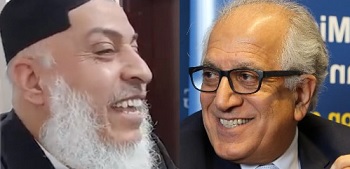
Stankezai (left) and Zalmay Khalilzad (right)
Ayaz Gul
VOA News
August 28, 2021
ISLAMABAD – The United States on Saturday hailed the Taliban’s commitment that no one will be prevented from traveling out of Afghanistan after August 31, the deadline President Joe Biden has set for all U.S. and NATO troops to exit the country.
Zalmay Khalilzad, special U.S. envoy for Afghan peace, made the remarks a day after a central Taliban leader in a televised address said that Afghans with valid documents and passports would be free to travel to the country of their choice — by air or by land — beyond the deadline.
“The statement is positive. We, our allies, and the international community will hold them to these commitments,” Khalilzad wrote on Twitter.
Friday’s address by Sher Mohammad Abbas Stanikzai, deputy head of the Taliban’s Qatar-based political commission, was aimed at easing fears his Islamist movement might not permit safe passage for Americans, for third-country nationals, and for Afghans who worked with foreign forces in the country past August 31.
“Let the foreign forces withdraw first … and then our compatriots — whether they have worked with the Americans or otherwise — may leave the country if they want and for whatever reason there may be. All airports, particularly Kabul airport, will be open for their travel,” Stanikzai said.
Thousands of people, including journalists, former government officials and civil society activists, have struggled to get on the last flights leaving the Afghan capital’s beleaguered international airport before the deadline for the Western evacuation operation.
Suicide bomber
On Thursday, a suicide bomber blew himself up on the perimeter of Kabul’s airport, killing about 170 people, including 13 U.S. service members. An Islamic State affiliate in Afghanistan claimed responsibility for the carnage.
The scramble to leave the country stemmed from fears the Taliban’s return to power in Kabul would see the imposition of their strict version of Islamic laws in Afghanistan, which the fundamentalist group had enforced during its rule from 1996 to 2001.
The Taliban at the time barred women from leaving their homes without a male relative, barred girls from receiving an education, and banned music, among other controversial measures, leading to international isolation of Afghanistan.
The Islamist group has now promised to institute what it says will be an “inclusive Islamic government” in Kabul, saying the arrangement respects human rights, particularly the rights of women to study and work.
In his Friday speech, Stanikzai urged Afghans to unite to rebuild their war-ravaged country, saying trained and educated people also should come back to join the effort.
The Taliban seized control of the national capital on August 15, capping a weeklong military campaign that brought 33 of Afghanistan’s 34 provinces under the group’s control in the face of a dramatic collapse of the U.S.-backed government in Kabul and its security forces.
The Islamist group is under pressure from the U.S. and neighboring countries to live up to public pledges that it would include all Afghans in the way it runs the country and would respect human rights to avoid Afghanistan’s international isolation.
The Taliban instructed female public health workers Friday to return to their regular duties, and they have allowed female television presenters to broadcast news as usual.
The governor of the southern Afghan province of Kandahar, which is known as the Taliban’s birthplace, earlier in the week told a gathering of Islamic clerics that men would not be forced to grow beards and people would not be forced to stop listening to music.
Critics have doubts
Domestic and foreign critics, however, remain skeptical about whether the Islamist group will deliver on its pledges.
“I think I should be really clear here: There’s no rush to recognition of any sort by the United States or any international partners we have talked to,” White House press secretary Jen Psaki told reporters Friday when asked if the Taliban were asking Washington for recognition.
Two Afghan Athletes Arrive In Tokyo To Compete In Paralympics

Zakia Khudadadi
Radio Free Europe/Radio Liberty
August 28, 2021
Afghanistan’s two Paralympic athletes have arrived in the athletes’ village in Tokyo and will compete next week in their events, the International Paralympic Committee (IPC) said on August 28.
The two-person team of Zakia Khudadadi, a tae kwon do athlete, and Hossain Rasouli, a track athlete, flew from Kabul to Paris before continuing to Tokyo, the IPC said.
The pair were warmly welcomed to the Tokyo 2020 Paralympic village, the IPC said in a statement.
They had been due to arrive in Tokyo on August 17 but were unable to leave Afghanistan after the Taliban swept to power.
The possibility that she would not make it out of Kabul prompted Khudadadi to make a video appealing for help to leave so she could take part in the Paralympics.
“I request from you all, that I am an Afghan woman and as a representative of Afghan women ask for you to help me,” Khudadadi said in her video, which Reuters said it had received from the Afghanistan Paralympic Committee.
Khudadadi will be Afghanistan’s first female athlete to compete at the Paralympics since the Athens Paralympics in 2004. She will compete in the women’s tae kwon do 44-49-kilogram weight category. Rasouli will compete in the men’s 400 meters.
IPC President Andrew Parsons said in the IPC statement that the IPC was told 12 days ago that the Afghan Paralympic team could not travel to Tokyo.
The announcement “broke the hearts of all involved in the Paralympic movement and left both athletes devastated,” he said.
But thanks to a “major global operation” he said they were evacuated from Afghanistan and have now arrived safely in Tokyo for the 2020 Paralympics, which began on August 24 and last through September 5.
Chelsey Gotell, the IPC Athletes’ Council chairperson, said that both athletes have said that after years of training they wanted to compete in the Tokyo 2020 Paralympic Games.
“The fact that so many authorities have combined to make this possible is truly wonderful,” she said, according to the IPC statement.
“On behalf of their fellow 4,403 Paralympic athletes competing at the Tokyo 2020 Paralympic Games, I welcome Zakia and Hossain to the Paralympic Village,” she said. “This is their home for the next nine days, and as a community we are 100 percent behind them.”
With reporting by AP, AFP, and Reuters
Copyright (c) 2021. RFE/RL, Inc. Reprinted with the permission of Radio Free Europe/Radio Liberty, 1201 Connecticut Ave NW, Ste 400, Washington DC 20036.
Why the only winner of America’s war in Afghanistan is opium

New York Post: Between 2002 and 2019, American taxpayers spent at least $9 billion to eliminate or transform the poppy fields that produced almost all of the world’s heroin — but instead ended up tripling that production, quadrupling the acreage covered by the deadly flowers, and intensifying the insurgency that plagued the country. As a result, opium “emerged as the unrivaled winner of the longest war in American history,”… Click here to read more (external link).
The Old Cliché About Afghanistan That Won’t Die

Politico:‘Graveyard of Empires’ is an old epitaph that doesn’t reflect historical reality — or the real victims of foreign invasions over the centuries – Afghanistan, in its long existence, has sadly been more like the roadkill of empires — a victim to their ambitions. Click here to read more (external link).
Afghanistan Human Rights Violations Surge Since Taliban Takeover
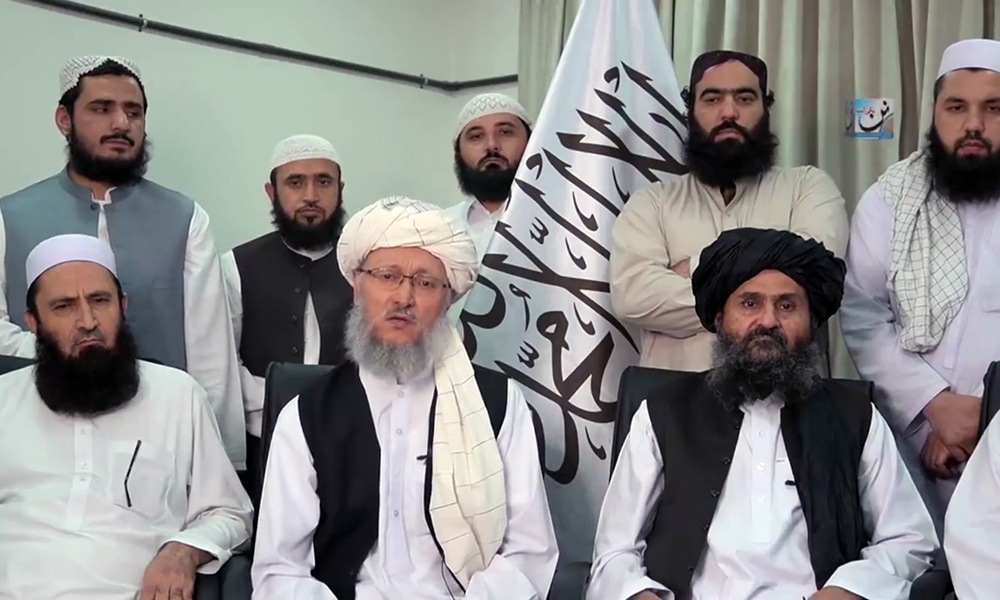
Taliban Militant Leadership
Lisa Schlein
VOA News
August 28, 2021
GENEVA – U.N. and private aid agencies say human rights violations have been surging in Afghanistan since Taliban militants seized control of the country.
Aid agencies say Afghanistan is at a very dangerous point. They say an increasingly brutal conflict is worsening the already serious human rights violations in the country.
CEO of the Asia Pacific Refugee Network Najeeba Wazedafost says many people feared the resurgence of the Taliban, as the U.S. and NATO withdrew troops from Afghanistan. But she says few people thought the Taliban would gain control over the country so quickly.
She says it is horrifying to see the rapid escalation of human suffering and displacement under Taliban rule.
“It has been quite heartbreaking, especially in the past week, receiving a vast amount of calls to our ASPRN crisis helpline, where people have been reporting executions and beatings, and clampdown on media and radio stations. They have been reporting to us about Taliban door-to-door searches, targeted killings and looting in the capital. And again, we have been hearing about schools, and hospitals, and thousands of homes being attacked,” she said.
Wazedafost says she is most concerned about the voices of fear she is hearing from women. She says they talk about their fear of being killed simply because they are female. She says she also fears border closures triggered by the COVID-19 pandemic will prevent women and girls fleeing violence and persecution from finding safety.
Wazedafost is appealing to western countries that are leaving Afghanistan to not abandon the women and girls left behind and leave them without hope and the support they need to survive their changed circumstances.
The United Nations says decades of conflict, compounded by a second drought in four years and the devastating socioeconomic impact of COVID-19, have wiped out Afghanistan’s ability to survive without international support.
The U.N. Office for the Coordination of Humanitarian Affairs says nearly half of Afghanistan’s population, about 18 million people, need humanitarian assistance. The head of OCHA’s coordination division, Wafaa Saeed Abdelatef, says at least a third of the population does not have enough to eat and is suffering from acute hunger.
“We also estimate that half the children under five are acutely malnourished. And when a child is malnourished, this means also no access to enough food, to health, to water, to hygiene, to sanitation. And, also, malnutrition has a severe and irreversible impact on children. So, this is something that we cannot let continue,” she said.
This year’s United Nations humanitarian appeal for $1.3 billion has received just $500 million, leaving a funding gap of $800 million.