
Experts fear brain drain may drag Afghanistan’s recovery

Ariana: Thousands of skilled and educated people have left or are leaving the country due to an uncertain future. Many of whom are reportedly qualified professionals from civil servants to lawyers, IT experts and health professionals. Click here to read more (external link).
Taliban Appoints New Staff for the Embassy of Afghanistan in Pakistan
 8am: As Pakistan hasn’t recognized the Taliban, the new Taliban representative to run the affairs of the Afghan embassy in Islamabad will not have the official title of “ambassador”. Click here to read more (external link).
First group of LGBT+ Afghans fleeing Taliban arrive in the UK
 The Guardian (UK): A group of LGBT+ Afghans has arrived in Britain, the first since the Taliban’s return to power in August caused panic among gay and transgender Afghans, who feared persecution and even death under the Islamists’ rule. Click here to read more (external link).
U.S. Government Watchdog Criticizes Withholding Of Information On Afghanistan

John Sopko
Radio Free Europe/Radio Liberty
October 30, 2021
A U.S. government watchdog on October 29 accused the State Department and Pentagon of withholding information about the collapse of Afghanistan’s government and the true strength of the country’s military forces.
John Sopko, Special Inspector General for Afghanistan Reconstruction (SIGAR), said the withheld information would have helped lawmakers and the American people assess whether the U.S. should have ended its mission sooner, and he called on the two departments to release all the relevant information.
“The full picture of what happened in August — and all the warning signs that could have predicted that outcome — will only be revealed if the information that the Departments of State and Defense have already restricted from public release is made available,” Sopko said.
Sopko, who has been a frequent critic of the way the Afghan war was conducted, spoke at the annual conference of the Military Reporters & Editors Association in Arlington, Virginia.
He said the State and Defense departments “should declassify and make available to SIGAR and Congress all internal DOD and State Department cables, reports, and other material reflecting the security situation on the ground over the last few years — especially those reports that differed from the public statements of the agencies in Washington.”
Sopko said among the information that the Defense Department (DOD) restricted was on the performance of the Afghan security forces.
In public the Pentagon repeatedly touted the size and strength of the Afghan National Defense and Security Forces as superior to the Taliban. In reality, “nearly all the information you needed to determine whether the Afghan security forces were a real fighting force or a house of cards waiting to fall” was restricted, he said.
“In light of recent events, it is not surprising that the Afghan government, and likely some in DOD, wanted to keep that information under lock and key,” Sopko said.
The Afghan military collapsed as the Taliban swept across the country, ultimately seizing power in Kabul on August 15 with barely a shot fired.
Sopko said shortly afterward the State Department asked him to temporarily suspend online access to certain reports on SIGAR’s website to ensure the safety of U.S.-affiliated Afghans.
After Sopko complied, the State Department request that SIGAR redact information from its reports, including removing all mentions of former Afghan President Ashraf Ghani.
Sopko said that while he is sure the former president “may wish to be excised from the annals of history,” the department “was never able to describe any specific threats to individuals that were supposedly contained in our reports.”
A State Department spokesperson told Reuters the department had requested “some reports be temporarily removed to redact identifying information from public records and protect the identities of Afghans and Afghan partner organizations” due to security concerns.
The SIGAR was established by Congress in 2008 and since then has released more than 50 quarterly reports for Congress detailing U.S. operations and spending in Afghanistan.
In his introduction to the latest report, released on October 30, Sopko said that U.S.-funded reconstruction has now paused in Afghanistan except for some humanitarian aid to address food shortages aggravated by drought and the COVID-19 pandemic.
“The United States is not providing any assistance to the Taliban or any part of the government of Afghanistan,” according to the report.
Sopko notes that the single costliest reconstruction effort — training and equipping the Afghan National Defense and Security Forces (ANDSF), which no longer exists — had a price tag of $89 billion and other reconstruction objectives, such as to assist women and girls, are under threat from the Taliban regime.
“These are sobering facts, and we owe all who served in Afghanistan — as well as the American taxpayer — an accurate accounting of why the 20-year U.S. mission in Afghanistan ended so abruptly, with so little to show for it,” Sopko said.
With reporting by Reuters, the Hill, and CNN
Copyright (c) 2021. RFE/RL, Inc. Reprinted with the permission of Radio Free Europe/Radio Liberty, 1201 Connecticut Ave NW, Ste 400, Washington DC 20036.
Taliban Imposing ‘Charity’ Taxes On Farmers Who Need Aid
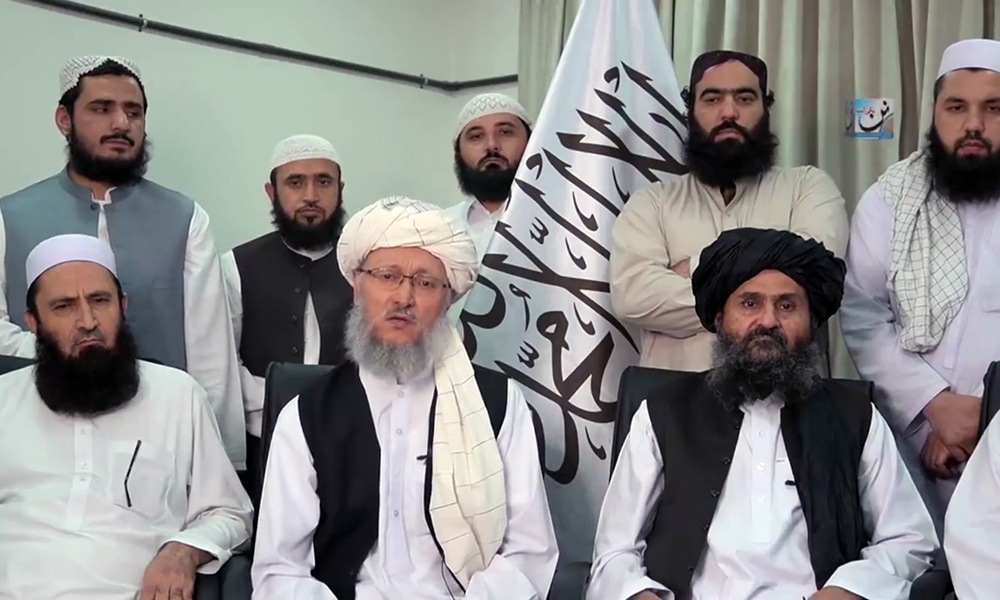
Taliban Militant Leadership
Ron Synovitz
RFE/RL’s Radio Azadi
October 29, 2021
War, drought, and COVID have devastated farmers across Afghanistan.
Now, Afghan farmers who’ve lost money trying to grow crops over the past year say the Taliban is dealing them another crippling blow.
The cash-strapped regime is making them pay so-called charity taxes on their land and harvests, describing the payments as an obligation under Islamic law.
The charity taxes are being collected despite the fact that farmers themselves are among the 14 million Afghans that the World Food Program says are already facing acute hunger.
Samiullah, a 28-year-old Afghan farmer with eight acres of land in Kapisa Province north of Kabul, is among those whose families need humanitarian aid to survive the coming winter.
Irrigation canals in the so-called green belt around Samiullah’s village of Kham Zargar helped him weather the drought better than farmers who had to haul water from wells to keep their crops alive.
But even before the Taliban seized power in Kabul in August, the cost of fertilizer and other agricultural chemicals had soared due to Taliban blockades on transport routes and global COVID supply-chain disruptions.
Samiullah was not allowed to write off the thousands of dollars in unexpected costs he incurred due to war and COVID. Taliban tax collectors do not take into consideration the losses farmers have incurred.
Thus, Samiullah’s “ushurp” tax was calculated as a flat 10 percent of the funds he received for his harvest.
Samiullah also has to pay a 2.5 percent “zakat” tax on the value that Taliban tax collectors estimated his property is worth.
“When we calculate our costs, with such a high price for chemical fertilizer alone, there is nothing left for us in the end except the hard work we go through,” Samiullah tells RFE/RL’s Radio Azadi.
To the east of Kabul, in neighboring Nangarhar Province, 30-year-old livestock rancher Ezat took out loans last year to buy land.
But the drought and economic collapse under the Taliban have left Ezat unable to repay those loans — forcing him to sell much of his land at a loss.
Now, because the Taliban taxes him without considering his losses, Ezat says he cannot afford to pay the tithes and “zakat.”
Charitable Obligation
The Taliban justifies its charity taxes as one of the five pillars of Islam that are considered obligations for all Muslims.
Other such obligations include a declaration of faith, daily prayer, fasting during the month of Ramadan, and taking part in the Hajj pilgrimage.
Zakat differs from the voluntary act of giving charitable gifts out of kindness or generosity.
It is meant to be compulsory for those who earn incomes above a certain amount, and it is based on a person’s income as well as the value of their possessions.
Recipients of zakat are meant to be the poor and needy, struggling converts to Islam, people who are enslaved or in debt, stranded travelers, and soldiers who fight to protect the Muslim community.
Those who collect zakat also are compensated for the work they do.
Critics of zakat include Islamic scholars and aid workers who note that the practice has failed to alleviate poverty in the Muslim world.
They argue that the funds often are wasted and mismanaged.
Agha Gol, a resident of Kabul’s Shakardara district, was forced to pay taxes to the Taliban for his garden.
Gol says the Taliban has yet to standardize its rules on collecting tithes and charity taxes. He says that can make the taxes arbitrary and prone to corruption by abusive tax collectors.
“You have to pay the [Taliban-led] government,” Gol told Radio Azadi. “But first, they need to have a specific law and create a specific office for payments to be forwarded to the Taliban’s treasury.”
In Kabul, the Taliban-led government’s Agriculture Ministry says it is collecting charity taxes from farmers, ranchers, and people with small garden plots in order to bolster revenues and increase the “self-sufficiency” of the country.
Representatives of the Taliban ministry tell Radio Azadi that they are not sending out tax payment notification letters through mosques and villages in rural areas.
But they admit that work on collecting tithes and charity taxes is under way.
Residents of Ghor Province refute the ministry’s claim that the Taliban is not delivering tax payment notifications.
They tell Radio Azadi the Taliban’s tax collection process began when local militants posted so-called night letters at local mosques and on the walls of residential compounds.
Farmers in the central Afghan province also tell Radio Azadi that Taliban gunmen have stormed their homes at night to demand that they pay tithes and charity taxes.
Those without money to make the payments say the Taliban has seized their livestock instead — making their families even more dependent on humanitarian aid in the months ahead.
Taliban Cash Crunch
The Taliban argues that its cash shortage could be alleviated if Washington would release $9.4 billion in Afghan central bank reserves held in the United States.
Those reserves remain frozen amid uncertainties about the Taliban regime’s human rights record and reservations about whether to recognize the Taliban as Afghanistan’s legitimate government.
Nabila Massrali, spokeswoman for European Union foreign policy chief Josep Borrell, notes that regular EU development aid to Afghanistan also remains frozen.
Massrali says a $350 million EU humanitarian aid package announced to support “basic needs in direct benefit of the Afghan people” will not be delivered through the Taliban.
“It goes through international organizations, I mean the United Nations, and nongovernmental organizations on the ground” to guarantee the aid is not diverted by the Taliban, she told Radio Azadi.
“The Taliban are facing a shortage of liquidity not just to pay salaries but to pay everything. So they need the international community’s help,” Massrali explained. “Our engagement will also depend on the action of the Taliban.”
Meanwhile, cash shortages, bank closures, and the suspension of money transfers to Afghanistan since the Taliban seized Kabul continue to contribute to hyper inflation and rising food costs.
According to the World Food Program (WFP), more than 60 percent of Afghans rely on agriculture for their incomes.
In September, just weeks after the Taliban seized power, the WFP estimated that 93 percent of Afghans were not getting enough food to eat — an increase from 80 percent before the Taliban took over.
“Taliban control will undoubtedly make a bad situation worse,” says Jamie Lutz, a global food security researcher at the Center for Strategic and International Studies (CSIS).
Lutz notes that the former Afghan government depended heavily on foreign aid, with about 80 percent of its budget coming from the United States and other international donors.
“The withdrawal of international support in the country has raised questions about how the Taliban will fund social services and food assistance,” Lutz says.
“The Taliban takeover is also worsening disruption to food supply chains,” she concludes.
Written by Ron Synovitz in Prague with reporting by RFE/RL’s Radio Azadi.
Copyright (c) 2021. RFE/RL, Inc. Reprinted with the permission of Radio Free Europe/Radio Liberty, 1201 Connecticut Ave NW, Ste 400, Washington DC 20036.
Afghanistan: Taliban ‘Vice’ Handbook Abusive
 HRW: Taliban officials in Afghanistan’s provinces are using a manual that imposes rules harsher than the abusive policies announced by their leaders in Kabul. And Taliban authorities often do not comply with the rights protections that the manual, from the Taliban’s Ministry of Vice and Virtue, sets out.
In the manual, the Taliban discourages people from “helping, befriending…infidels” and instructs religious leaders to advise men on growing their beards. Those who fail to pray or fast as required by religious obligations are to be reported. It prohibits parties and listening to music audible outside a home, cinemas, gambling, and “inappropriate use of tape cassettes, dish antenna, computer and mobile.”
Cricket: Pakistan wins by 5 wickets
 Business Insider: Pakistan beat Afghanistan by five wickets in their Group 2 Super 12 match of the ICC T20 World Cup here on Friday. Click here to read more (external link).
Afghanistan’s girls learn, code ‘underground’ amid Taliban curbs
 Al Jazeera: Hundreds of girls and women continue to learn – some online and others in hidden makeshift classrooms – despite closure of schools. Click here to read more (external link).
Related
Khalilzad Had Threatened Ghani’s Opponents at Karzai’s House, Spanta Says

Khalilzad
8am: “Mr. Khalilzad considers Dr. Ghani’s obstinacy to maintain power as the main obstacle to his so-called peace,” Dr. Spanta, former national security adviser to Hamid Karzai, tweeted on Friday, October 29. “Ghani’s madness in maintaining his illegitimate power and his hostility to peace and the rule of law was evident. But Mr. Khalilzad, weren’t you the one who threatened Dr. Ghani’s opponents who accused him of election manipulation in Mr. Karzai’s house?” Click here to read more (external link).