
 Ariana: The government of Pakistan, facing gas shortage as winter sets in, has worked out a plan to import liquefied petroleum gas (LPG) overland from Turkmenistan through Afghanistan, Pakistan Today reported on Thursday. The customs office in Quetta, the capital of Balochistan, after consultations with stakeholders, sent a plan to the Federal Board of Revenue to import LPG across the Chaman border, the paper said, citing sources. The federal government is ready to take the big step of importing LPG from Turkmenistan and will allow entry of tanker trucks, the sources said. Click here to read more (external link).
Taliban Members Steal a Car in Islam Qala, Herat
 8am: Taliban fighters are committing armed robbery in the outskirts of Herat province, sources confirmed to Hasht-e Subh on Friday (December 9th). A group of four Taliban fighters stopped a young man’s car at a checkpoint in the Kalata Hakim neighborhood of Islam Qala district early this week, sources detailed. Taliban fighters first searched him and then told him: “You must come with us to the city, we have the identity cards of the Islamic Emirate with us.” Click here to read more (external link).
Taliban Denounce ‘Reprehensible’ Outcry Over Afghan Public Executions, Flogging

Zabihullah Mujahid
Ayaz Gul
VOA News
December 8, 2022
ISLAMABAD — The hardline Taliban government in Afghanistan pushed back Thursday against an international outcry over its first public execution and application of Sharia, or Islamic law, to criminal justice at large, calling it “reprehensible” and “interference” in the country’s internal affairs.
Taliban spokesman Zabihullah Mujahid said in a statement the criticism had “unfortunately” stemmed from a lack of understanding and research about Islam as well as Afghanistan, where he said more than 99% of the population are Muslim.
“They have rendered many sacrifices for the enforcement of Islamic laws and system in the country,” Mujahid said.
On Wednesday, the radical Taliban carried out their first public execution since seizing power last year, putting to death a man convicted of murder, causing outrage among global human rights defenders. The United States called the execution “despicable.”
The execution was staged in a sports stadium in western Farah province, where top Taliban leaders were among hundreds of spectators. Officials said the sentence, carried out by the father of the victim, was in line with “qisas,” an Islamic law stipulating the person is punished in the same way the victim was murdered.
The United Nations decried the action as a form of “cruel, inhuman or degrading treatment or punishment” and “contrary to the right to life protected” under international laws.
Mujahid defended the public execution, saying death penalties “are given all over the world, even in America and Europe.”
In recent weeks, Taliban authorities also have flogged dozens of men and women in crowded football stadiums in several areas, including the capital, Kabul, for committing alleged “moral crimes” such as adultery, theft, running away from home, “illegal relationships, and sodomy.”
On Thursday, the Taliban Supreme Court announced the public flogging of another 27 convicts, including nine women, in Parwan province, about 50 kilometers north of the Afghan capital. It said the “criminals confessed” to their crimes without any force.
“The fact that Afghanistan is being criticized for applying Islamic sentences shows that some countries and organizations have either insufficient knowledge or have problems with Islam, respecting Muslims’ beliefs and laws,” Mujahid stated.
“This action is an interference in the internal affairs of countries and is reprehensible.”
U.S. State Department spokesman Ned Price told reporters in Washington that officials were closely watching the Taliban’s treatment of Afghans and their strict interpretation of Sharia.
“This indicates to us that the Taliban seek a return to their regressive and abusive practices of the 1990s,” he said, referring to the hardline group’s previous rule in Afghanistan from 1996 to 2001.
“It was an affront to the dignity and the human rights of all Afghans then; it would be an affront to the dignity and the human rights of all Afghans now. It is a clear failure by the Taliban to uphold their promises,” Price added.
While the former Taliban government was recognized by only three countries, including Saudi Arabia, the United Arab Emirates and neighboring Pakistan, no foreign government has yet established formal ties with the new male-only regime in Kabul over human rights concerns, especially the treatment of Afghan women.
Despite repeated assurances to the international community that they would respect women’s rights to public life and education, the Taliban have ordered women to cover their faces in public and not undertake long road trips without a close male relative.
Women are barred from entering public parks, gyms and baths, while most female government staff members have been told to stay at home.
Teenage girls have been banned from attending school beyond the sixth grade across most of Afghanistan.
Thomas West, the U.S. special Afghan representative, on Wednesday met with Taliban Defense Minister Mulawi Mohammed Yaqub in Abu Dhabi where he raised “the deteriorating” human rights situation in Afghanistan, particularly for women and girls.
“The country’s economic & social stability & the Taliban’s domestic & international legitimacy depend enormously on their treatment of Afghanistan’s mothers & daughters,” West said on Twitter after the meeting.
The Taliban regained power in August 2021 as the United States and NATO withdrew their troops from the country after 20 years of war.
The transition triggered enforcement of international sanctions against the former insurgent group and suspension of financial aid to Afghanistan, worsening humanitarian conditions and plunging the conflict-torn country’s economy into crisis.
The Taliban began implementing public punishments in early November, when their reclusive supreme leader, Hibatullah Akhundzada, ordered judges to fully enforce Sharia. Akhundzada has pledged repeatedly to govern Afghanistan strictly in line with Islamic law, telling the international community he would not compromise on Sharia, come what may.
Afghans Struggle For Survival As Country Braces For Second Winter Under Taliban Rule
 By RFE/RL’s Radio Azadi
Abubakar Siddique
December 8, 2022
Mahmood has been selling off what is left of his family’s meager possessions in order to prepare for the harsh winter ahead.
“I sold our carpets and kitchen utensils to buy food and fuel for the winter,” the father-of-five, who lives in the northern Afghan province of Parwan, told RFE/RL’s Radio Azadi.
Mahmood is among the millions of Afghans who aid groups say will struggle to survive as the country braces for its second winter under Taliban rule. There are fears that this winter could be even worse as hunger and disease spread and the prices of food and energy surge.
The Taliban’s takeover of Afghanistan in August 2021 triggered an economic collapse and worsened a major humanitarian crisis. Western donors abruptly cut off assistance and the new government was hit by international sanctions.
Aid groups have warned that the onset of winter will compound the acute humanitarian crisis in Afghanistan, where around 90 percent of people already do not have enough to eat.
Many Afghans are bracing for the worst. More and more people are selling their belongings to make ends meet.
Halima, a widow in the capital, Kabul, has already sold most of her family’s belongings to feed her five children. “The only things I haven’t sold are things that nobody will buy,” she told Radio Azadi.
Afghans who do not have possessions or employment have taken even more desperate steps. Some families have married off their underage daughters. Others have sold their kidneys or children in a bid to avoid starvation.
Tapiwa Gomo, a spokesman for the United Nations Office for the Coordination of Humanitarian Affairs (OCHA), told RFE/RL that Afghan families are being forced to take “more and more severe coping strategies” as their finances deteriorate.
‘A Step Away From Famine’
Martin Schuepp, director of operations at the Red Cross who visited Afghanistan last week, said Afghans face an “impossible choice” this winter: “to eat or to buy heat.”
“They can’t afford either, resulting in a frightening rise in malnutrition and pneumonia cases,” he said.
The Red Cross estimates that child malnutrition cases this year are 90 percent higher than in 2021, while pneumonia has risen by 55 percent during the same period.
“Lack of warm clothing, insulation, and heating heightens the risk of respiratory infections, hypothermia and preventable mortality among children and the elderly,” said Gomo.
With many Afghans unable to afford food or heating, the number of people in need of humanitarian assistance has surged. According to the OCHA, more than 28 million Afghans need humanitarian assistance, a 16 percent increase from last year.
“Severity levels remain unprecedented, with 6 million people a step away from famine,” said Gomo. “This is still one of the highest figures in the world in absolute terms.”
Power Cuts
Many Afghans cannot afford gas, coal, wood, or fuel to cook and heat themselves. Those who rely on electricity, meanwhile, have been reeling from frequent and prolonged power cuts in recent weeks.
Uzbekistan, from where Afghanistan imports significant amounts of electricity, has cut its exports due to technical issues, sending prices soaring.
Fazal, a Kabul resident, said electricity is only available for a few hours each day, usually late at night.
Another Kabul resident, Bashir, said the rise in electricity prices has made it hard for him to make ends meet.
“I am struggling to pay for the high price of electricity while also coping with inflation,” he said.
Food prices have increased substantially compared to last year. The World Food Programme has said that the food basket it provides to vulnerable Afghans is 20 percent more expensive this year because of the global food and energy price hikes caused by the war in Ukraine.
“We are destitute, desperate, and need help,” said Akbar who lives in the southeastern Paktia Province. Without assistance, he said, many in his village will not survive the winter.
Copyright (c) 2022. RFE/RL, Inc. Reprinted with the permission of Radio Free Europe/Radio Liberty, 1201 Connecticut Ave NW, Ste 400, Washington DC 20036.
US Says It Will Intervene If Terrorists Regroup in Afghanistan
 Khaama: The US State Department expressed concerns that Afghanistan would once again become a haven for terrorists while simultaneously warning that it would intervene and take action if terrorists regrouped in Afghanistan. The statement was made on Wednesday in response to a question regarding the escalation in violence in Afghanistan and the government’s failure to stop offering “safe havens” to terrorist organizations, such as the Tehreek-e-Taliban Pakistan (TTP), al-Qaeda, the Islamic State, and others. Click here to read more (external link).
Related
1TV Afghanistan Dari News – December 8, 2022
People with tuberculosis face multiple barriers accessing treatment in Afghanistan
 MSF: Difficulties reaching and affording medical care are not the only barriers to TB treatment faced by people in Afghanistan. Another is the widespread lack of knowledge about the disease. MSF teams carry out regular health promotion activities in local communities in Kandahar to improve people’s understanding of TB. Over 70 per cent of patients in MSF’s Kandahar TB hospital are women and children. “Women and children stay at home in dusty, poorly ventilated rooms for longer periods of time than men,” says Tommy. “If a woman gets infected, the children are likely to catch the disease as well,” he says. An additional challenge for female patients is that they are generally required to be accompanied by a male family member to the hospital, and this coupled with the economic barriers can significantly reduce their access to healthcare. Click here to read more (external link).
Former Farah MP: Taliban Convicted Taj Mir Without Investigation

8am: Abdul Sattar Hussaini, a former parliament member (MP), representing Farah province, claims that the Taliban killed a person based on allegations. Mr. Hussaini said in a video, that went viral on social media on Wednesday evening (December 7th), the Taliban did not adhere to human rights, but violated them. Click here to read more (external link).
Related
Taliban Holds First Public Execution In Afghanistan Since Retaking Power

Haqqani (left) and Baradar (right)
By RFE/RL’s Radio Azadi
December 7, 2022
Afghanistan’s Taliban administration has carried out the death penalty of a man convicted of murder in the country’s first public execution since the militants retook power in August last year.
Zabihullah Mujahid, a spokesman for the ruling Taliban, said on December 7 that a group of senior officials attended the execution of a man from the Injil district of Herat Province. He allegedly confessed to killing a man with a knife and taking his motorcycle and phone during a robbery five years ago.
Reuters reported that acting Interior Minister Sirajuddin Haqqani and acting Deputy Prime Minister Abdul Ghani Baradar, along with the country’s chief justice, acting foreign minister, and acting education minister, attended the execution in the western part of Afghanistan.
The Taliban took control of the country last August as international forces withdrew from Afghanistan following two decades of fighting.
The militants have formed an all-male cabinet made up entirely of members of the group and almost exclusively of ethnic Pashtuns.
They have further restricted women’s rights to work and study, triggering widespread international condemnation.
Most of the world’s countries do not recognize the Taliban-led government amid concerns that the militants are not living up to their promises of respecting human rights. However, on March 17, the United Nations Security Council voted to establish official ties with Afghanistan.
Capital punishment was widely practiced by the previous Taliban regime, which ruled much of the country from 1996-2001, when executions and punishments such as stoning were routinely conducted in front of large crowds.
Patricia Gossman, associate Asia director at Human Rights Watch, recently told Radio Azadi that if the Taliban resumes “barbaric and oppressive actions” such as public executions, it “will deserve international condemnation.”
With reporting by Reuters
Copyright (c) 2022. RFE/RL, Inc. Reprinted with the permission of Radio Free Europe/Radio Liberty, 1201 Connecticut Ave NW, Ste 400, Washington DC 20036.
Related
The Jogi nomads of Afghanistan are fighting for their rights
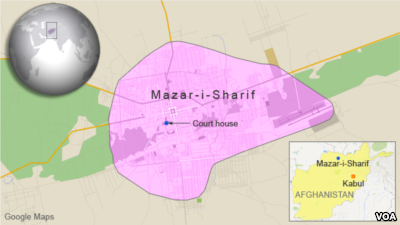
Mazar-e Sharif
Equal Times: The Jogi camp, located on the outskirts of Mazar-e Sharif, a large city in the north of the country, is home to some 15 families and none of the children go to school. “What’s the point of going to school if you don’t have anything to eat?” asks Aisha, a neighbour who is listening to the conversation at the door of the tent. “They have to help their families! By selling the plastic they collect in the city centre, they bring in about a hundred afghani a day [€1.13], enough to buy some bread.” Click here to read more (external link).