logo

Daily Updated Afghan News Service

  • Home
  • About
  • Opinion
  • Links to More News
  • Good Afghan News
  • Poll Results
  • Learn about Islam
  • Learn Dari (Afghan Persian/Farsi)

Recent Posts

  • 19 Afghan migrants killed as boat capsizes off Turkish coast April 2, 2026
  • Afghanistan falls 5–1 to Syria in Asian Cup qualifier April 2, 2026
  • Floods, rainfall kill 48 in Afghanistan over past week, ANDMA says April 1, 2026
  • US eases asylum freeze for vetted migrants, keeps Afghanistan ban April 1, 2026
  • Tolo News in Dari – April 1, 2026 April 1, 2026
  • More Than 28,000 Afghans Return From Iran As Crisis Deepens April 1, 2026
  • From Rotor Drones to Kamikaze UAVs: Tracking the Taliban’s Five-Year Shift March 31, 2026
  • Nearly 1,500 Afghans died on migration routes in 2025, IOM says March 31, 2026
  • From Pressuring Staff to Embezzling Donor Funds: Complaints Against Taliban Environmental Chief in Herat March 31, 2026
  • Tolo News in Dari – March 31, 2026 March 31, 2026

Categories

  • Afghan Children
  • Afghan Sports News
  • Afghan Women
  • Afghanistan Freedom Front
  • Al-Qaeda
  • Anti-Government Militants
  • Anti-Taliban Resistance
  • AOP Reports
  • Arab-Afghan Relations
  • Art and Culture
  • Australia-Afghanistan Relations
  • Book Review
  • Britain-Afghanistan Relations
  • Canada-Afghanistan Relations
  • Censorship
  • Central Asia
  • China-Afghanistan Relations
  • Civilian Injuries and Deaths
  • Corruption
  • Crime and Punishment
  • Drone warfare
  • Drugs
  • Economic News
  • Education
  • Elections News
  • Entertainment News
  • Environmental News
  • Ethnic Issues
  • EU-Afghanistan Relations
  • Everyday Life
  • France-Afghanistan Relations
  • Germany-Afghanistan Relations
  • Haqqani Network
  • Health News
  • Heroism
  • History
  • Human Rights
  • India-Afghanistan Relations
  • Interviews
  • Iran-Afghanistan Relations
  • ISIS/DAESH
  • Islamophobia News
  • Japan-Afghanistan Relations
  • Landmines
  • Media
  • Misc.
  • Muslims and Islam
  • NATO-Afghanistan
  • News in Dari (Persian/Farsi)
  • NRF – National Resistance Front
  • Opinion/Editorial
  • Other News
  • Pakistan-Afghanistan Relations
  • Peace Talks
  • Photos
  • Political News
  • Reconstruction and Development
  • Refugees and Migrants
  • Russia-Afghanistan Relations
  • Science and Technology
  • Security
  • Society
  • Tajikistan-Afghanistan Relations
  • Taliban
  • Traffic accidents
  • Travel
  • Turkey-Afghanistan Relations
  • UN-Afghanistan Relations
  • Uncategorized
  • US-Afghanistan Relations
  • Uzbekistan-Afghanistan Relations

Archives

Dari/Pashto Services

  • Bakhtar News Agency
  • BBC Pashto
  • BBC Persian
  • DW Dari
  • DW Pashto
  • VOA Dari
  • VOA Pashto

Institutional Purge Continues: Taliban Are Removing, Demoting or Coercively Transforming Employees in Selected Revenue Offices

30th August, 2023 · admin

Taliban militants dancing (file photo)

8am: Sources continue to cite another motive behind the Taliban’s actions as the dismissal of non-Pashtun individuals and the relocation of “trustworthy” members of the group. A source added, “The goal in this regard is to move individuals deemed more trustworthy. It’s the path toward becoming a mafia-like accumulation of wealth. Specific individuals, perhaps in exchange for bribes, are hired, and are meant to be placed in key positions.” According to them, this process has been executed in many provinces previously, but it has recently commenced in the provinces of Panjshir, Kunduz, and Parwan. Meanwhile, sources in the provinces of Parwan and Kunduz also reveal that approximately 60% of employees from other ethnicities in these two provinces have been dismissed by the Taliban. Click here to read more (external link).

Posted in Corruption, Ethnic Issues, Taliban | Tags: Ethnic descrimination, Life under Taliban rule, Pashtun Taliban, Pashtunization |

Afghan Refugees In Iran Say Camps Filled With Misery As They Await Fate

30th August, 2023 · admin

By RFE/RL’s Radio Azadi
August 30, 2023

Hundreds of Afghan migrants who fled to Iran say they are living in squalid camps located in the southeastern city of Zahedan, battling hunger and dehydration under relentless summer conditions as they wait for news about their return to Afghanistan.

Hundreds of thousands of Afghans are said to have migrated across the border since Taliban militants seized power in August 2021 following the hasty departure of international peacekeeping forces. The influx has come at a time when Tehran is already struggling with economic woes sparked by the imposition of drastic international sanctions over its nuclear program.

Taliban officials have said they seek the safe return of the refugees, but little movement on the issue has been made to address the situation as more and more people cross the border.

One pregnant woman in the Zahedan camp told RFERL’s Radio Azadi that, after a week in the camp, she is without steady access to water, food, or health services.

She and her family fled soon after the Taliban took power, and they have been moving around trying to find some stability. But a lack of legal documents and the harassment of her husband by Iranian police have left her with little hope other than to eventually return home.

“We are stuck inside the camp in Zahedan, and now we can’t leave. There is no food, no water, we are about 500 people, young, old, and children, we are all stuck here in this hot weather and there is no one to help us,” she said.

“We say we are going to Afghanistan and they [Iranian authorities] say go, but how? How? There is no solution, there is no hotel to stay at and we don’t have a bus to go to Afghanistan.”

While the refugees say conditions were never good at camps like the one in Zahedan, they have deteriorated in recent months and their treatment by local officials has also worsened, with many complaining of constant harassment.

International human rights groups have documented years of violations against Afghan refugees and migrants in Iran, including physical abuse, detention in unsanitary and inhumane conditions, forced payment for transportation and accommodation in camps, slave labor, and the separation of families.

In 2015, Iranian Supreme Leader Ayatollah Ali Khamenei issued a decree allowing all Afghan children to go to school. But Afghans are still denied many other basic services, including access to medical care, jobs, and housing.

Written by Ardeshir Tayebi based on an original story in Persian by RFE/RL’s Radio Farda

Copyright (c) 2023. RFE/RL, Inc. Reprinted with the permission of Radio Free Europe/Radio Liberty, 1201 Connecticut Ave NW, Ste 400, Washington DC 20036.
Posted in Iran-Afghanistan Relations, Refugees and Migrants |

Female Afghan Journalists Describe Life Under Taliban Misogyny

30th August, 2023 · admin

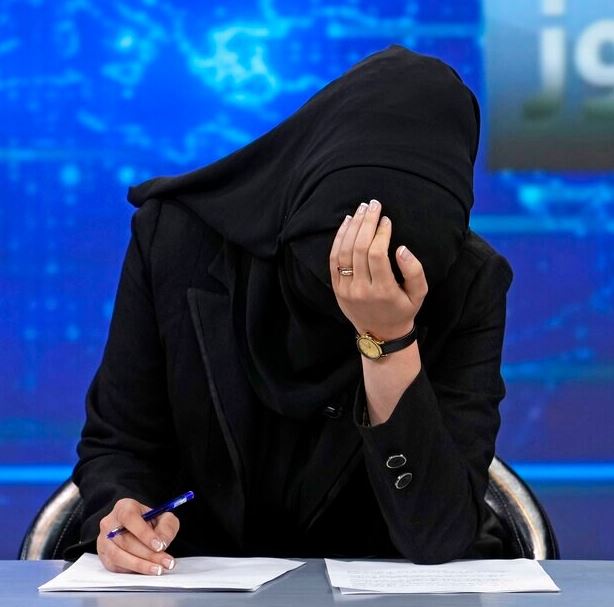
FILE – TV anchor Khatereh Ahmadi bows her head while wearing a face covering as she reads the news on TOLO NEWS, in Kabul, Afghanistan, May 22, 2022, after Taliban rulers required all female TV news anchors in the country to cover their faces while on-air.

Akmal Dawi
VOA News
August 30, 2023

In 2016, a young girl, whom we will call Zarghona to protect her identity, embarked on a remarkable journey in central-south Afghanistan. At just 14 years old, she joined a local radio station in Ghazni province, eager to make her voice heard. Initially entrusted with a daily entertainment program for young people, Zarghona’s charisma and talent soon led her to more challenging assignments.

“I presented a culinary program, as well as a cultural awareness program,” she said, her voice tinged with nostalgia.

By 2021, Zarghona’s career was soaring, and she had dreams of pursuing higher education in journalism in Kabul and working for the national media in the capital city.

Before the year’s end, though, everything changed dramatically.

As the Taliban swept into power in August of that year, one of their first acts was to indefinitely suspend secondary education for girls, extinguishing the hopes of countless young women like Zarghona. The new Islamist regime also terminated the employment of almost all female public servants, with few exceptions, in the education and health sectors.

The national broadcasting agency, Radio and Television Afghanistan, saw all of its female journalists dismissed, and private TV channel anchors were compelled to wear face masks.

Under the Taliban’s gender-based discriminatory regime, female journalists are barred from interviewing male government officials, forbidden from participating in press conferences without a male chaperone, and restricted from traveling for reporting purposes.

These rules, unapologetically designed to push women out of journalism, paint a grim picture for Zarghona and many other young women who desperately want to work as journalists.

Despite this bleak reality, for about two years, Zarghona has waited anxiously for an announcement from the Taliban that schools and universities would reopen for girls, and women would be allowed to return to work.

Others hold no such hope.

“I see the future even darker. The restrictions [against women] are increasing day after day, and the Taliban do not care how we suffer,” said Madina Bamyani (not her real name), a journalist in the central Bamyan province.

The three journalists who spoke with VOA for this article still reside in Afghanistan, but they all asked to remain anonymous, fearing reprisals from the Taliban.

Targeted persecution

Earlier this year, Bamyani received a job offer from a U.S.-based Afghan media outlet to produce video reports about alleged Taliban atrocities in Bamyan and nearby provinces.

The private media sector — once a thriving industry thanks to the international support it received — has been crushed as Taliban restrictions force hundreds of journalists and media professionals to seek asylum in countries around the world.

Outside their homeland, some Afghan journalists have managed to secure funding and launch digital news and analysis outlets aimed at Afghan audiences. But working for those outlets is perilous in Taliban-ruled Afghanistan.

“After I produced a report about the ban on women’s beauty salons, the Taliban investigated and discovered my identity,” Bamyani said. Fearing detention, she fled to Kabul after her employers warned her they would not be able to help if the Taliban found out about her work for them.

The United States has played a significant role in supporting Afghan media development over the past two decades, spending more than $220 million on media support programs, according to the Special Inspector General for Afghanistan Reconstruction.

In September 2022, a year after the Taliban seized power, the U.S. Agency for International Development allocated $20 million for projects supporting Afghan media, including $5 million in grants and a nearly $12 million award that aims to deliver news and educational content for Afghans until mid-2026.

“The United States remains committed to supporting the fundamental right of freedom of expression, including for journalists and human rights defenders, and supports their ability to operate freely without fear of violence against them,” said a spokesperson for the U.S. State Department.

Taliban officials accuse media organizations from abroad that produce content for Afghans of spreading lies and propaganda, and they have targeted reporters and producers working for such outlets.

Parwiz Shamal, an Afghan journalist and founder of Chalawsaf, an Afghan media observer organization, said the Taliban have detained several reporters on charges that they worked for media entities that are not permitted to operate in Afghanistan.

“Nobody is there to defend those reporters because the Taliban consider these outlets illegal, and like in any other country, work for a disallowed organization bears legal responsibilities,” Shamal said.

Information blackout

When the Taliban announced the closure of beauty salons for women in July, there was no public debate or critical media coverage about it.

“We are forced to comply with their misogynistic orders knowing well that those orders are against us,” said Yagana Niekhandish, a female journalist in Herat province.

“If I refuse to comply, the Taliban’s intelligence agency will throw me in jail overnight,” she said.

The Taliban’s intelligence agency has been accused of detaining, and in some cases torturing, about 50 journalists during the past two years, free press groups have reported.

In rural areas, the suppression of women’s voices is even more severe, with local Taliban and religious leaders banning women from radio broadcasts, effectively silencing them from public conversations.

Human rights groups say the Taliban’s anti-women policies are aimed at erasing women from all public spheres, but Taliban officials maintain they are committed to women’s rights — as long as they are within the confines of Islamic Sharia and local traditions.

As Afghan women vanish from public life, access to credible information about their living conditions, from health to income to education, becomes increasingly unavailable.

The Taliban have dissolved the two state institutions — the Ministry of Women’s Affairs and the Afghanistan Independent Human Rights Commission — that monitored and reported on women’s issues and proposed policies to empower them.

“I guess everybody knows what’s happening in Afghanistan, it is an official femicide,” Zarghona said.

“What pains me more is that I’m not able to report it to the world.”

Posted in Afghan Women, Censorship, Media, Taliban | Tags: Afghan Journalists, Life under Taliban rule, Press Freedom, Taliban war on women |

Tolo News in Dari – August 30, 2023

30th August, 2023 · admin

Posted in News in Dari (Persian/Farsi) |

Detention, Torture, Murder: Life Under The Taliban For LGBT People

30th August, 2023 · admin

LGBT activists say the return of the Taliban to power in 2021 in Afghanistan has resulted in discrimination, torture, and even murder. One gay man told RFE/RL that he had to quit school to protect his identity while another said he and his boyfriend were tortured by the Taliban.

Posted in Human Rights, Taliban | Tags: LGBTQ in Afghanistan, Life under Taliban rule |

Armed Clashes Erupt Between Taliban and ISIS in Nimruz

30th August, 2023 · admin

8am: According to reports from sources speaking to Hasht-e Subh, a confrontation took place on Tuesday, August 29th, between Taliban and ISIS in the vicinity of Sistan Township, Zaranj city, the capital of Nimruz province. The armed clash reportedly lasted for nearly half an hour, according to the sources. A source from Zaranj city has stated that following the clash, the Taliban detained five individuals on charges of being associated with the ISIS group. Click here to read more (external link).

Posted in ISIS/DAESH, Security, Taliban | Tags: Nimroz, Taliban Security Failure, Taliban vs. ISIS |

UN’s Otunbaeva Says Afghanistan Should Be Included In Global Climate Talks

30th August, 2023 · admin

Roza Otunbaeva

By RFE/RL’s Kyrgyz Service
August 29, 2023

A top UN official expressed concerns that Afghanistan has been excluded from global discussions on climate change, despite being among the top 10 countries worldwide facing climate-related issues.

Afghanistan has been excluded from the UN’s global climate summit talks since the Taliban takeover in 2021.

Roza Otunbaeva, head of the UN Assistance Mission in Afghanistan (UNAMA), highlighted the impact of climate change and drought conditions on the poverty level of the country and pointed to the importance of Taliban-driven initiatives, such as the Amu Darya River water project.

The comments came in an interview published on August 29 by RFE/RL’s Kyrgyz Service.

One issue of concern, Otunbaeva said, is the massive canal project begun by the Taliban to divert water from a key river to help the farming sector of northern Afghanistan. But some Central Asian nations worry over how the project could reduce water supply to their regions.

“[Taliban rulers] are digging a hundred kilometers of the channel aiming to deliver water from Amu Darya River. They are going to farm new places and want to have independence on food security,” she noted.

“However, this is a very dangerous point for our neighborhood (Central Asian countries) because of [resulting] water issues,” said Otunbaeva, who served as the interim president of Kyrgyzstan in 2010-11.

The Taliban administration has prioritized the Qosh-Tepe canal project, begun in early 2022, with the aim of allocating Amu Darya waters among the Central Asian states — Kyrgyzstan, Tajikistan, Turkmenistan, and Uzbekistan — a plan that originated during the Soviet era.

In November, independent Afghan climate activist Abdulhadi Achakzai attended as the only representative of his nation at the UN Conference of Parties (COP27) in the resort city of Sharm el-Sheikh, Egypt.

The 2021 Global Climate Risk Index positioned Afghanistan as the sixth most vulnerable country to climate-related threats.

Afghanistan faces frequent natural disasters that are endangering life, livelihoods, homes, and infrastructure.

Hundreds of Afghans die every year in torrential rains, landslides, and floods, particularly in rural areas where poorly built homes are often at risk of collapse.

The UN has said that decades of war, environmental degradation, and climate change have made a growing number of Afghans vulnerable to natural disasters.

Copyright (c) 2023. RFE/RL, Inc. Reprinted with the permission of Radio Free Europe/Radio Liberty, 1201 Connecticut Ave NW, Ste 400, Washington DC 20036.
Posted in Environmental News, UN-Afghanistan Relations | Tags: Climate Change |

‘I’m Terrified’: Social Media Influencers Fearful After Mysterious Death Of Popular Afghan YouTuber

30th August, 2023 · admin

Hora Sadat

Naqiba Barekzai
Abubakar Siddique
August 29, 2023

Radio Free Europe/Radio Liberty

Hora Sadat, a female YouTuber, built a large social-media following by producing light-hearted videos about life in Afghanistan.

Even after the Taliban seized power in 2021, the 25-year-old remained unfazed. She continued to generate content for her more than 300,000 subscribers despite the militant group’s attempts to erase women from public life.

Last week, Sadat’s social-media accounts fell silent. She was allegedly poisoned after attending a private event in the capital, Kabul, on August 21. The Taliban said it had arrested two people — a man and a woman — in connection with her death.

Although the motive for her alleged poisoning is not clear, her death has had a chilling effect on female online personalities and social-media influencers still active in Afghanistan.

Speaking to RFE/RL’s Radio Azadi, several female YouTubers, who spoke on condition of anonymity for security reasons, said they fear for their lives and have cut their online presence.

“Any woman who works for the media, is active in civil society, or appears on social media faces extreme threats,” Shakeela, a female YouTuber who requested that her real name not be used, told Radio Azadi.

Shakeela says she no longer films in public, opting to produce videos from the safety of her home. Even then, she does not show her face in her videos. “Out of fear, I cannot even tell our neighbors that I run a YouTube channel,” said Shakeela, who lives in Kabul.

Only a handful of young female Afghan YouTubers have continued their activities under the Taliban, which has waged a brutal crackdown on dissent.

Many social-media personalities, including men, have avoided criticizing the Taliban or commenting on politics. Instead, they have focused on showcasing Afghan culture and natural beauty. Despite their apolitical nature, the online content has shed some light on Taliban-ruled Afghanistan.

Suraya, another female YouTuber in Kabul, says Sadat’s death has spread fear among Afghan women who play a visible role in society. “I am terrified,” she told Radio Azadi.

‘You’re On Your Own’

Some women’s rights activists in Afghanistan have blamed the Taliban for Sadat’s death, although there is no evidence of the militant group’s involvement.

Last week, members of the Afghan Women’s Empowerment Movement gathered at Sadat’s grave and expressed concerns over what they said were the targeted killings of prominent women.

“By going to Hora’s grave, we first want to share our sorrow with her family and friends. Then we want the international community to punish those who are behind the mysterious and targeted killings of women,” Halima Hakimi, a member of the movement, told Radio Azadi.

In January, Mursal Nabidzadah, a former female lawmaker, was shot dead along with a bodyguard when unidentified gunmen broke into her house in Kabul. The motives for her killing remain unclear.

Sadat’s death has underscored the dangers faced by women under the Taliban.

Since seizing power, the hard-line Islamist group has banned women from education and most forms of employment, effectively denied them any public role in society, and imposed strict limitations on their mobility and appearance. The militants have violently suppressed protests by women and detained female activists.

The Taliban has also dismantled the Women’s Affairs Ministry and Afghanistan’s Independent Human Rights Commission as well as closing shelters, legal assistance programs, and special courts that were designed to combat violence against women and girls.

“The message this has sent to women and girls is that if you are facing violence or threats, the Taliban administration will not offer you any help — you’re on your own,” said Heather Barr, associate women’s rights director at Human Rights Watch. “Women have every reason to fear for their safety.”

Copyright (c) 2023. RFE/RL, Inc. Reprinted with the permission of Radio Free Europe/Radio Liberty, 1201 Connecticut Ave NW, Ste 400, Washington DC 20036.
Posted in Afghan Women, Crime and Punishment, Media, Security, Taliban | Tags: Life under Taliban rule, Taliban Security Failure |

Tolo News in Dari – August 29, 2023

29th August, 2023 · admin

Posted in News in Dari (Persian/Farsi) |

Taliban Governor in Yangi Qala District, Takhar Province Accused of Manipulating Humanitarian Aid: Local Reports

29th August, 2023 · admin

8am: Shamsuddin Hemayoun, the governor of the Yangi Qala district in Takhar province, stands accused of manipulating a substantial quantity of humanitarian aid, including approximately 160 bags of chemical fertilizers and improved wheat. This aid was generously provided by the “Swedish Committee for Afghanistan” to cater to the needs of vulnerable locals and struggling farmers in the province. Sources who spoke with Hasht-e Subh on Tuesday, August 29, have revealed that this high-ranking Taliban official orchestrated the alleged manipulation of humanitarian assistance roughly a week ago. Click here to read more (external link).

Posted in Corruption, Economic News, Taliban | Tags: Corrupt Taliban, Life under Taliban rule, Takhar, Taliban stealing aid |
Previous Posts
Next Posts

Subscribe to the Afghanistan Online YouTube Channel

---

---

---

Get Yours!

Peace be with you

Afghan Dresses

© Afghan Online Press
  • About
  • Links To More News
  • Opinion
  • Poll