
 8am: Local sources in Herat have confirmed the death of a Taliban fighter in the province. According to reports received on Wednesday, January 31st, the Taliban member was gunned down in the Golran district of Herat. This development follows recent clashes in the province. Two nights ago, skirmishes erupted between Taliban insurgents and unidentified assailants, resulting in the death of one Taliban operative and injuries to four civilians. Click here to read more (external link).
China’s President Receives Afghan Ambassador; Taliban Seek Recognition From Russia, Iran
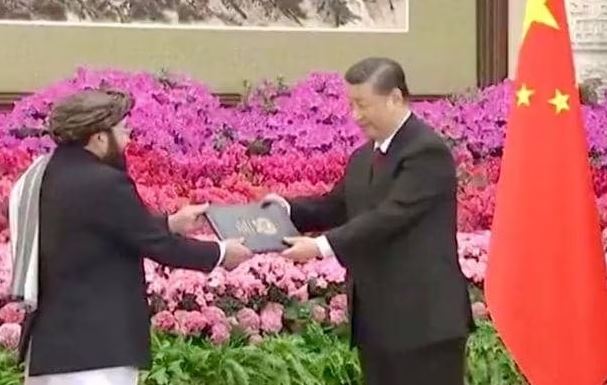
The Taliban’s ambassador to China, Bilal Karimi, left, is seen presenting his credentials to Chinese President Xi Jinping, in a photo posted on X Jan. 30, 2024, by Abdul Qahar Balkhi, spokesperson of the Taliban’s foreign ministry.
Akmal Dawi
VOA News
January 30, 2024
Chinese President Xi Jinping on Tuesday received the credentials of ambassadors from several countries, including neighboring Afghanistan, in what amounts to the first official recognition of the interim Taliban government by a major nation.
Xi welcomed Bilal Karimi, the Taliban-appointed Afghan ambassador, in a formal ceremony at the Great Hall of the People, along with ambassadors from Cuba, Pakistan, Iran and 38 other countries.
“China has understood what the rest of the world has not,” Zabihullah Mujahid, the Taliban’s chief spokesperson, said Tuesday at an event on the social media platform X.
“We are not in a unipolar world,” Mujahid said while calling on Russia, Iran and other countries to take similar steps and upgrade bilateral diplomatic relations with Kabul.
Xi told the new ambassadors that China is seeking deep friendship and mutually beneficial cooperation with their countries, Chinese state news agency Xinhua reported.
Matthew Miller, spokesperson for the U.S. State Department, said whether Beijing has officially recognized the Taliban regime is for Chinese officials to clarify.
“I have seen some comments from them to the contrary,” Miller told VOA on Tuesday. For the United States, Miller said, the Taliban’s relationship with the international community depends on their actions.
“China may be getting ready to break ranks and take the final technical step either within the U.N. system or outside of it through a bilateral initiative,” Omar Samad, a former Afghan ambassador, wrote to VOA.
Javid Ahmad, Afghan ambassador to the United Arab Emirates under the former Afghan government, called the Chinese move an act of recognition.
“The signal is unmistakable, as no head of state would accept ambassadorial credentials unless they recognize the government. In this instance, the Chinese leadership is treating the Taliban envoy in the same manner as other ambassadors, a clear indication of recognition,” Ahmad told VOA.
While China’s recognition marks a significant step, it remains an isolated one. No other major nation has recognized the Taliban’s “Islamic Emirate of Afghanistan,” and the United Nations has repeatedly denied their requests for representation at the world body.
The United States and European countries have imposed economic and political sanctions on Taliban leaders and entities, accusing them of grave human rights violations, particularly concerning women’s rights to education and work.
Since reclaiming power in August 2021, the Taliban have steadily established control over many Afghan diplomatic missions, primarily in neighboring countries. The group now oversees embassies in at least 14 countries, including Pakistan, Uzbekistan and Turkmenistan.
Some countries, including Russia, China and Iran, have maintained their embassies in Kabul.
Last week, Russian Foreign Minister Sergey Lavrov told reporters in New York that Moscow had not recognized the Taliban regime because of political and human rights considerations.
“We, as the rest of the U.N. members, do not officially recognize the Taliban,” Lavrov said through a translator.
Last month, the U.N. Security Council authorized the secretary-general to appoint a special envoy for Afghanistan to facilitate coordinated international engagement with de facto Taliban authorities.
Taliban officials have objected to the appointment of the new envoy, saying the U.N. should stop treating Afghanistan as an anomaly within the international community.
VOA correspondent Margaret Besheer contributed to this article.
Afghanistan falls 12 places to 162 in global corruption index
 Ariana: Afghanistan has fallen 12 places to 162nd position in the Corruption Perceptions Index (CPI) for 2023 compared to the previous year, Transparency International said in a report released Tuesday. Afghanistan has scored 20 out of 100 in the new index, ranking 162 out of 180 countries and territories. Last year, Afghanistan stood at the 150th spot with a score of 24. This comes as the Islamic Emirate of Afghanistan (IEA) [Taliban] has repeatedly said that corruption has been reduced to nearly zero since it took power in August 2021. Click here to read more (external link).
Conserving Afghanistan’s Cultural Heritage Under Taliban Rule

Destroyed Buddha Statue
HIR: The Taliban’s dynamiting of the Bamiyan Buddha marked just one of many instances of cultural loss in Afghanistan’s history. In the 1960s, French archaeologists caused irreparable damage by using bulldozers to excavate Ai-Khanoum, an ancient Greek city. In 1989, Russia ended its 10-year occupation of Afghanistan. When its forces pulled out, civil war ensued. During the conflict, in 1993, a bomb aimed at the Ministry of Defense hit an unintended target across the road: the National Museum of Afghanistan. That opened up the walls to plunderers, who stole an estimated 70 percent of the museum’s collection over the following months, including statues from antiquity and the famous Begram ivories, thousands of decorative plaques and figures carved from ivory and bone. The loss of cultural heritage persists today. In April 2023, a report revealed that Dilberjin, the largest ancient city in northern Afghanistan, had been significantly and systematically looted from 2019 to 2021. Looting and illegal excavations in the Bamiyan Valley, where the Bamiyan Buddhas had been located, have also been reported. Click here to read more (external link).
Tolo News in Dari – January 30, 2024
Taliban Coercion in Charikar City: Residents Unable to Afford 20-Year Municipal Cleaning Fee

8am: Some residents of Charikar City, the capital of Parwan province, say that the Taliban have set a one-week deadline for them to pay the 20-year Municipal Cleaning Fee arrears of the city. The Taliban have warned the residents of Charikar that if they do not pay this amount within a week, their homes will be sealed. According to the residents, the Taliban demand the “Municipal Cleaning Fee” based on house valuation from the people. However, the residents of Charikar say that due to the poor economic situation in the country, they are unable to pay this amount of money. They accuse the Taliban of “coercion” and emphasize that this group has multiplied the Cleaning Fee. On the other hand, some legal experts say that with the Taliban’s resurgence, Afghanistan’s legal system has been “halted” and no legitimate legal action is being taken. According to them, the Taliban’s actions, which are carried out in the absence of an official constitutional legality, are more of “autocracy and obscurantism” than legal legitimacy. Click here to read more (external link).
Pakistan’s Ex-PM Khan Sentenced To 10 Years Over US-Related State Secrets

Imran Khan
Ayaz Gul
VOA News
January 30, 2024
ISLAMABAD — A special court in Pakistan sentenced former Prime Minister Imran Khan to 10 years in prison Tuesday on charges that while in office, he made public state secrets involving the United States.
Khan’s former foreign minister, Shah Mehmood Qureshi, was also given a 10-year jail term in the lawsuit stemming from a classified cable, internally known as a cipher.
Khan claimed the diplomatic cable had documented the U.S. role in the toppling of his government with the help of the military to punish him for pushing Pakistan to have a foreign policy free of American influence. Washington and the Pakistan military denied the accusations.
The 71-year-old former Pakistani prime minister, who was ousted from power in April 2022 by an opposition alliance, has rejected the cipher trial as politically motivated and manufactured by the country’s powerful military.
Khan’s Pakistan Tehreek-e-Insaf, or PTI, party decried the court ruling as “a complete mockery and disregard of the law” in a trial “with no access to media or public.” The party said its legal team “will challenge the decision in a higher court” and “hopefully will get this sentence suspended.”
The single-judge tribunal conducted the trial inside a high-security prison near Islamabad, with no access to foreign and most mainstream Pakistani media representatives.
Tuesday’s conviction under the Official Secrets Act comes ahead of parliamentary elections in Pakistan, which are scheduled for Feb. 8.
The cipher was sent to Islamabad by Pakistan’s ambassador in Washington in March 2022, a month before a parliamentary vote of no-confidence removed Khan from power.
The ousted Pakistani leader has maintained that the U.S. in the cipher had encouraged the military to orchestrate the vote, and he was obligated to share the cipher’s contents with his voters to expose the foreign “conspiracy” against his government.
Khan has been in jail since August after being convicted on controversial corruption charges and sentenced to three years. He was subsequently disqualified from contesting an election for five years in line with the election laws that bar convicts from standing.
The cricket hero-turned-politician denies any wrongdoing, accusing the military of orchestrating nearly 200 charges against him, ranging from rioting and corruption to terrorism since his ouster.
Khan swept to power in 2018 when his PTI won the 2018 parliamentary elections, but he developed differences with the military over key appointments and foreign policy matters that critics blame for his removal from office.
The military has directly ruled Pakistan for more than three decades, and generals have been constantly accused of playing a role in making or dislodging elected governments during most of the remainder of the 77 years of Pakistani independence..
The security institution denies it interferes in political matters, but its former chief, General Qamar Javed Bajwa, admitted in a nationally televised speech just days before his retirement in November 2022 that the military had been meddling in politics for the past 70 years.
A government crackdown backed by the military has detained scores of PTI leaders in recent months, forcing many others to quit the party or join anti-Khan political forces. The party is also banned from holding election rallies, and mainstream media cannot air Khan’s name.
Despite the crackdown, recent public opinion polls showed Khan is the most popular politician in Pakistan, and the PTI is the largest national political party.
Afghanistan’s Taliban Host Multilateral Huddle To Promote Regional Cooperation

Muttaqi
By Ayaz Gul
VOA News
January 29, 2024
ISLAMABAD — Afghanistan’s fundamentalist Taliban hosted their first international meeting Monday since returning to power in Kabul, saying it is aimed at promoting economic connectivity and cooperation with regional countries on “common challenges.”
Special representatives and ambassadors from neighboring and regional countries, including China, Russia and Iran, attended the gathering in the Afghan capital titled Afghanistan Regional Cooperation Initiative.
Taliban Foreign Minister Amir Khan Muttaqi told the inaugural session that “regional security remains of grave importance” for his government, known as the Islamic Emirate of Afghanistan or IEA. His office released the English translation of his local language speech.
Muttaqi explained that the meeting had been convened to develop a “region-centric narrative” to enhance cooperation “for a positive and constructive engagement between Afghanistan and regional countries to tackle existing and potential threats.”
The Taliban reclaimed power in August 2021 when the United States-led Western troops withdrew from the country after their involvement in the Afghan war for nearly 20 years.
However, the international community has not recognized the de facto Afghan government mainly over its restrictions on women’s access to education and work.
The United Nations has also refused to give Afghanistan’s seat at the world body to the Taliban until they ease their restrictions on Afghan women’s freedom of movement and work and govern the country through an inclusive political setup representing all Afghan ethnicities.
The Taliban have defended their administration and policies as aligned with Afghan culture and Islamic law, rejecting calls for reforms as an interference in the country’s internal affairs.
“I would like to take this opportunity to put across to you a clear message: The Islamic Emirate of Afghanistan respects others’ interests, choices, government structures, and development models and, in return, expects others to respect Afghanistan’s interests and government and development choices and models,” Muttaqi said Monday.
“Therefore, our choices shall be respected. Instead of proposing governance models and pointing fingers at the (Afghan ruling) system, it is better to engage in mutual interests,” the Taliban foreign minister said.
He urged delegates to convey the “ground realities of today’s Afghanistan” to the United Nations meeting scheduled for next month in Qatar in hopes of fostering a “constructive engagement” and “acceptable approach” for his country.
The two-day conference in Qatar’s capital, Doha, will open on February 18. U.N. Secretary-General Antonio Guterres will convene the meeting with member states, regional organizations, and special Afghanistan representatives.
“The objective of the meeting is to discuss how to approach increasing international engagement in a coherent, coordinated, and structured manner, including through consideration of the recommendations of the independent assessment on Afghanistan,” said Guterres’ spokesman Stephane Dujarric while speaking to reporters in New York last week.
The U.N.-mandated assessment determined that “international engagement is not working,” nor does it “serve the humanitarian, economic, political or social needs of the Afghan people.”
The Doha meeting is also expected to discuss the appointment of a U.N. special envoy for Afghanistan in accordance with the assessment’s recommendations.
On Monday, Muttaqi reiterated Kabul’s opposition to appointing a U.N. special envoy, saying the world body already maintains its presence in Afghanistan and his administration is ready to engage with international stakeholders on all issues. He cautioned that previous “externally imposed” solutions and interventions led to instability in his conflict-torn South Asian nation.
The U.N.-authorized assessment has linked the recognition of the Taliban government to compliance with Afghanistan’s international treaty obligations and commitments and the immediate removal of sweeping curbs on women’s rights to education and employment opportunities.
Tolo News in Dari – January 29, 2024
Polio vaccination campaign kicks off in 21 provinces

Child getting polio drops (file photo)
Ariana: A polio vaccination campaign has been launched in 21 provinces and will reach more than 7.5 million children under the age of five, the Ministry of Public Health said. Afghanistan and Pakistan are the only two countries in the world that still record cases of the virus on a regular basis. However, so far this year, Afghanistan has not recorded a single case. Health officials said that in 2023, six positive cases of polio were registered in the country. Click here to read more (external link).