
CBC News: Court documents reveal U.S. prosecutors have evidence that could link a former University of Manitoba student to a fatal car bombing in Afghanistan. Muhanad Mahmoud al-Farekh and two other University of Manitoba students flew to Karachi, Pakistan, in March 2007 after selling their belongings, according to the FBI. Click here to read more (external link).
Afghanistan: the Catastrophic Quagmire
 CounterPunch: The country is a deeply corrupt, politically incoherent, economically insolvent, insurgent-ridden shambles that leads the world in production of heroin. Click here to read more (external link).
Saad Mohseni: Afghanistan Is a Better Place – and the Taliban Hate It

Saad Mohseni
Wall Street Journal: There is much to lose. Under Taliban rule, television was banned, and all but one radio station silenced. Only the religious radio station, Voice of Shariah, was allowed, operating under strict guidelines. An Afghan today has access to more than 70 TV stations, 175 radio channels, hundreds of print publications and local online platforms. Click here to read more (external link).
Cricket: Spinghar Tigers win Shpageeza T20
 1TV: Spinghar Tigers became Afghanistan’s domestic T20 tournament Shpageeza champions for 2015 after beating Kabul Eagles in thrilling final on Friday. In 2014, the champions were Mes Ainak Knights but they struggled this year as could not even be included in semi-finals. For Spinghar Tigers, it was their second appearance in finals of the tournament. Click here to read more (external link).
Afghanistan Stakeholders Push Diplomacy
 VOA News
Ayaz Gul
November 13, 2015
ISLAMABAD—An anticipated annual winter reduction in fighting in Afghanistan has prompted international and regional partners to intensify efforts to encourage a revival of Afghan peace talks.
This year’s fighting season witnessed a sharp increase in Taliban-led insurgent advances across Afghanistan since the Islamist group was ousted from power in late 2001.
The battlefield setbacks are not surprising to many, as Afghan security forces took on the insurgency for the first time without any direct international military assistance after NATO ended its combat mission last year.
However, at a time of dwindling foreign financial assistance, questions are being raised about the sustainability of the Afghan military campaign in the years to come.
These concerns have prompted key partners such as the United Nations, the United States and China to push the warring sides to return to peace talks.
On Friday, Nicholas Haysom, chief of United Nations Assistance Mission in Afghanistan (UNAMA), visited Islamabad and met with top Pakistani officials to discuss the peace efforts.
A U.N. spokesman told VOA the discussions centered on “prospects for peace in Afghanistan and how to achieve wider regional cooperation.”
Earlier this week, China’s special envoy for Afghanistan and Pakistan, Deng Xijun, visited both countries to underscore the need for resuming peace talks between the Afghan government and the Taliban. He spoke to local media in Islamabad.
“We think that the Taliban is one of the main forces of Afghanistan in the political arena and we think that the peace talks is the only way out for Afghanistan to achieve lasting peace and stability,” he said.
The Chinese envoy cautioned the peace process is fraught with many problems and challenges. He also offered to facilitate the Afghan dialogue, provided all stakeholders agreed.
Xijun reiterated that a peaceful Afghanistan will ensure stability in China’s restive border region of Xinjiang and allow enhanced Chinese economic investment in Afghan reconstruction projects.
Speaking in Kabul on Wednesday, the U.S. commander of the NATO-led Resolute Support mission in Afghanistan, General John Campbell, called for coordinated regional efforts for ending the violence. He acknowledged that continued insurgent attacks and reports of divisions among the Taliban could pose challenges.
“I think Pakistan, I think Afghanistan, I think China, I think the United States, I think many countries can continue to encourage them (the Taliban) to come to the peace table and if they are divided it will be a little bit tougher and may take a little bit longer. But again, I think reconciliation, I think the peace process is where this has to end up at some point in time,” said Campbell.
In his bid to end violence in Afghanistan, President Ashraf Ghani set aside past differences with Pakistan and requested it use its influence with the Taliban to help in facilitate peace talks with the insurgent group.
The move led to the groundbreaking face-to-face talks between the Afghan government and Taliban officials in July, the first such interaction in 14 years.
Ghani, however, was criticized by political opponents and members within his own national unity government, blaming Pakistan for Afghan’s instability. General Campbell defended Ghani’s peace moves.
“So, here he is trying to reach out to drive them (the Taliban) to the peace process and he is being very careful about it and people are criticizing him on that, which did not help matters at all. Again, all it did, it helped the Taliban, it did not help the national unity government,” said Campbell.
The Pakistan-backed Afghan peace process was halted just days after the preliminary first round when it was revealed that longtime Taliban leader Mullah Omar had died two years ago. Taliban insurgents have since intensified their hostilities and had briefly overrun the key northern city of Kunduz in late September.
A splinter faction opposed to Omar’s successor, Mullah Akthar Mansoor, has recently appointed its own leader, Mullah Rasool Akhund, to lead the dissidents. But Manoor’s faction has downplayed the division, saying the Taliban is intact.
The recent spike in violent attacks has added public pressure on Afghan leaders to keep Pakistan from any future peace and reconciliation efforts.
There are also growing Afghan allegations that Pakistan has not cut covert ties to the Taliban, charges Islamabad denies.
Former Afghan Interior Minister Umar Daudzai insists that instead of relying on another country’s mediation, Afghans, with the help of the United Nations, can find a solution to the conflict.
“That mediation role should be given to Afghans or Afghans should take that mediation role because there is a traditional jirga mechanism in the Afghan culture where there is a conflict then few reputed impartial elders come forward and declare themselves as mediators between the Taliban and the government,” said Daudzai.
Despite the growing Afghan opposition to Pakistan’s role in the peace process, officials in Islamabad, requesting anonymity, tell VOA that behind the scene efforts are underway to push the Taliban to cease their violent campaign and return to the peace table.
In the face of widespread domestic opposition, Afghan diplomatic sources say Kabul is awaiting concrete counter-insurgency steps from Islamabad to enable President Ghani to attend a key summit on Afghanistan to be hosted by Pakistan next month.
The meeting of the so-called “Heart of Asia-Istanbul Process” was launched in 2011 to bring together regional countries to promote peace and prosperity in the war-torn nation.
The Taliban, however, has criticized Ghani’s government as a “multi-headed” administration devoid of any specific policy on peace.
“We want peace, which is good for our people and the country,” the Islamist group said in a statement. It also reiterated that the complete withdrawal of foreign forces and the establishment of “an Islamic government” are essential for peace in Afghanistan.
Afghans keep up protest against insecurity
 Press TV | November 12, 2015
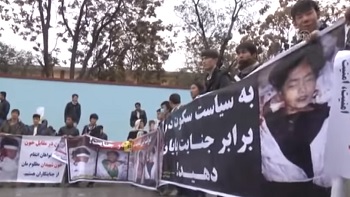
Hundreds of people have rallied across Afghanistan, protesting nationwide insecurity a day after thousands marched in the country’s capital outraged at the beheading of seven members of the mostly Shia Hazara community.
On Wednesday, an estimated crowd of 10,000 marched on the presidential palace in Kabul reacting to the discovery of the bodies of the victims — four men, two women, and a child — in the southeastern Afghan province of Zabul on Saturday. Taliban militants are suspected to have killed the seven, who had been kidnapped in the neighboring Ghazni Province nearly six months ago.
Protests continued on Thursday in the provinces of Balkh in the north, Herat in the west, and Nangarhar in the east, with demonstrators holding up banners with photos of the victims, The Associated Press reported.
Lilia Mohammadi, a protest leader, said the bodies would be returned to Ghazni later in the day, adding that government officials were expected to respond to the demands of the organizers of the Wednesday demonstration.
Afghanistan’s National Directorate of Security has dismissed Taliban claims that they had been killed by affiliates of the Daesh terrorist group, which operates mainly in Syria and Iraq.
In a recent televised address, Afghan President Mohammad Ashraf Ghani vowed revenge for the killings.
“We are committed to taking revenge for our countrymen’s blood. In this way, we will not spare any effort. But you have to remember that anything can happen if we don’t control our feelings. We should avoid reactions that could result in anarchy,” he said.
Mother Of Beheaded Child Unaware Of Her Daughter’s Death
Shokriya
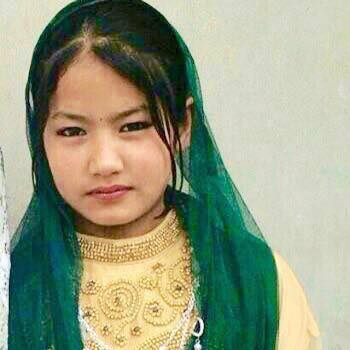
Tolo News: Shokriya a 9-year-old girl who was among the Zabul Seven beheaded recently by Daesh militants was on her way to Pakistan with family members when she was abducted last month along with the other victims. According to the child’s devastated father, Ramazan, his daughter’s death has been kept secret from her mother. He said his wife is ill and has not yet been informed of her death. Click here to read more and watch video (external link).
Gen. Dostum hints at Pakistan as violence soars across Afghanistan

Dostum
Khaama Press | November 12, 2015
The First Vice President of Afghanistan Gen. Abdul Rashid Dostum hinted at Pakistan for fueling violence and insurgency in the country.
In his statement following a widespread demonstration in capital Kabul after the beheading of women and a child by the alleged Islamic State militants, Gen. Dostum said “It is certain that a number of Taliban and Madrasa Mullahs are not involved behind the incidents and ill-fated plans but the spy agency of our southern neighbor is having a critical role in bloodshed and violence in the country.”
He was apparently gesturing towards Pakistan as the ‘southern neighbor’ of Afghanistan but he warned that the terrorist groups will not suffice by having a grip in Afghanistan only and insisted that they are looking to expand in Central Asia, Russia, China, Turkey and even in Europe.
In the meantime, Gen. Dostum said the recently emerged Islamic State terror group was likely involved in the growing violence across the country, calling the emergence of the terror group as a sophisticated and a major game.
He also thanked President Barack Obama for extending the military presence of United States in Afghanistan and urged that the American forces should continue to their military operations in the country in a solemn and precise way in a bid to eliminate terrorism from the country.
Gen. Dostum also added that latest rally by the Afghan people demonstrates their frustration and hatred against terrorism and horrible acts by them including stoning to death, beheadings, suicide attacks and explosions.
US-led forces in Afghanistan abusing detainees: ICC
 Press TV | November 12, 2015
The International Criminal Court (ICC) says it has evidence indicating that US-led foreign forces in Afghanistan have subjected detainees to physical and psychological abuse.
In an annual report on the court’s various preliminary investigations released on Thursday, the ICC’s Office of the Prosecutor said the US-led troops had caused serious harm to Afghan prisoners in the violence-wracked Asian country.
“The infliction of ‘enhanced interrogation techniques’ … would have caused serious physical and psychological injury,” the report said, adding that the policy of the perpetrators was to focus on those “most responsible” for serious crimes.
The inquiries conducted by the United States into the alleged violations by its personnel in Afghanistan had not resulted in any convictions or risen high up the chain of command, the report went on to say.
The report comes as the ICC has been investigating alleged crimes committed since 2003 by all parties to the US-led invasion of in Afghanistan.
Elsewhere, the report further said that there was evidence of violations committed by both Taliban militants and forces supporting the Afghan government, adding that neither side was seriously investigating the allegations.
Afghanistan is gripped by insecurity nearly 14 years after the United States and its allies attacked the country in 2001 as part of Washington’s so-called war on terror. Although the offensive overthrew the Taliban, many areas across Afghanistan still face violence and insecurity.
At least 13,500 foreign forces remain in Afghanistan despite the end of the US-led combat mission, which came on December 31, 2014. The forces, mainly from the US, are there for what Washington calls a support mission.
Khak-e-Afghan District A Daesh Stronghold: Security Sources
 Tolo News: Local security officials in southern Zabul said on Thursday that the Khak-e-Afghan district has become a Daesh stronghold and that Afghan forces retreated from the area eight years ago. Security sources added that in this time no military operation has ever been launched to retake the district and that Afghan forces have never battled Daesh in the area. Click here to read more (external link).