
New York Times: A campaign of kidnappings against the Hazara ethnic group intensified on Saturday as gunmen stopped a number of buses along Afghanistan’s main highway and separated out the Hazara passengers, officials said. Click here to read more (external link).
Afghanistan and Pakistan: The Poisoned Legacy of the Durand Line
 Huffington Post: The new border, dubbed the Durand Line, divided the Pashtun tribal lands, a region informally referred to as Pasthunistan in two, with half of the Pashtun tribal region now part of British India and the balance remaining part of Afghanistan. The line also resulted in the loss of the province of Baluchistan to British India, depriving Afghanistan of its historic access to the Arabian Sea. The Durand Line also ensured that there would be a thin strip of Afghanistan running to the Chinese border, thus separating the Russian empire from British India. The Durand Line would become one of the principal issue of Afghanistan’s foreign policy for the next century and even now remains at the heart of Afghanistan’s relations with Pakistan. Click here to read more (external link).
Dead bodies of 22 Pakistani militants returned to Pakistan
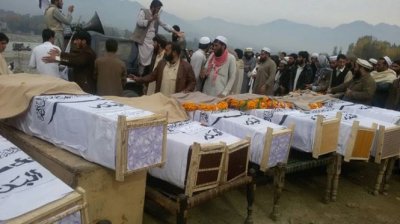 Khaama Press
November 21, 2015
The dead bodies of 22 Pakistani militants who were killed in Afghanistan have been returned to Pakistan.
According to Azadi Radio’s affiliate Mashal Radio, the dead bodies were buried in their ancestral grave yard in Lower Dir area of Pakistan’s Khyber Pakhtunkhwa Province on Friday.
A local official Alam Zib has told Mashal Radio that the killed insurgents belonged to al-Badar Mujahideen and Jamat-ud-Dawah armed groups.
Meanwhile, residents of Timergarah have posted pictures showing coffins wrapped in the flag of al-Badar Mujahideen group, with a note that they were killed in a drone strike in Afghanistan, the news agency reports.
An Afghan official has told Mashal Radio on condition of anonymity that the 22 were killed three days before in security operation of Afghan forces in Khost province.
The media citing reports further states that al-Badar Mujahideen has participated in clashes in Kashmir and under the umbrella of Hizb-i-Islami of Hekmatyar in Afghanistan.
This comes as Afghan government has been asking Pakistan to stop training terrorists and sending them to Afghanistan for its “undeclared war” but Pakistan turns them as allegations.
24,000 Afghan families displaced by Daesh: Official
 Press TV
November 21, 2015
An Afghan official says more than 24,000 families have fled their homes in the country’s troubled eastern province of Nangarhar amid the atrocities being perpetrated by the Takfiri Daesh terrorist group.
“The total number of the displaced families was around 20,000, but now this figure has risen to more than 24,000,” Ghulam Haidar Faqirzai, the head of the organization for internally displaced families in the province, said on Friday.
Provincial Governor Salim Khan Kunduzi also confirmed that thousands of families have been displaced ever since Daesh militants started their activities in the province, arguing that sufficient aid has not been provided to the needy families.
A displaced local said, “Government should establish a camp for us and help us. We didn’t receive any aid over the past several months.”
“They (officials) claim to have launched a military operation, but the fact is they do not go anywhere beyond their checkpoints,” another resident claimed.
“Daesh fighters killed my father. Daesh forced him to sit on a bomb, and then detonated the explosive device,” another civilian from the area said.
Attaullah Khogyani, the spokesman for the Nangarhar provincial governor, said on Friday that 12 Daesh terrorists had been killed and five others wounded as Afghan forces launched an operation in the provincial Achin district the previous night.
He added that three Afghan government troops also sustained injuries during the offensive.
Nangarhar has been witnessing a rise in the number of Daesh terrorists in some of its districts in recent months.
Afghanistan is gripped by insecurity 14 years after the United States and its allies attacked the country as part of Washington’s so-called war on terror. Although the 2001 attack overthrew the Taliban, many areas across Afghanistan still face violence and insecurity.
Foreigners ‘Faking’ Afghan Identity in Refugee Camps
 Tolo News: Afghan migrants revealed on Saturday that foreign nationals – particularly Iranian and Pakistani citizens – are registering themselves as Afghan, Iraqi or Syrian on their asylum application forms at refugee camps. Click here to read more (external link).
Afghanistan’s Dostum unites friends, foes in anti-Taliban fight

Dostum
AFP: As the Taliban expand into his old stomping grounds in northern Afghanistan, former warlord General Abdul Rashid Dostum — who boasts of having a PhD in killing militants — is galvanising legions of devout followers and erstwhile foes for battle. Click here to read more (external link).
Afghan Investigation Says Weak Leadership Led To Fall Of Kunduz

Amrullah Saleh
Radio Free Europe/Radio Liberty
November 21, 2015
Afghan investigators have blamed poor leadership, misuse of resources, and lack of coordination between Afghan security forces for the Taliban’s capture of Kunduz city in September.
“On the day of the crisis, nobody knew who was in charge,” said Amrullah Saleh, a former chief of the national intelligence agency, at a news conference in Kabul on November 21.
Saleh was named by Afghan President Ashraf Ghani to head the investigation. He did not single out any military or government officials but proposed reform of the National Security Council.
Taliban militants took control of the city on September 28 and held it for three days before government forces, backed by U.S. troops and aircraft, helped them drive the militants out of the city.
Around 200 residents, police, and soldiers were killed in the fighting in Kunduz.
Based on reporting by Reuters and AP
Copyright (c) 2015. RFE/RL, Inc. Reprinted with the permission of Radio Free Europe/Radio Liberty, 1201 Connecticut Ave NW, Ste 400, Washington DC 20036.
20 Bus Passengers Kidnapped in Afghanistan
 VOA News
Ayaz Gul
November 21, 2015
ISLAMABAD—Authorities in Afghanistan said unknown gunmen on Saturday kidnapped at least 20 bus passengers in a southern region where suspected loyalists of the self-named Islamic State (IS) group earlier this month beheaded seven civilian hostages, including three females.
Police officers in the volatile Zabul province said militants stopped several buses on the main highway not far from the provincial capital early in the morning and seized the passengers.
Provincial authorities told VOA Afghan security forces have launched a search-and-rescue operation in the area.
There has been no immediate claim of responsibility for the kidnappings.
Muslim sect
Most of the hostages are said to be members of the ethnic Hazara Shi’ite Muslim community.
Local officials tpld VOA that militants boarded the buses and checked identities of the passengers before capturing the Hazaras.
The incident happened on the main highway that links the capital, Kabul, with the southern Kandahar province, usually referred to as Kabul-Kandahar highway.
The incident comes just days after seven members of the Afghan minority community were allegedly beheaded by IS a month after they were kidnapped from a bus travelling between Zabul and the province of Ghazni.
Three females, including a 9-year-old girl were among the victims.
The violence provoked massive anti-government demonstrations in the Afghan capital against the IS brutality, with angry protesters blaming the government for failing to protect civilians and improve security around Afghanistan.
The demonstrations died down after President Ashraf Ghani assured protest leaders the government would promptly probe the incident to bring the culprits to justice.
Afghan officials have acknowledged the presence of Daesh — the Arab name for the Islamic State group — fighters in parts of Zabul and in eastern Nangarhar province.
Taliban clashes
The extremists have also recently clashed with fighters of the main Taliban insurgency in recent days.
IS, which controls large areas in Iraq and Syria, is slowly increasing its presence in Afghanistan. The terror group is said to have established a strong base in the eastern Nangarhar province that borders Pakistan.
Provincial authorities said thousands of families from Achin, Nazian and Debhala districts have recently fled their homes to escape increased Daesh brutality in these areas near the Pakistani border.
In a new survey released this past week, the San Francisco-based Asia Foundation found that 74 percent of Afghans said they have heard of IS, and more than half of them say they consider it a current or future local security threat.
Two employees of Finance Ministry arrested on corruption charges
 Khaama Press
November 21, 2015
Two employees of the Ministry of Finance have been arrested on corruption charges.
The two officials of the Revenue Department were referred to the Attorney General after prosecutors detained them for demanding bribe, the ministry said in a statement.
The case is under further investigation and the suspects would be dealt with in accordance to the law.
Fight against corruption is in the priorities of the Ministry of Finance and whoever demanding bribe would face legal action, the statement adds.
The National Unity Government (NUG) expressed strict stance against corruption when it came into shape in September last year.
Before this arrest, The Ministry of Urban Development Affairs and Housing referred six of his employees for legal processing after finding them guilty of corruption.
Afghans lose everything in quest for better life in Europe
KABUL, Nov. 21 (Xinhua) — Countless numbers of Afghans leave their militancy-plagued and economically impoverished country for developed countries in Europe annually to settle there and embrace a more prosperous life, but fortune sides with few.
“This was my dream to reach Europe and establish a peaceful and successful life there. To change my dream into reality I had sold whatever I had here three years ago and handed over the money to a human trafficker to take me to Europe. But the dream quickly became a nightmare involving forcible deportation,” Mohammad Haidar, 32 told Xinhua.
A resident of Wardak’s provincial capital Maidan Shahr, just 35 km west of Kabul, Haidar sold his house and farmland in 2012 and left for Europe without legal travel documents and with only the support of a human trafficker.
Exhausted from protracted instability in his homeland and long for an affluent life in Europe, Haidar, after months of hard traveling via land and sea and having crossed several countries including Iran, Turkey, Greece and Italy, reached his dream destination, the wealthy country in northern Europe, Norway.
“At last, I reached Norway in 2012 and was staying in a camp of migrants there for more than two years,” a dejected Haidar said.
“Unfortunately, my application for asylum in Norway after processing was rejected and they sent me back to Afghanistan some six months ago.”
Continued instability, a high rate of unemployment and poverty have driven many Afghans to migrate to other countries to escape the difficult circumstances.
Long queues of visa seekers amass almost every day outside the gates of the Iranian, Pakistani and Turkish embassies here in Kabul in a bid to escape from their strife-torn country and live a new life abroad.
“I am back home but have nothing to eat, no job and no regular income to support my family,” Haidar exclaimed.
Recalling his ordeal, Haidar said that in addition to having days and nights traveling on foot he along with dozens of others had risky journeys in overloaded boats to reach Italy.
Like Haidar, another returnee is Hamza from the northern Baghlan province who was stopped by the police at the Iran-Turkey border and deported to Kabul three months ago.
“I dealt with a smuggler to take me to Germany at a cost of 7,000 U.S. dollars but the Iranian police stopped us at the Iran-Turkey border and sent us back in September,” Hamza told Xinhua.
Thousands of Afghans, mostly young, educated, university graduates leave for European countries every month to seek jobs there and escape insecurity and poverty in their homeland.
Putting their lives at risk, some Afghans after selling their property and possessions at home, take treacherous routes to reach their dreamlands, but some are killed on the way, others are lost at sea when the packed boast capsize.
“A total of 146,000 Afghans have applied for asylum in European countries and 80,000 of them in Germany,”Afghan Minister for Refugees and Repatriation Affairs, Sayed Hussain Alemi Balkhi told Xinhua, admitting an increase in the number of Afghan asylum seekers in the current year.
Balkhi, also said that more than 2.5 million registered and unregistered Afghan refugees are presently living in Pakistan and more than 2 million others in Iran.
According to Nadir Farhad, the spokesman for the UN Refugee Agency (UNHCR) in Kabul, many of Afghan asylum seekers are economic migrants.
“Essentially, the continued instability, security problems and extreme poverty are the driving reason for Afghans to leave their country for safer places,” political analyst Khan Mohammad Daneshjo told Xinhua.
Daneshjo who is editor-in-chief of the publication the “Weekly Abadi” , also maintained the feeling of insecurity caused by irresponsible people carrying arms and bleakness about the future of the country would drive more Afghans choosing to escape to fulfill their dreams abroad.
“Two innocent citizens were gunned down in daylight on Wednesday but the government has yet to identify and punish the culprits,” Daneshjo said, adding that an average Afghan doesn’t have a mud house during his life in Afghanistan but months after reaching Europe, might be provided with shelter and a social welfare to live in relative comfort.
The government here, however, the analyst opined, does not have the “capacity to provide jobs and ensure security to returnees.”