
COVID-19: 260 New Cases, 10 Deaths Reported in Afghanistan
 Tolo News: The Ministry of Public Health on Sunday reported 260 new positive cases of COVID-19 out of 1,495 samples tested in the last 24 hours. The data by the ministry shows that the cumulative number of total cases is now 47,901, the number of total reported deaths is 1,875, and the total number of recoveries is 37,782. Click here to read more (external link).
Pompeo Says Violence In Afghanistan ‘Unacceptably High’ As Peace Talks Get Under Way
Mike Pompeo
Radio Free Europe/Radio Liberty
December 5, 2020
U.S. Secretary of State Mike Pompeo says violence in Afghanistan is “unacceptably high” as delayed peace talks between the Afghan government and the Taliban get under way.
Pompeo said that Washington has asked the warring parties “to stand back and indeed stand down,” adding that he hoped that the two sides can begin to address some of the “front end” issues, including a nationwide cease-fire.
Pompeo’s comments, made in a virtual address to an annual security conference on December 4, came two days after Afghan government and Taliban negotiators reached a deal in Doha to proceed with talks aimed at ending 19 years of war.
The deal was considered a breakthrough because it advances talks beyond basic procedural questions to more substantive issues, including reaching an elusive cease-fire.
Pompeo said that he met with the negotiating teams during a visit to Doha on November 21.
“I made clear to them that the violence levels can’t continue while these negotiations go on and it won’t work,” Pompeo said.
Earlier this week, the U.S. special representative for Afghanistan, Zalmay Khalilzad, said that he was heading back to the region to gather international support for the peace talks.
The negotiations were to have begun on March 10, but they were delayed by disputes mainly over prisoner releases and the rules and procedure for the talks amid continuing violence.
The U.S.-backed government has held power in Afghanistan since 2001, though the Taliban controls large swaths of the country and the government in Kabul is considered weak.
Under a U.S.-Taliban deal signed in Doha in February, all foreign forces are scheduled to leave Afghanistan by May 2021 in exchange for security guarantees from the militant group. NATO has roughly 11,000 troops in Afghanistan from several countries.
In November, the Trump administration announced that 2,000 American troops will exit Afghanistan by mid-January, leaving just 2,500 behind.
How the peace process develops, and the pace of any further U.S. withdrawal, is expected to be determined after the incoming administration of President-elect Joe Biden takes power in January.
Based on reporting by Reuters and tolonews.com
Copyright (c) 2020. RFE/RL, Inc. Reprinted with the permission of Radio Free Europe/Radio Liberty, 1201 Connecticut Ave NW, Ste 400, Washington DC 20036.
Related
1TV Afghanistan Dari News – December 5, 2020
253 New Cases of COVID-19, 18 Deaths Reported in Afghanistan
Tolo News: Amidst an increase in the cases of the coronavirus, the Ministry of Public Health on Saturday reported 253 new positive cases of COVID-19 out of 1,400 samples tested in the last 24 hours across the country. The cumulative number of total cases is now 47,641, the number of total reported deaths is 1,865, and the total number of recoveries is 37,485. Click here to read more (external link).
Related
Afghan Activists Cautiously Optimistic About New Protection for Rights Defenders

Mohammad Sarwar Danish
Roshan Noorzai
VOA News
December 4, 2020
Afghan human rights monitors are sounding the alarm over a spike in attacks against them by unknown assailants, as they cautiously welcome the formation of a new government body to protect rights activists.
In a presidential decree Tuesday, the government in Kabul announced the Joint Commission for the Protection of Human Rights Defenders to address human rights issues in Afghanistan and establish a protection mechanism for rights advocates. The commission is led by Vice President Sarwar Danish, with the minister of interior and the head of the National Directorate of Security (NDS) as its members.
“The establishment of such a commission was needed,” said Lal Gul, chairman of the Afghanistan Human Rights Organization.
Gul, whose Kabul office was attacked in 2006 and 2015 by unidentified armed men, expressed frustration at the way the government has handled cases of targeted killings against activists. He said that security forces have largely failed to provide satisfactory answers to the families of victims.
“It is difficult to talk about the effectiveness of forming such a commission. Let us see what measures and actions it will take,” he told VOA from Kabul.
Earlier this year, 32 human rights organizations in Afghanistan called on the government to establish such a body to address an uptick in violence against rights activists. The organizations cited harassment, threats and violence against rights activists, adding that the attacks were not “effectively investigated, and suspected perpetrators have not been brought to justice.”
Heavy toll in 2020
The U.N. Assistance Mission in Afghanistan (UNAMA) reported in October that 531 civilians were killed and 403 injured in targeted killings in the first nine months of 2020, a 39% increase compared with the same period in 2019. With 2,117 total civilian deaths from violence, it said targeted killing was the third main cause of civilian casualties after ground engagement and improvised explosive devices.
According to Zabihullah Farhang, a spokesperson for Afghanistan’s Independent Human Rights Commission (AIHRC), a string of assassinations in recent months have targeted women working outside their homes, rights activists, tribal and community leaders, religious figures and journalists.
He said the violence is “one of the bloodiest tactics” used by militants to intimidate those promoting human rights and civil society in the country.
The watchdog Amnesty International said in a statement Thursday that the establishment of the new government commission was a “major step” to address the risks rights defenders are facing.
“With violence escalating across the country, attacks on human rights defenders on the rise and huge uncertainty around the outcome of the peace talks, this commitment could not come at a more important time,” said Samira Hamidi, Amnesty International’s Afghanistan campaigner.
Hamidi asked the government of Ashraf Ghani to provide full support to the body “to ensure that this isn’t just an empty promise.”
Afghan officials have repeatedly blamed the Taliban and its Haqqani Network affiliate for the recent assassination attempts, saying the group uses violence to pressure the government.
“They are the major terrorist groups. These attacks are beyond the capabilities of other groups,” Siddeq Siddiqqui, a spokesperson for the Afghan government, told VOA.
Some skeptics
However, some activists remain suspicious of the government position, saying the security authorities are not transparent in their investigation into most of the cases.
One of the skeptics, Mudasar Dawat, told VOA that security officials have given his family contradicting accounts of the November 12 assassination of his brother, Mohammad Ilyas Dayee, 33, who was a journalist with Radio Free Europe/Radio Liberty.
“The government officials tell us that the case is under investigation, and that they have arrested some and suspect a few others. But they have not provided us further information,” Dawat said. His brother was killed when a magnetic bomb ripped through his car.
“His only crime was giving voice to the people in Helmand,” Dawat said.
No group has taken responsibility for the killing. Human Rights Watch in a statement November 12 said Dayee had told the organization he received death threats warning him not to report about Taliban military operations.
Shukria Barakzai, a former member of the lower house of Afghan parliament, expressed similar concerns about the authorities handling the investigation of the 2014 failed suicide bombing attack against her.
“Unfortunately, the Afghan government has told me different stories. First, they told me that the Taliban were behind the attack, then they told me that it was Haqqani Network. I still do not know who was behind the attack,” Barakzai said.
Some Afghan experts say the government will likely have to provide security for outspoken rights activists who are vulnerable to militant attacks in the coming months.
Sayed Khalid Sadat, a law professor at Salam University in Kabul, told VOA the newly formed government commission could help provide that security if the government gives it executive powers.
“The commission should act as a coordinating body between state security agencies, and it should have executive power to address the threats that the human rights activists are facing,” Sadat said.
Iran warns about ‘suspicious’ moves to disrupt Iran-Afghanistan ties
Press TV
December 4, 2020
Iran has warned about “suspicious” moves by those who seek to disrupt cordial relations between Tehran and Kabul, after a video purportedly showing Afghan nationals being insulted by Iranians went viral.
The Iranian Police issued an announcement on Friday suggesting the video published on social media with regards to insulting Afghan nationals was basically untrue, and that the incident in question had not happened in Iran.
In a separate statement, Iranian Foreign Ministry spokesman Saeed Khatibzadeh expressed regret over such incidents, wherever in the world they might occur.
He called on the government and officials of the brotherly and friendly country of Afghanistan to be more careful with releasing news and not to rush when issuing official statements.
“At a time when the Khaf-Herat railroad is to be inaugurated by both countries’ presidents in the coming days as the symbol of extensive cooperation between the two sides, it is inevitably necessary to be wary of suspicious actions by those who are against [Iran-Afghanistan] relations,” Khatibzadeh noted.
“Iran and Afghanistan are two friendly and neighboring countries with a common culture and a historical background of unity and cooperation,” the Iranian police said in its statement.
“The Islamic Republic of Iran has always supported Afghanistan despite all the problems and cruel sanctions, and will do so in the future,” it added.
It said Afghan people have entered Iran in the past decades because of the numerous problems they faced, and Iran has always warmly received and hosted them as its brothers and sisters.
However, it added, enemies are not pleased with this empathy and humanitarian interaction between the two sides, and make mischievous moves every now and then.
“They spare no effort to destroy trust between the two countries, but the people of Iran and Afghanistan will always stand by each other and these tensions will not disrupt their cordial relations,” it added.
Similar efforts to disrupt Iran-Afghanistan relations were also made earlier this year after two incidents in which Afghan nationals were killed.
The first was in May, when a group of 54 Afghan migrants allegedly sought to enter Iran, but were thrown into Harirud, on the border between Iran and Afghanistan.
Western media claimed that Iranian border guards killed the migrants by forcing them into the river at gunpoint. Eighteen were reportedly drowned, among them a 12-year-old boy. However, Iran categorically rejected the claims.
In the next incident, on the third of June, a bus fire on the road from the Iranian central city of Yazd, went as such: the car was transporting illegal Afghan refugees or entrants to other cities.
When the police became suspicious and the driver refused to stop, the police shot at one of the back tires of the car, which caught fire after skidding on the asphalt for some eight kilometers due to its high speed. Finally, it hit the center guardrail, and eventually caught fire. This was also used as a pretext to impact Tehran-Kabul relations.
Pakistan Says Afghan Border Fence Nearly Complete
Durand Line
Ayaz Gul
VOA News
December 4, 2020
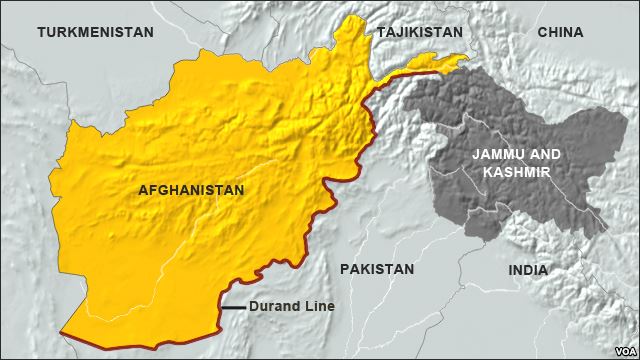
ISLAMABAD – Pakistan’s military says it will have fenced off the country’s roughly 2,600-kilometer historically porous border with Afghanistan within the next two months.
The army’s media wing Friday shared the latest assessment with VOA on the massive unilateral construction effort that was launched in early 2017 to block militant infiltration, smuggling and other illegal crossings on the Pakistan-Afghanistan border.
Inter Services Public Relations, or ISPR, said the barrier has already been installed along “about 83 percent” of the western Pakistani frontier. Additionally, hundreds of new outposts and forts have been built under the roughly $500 million program.
The pair of three-meter-high mesh fences, a couple of meters apart, are filled and topped with coils of razor wire, running through rugged terrain and snow-covered, treacherous mountains at elevations as high as 4,000 meters.
The ISPR attributed a “massive decrease” in the number of terrorism-related incidents in Pakistan to the border security project. Pakistani troops involved in building the fence have also come under deadly militant attacks from the Afghan side and in some cases clashes with Afghan security forces.
Afghanistan has historically disputed the 1893 British colonial era demarcation and Afghan officials still refer to the border as the Durand Line. Pakistan rejects the objections and maintains it inherited the international frontier after gaining independence from Britain in 1947.
Under the military-led border management project, Islamabad has also upgraded several formal crossings with Afghanistan to further facilitate bilateral and transit trade activities with the war-ravaged landlocked country.
Iranian Border
The Pakistani army is also working on enhancing the security of the country’s more than 900-kilometer southwestern border with Iran. It has already fenced off about 30% of the frontier and the project is expected to be finished by the end of 2021, according to the ISPR.
The largely porous border separates Pakistan’s Baluchistan and Iran’s Sistan-Baluchistan provinces, both experiencing militant attacks blamed on fugitive separatists hiding on Pakistani and Iranian soils.
The war crimes report has reawakened old traumas for Afghan-Australians
 The Guardian (UK): It’s nearly two weeks since Australian defence force chief Angus Campbell released the Brereton report, alleging war crimes perpetrated by Australians in Afghanistan. Two immensely difficult and challenging weeks not just for the ADF but for Afghan-Australians. Click here to read more (external link).