
3 Female Polio Vaccinators Killed in Afghanistan
 Ayaz Gul
VOA News
March 30, 2021
ISLAMABAD – Unknown gunmen have shot dead three female anti-polio workers in Afghanistan, one of the two countries in the world along with its neighbor Pakistan, where the crippling children’s disease remains endemic.
Tuesday’s violence came on the second day of a five-day polio immunization drive, this year’s first in the conflict-torn country, that officials say aims to reach nearly one million Afghan children under five years of age in 32 out of the country’s 34 provinces.
Officials said the slain women were administering polio drops to children in parts of Jalalabad, the capital of eastern Nangarhar province.
No one immediately took responsibly for the violence.
Afghanistan reported 56 new cases of polio in 2020, and officials have already detected around two dozen new cases this year.
Continued fighting and a ban on door-to-door vaccinations in areas held by Taliban insurgents are blamed for hampering efforts to eradicate the polio virus in the country.
The Afghan health ministry estimates about three million children were deprived of the polio vaccine in the past three years.
Health Minister Waheed Majroj told a gathering Monday while launching the polio immunization campaign that security concerns may again deprive about one million children from receiving polio drops in 2021.
Pakistan also launched its five-day nationwide door-to-door vaccinations of children against polio on Monday amid a substantial surge in coronavirus infections.
The polio immunization drive targets more than 40 million children under the age of five across 156 Pakistani districts, said Faisal Sultan, special assistant to the Pakistani prime minister on national health services.
Sultan said the government has engaged some 285,000 frontline workers, respecting coronavirus safety guidelines, to administer polio drops to the targeted population.
Anti-polio drives have also suffered setbacks in Pakistan in recent years due to attacks on vaccinators and police personnel guarding them, leading to a spike in new infections. The violence has killed scores of polio workers and security guards escorting them.
Islamist militants see the polio vaccine as an effort to collect intelligence on their activities while radical religious groups in conservative rural parts of majority-Muslim Pakistan reject the immunization as a Western-led conspiracy to sterilize children.
Pakistani officials insist attacks on polio teams have particularly increased since 2011 when the U.S. Central Intelligence Agency arranged a fake vaccination campaign with the help of a local doctor, enabling U.S. forces to locate and kill fugitive al-Qaida chief Osama bin Laden deep inside Pakistan.
Pakistan, where polio infected 84 children in 2020, has reported one confirmed case so far this year.
”The year 2021 presents a unique opportunity to leverage the gains made in 2020, despite the challenges of the (COVID-19) pandemic,” said a government statement released in connection with Monday’s launch of the immunization drive.
The South Asia nation’s second polio drive of 2021 comes amid a third wave of coronavirus infections, with Pakistani officials reporting more than 4,000 new cases and 100 deaths from the COVID-19 pandemic in the last 24 hours.
Hours after Monday’s polio vaccination drive began, authorities imposed partial lockdowns in “high-risk” Pakistani districts, including the capital, Islamabad, citing a “very dangerous” spike in new coronavirus cases.
Since the coronavirus outbreak in the country 13 months ago, the government has recorded nearly 14,400 deaths from COVID-19 and more than 663,000 infections.
Pakistani officials said the rate of people testing positive for COVID-19 had alarmingly risen to nearly 12% from a low of about 3% a few weeks ago, suggesting the actual number of infections is likely much higher than the reported cases.
Sultan said the current wave of coronavirus infections has the “potential to be worse than the first one in the summer of 2020,” when Pakistan had to impose a nationwide lockdown to contain the virus.
Pakistan President Arif Alvi tweeted Monday that he had been tested positive for COVID-19 as did the country’s defense minister, Shaukat Khattak.
Prime Minister Imran Khan had also tested positive for the virus earlier this month. Faisal tweeted Sunday that Khan had made “steady clinical recovery” and had been advised to resume building up his official work routine.
Afghan Rights Group Probes Reports Of Civilians Killed During Anti-Taliban Operation

Radio Free Europe/Radio Liberty
March 30, 2021
An Afghan human rights group says it is investigating the alleged killing of civilians during fighting between government forces and Taliban insurgents in the eastern province of Khost.
The Afghanistan Independent Human Rights Commission (AIHRC) announced the launch of its probe on March 29 after a number of women, children, and other civilians were reported killed by Afghan special forces in Saberi district last week.
A video taken circulated on social media purportedly shows an old man from Saberi carrying a child’s lifeless body and claiming several members of his family were killed.
An unidentified official was quoted as saying that a pregnant woman and her unborn child were killed and four children wounded in an explosion inside a house.
Officials claimed the blast was due to explosives hidden by the Taliban, while the militant group accused pro-government forces of lobbing mortars at civilian houses.
Provincial Governor Mahmand Katawazi confirmed that an operation was ongoing in Saberi but denied any civilian casualties.
“All those videos and photos that are claiming to be of civilians, those are not true,” Katawazi said, adding that four members of the security force were wounded and several Taliban fighters were killed in the fighting.
Taliban spokesman Zabihullah Mujahid said the government should stop such attacks if it seeks a reduction in violence. The Taliban has resisted agreeing to a cease-fire long sought by the government.
The Afghan special forces operate under Afghanistan’s intelligence agency, the National Directorate of Security.
They have in the past been accused of repeated attacks on civilians and have been criticized by human rights activists and the United Nations for their heavy-handed tactics.
Based on reporting by AP and dpa
Copyright (c) 2021. RFE/RL, Inc. Reprinted with the permission of Radio Free Europe/Radio Liberty, 1201 Connecticut Ave NW, Ste 400, Washington DC 20036
Last Afghan Jew Prepares To Leave Amid Exodus Of Minorities

Zablon Simintov
Radio Free Afghanistan
Abubakar Siddique
March 29, 2021
KABUL, — Zablon Simintov is Afghanistan’s only Jew. The 61-year-old has borne separation from his family and life during civil wars and Taliban oppression to stay in his homeland, Afghanistan.
But Simintov is now planning to leave Afghanistan as the withdrawal of Western forces looms amid ongoing peace efforts that will likely result in the Taliban’s return to government.
“After our important festivals [Rosh Hashanah and Yom Kippur in September], I will leave Afghanistan,” he told Radio Free Afghanistan. “If you decide to leave then it is difficult to stay,” he added. “If the Taliban return, they are going to push us out with a slap in the face.”
But his increasing worries over the past two years have convinced him to leave.
Simintov, whose wife and two daughters have lived in Israel for more than two decades, used to say it was God’s will that he lived in Afghanistan. But he has worried about his future there ever since Washington began negotiating a peace deal with the Taliban in 2018.
“Peace talks are making people worried that if the Taliban come and if they behave the same as they used to during their regime [in the 1990s] then people will be worried,” he told the BBC in 2019.
Simintov is not the only one leaving his homeland, which in the mid-20th century boasted a 40,000-strong Jewish community.
Afghanistan’s Hindu and Sikh minority has shrunk from more than 200,000 in the 1980s to a few hundred families today. Most members of Afghanistan’s tiny Hindu and Sikh minority have already left while others plan to join exiled members of their community in India. Militant attacks have targeted their temples and leaders, killing scores, while criminals kidnapped members of the community for ransom.
There is a risk that Afghanistan’s non-Muslim minorities, many of whose members fled during the tumultuous decades following the 1978 communist coup, could vanish completely if peace does not follow the departure of international troops this year.
Sandeep Singh, 20, recently relocated to India. He told Radio Free Afghanistan that in addition to the security threats, his community faced systemic discrimination in their homeland.
“When I used to go to school [in Kabul], both the students and the teachers would ridicule me,” he said. “They would pull my hair and turban,” he added. Sikhism requires its adherents to wrap their hair in a turban.
Bushra, 17, is a Sikh high-school student in Kabul. She told Radio Free Afghanistan that she regularly faces harassment and ridicule because of her faith. “Everybody comments on my appearance and taunts me for having small eyes,” she said. “They make fun of how I dress.”
Soni Singh, an Afghan Sikh who now lives in exile in New Delhi, says it is difficult for the community to integrate into their new country while it’s not feasible to return to Afghanistan.
“When we return to Afghanistan and try to use our skills to get ahead, we are told that we come from another country,” he told Radio Free Afghanistan. “Our children are called names because we do not trim our hair,” he added. “They call us Hindus despite the fact that we are Sikhs.”
A Crucial Transition
Afghanistan’s religious minorities face discrimination despite the country’s current constitution guaranteeing protections against discrimination. While minorities have made some progress such as gaining limited government protection, the freedom to worship, and token representation in the government, their future hangs in the balance as Afghanistan braces for a critical transition.
While U.S. forces are unlikely to meet the May 1 deadline in line with Washington’s agreement with the Taliban, President Joe Biden is keen on underscoring the fact that his country’s troops will leave Afghanistan in the near future. The withdrawal looms amid a deadlock between the Taliban and the Afghan government and uncertainty over the peace process.
It is, however, clear that Islam will play a larger role in the country’s politics and public policies if the hard-line Taliban Islamists return to the government, which could see a revival of more literal interpretations of Islamic law.
Afghan clerics and Islamic scholars insist that discrimination against non-Muslims has no place in Islam.
“If religious minorities live in an Islamic country, its government is obliged to protect them,” Mufti Bilal Ahmed Safir, a religious scholar in Kabul, told Radio Free Afghanistan. “Their lives and properties should be protected, and they should be granted all the rights given by Allah.”
During the 1990s, the Taliban and rival Islamist groups pledged protection of minorities, but most Hindus and Sikhs fled to India. Months before its regime fell in December 2001, the Taliban contemplated forcing Hindus to wear identity badges to distinguish them from majority Muslims.
“Despite such efforts, the small communities of religious minorities — including Hindus, Sikhs, Christians, Ahmadi Muslims, and Baha’is, who experienced egregious human rights violations under Taliban rule — remained endangered, without the ability to observe their faith publicly for fear of violent reprisal by terrorist groups or society at large,” noted the U.S. Commission on International Religious Freedom in its annual report last year.
Sardar Gurbachan Singh Ghazniwal, 50, did everything he could to stay in Afghanistan. He even lived inside the Gurdwara, the Sikh temple, in Kabul for years after losing his businesses and properties in the southeastern city of Ghazni.
But after the Islamic State militants attacked the Kabul Gurdwara last year and killed 25 Sikhs – including nine of his relatives — Ghazniwal made up his mind to move to India.
“Whenever I travel in a bus or taxi, my fellow [Afghan] Muslim brothers ask me, ‘Where do you come from in India, Sardar?’,” Ghazniwal told Radio Free Afghanistan. “They even don’t consider how I can speak Pashto and Dari, [the two major Afghan languages] so well if I had come from Afghanistan,” he added. “Even when I speak fluent Pashto and Dari, I am not considered an equal [citizen].”
The looming uncertainty might force most if not all of Afghanistan’s non-Muslim citizens to follow Ghazniwal’s path.
“If the situation in the country gets worse, I will escape,” Simintov told Reuters.
Copyright (c) 2021. RFE/RL, Inc. Reprinted with the permission of Radio Free Europe/Radio Liberty, 1201 Connecticut Ave NW, Ste 400, Washington DC 20036
Heart of Asia Conference on Afghanistan Kicks Off in Dushanbe
 Ayesha Tanzeem
VOA News
March 29, 2021
ISLAMABAD, PAKISTAN – A regional ministerial conference called the Heart of Asia-Istanbul Process (HoA-IP) started Monday in Tajikistan’s capital Dushanbe to try to advance the goal of ending the decades long conflict in Afghanistan.
Afghan President Ashraf Ghani, who arrived early Monday to attend the annual conference, also met his Tajik counterpart Emomali Rahmon on the sidelines.
The meeting is just the latest in a flurry of diplomatic efforts to jumpstart a peace process that has been stalled for months.
The gathering is taking place as a May 1 deadline, negotiated separately between the United States and Taliban, to withdraw all foreign forces from Afghanistan, looms. President Joe Biden told reporters in his first press conference last week that it was “going to be hard to meet the May 1 deadline.”
However, Biden said he could not envision U.S. troops staying in Afghanistan past next year.
“It is not my intention to stay there for a long time,” the U.S. leader said.
The Taliban have warned that any deviation from the deadline might result in the group restarting its attacks against foreign forces.
“Any responsibility for the prolongation of war, death, and destruction will be on the shoulders of those whom committed this violation,” the group’s spokesman Zabiullah Mujahid said in a statement.
Taliban stopped direct attacks on the U.S. and NATO forces once it signed an agreement with the U.S. in Doha in February of 2020. However, it increased its attacks on Afghan forces, taking the level of violence to a 10 year high at times.
The increase in violence has been a major deterrent in progress in peace talks between the Afghan government and Taliban, which officially started on September 12, 2020.
Under the agreement the U.S. signed with the Taliban, the militant group was supposed to negotiate with the Afghan government and other factions to find a resolution to the conflict, but the two sides have made scant progress and have yet to agree on the agenda for the talks.
The Taliban are under intense international pressure to reduce violence or announce a ceasefire.
Following another regional conference on Afghanistan hosted by Russia earlier this month, the U.S., Russia, China, and Pakistan, issued a joint statement calling on all parties in Afghanistan to reduce violence and for the Taliban to forego their ‘spring offensive,’ the yearly renewal in attacks after a winter lull, in order to facilitate peace negotiations.
The Taliban sent signals that it may be ready to yield.
“We have floated a plan under which all related sides will reduce violence. But this is not a cease-fire,” Taliban spokesman Mohammad Naeem told VOA earlier this month.
To create momentum for the peace talks, the U.S. has recently proposed several ideas, including creating a transitional government that includes the Taliban. Afghan President Ghani, who took office for the second time last year and still has four more years to go, has strongly rejected that proposal, calling elections the only way to form a new government.
HoA-IP was launched in 2011 in Istanbul, Turkey, to help find a solution to the challenges facing Afghanistan. Fifteen countries participate in this process, while another 17 countries and 12 regional and international organizations support it.
Around 50 countries and international organizations are attending the ninth conference of its kind. Participants will issue a statement at the end.
The Dushanbe conference comes in advance of another meeting in Turkey organized by the United Nations which both Taliban and the Afghan government are likely to attend. The Turkey conference, expected in the next couple of weeks, is being viewed as a game changer in the Afghan peace process.
Related
1TV Afghanistan Dari News – March 29, 2021
Behsud Situation: MPs Call for Alipoor’s Arrest

Alipoor (also known as Commander Shamsheer)
Tolo News: Some lawmakers in the lower house of the Afghan Parliament on Monday called for the arrest and prosecution of Alipoor, a local commander in Behsud district in Maidan Wardak, who is accused of downing an army helicopter in the district. The Wolesi Jirga speaker and some members said that the second vice president, Mohammad Sarwar Danesh, released Alipoor on bail three years ago, and that now Danesh should respond to the families of nine people who were killed in the downing of the helicopter in Behsud this month. Click here to read more (external link).
First Polio Vaccination Campaign of Solar Year Begins

Child getting polio drops (file photo)
Tolo News: The current fiscal year’s first polio vaccination campaign began on Monday, and officials said that Afghanistan ranks nearly at the top globally of reported poliovirus cases in the past nine years, second only to Pakistan. UNICEF officials said that 56 new cases of poliovirus were reported in Afghanistan in 2020. Click here to read more (external link).
Football: Kabul’s Istiqlal Defeats Khost’s Atalan 3-0
 Tolo News: Kabul’s Istiqlal defeated Khost’s Atalan team 3-0 in the third match of Afghanistan Champions League on Saturday. The league began in Kabul last week. 12 teams from six zones are competing in the league, and the matches will be held in Kabul, Herat and Balkh provinces. Click here to read more (external link).
Other football news
Abdullah backs idea of power-sharing with Taliban
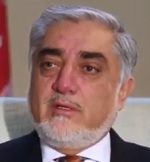
A. Abdullah
1TV: Chairman of Afghanistan’s High Council for National Reconciliation Abdullah Abdullah has expressed support for the idea of power sharing with Taliban as part of peace process. Speaking in an interview with France 24, Abdullah suggested there could be discussions on power-sharing arrangement for a period of time but not exactly how the US proposal envisages. Click here to read more (external link).