
Taliban torturing and harrasing Arab ethnic minorities in Faryab province
Arab ethnic minority of Afghanistan in Faryab province saying Taliban torturing and accusing them of links with ISIS. An elderly man while cring says the Taliban, hang if you proved we have ties with ISIS. He says Taliban electrified my son. pic.twitter.com/SJSKWZRyMt
— Tajuden Soroush (@TajudenSoroush) December 8, 2021
‘Safe Spaces’: After Taliban Crackdown, Afghan Women Take Their Protests Home

Protest against Taliban (file photo)
By Abubakar Siddique
Radio Free Europe/Radio Liberty
December 8, 2021
Arifa Fatimi was among the hundreds of Afghan women who spilled into the streets of Kabul following the Taliban’s forcible takeover of Afghanistan in August.
For weeks, the women staged almost daily protests to demand their rights, representation in government, and roles in the deeply religious and conservative country of 38 million.
But following the Taliban’s violent crackdown on the protests and its ban on unsanctioned rallies, the street rallies waned. Yet the women have continued to protest — this time from the relative safety of their homes.
“Rising threats eventually forced us to adopt an alternative way to protest,” Fatimi, a women’s rights activist, told RFE/RL. “So, we turned to safe spaces from where we have kept raising our voices.”
Fatimi said she initially braved the Taliban’s threats and violence, including the group’s use of tear gas and warning gunshots to disperse the crowds.
But she stopped marching on the streets after she and several other protesters were detained and held for several hours by the feared Badri Brigade, the Taliban’s special forces, after a rally in late October.
Since then, Fatimi and other female protesters have staged around 20 rallies, all from inside their homes. The protests often include a small group of women holding placards and taking turns to speak on camera. The women record the events on their smartphones and share them with journalists and on their social media accounts.
The latest protest was held in Kabul on December 5, during which women insisted that a recent Taliban decree on women’s rights was inadequate.
The December 3 decree called for the enforcement of certain women’s rights that are already enshrined in Islamic law, and it failed to mention key areas of concern for rights groups and Western governments, including the right to education and employment.
‘Sign Of Repression’
Since regaining power, the Taliban has tried to project a more moderate image to convince the international community that it has changed.
But the militant group has reimposed some of the same repressive laws and retrograde policies that defined its rule from 1996 to 2001, when it banned girls from attending school and women from working outside their homes.
In September, the Taliban formed an all-male government that was made up exclusively of senior militants. It did not include any women, even in secondary roles. The Taliban said women were not suited to serve in the cabinet.
The militants also abolished the Women’s Affairs Ministry and reestablished the feared Ministry for the Promotion of Virtue and Prevention of Vice.
The Taliban has advised women to largely remain indoors for their own safety. The militants have also ordered tens of thousands of former female government workers not to return to work even as their male colleagues went back.
The hard-line group has allowed girls in grades one through six to attend school. But girls’ secondary school education has been restricted to only a handful of the country’s 34 provinces.
Afghan women have been permitted to study at some private universities and colleges. But the Taliban has enforced a new dress code and separated men and women in what activists have described as practices alien to Afghan culture and a “clear sign of repression.”
‘Dark Future’
Wahida Amiri, a female rights activist and protester, has credited the rallies with forcing the Taliban to make some concessions regarding female education.
But she said the Taliban’s refusal to budge on girls’ secondary school education, employment, and participation in politics will continue to feed the protests.
“We do not have any economic freedom and have lost the right to grow, prosper, and get an education,” Wahida Amiri, a female rights activist and protester, told RFE/RL.
“[The Taliban] is obsessed with confining women to the four walls of their homes,” she said. “I don’t know what kind of dark future is in store for us with them.”
Amiri vowed that she and other women would continue their protests, even if they had to hold them in private.
“We realized we could organize effective protests inside our homes by writing out our demands and slogan on cue cards and quietly gathering in the privacy of our homes,” she said.
She said one of their first indoor protests was inside a classroom on October 20 when they joined female teachers who were reluctant to march on the streets.
Some Taliban leaders have described the women’s protests as an international conspiracy against their regime.
The militants have gone to great lengths to root out the protests, including raiding private residences.
Naeema Asadi, another female activist and protester, said women were forced to abandon their street marches after the Taliban obtained a list of the protesters in October.
“A large number of women wanted to participate in our protests, but they could not go on the streets because they feared the Taliban,” she told RFE/RL.
“All our protests were accompanied by intense fear,” she said. “We turned to holding protests at home, so our voices are not silenced.”
Copyright (c) 2021. RFE/RL, Inc. Reprinted with the permission of Radio Free Europe/Radio Liberty, 1201 Connecticut Ave NW, Ste 400, Washington DC 20036.
Related
Mark Meadows says Trump threatened to wipe out an Afghan village — a war crime — in a phone call with a Taliban negotiator: book

Donald Trump
Insider:”‘Before we start this withdrawal,’ President Trump said, ‘I want to make something clear. Let me just tell you right now that if anything bad happens to Americans or America interests, or if you ever come over to our land, we will hit you with a force that no country has ever been hit with before — a force so great that you won’t even believe it,” Meadows wrote.
Meadows recalled Trump saying: “And your village, Mullah? We know where it is. We know it’s the Weetmak village. If you dare lay hands on a single American, that will be the first thing that I destroy. I will not hesitate.”
‘You will be hanged’: Inside story of how girls from Afghan youth football team escaped Taliban
 The Independent (UK): ‘Leaving the country was the only option’ says captain. ‘They have killed the soul of women and just left their bodies’. Women and girls beaten and threatened with death for playing football in Afghanistan have revealed the horror of their long and harrowing journey to safety in Britain. Click here to read more (external link).
Related Video
Suliman Safi to lead Afghanistan at the ICC U19 Cricket World Cup 2022
 Ariana: Left-hand top-order batter Suliman Safi will lead the 20-member Afghanistan U19 squad in the ICC U19 Men’s Cricket World Cup which will be played in January and February next year in the West Indies. The Afghan Cricket Board (ACB) said in a statement that Safi will also captain the team in the U19 Asia Cup that will be played in the UAE later this month. Click here to read more (external link).
Beijing Pledges 3M Doses Of Covid-19 Vaccine for Afghanistan
 Tolo News: China pledged to provide three million doses of Covid-19 vaccine to Afghanistan as part of the humanitarian support for the country. Around 800,000 doses of the vaccine arrived in Kabul on Wednesday. While handing over the vaccine to the Afghan health officials in a ceremony, the Chinese Wang Yu said that around 200,000 doses of vaccine would arrive on Thursday. Click here to read more (external link).
Pakistan Frees Jailed Taliban Militants As Part Of Truce Deal
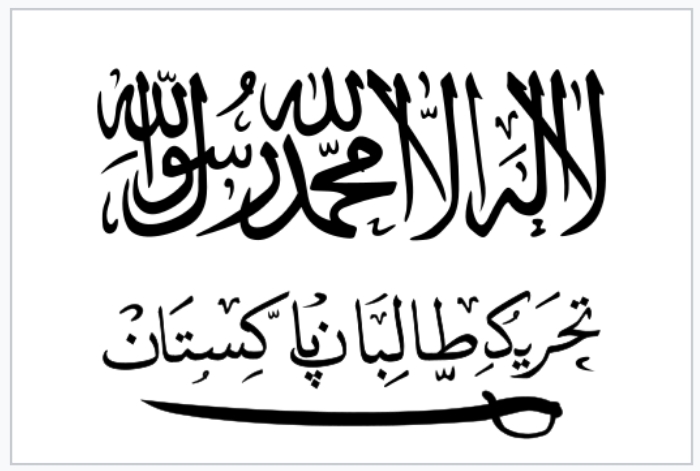
TTP Flag
Daud Khattak
Radio Free Europe/Radio Liberty
December 8, 2021
Pakistan has released 12 members of the Tehrik-e Taliban Pakistan (TTP) from custody, a source told RFE/RL on December 8, amid ongoing negotiations to reach a peace deal with the Islamist group fighting a guerrilla war in the northwestern tribal region bordering Afghanistan.
The government and the banned militant group, also known as the Pakistani Taliban, announced a monthlong cease-fire on November 8 as the two sides advanced talks for a possible agreement to end 14 years of conflict.
The release of 100 jailed TTP members was one of the group’s preconditions for reaching a permanent cease-fire agreement.
A source in Pakistan’s tribal region told RFE/RL that 12 inmates held in the Jandola area of South Waziristan had been transferred on December 7 to the neighboring Afghan province of Paktika, where they were handed over to the TTP.
The move came on the eve of the expected end of the monthlong truce.
Most of the freed militants were said to be from Pakistan’s Bajaur tribal district.
The group did not include prominent TTP members, the source told RFE/RL, adding that more prisoners are expected to be released in the next few days.
Over the past 15 years, Pakistan has signed three peace deals with the Pakistani Taliban, but none of them have lasted beyond a few months.
Pakistan conducted a massive military operation against the TTP across the northwestern regions in June 2014, forcing the group’s militants and leadership to take refuge across the border in Afghanistan.
However, the TTP has gradually staged a comeback in the mountainous, tribal regions since late 2019 and considerably increased the frequency of their attacks this year.
Sources told RFE/RL that the current talks were being held by senior Pakistani military officials and top TTP representatives, with the mediation of the Afghan Taliban.
The TTP is a separate militant group from the Afghan Taliban, which toppled the Western-backed government in Kabul in mid-August. But Pakistan’s militant groups are often interlinked with those across the border in Afghanistan and the TTP follows the same hard-line Sunni Islam as its Afghan counterparts.
Leaders of Pakistani opposition parties, including the Pakistan People’s Party and the Pakistan Muslim League, have criticized the talks with the TTP, saying the government should not negotiate with killers of Pakistani civilians, soldiers, and politicians.
The families of the schoolchildren killed in a 2014 attack on a military-run school in the northwestern city of Peshawar have also raised objections to the negotiations. At least 150 people were killed in the assault claimed by the TTP, most of them children.
Copyright (c) 2021. RFE/RL, Inc. Reprinted with the permission of Radio Free Europe/Radio Liberty, 1201 Connecticut Ave NW, Ste 400, Washington DC 20036.
Taliban gunmen steal tonnes of Australian food sent to the poorest Afghanistan families who face starving to death in famines as the country’s economy collapses

Taliban fighters (file photo)
The Daily Mail (UK): Taliban militants pulled guns on United Nations aid workers and took off with 3.7 tonnes of Australian flour meant to be delivered to some of Afghanistan’s poorest families as the war-torn country faces a catastrophic famine. The Australian Government donated the vital baking staple through the World Food Program as part of a $100 million handout which also includes other UN agencies. Click here to read more (external link).
An Increase in Criminal Offenses Has Raised Concerns Among Baghlan Residents
 8am: Some residents of Baghlan province say that the rates of criminal offenses, especially armed robberies, have risen in the last few months. On the other hand, local Taliban officials for Baghlan province say that the city is safe and people can live in peace. Click here to read more (external link).
More Security News