
logo

Daily Updated Afghan News Service

  • Home
  • About
  • Opinion
  • Links to More News
  • Good Afghan News
  • Poll Results
  • Learn about Islam
  • Learn Dari (Afghan Persian/Farsi)

Recent Posts

  • Flood death toll in Afghanistan rises to 51 April 2, 2026
  • Kandahari Hat: From Style Choice to Forced Attire in Kabul April 2, 2026
  • UN review finds Taliban policies violate women’s rights convention April 2, 2026
  • Bennett Reports 471 Civilian Casualties from Unexploded Ordnance in Afghanistan Last Year April 2, 2026
  • Senior Officials Sent To China For Talks With Taliban, Says Pakistan April 2, 2026
  • Tolo News in Dari – April 2, 2026 April 2, 2026
  • 19 Afghan migrants killed as boat capsizes off Turkish coast April 2, 2026
  • Afghanistan falls 5–1 to Syria in Asian Cup qualifier April 2, 2026
  • Floods, rainfall kill 48 in Afghanistan over past week, ANDMA says April 1, 2026
  • US eases asylum freeze for vetted migrants, keeps Afghanistan ban April 1, 2026

Categories

  • Afghan Children
  • Afghan Sports News
  • Afghan Women
  • Afghanistan Freedom Front
  • Al-Qaeda
  • Anti-Government Militants
  • Anti-Taliban Resistance
  • AOP Reports
  • Arab-Afghan Relations
  • Art and Culture
  • Australia-Afghanistan Relations
  • Book Review
  • Britain-Afghanistan Relations
  • Canada-Afghanistan Relations
  • Censorship
  • Central Asia
  • China-Afghanistan Relations
  • Civilian Injuries and Deaths
  • Corruption
  • Crime and Punishment
  • Drone warfare
  • Drugs
  • Economic News
  • Education
  • Elections News
  • Entertainment News
  • Environmental News
  • Ethnic Issues
  • EU-Afghanistan Relations
  • Everyday Life
  • France-Afghanistan Relations
  • Germany-Afghanistan Relations
  • Haqqani Network
  • Health News
  • Heroism
  • History
  • Human Rights
  • India-Afghanistan Relations
  • Interviews
  • Iran-Afghanistan Relations
  • ISIS/DAESH
  • Islamophobia News
  • Japan-Afghanistan Relations
  • Landmines
  • Media
  • Misc.
  • Muslims and Islam
  • NATO-Afghanistan
  • News in Dari (Persian/Farsi)
  • NRF – National Resistance Front
  • Opinion/Editorial
  • Other News
  • Pakistan-Afghanistan Relations
  • Peace Talks
  • Photos
  • Political News
  • Reconstruction and Development
  • Refugees and Migrants
  • Russia-Afghanistan Relations
  • Science and Technology
  • Security
  • Society
  • Tajikistan-Afghanistan Relations
  • Taliban
  • Traffic accidents
  • Travel
  • Turkey-Afghanistan Relations
  • UN-Afghanistan Relations
  • Uncategorized
  • US-Afghanistan Relations
  • Uzbekistan-Afghanistan Relations

Archives

Dari/Pashto Services

  • Bakhtar News Agency
  • BBC Pashto
  • BBC Persian
  • DW Dari
  • DW Pashto
  • VOA Dari
  • VOA Pashto

Afghan Boxers Refuse To Return To Their Homeland For Fear Of Taliban

16th December, 2021 · admin

By Ron Synovitz
RFE/RL’s Radio Azadi
December 16, 2021

Silab Nouri is one of nine boxers on Afghanistan’s national team who have been stranded in Serbia since competing in an international tournament there last month.

Their temporary visas to participate in the World Boxing Championships organized by the Amateur International Boxing Association (AIBA) have expired. But they refuse to return to Taliban-ruled Afghanistan.

Instead, they hope to receive humanitarian visas or asylum in any European country that will take them.

“The current situation in Afghanistan is completely messed up,” Nouri told RFE/RL’s Radio Azadi. “We are witnessing suicide bombings, explosions, and targeted killings every day there. We cannot make progress in terms of our sport or our education there.”

“We are waiting in Serbia until we can move to a country where our future athletic activity and our education will be guaranteed,” Nouri said.

Nouri’s 20-year-old teammate Hasibullah Malikzada told RFE/RL that the lives of the boxers will be “in danger” if they return to their homeland.

“We hope we will receive visas from European countries for the sake of our sport and our lives,” Malikzada says.

“After the Taliban came, we couldn’t continue boxing,” the lightweight amateur national champion of Afghanistan explained.

The gym where the team trained in Kabul was closed shortly after the Taliban seized power in August. But the boxers continued to train secretly for months, moving their equipment in gym bags to undisclosed locations for each workout.

Malikzada says is he also is worried about the safety of his relatives because some family members had ties with the government that was ousted by the Taliban.

He also says his brothers had joined the anti-Taliban resistance movement in the Panjshir Valley north of Kabul — a group of former government troops and militia fighters who had briefly staged a last stand against the militant group.

“If the Taliban find us, they will kill us,” Malikzada says. “I just want to be a champion. I really want this. This is my dream.”

Hundreds of athletes and sports administrators have fled their homeland since the Taliban forcibly seized power, including top male athletes as well as female soccer, volleyball, and basketball players.

Their fears have been driven partly by the Taliban’s rule of Afghanistan during the 1990s when many sports were considered “against human dignity” and banned along with music, films, and other forms of entertainment.

This time, the Taliban has claimed it will not ban any sport so long as it complies with its tribal interpretation of Islamic law. But it has not confirmed whether it will allow women to play any sports.

Afghan athletes have also been alarmed by the mounting reports of human rights abuses committed by the Taliban, including extrajudicial killings, arbitrary arrests, and torture.

‘Painful Story’

Waheedullah Hameedi, the secretary-general of the Afghanistan Boxing Federation (ABF) who traveled to Belgrade with the team, says the saga is “a painful story.”

Hameedi says nobody wants to leave their homeland. But he has received “too many warnings” from family and friends who say he should not return to Afghanistan.

The 24-year-old Hameedi inherited the post as Afghanistan’s top boxing administrator from his father, who was assassinated by the Taliban in 2019 for recruiting women to the sport.

With the responsibility of the Afghan team now in his hands, Hameedi has been sending desperate messages from Belgrade to contacts around the world in the hope that someone will help.

According to Hameedi, the Afghan boxers have faced numerous threats from the Taliban.

“Boxing is ‘haram’ for the Taliban — something that is forbidden,” he says.

Taliban members who were appointed as de facto officials in the Afghan National Olympic Committee (ANOC) deny that the lives of the boxers are at risk if they return to Kabul.

Dad Mohammad Nawak, the Taliban’s chief information officer at the ANOC, told RFE/RL that his department has been in contact with some of those who have expressed fears about returning home from Belgrade.

Nawak insists they will be safe, saying the Taliban “has proven to be a strong supporter of sports.”

But that has failed to allay the fears of Afghan athletes, who have heard tales of brutality committed by the Taliban in recent months.

Nada Al-Nashif, the United Nations deputy high commissioner for human rights, has expressed alarm about “continuing reports of extrajudicial killings across the country, despite the general amnesty announced by the Taliban” after it regained power.

“Between August and November, we received credible allegations of more than 100 killings of former Afghan national security forces and others associated with the former government,” Al-Nashif said on December 14.

“At least 72 of these killings [were] attributed to the Taliban,” he said. “In several cases, the bodies were publicly displayed. This has, of course, exacerbated fear among this sizeable category of the population.”

Mahjabin Hakimi, a member of the Afghan women’s youth volleyball team, was reportedly beheaded in Kabul in August as the Taliban was advancing into the city.

Zaki Anwari, a 19-year-old member of the Afghan national youth soccer team, was crushed to death by the landing gear of a U.S. evacuation flight he had grabbed onto in a desperate attempt to stow away shortly after the Taliban arrived in Kabul.

Video footage showed Anwari’s body falling from the plane. U.S. military officials confirmed that human remains were also found in the landing gear after the flight arrived in Qatar.

International Olympic Committee (IOC) President Thomas Bach has called for other countries to help evacuate more than 700 athletes who remain in Afghanistan, asking foreign governments to help secure humanitarian visas.

“There are still many members of the Olympic Community in Afghanistan who are at risk,” Bach said. ‘We have to and we will continue to help them.”

“But we need for this the support of as many as possible governments and national Olympic committees,” Bach said. “We can only get them out in many cases if we can give the assurance that they are welcomed by humanitarian visas in countries.”

‘What To Do Next’

The new Taliban regime’s efforts to present a moderate image than its rule from 1996 to 2001 has included attempts to promote the men’s national cricket team.

But it has not yet made a formal ruling about the future of boxing in Afghanistan.

Bashir Ahmad Rustamzai, the Taliban’s new sports chief, said in September that the militants “will not ban any sport, unless it does not comply with Shari’a law,” although he did not confirm if women could participate in any sports.

The Taliban did give the Afghan boxers permission to go to Belgrade after talks in Qatar between IOC delegates and the Taliban-appointed head of the ANOC. The Taliban maintains a political office in the Gulf state.

“Both parties reiterated the fundamental right to access and practice sport safely for all individuals without discrimination,” the IOC said in a statement.

But the IOC also said it “continues to recognize the existing National Olympic Committee of Afghanistan” rather than the ANOC’s Taliban-appointed de facto leadership.

That meant the Afghan boxers in Belgrade could not compete under Afghanistan’s flag.

Allowing that would have meant the AIBA was offering de facto recognition of the Taliban as Afghanistan’s legitimate government — something no country has done yet.

Instead, the Afghan boxers competed as members of the AIBA’s “Fair Chance” team — a group composed of athletes from countries torn by crisis and war.

Now that the international tournament is over, Hameedi says the Afghan boxers do not want to cross borders illegally to reach the European Union.

But he says he has contacted several European embassies in Belgrade about obtaining humanitarian visas and asylum.

Although he says some EU countries have already turned them down, they have not given up hope.

Marko Stambuk, an attorney who works with the Belgrade Center for Human Rights, says the Afghan boxers have contacted the group and have been advised about their asylum options in Serbia.

But the team members have not yet applied for asylum in Belgrade.

“Now they are thinking about what to do next,” Stambuk says.

Copyright (c) 2021. RFE/RL, Inc. Reprinted with the permission of Radio Free Europe/Radio Liberty, 1201 Connecticut Ave NW, Ste 400, Washington DC 20036.
Posted in Afghan Sports News, Refugees and Migrants, Taliban | Tags: Boxing, Escape from the Taliban |

4 Things You Need To Know About Getting a PhD in International Relations

16th December, 2021 · admin

The current world as we know it is facing different kinds of challenges left, right, and center; from global warming to epidemics, war, and poverty, just to name a few. Some of these issues are quite complex to address, creating a dire need for high-intellect and ambitious individuals who can impact the world as a community positively. 

Here are some reasons Ph.D. holders in International Relations can be a great fit, alongside six things you should know about getting one. 

1. Why Should You Take An International Relations Ph.D.?  

There are many reasons anyone would want to pursue a Ph.D. course in international relations. Besides the growing demand for Ph.D. holders in IR, it allows you to make a difference in the world. You get the chance to play a role in solving some of the social-economic and political problems hitting the world hard in this age and day. In the process, you also get to travel the world, explore different cultures, and gain real-world experience as you build a lucrative career.

2. What’s International Relations All About?  

During their studies, an international relations graduate acquires immense knowledge about the main issues facing the world today. The crucial yet intriguing subject focuses mainly on culture, education, economics, and political science, alongside their impact on today’s society. 

International relations students also get to learn the means and reasons why individuals and governments need to respond to these global issues accordingly. A PhD in this area of study gives you deeper knowledge and expertise compared to a bachelor’s or master’s degree.  

3. How Long It Takes 

How long you take to complete any course program depends on various factors, including the type, available options, and the institution you enroll in. Just like associate’s degree, college, bachelors’, and master’s programs, the same applies to doctoral programs. The fastest PhD programs usually take between two to five years on average. Accelerated doctoral programs usually take a shorter time to complete and can be done online. Again, this will largely depend on the institution you choose to get the course from.

4. Qualification Criteria and Course Options 

Of course, this is a PhD program, meaning that you will at least need a master’s or undergraduate degree in a related field to qualify for admission depending on where you’re studying. Including PhD exchange students, most higher learning institutions also have their own set of admission qualification criteria for different courses and study programs. In a nutshell, some of these may include:

  • Academic background and merit
  • Language
  • Residency
  • Suitability evaluation score

In many cases, you will also need to have performed well in a relevant field during your undergraduate and/or master’s studies.

In summary, an international relations doctorate degree can be a huge asset. It takes a considerable amount of time amount, money, and effort, but it’s all worth your while in the end. The above pointers should help you decide if this career path is right for you.

Posted in Misc. |

What Does the National Resistance Front of Afghanistan Have to Offer?

15th December, 2021 · admin

The Diplomat: For a multiethnic and multicultural country like Afghanistan where no particular group enjoys dominance, a political system that embraces diversity and could guarantee political and social pluralism is what the NRF find most fitting.  Click here to read more (external link).

Posted in Ethnic Issues, NRF - National Resistance Front, Political News |

‘Let Them Die’: Rights Report Documents Possible War Crimes In Afghanistan

15th December, 2021 · admin

By RFE/RL’s Radio Azadi
December 15, 2021

Amnesty International says it has documented torture and extrajudicial executions committed by the Taliban as the group seized power in Afghanistan in August.

Taliban members have “tortured and killed ethnic and religious minorities, former ANDSF (Afghan National Defense Security Forces) soldiers, and those perceived as government sympathizers in reprisal attacks,” Amnesty International said in a report issued on December 15.

The evidence shows that “far from the seamless transition of power that the Taliban claimed happened, the people of Afghanistan have once again paid with their lives,” Agnes Callamard, Amnesty International’s secretary-general, said in a news release.

The report also said the ANDSF and the U.S. military were responsible for attacks that resulted in “extensive civilian suffering” as the government collapsed.

Callamard urged the International Criminal Court (ICC) in The Hague to “follow the evidence on all possible war crimes, no matter where it leads.”

Amnesty International collected evidence for the report by conducting research in Kabul, including face-to-face interviews with 65 people from August 1-15, and interviews with 36 victims and witnesses from 10 provinces from August to November using encrypted mobile apps.

The report documents possible war crimes, including alleged torture and other inhuman treatment of captives, the alleged use of mortars by the ANDSF in populated areas, and a U.S. drone strike in the final days of the chaotic U.S. military withdrawal that killed civilians, including children.

One of the attacks carried out by the Taliban took place on September 6 in Bazarak, the capital of Panjshir Province, which was the last holdout against Taliban control.

About 20 men were captured and detained for two days by Taliban forces. The men were “tortured, denied food, water, and medical assistance, and repeatedly threatened with execution,” Amnesty International said.

One of the men captured recounted how the captives were held underground and when they asked for medical treatment for the wounded, the Taliban said, “Let them die.”

The Taliban also attacked the nearby village of Urmaz on September 6 and conducted door-to-door searches to identify people suspected of working for the Western-backed government.

“The fighters extrajudicially executed at least six civilian men within 24 hours, mainly by gunshots to the head, chest, or heart,” according to the report, noting that such killings constitute war crimes.

Eyewitnesses said that while some of the men had previously served in the ANSDF, none was in the security forces or taking part in hostilities at the time of their execution.

The report also documents reprisal attacks and executions of people affiliated with the former government in Spin Boldak.

Amnesty International previously documented the Taliban killing 13 ethnic Hazaras in Ghazni Province, as well as 11 members of the ANDSF in the village of Kahor in Daykundi Province.

The report also said the U.S. military and the ANDSF contributed to the violence between June and August by continuing a “pattern of civilian harm.”

It said two mortar attacks in Zakhail, a suburb of Kunduz city, “most likely” were launched by the ANDSF. The two attacks occurred in June and killed a 20-year-old man and a 12-year-old girl, the report said.

The U.S. drone strike killed 10 people, including seven children, in Kabul on August 29. An investigation by the U.S. Air Force inspector-general last month called the drone strike “a tragic mistake.”

On December 13, the Pentagon announced that no U.S. military personnel would be held accountable for the strike.

Washington is considering reparations for the relatives, including allowing them to immigrate to the United States.

The Amnesty International report comes a day after a UN official said the first four months of Taliban rule in Afghanistan had been marked by “credible allegations” of more than 100 extrajudicial killings, the denial of women’s rights, and the recruitment of boys to be soldiers.

Copyright (c) 2021. RFE/RL, Inc. Reprinted with the permission of Radio Free Europe/Radio Liberty, 1201 Connecticut Ave NW, Ste 400, Washington DC 20036.

Related

  • Amnesty: Government collapse marked by ‘repeated war crimes and relentless bloodshed’ – new report
  • The Taliban say they’ll kill me if they find me’: a female reporter still on the run speaks out
Posted in Civilian Injuries and Deaths, Ethnic Issues, Human Rights, Taliban | Tags: ethnic cleansing, Hazaras, Life under Taliban rule, Taliban Executions, Taliban War on Muslims, War Crime |

US to donate another 1 million COVID-19 vaccine doses to Afghanistan

15th December, 2021 · admin

Ariana: US Special Representative Thomas West stated in a tweet that the assistance will be provided through COVAX, a worldwide initiative aimed at equitable access to COVID-19 vaccines. Click here to read more (external link).

Posted in Health News, US-Afghanistan Relations | Tags: Coronavirus (COVID-19) in Afghanistan |

Afghan Cricket Team’s 2022-2023 Schedule Announced

15th December, 2021 · admin

Tolo News: According to the schedule, which the ACB posted on Twitter, the Afghanistan National Cricket Team, in addition to taking part in the ACC Asia Cup and ICC T20 World Cup in 2022, will also play 3 ODIs against the Netherlands in January in Qatar, 3 ODIs and 5 T20s against Zimbabwe in January- February, 3 ODIs and 2 T20s against Bangladesh in February-March, 3 ODIs against India in March, 3 T20s against Australia in India May-June, 1 Test and 5 ODIs against Ireland in July-August, 2 T20s, 5 ODIs and 2 tests against Zimbabwe in Nov-Dec.  Click here to read more (external link).
Related

  • Afghanistan to host Pakistan for ODI series
Posted in Afghan Sports News | Tags: Afghanistan Cricket Board, Cricket |

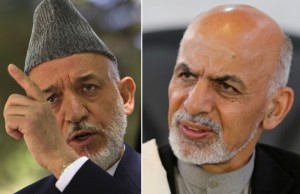
The AP Interview: Karzai ‘Invited’ Taliban to Stop Chaos

15th December, 2021 · admin

Karzai (left) and Ghani (right)

AP: The Taliban didn’t take the Afghan capital — they were invited, says the man who issued the invitation. In an Associated Press interview, former Afghan President Hamid Karzai offered some of the first insights into the secret and sudden departure of Afghan President Ashraf Ghani — and how he came to invite the Taliban into the city “to protect the population so that the country, the city doesn’t fall into chaos and the unwanted elements who would probably loot the country, loot shops.” Click here to read more (external link).

Posted in Interviews, Political News, Security, Taliban | Tags: Ashraf Ghani, Hamid Karzai |

Tolo News in Dari – December 15, 2021

15th December, 2021 · admin

Posted in News in Dari (Persian/Farsi) |

‘A Broken Phone And A Broken Heart’: Afghan Refugees Recount Robberies On Their Journey To Serbia

15th December, 2021 · admin

Thousands of migrants from war-torn countries including Afghanistan, Syria, and Iraq are being temporarily housed in centers in Serbia. Most left home with little more than money, documents, a phone, and some prized personal possessions. RFE/RL spoke to Afghan refugees at the Krnjaca asylum center near Belgrade. They told stories of being robbed by police during their perilous journey of what little they had.

Posted in Refugees and Migrants |

U.S. Ambassador to Pakistan Nominee Vows to Press Islamabad to Target ‘All’ Terrorists

14th December, 2021 · admin

Blome

Michael Hughes
AOPNEWS
December 14, 2021

President Joe Biden’s nominee to serve as Ambassador to Pakistan, Donald Blome, during his confirmation hearing told a Senate panel that, if confirmed, he aims to pressure Islamabad to abandon its selective counterterrorism practices.

Islamabad has been long criticized for cracking down on anti-government groups such as the TTP while supporting other terrorist entities that Pakistan has used as assets in its struggle with India over Kashmir.

“On the critical issue of counterterrorism, if confirmed, I will press Pakistan to target all terrorist groups without distinction,” Blome told the U.S. Senate Foreign Relations Committee on Tuesday. “The United States and Pakistan are committed to combating Al-Qaida, ISIS-Khorasan and Tehrik-e-Taliban Pakistan. If confirmed, I also will engage Pakistan on fighting all other groups – including Lashkar-e-Taiba and Jaish-e-Mohammed.”

Blome, a State Department diplomat since 1999 who currently serves as U.S. ambassador to Tunisia, was questioned on Washington’s approach to improving matters with Pakistan on the counterterrorism and human rights fronts.

During the hearing Senator Bob Menendez, who chaired the proceedings, slammed Islamabad for providing safe haven to the Taliban even as the militant group killed U.S. troops inside Afghanistan. In addition, Menendez claimed the failure of the U.S. mission in Afghanistan was due in part to years of Pakistani “double-dealing.”

In his written testimony submitted ahead of the hearing, Blome said the relationship with Pakistan remains “extraordinarily consequential” for U.S. core interests and warned that the region can ill afford another conflict, especially between nuclear-armed states.

The nominee acknowledged the importance of a détente between New Delhi and Islamabad, which many realize is pivotal for convincing Pakistan to ratchet down support for terrorists. He wisely tried to avoid signaling if Washington leans toward either side of the rivalry. 

The situation is certainly made complex in light of the U.S. priority of countering China at all costs. India has long been a fierce rival to China while Islamabad and Beijing for years have forged a close relationship.

“If confirmed, I will work with my colleagues to decrease tensions between India and Pakistan. I have been encouraged by the continued ceasefire along the Line of Control,” Blome said. “Strong U.S. bilateral partnerships with India and Pakistan are not mutually exclusive; we need productive ties with both states. Pakistan and India should decide the pace, scope, and character of their bilateral interactions.”

Blome also tried to send a stern message to Islamabad over alleged human rights abuses.

“Religious minorities in Pakistan have long faced societal and legal discrimination, as well as accusations of blasphemy. These accusations have undermined the rule of law, threatened mob rule, deeply damaged Pakistan’s international reputation, and led to murderous violence and many deaths,” the diplomat told the Senate panel. “If confirmed, I will speak out against these abuses and violations of human rights and religious freedom.”

He said he will also urge the Pakistani government to cease harassing journalists and members of civil society who have faced assaults, kidnappings, and disappearances.

With respect to Afghanistan, the diplomat, who was the top political officer at the U.S. embassy in Kabul in 2012-2013, underscored the importance of encouraging an “inclusive” Afghan government that respects and promotes rights of all individuals – including women, girls and minorities.

The U.S. line on Pakistan has softened in recent years as Washington tried to pull out troops from Afghanistan, believing that they needed Islamabad to facilitate peace talks with the Taliban.

The Western world, meanwhile, has put little trust in the new government run by the Taliban – a group whose leadership includes members sanctioned by the UN and the U.S. The world even cut off billions of dollars’ worth of aid to Afghanistan for fear of benefitting the radical movement as some 23 million face starvation and the country is in the midst of economic implosion.

Just days ago the UN said it would distribute some $280 million to Afghanistan in a way that circumvents the Taliban regime. The White House, meanwhile, has conceded that they will be hard-pressed to ensure the Taliban does not exploit any of the funding that is unfrozen.

Pakistan, for its part, has excoriated the international community for freezing funding in light of the humanitarian crisis in Afghanistan. Prime Minister Imran Khan last week said Pakistan is trying to inform the world that “in spite of their like or dislike for the Taliban,” the primary concern should be the 40 million Afghans who have to suffer through the current situation.

This will likely be another hot issue on Blome’s agenda, who is widely expected to be confirmed shortly.

Blome ended his testimony by saying the United States has an opportunity to “renew and strengthen the bilateral relationship with Pakistan.” It will be interesting to see if the diplomat can accomplish this mission when the two countries in many ways have deep conflicting interests – from the U.S. rivalry with China to Pakistan’s battle with India. 


Posted in AOP Reports, Pakistan-Afghanistan Relations, Security, Taliban, US-Afghanistan Relations |
Previous Posts
Next Posts

Subscribe to the Afghanistan Online YouTube Channel

---

---

---

Get Yours!

Peace be with you

Afghan Dresses

© Afghan Online Press
  • About
  • Links To More News
  • Opinion
  • Poll