
 BBC: A charity worker trying to help a doctor flee Afghanistan says he fears for the man’s life. Nich Woolf from Burnham-on-Sea, Somerset, met the man while working in Afghanistan and says he and his family are in danger from the Taliban. He has written to the Prime Minister for help in allowing the man to come to England through the Afghan Citizens Resettlement Scheme (ACRS). “Every day that goes by the risk gets greater and greater,” said Mr Woolf. Click here to read more (external link).
Taliban stop Afghan women using bathhouses in northern provinces
 The Guardian (UK): The Taliban sparked outrage this week by announcing that women in northern Afghanistan would no longer be allowed to use communal bathhouses. The use of bathhouses, or hammams, is an ancient tradition that remains for many people the only chance for a warm wash during the country’s bitterly cold winters. Click here to read more (external link).
Tensions Along Durand Line Intensify: Pakistan’s NSA to Visit Kabul
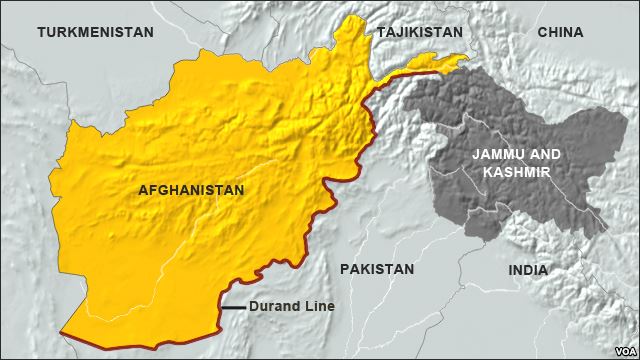
Durand Line
8am: Pakistan’s National Security Adviser, Moeed Yusuf is scheduled to visit Kabul as tensions along Durand Line intensify. The decision was made during a meeting of the Afghanistan Inter-Ministerial Coordination Center chaired by Asad Qaisar, National Assembly Speaker of Pakistan on Thursday, the statement said. Click here to read more (external link).
TAPI Pipeline Remains Incomplete After 3 Decades
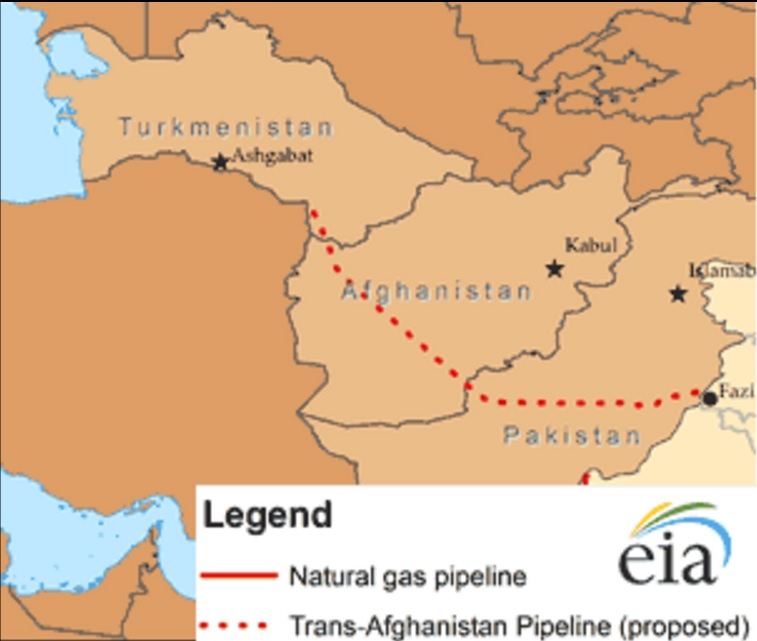
A map of the proposed route of TAPI by the U.S. Energy Information Administration (image from Wikipedia)
Tolo News: The major gas pipeline project known as TAPI– for Turkmenistan-Afghanistan-Pakistan-India–has yet to be completed despite being “in progress” for the past three decades. During this time Afghanistan has seen the collapse and establishment of various governments. TAPI is considered one of the major development projects in the region. Click here to read more (external link).
1TV Afghanistan Dari News – January 7, 2022
Tithes to Put Economic Pressure on Citizens
 8am: Since August 15, Taliban officials from the province’s agriculture and livestock department began collecting tithes from people in Bamiyan. In the process, the Taliban took one-tenth of every crop and animal of the peasants. Click here to read more (external link).
Taliban Arrest Former Deputy Head of the Electoral Complaints Commission
 8am: Taliban forces arrested Mawlawi Din-Mohammad Azimi, a former deputy head of the Independent Electoral Complaints Commission (IECC). He is a prominent member of the Jamiat-e-Islami party. The incident comes as the Taliban announced a general amnesty after taking control of Kabul. Click here to read more (external link).
Taliban Commend India for Sending Humanitarian Aid to Afghanistan

Ayaz Gul
VOA News
January 7, 2021
ISLAMABAD, PAKISTAN — Afghanistan’s Taliban said Friday they had received a fresh supply of medicines from India, as the United . warns harsh winter conditions are aggravating the severe humanitarian crisis facing millions of Afghans.
“The Islamic Emirate is grateful to India for its humanitarian assistance and cooperation,” said Taliban spokesman Zabiullah Mujahid in a local language tweet after Kabul airport authorities received the aid package. Mujahid used the official name of the new Taliban government.
The Indian foreign ministry noted in a statement that Friday’s delivery was the third batch of medical assistance “consisting of two tonnes of essential life-saving medicines” and said it is part of New Delhi’s ongoing humanitarian aid to Afghanistan.
India already has delivered half a million doses of COVID-19 vaccines and 1.6 tons of medical aid to Kabul through the World Health Organization. It has pledged to supply more medicines and food grains in coming weeks.
“India stands committed to continue our special relationship with the people of Afghanistan and provide them humanitarian assistance,” the ministry said.
New Delhi also has pledged to send 50,000 tons of wheat to Afghanistan and requested neighboring Pakistan’s help by allowing its transportation through its territory. Islamabad agreed to New Delhi’s request in November, and the two arch-rival countries are reported to be sorting out the modalities of the transportation.
Relief agencies say the humanitarian situation in Afghanistan was bad even before the Islamist Taliban took over the country last August, citing years of conflict and a prolonged nationwide drought.
The subsequent suspension of international assistance, though, along with international sanctions on the Taliban, and the freezing of Afghanistan’s foreign cash reserves by many countries and donor agencies have triggered an economic crisis in the aid-dependent country — increasing humanitarian needs to record levels.
The U.N. estimates that more than 24 million Afghans will need humanitarian assistance this year, and more than nine in 10 of them are likely to be acutely food insecure by March.
India maintained close ties with the Western-backed Afghan government ousted by the Taliban ousted in August. New Delhi invested several billion dollars in development projects in Afghanistan over the past several years to increase its influence in the country.
But the Indian diplomatic effort suffered a huge blow with the final withdrawal of the United States and allied troops from Afghanistan days after the Taliban retook power. The Islamist group is believed to have used sanctuaries in Pakistan to sustain its two decades long violent insurgency against local and foreign troops in Afghanistan.
India’s latest effort to provide humanitarian aid to Kabul is seen as an attempt to renew its diplomatic engagement with the country to sustain developmental projects, though Indian leaders remain deeply skeptical about the Taliban’s close ties with Pakistan.
Related
Afghans Fear For Their Rights As Taliban Resurrects Religious Policing

Afghan woman today, under Taliban rule
By RFE/RL’s Radio Azadi
Abubakar Siddique
January 6, 2022
When the Taliban seized power in August, the militant group vowed it would not resurrect the violent religious policing it enforced during its first stint in power. The hard-liners claimed they would limit themselves to preaching Islamic values of modesty and dignity.
But nearly five months after regaining power, the Taliban’s Ministry for the Promotion of Virtue and the Prevention of Vice has reclaimed its role as the enforcer of the group’s radical interpretation of Islamic law.
In a spate of decrees issued in recent weeks, the ministry has imposed restrictions on the behavior, movement, and appearances of residents, particularly those of women and girls.
While the militants have claimed the decrees are only recommendations, Taliban religious police have enforced the new laws, sometimes violently, in many areas.
Many Afghans have voiced their anger at the Taliban’s religious policing, saying it is a tool for humiliating citizens and controlling every aspect of their lives.
For Afghans, the decrees are reminiscent of the draconian rules the Taliban imposed during its brutal rule from 1996 to 2001. The Taliban forced men to pray and grow beards and women to cover from head to toe. They beat, maimed, or executed anyone who contravened their draconian laws.
In the 1990s, the feared Ministry for the Promotion of Virtue and Prevention of Vice was responsible for enforcing the Taliban’s morality laws, including its strict dress code and gender segregation in society. The ministry’s dreaded police were notorious for publicly beating offenders, including women.
Obaidullah Baheer, a Kabul-based academic, said by forcing its own interpretation of Shari’a law upon Afghans, the Taliban is “locking out the population from decision-making” and exposing its “tyrannical tendencies.”
Baheer said the Taliban views “any challenge to [its] policies as a challenge to the faith itself.”
Beheading Mannequins
Last month, the Taliban ordered shop owners in the western city of Herat to cut off the heads of mannequins, insisting they were un-Islamic.
The order angered local shopkeepers, who are already reeling from an economic crisis triggered by the Taliban takeover and the sudden halt in international assistance.
“These mannequins will be ruined if I am forced to behead them,” Mohammad Irshad, who owns three retail stores in Herat, told Radio Azadi. “It will negatively impact all our customers — men, women, and children. They will lose their appetite [for shopping].”
Abdul Wadud Faizada, the head of Herat’s Chamber of Commerce, said the “heads of mannequins should be covered and not destroyed.” The Taliban has said that did not go far enough.
“Our traders will suffer financially,” Faizada told Radio Azadi, noting that each mannequin typically costs between $70 and $100.
Some shopkeepers appeared to be already complying with the orders by sawing off the heads of shop dummies.
Shaikh Azizur Rahman, the head of the Ministry for the Promotion of Virtue and Prevention of Vice in Herat Province, said mannequins were “idols and thus are forbidden.”
Under Islam, idolatry is a sin, and the worship of idols is banned.
“If their heads are removed, they won’t appear as idols,” Rahman told Radio Azadi. “Thus, Islamic laws against idolatry won’t apply to them.”
But Mohammad Mohiq, an Islamic scholar, said the Taliban’s interpretation was incorrect. Dolls, he told Radio Azadi, were in “no way related to the idea or concept of an idol.”
Restricting Women
In late December, the Taliban announced that women seeking to travel more than 72 kilometers should be refused transport unless they were accompanied by a close male relative.
The advisory distributed by the Ministry for the Promotion of Virtue and Prevention of Vice also directed all vehicle drivers to refrain from playing music in their cars and not to pick up female passengers who did not wear an Islamic hijab covering their hair.
Since then, Taliban religious police have erected checkpoints across Kabul to inspect whether taxi drivers were complying with the orders.
“When we were stopped at one checkpoint, Taliban fighters said that women should observe strict hijab so that only their eyes are visible,” a female doctor, speaking on condition of anonymity, told Radio Azadi. She added that the militants also told her not to travel without a male chaperone.
The Taliban imposed the wearing of all-encompassing burqas in the 1990s. This time, the militants have not formally reintroduced the rule.
Last week, the Taliban also shut down all public bathhouses for women in the northern city of Mazar-e Sharif. Such facilities are considered crucial because many Afghans do not have access to heating or electricity at home.
Rabia, a woman in Mazar-e Sharif who did not reveal her real name, said the Taliban was directing all its resources into controlling the lives of citizens rather than addressing the myriad of problems facing the country, including a freefalling economy and a devastating humanitarian crisis.
The Taliban “needs to pay attention to many more important issues we are grappling with,” she said.
Tamana Siddiqi, a women’s rights activist in Mazar-e Sharif, criticized the Taliban’s closure of public bathhouses for women.
“People are dealing with growing economic pains, which means that not everyone can afford a hot bath inside their house,” she told Radio Azadi.
The new rules further infringe on the rights of women in Afghanistan since the Taliban takeover. The militants have excluded women from their interim government. They have also banned secondary school education for many girls and ordered the vast majority of women not to return to work.
Taliban officials appeared to disagree over the closures of the bathhouses.
Sardar Mohammad Haidari, head of the Ministry for the Promotion of Virtue and Prevention of Vice in the northern province of Balkh, announced last week that all female bathhouses had been shut in Mazar-e Sharif, the provincial capital.
But Mohammad Sadiq Akif, a spokesman for the ministry, said no order had been issued from Kabul.
There are signs that disagreement over moral policing is splitting the Taliban.
Nun Asia, a pro-Taliban website, removed an op-ed calling for the Taliban to scrap the Ministry for the Promotion of Virtue and Prevention of Vice. The article said the ministry was harmful to the reputation of the regime because it infringed on people’s privacy and encouraged the Taliban to spy on people.
Beards And Prayers For Men
Men face new regulations, too, as the Taliban’s religious police have instructed them to grow beards.
The militants claim maintaining a long beard is an essential element of Sunnah — an Islamic concept that requires Muslims to follow the practices of the Prophet Muhammad.
Akif, the Taliban spokesman, has claimed the group was not forcing men to grow beards.
“Our fighters cannot enforce this,” he told Radio Azadi. “They can only advise people.”
Hakmatullah, a resident of the southern province of Uruzgan, said the Taliban should not “interfere in such issues.”
“Ultimately, [each individual] will be accountable and have to bear the guilt or reap the rewards for their actions before God,” he told Radio Azadi.
In a decree issued in late September, the Taliban banned the shaving of beards and trimming of hair in Uruzgan. Violations can result in severe punishment, while barbers who were directly ordered to halt the practice are now struggling to make ends meet.
In some areas of Afghanistan, the Taliban has made it mandatory for all men to attend congregational prayers at mosques.
In parts of Kabul and the northern province of Takhar, the Taliban has fined residents who did not show up for prayers. Repeat offenders have faced arrest or beatings, locals said.
A Kabul resident told RFE/RL’s Radio Azadi that officials from the Ministry for the Promotion of Virtue and the Prevention of Vice recently announced the new rules at the Abu Hanifa Mosque in central Kabul.
“They said absence will first be fined,” said the resident, speaking on condition of anonymity for fear of Taliban retribution. “Then [a repeat offender] will be punished.”
The resident said the Taliban had ordered clerics at mosques in the capital to take a roll call and report those who failed to turn up.
In Takhar’s Rustaq district, Taliban fighters recently beat up two men who failed to attend prayers, locals said.
“In the Rustaq district, almost all mosques are open for worshipers, and those who do not attend prayers are fined and beaten,” said Sultan, a local resident who did not want to reveal his full name.
Copyright (c) 2022. RFE/RL, Inc. Reprinted with the permission of Radio Free Europe/Radio Liberty, 1201 Connecticut Ave NW, Ste 400, Washington DC 20036.
Pakistan Launches a Military Operation Against TTP
 8am: Pakistani military spokesman Babar Iftikhar said on Wednesday that peace talks with the Tehreek-e-Taliban Pakistan (TTP) had been suspended, adding that military operations were underway against the network. Click here to read more (external link).
Related