
 8am: The National Resistance Front in Panjshir province has claimed that its forces have killed 17 Taliban fighters in an ambush in this province. According to Sibghatullah Ahmadi, the NRF spokesman, the attacks were carried out on the Taliban fighters in the Hesa-e-Awal district, Chawbak area. “In the clashes, no Resistance forces are killed or injured,” he said. Click here to read more (external link).
1TV Afghanistan Dari News – May 20, 2022
Exiled Afghan politicians form council, call for talks with Taliban
 Ariana: While urging talks with IEA, the politicians issued a statement and declared support for the conflict that is underway in some provinces in the country. “Such a large meeting was held in Turkey with the Turkish police providing security. They will meet again in Austria two weeks later and then in Geneva. There is certainly something fishy going on,” said Ahmad Saeedi, a political analyst. Habibullah Janibdar, another political analyst, however, said that such meetings would not help Afghanistan as Afghans have already tested these politicians. Click here to read more (external link).
Internal Clashes Between Uzbek and Pashtun Taliban Fighters Leave 3 Dead in Baghlan
 8am: Taliban on the bases of vague allegations against Uzbek and Tajik Taliban members have been trying to remove them from their ranks. This is one of the reasons that have escalated internal conflicts and tensions among the Taliban members. As a result of internal conflicts among the Taliban fighters in Barka district of Baghlan province, 3 Taliban rebels are killed. Click here to read more (external link).
Ex-NSA Apologizes in BBC Interview on Fall of Kabul

Hamdullah Mohib
Tolo News: Hamdullah Mohib, former National Security Advisor (NSA) for the republic government, apologized during an interview focused on the collapse of the Afghan government. “Anything that is related to my failures, I take full responsibility for it and apologize for it, and I hope everyone involved will be able to come forward and explain … the situation … we owe it to the Afghan people, we owe it to history, we owe it to the partnership and the sacrifices that we made that we clear the history and learn from it so that we can offer a better future to the Afghan people.” Click here to read more (external link).
Hindukush Strikers win Green Afghanistan One Day Cup
 Ariana: Hindukush Strikers were crowned Green Afghanistan One-Day Cup champions after beating Pamir Legends in the final match on Friday. Batting first after winning the toss at Khost Cricket Stadium, Pamir Legends posted 172-4 in 39 overs before bad weather stopped play. Click here to read more (external link).
The Caliph v The Emir al-Mu’minin: Which Islamic Model of Statehood Will the Taliban Adopt?

Fair Observer: Two rival theological notions of leadership within the Taliban pose equal threats to Afghanistan and to global peace. The Kandahari-led Taliban are orthodox Hanafi Muslims with a tribal mentality whose ultimate aim is to establish an Islamic state in Afghanistan, dominated and governed by Pashtuns. The Haqqani group, on the other hand, follow a transnational jihadist ideology. Its ultimate aim is to unify all Islamic movements under a single Islamic caliphate, a goal previously pursued by the Islamic State of Iraq and the Levant under Abu Bakr al-Baghdadi. Click here to read more (external link).
Taliban Arrests 35 Panjshiri Youths in Kabul City
 8am: Over the past week, the Taliban rebels have arrested 35 Panjshiri residents in Kabul, the capital of Afghanistan, and taken them to an unknown location, sources confirm. As reported, some of these Panjshiri residents were sitting in front of their friend’s house. Suddenly, a number of the Taliban members raid them using a private vehicle. They are taken to an unknown location and no information on their whereabouts is available. Click here to read more (external link).
Hostilities Grow Between Taliban And Tajikistan Amid Border Closure, Truck Seizures
 By Abubakar Siddique
Radio Free Europe/Radio Liberty
May 19, 2022
Delshad has been stranded for over a week at Shir Khan Bandar, a river port along Afghanistan’s northeastern border with Tajikistan.
He is among dozens of Tajik truck drivers who transported coal to Afghanistan earlier this month. But the Taliban prevented the drivers from crossing back into Tajikistan after closing the border on May 10.
“We are not free to go anywhere,” Delshad told RFE/RL’s Tajik Service, adding that the Taliban had ordered the men not to leave their vehicles. Delshad said that around 100 Tajik trucks were stranded at the remote border crossing.
Another trucker, who spoke to RFE/RL on condition of anonymity, said that the Taliban allowed some of the drivers to cross the border after seizing their vehicles.
“They told us to leave our vehicles and then allowed us back into our country,” he said.
The border closure and seizure of Tajik trucks is the latest sign of growing hostilities between the Central Asian nation and Afghanistan’s hard-line rulers.
Tajikistan was the only neighboring country to publicly oppose the Taliban’s return to power in Afghanistan in August, calling the militant group a threat to regional stability. There have also been reports that Dushanbe is hosting or in contact with some of the leaders of the National Resistance Front (NRF), an anti-Taliban resistance group that is largely made up of ethnic Tajiks from Afghanistan.
Tajikistan has denied the claim.
Following the Taliban takeover, Tajikistan has conducted military drills near its 1,300-kilometer border with Afghanistan alongside troops from members of the Russia-led Collective Security Organization (CSTO).
The Taliban has stationed an estimated 4,000 fighters along its border with Central Asia. Taliban officials insisted the move would contribute to regional stability. But Afghanistan’s northern neighbors have expressed skepticism.
The Taliban also deployed battalions of suicide bombers known as Lashkar-e Mansoori in Afghanistan’s northeastern provinces of Badakhshan and Takhar, adding to anxieties in Tajikistan.
The two provinces are home to hundreds of militants from Tajikistan, Uzbekistan, and other countries who have fought alongside the Taliban for many years.
For years, the Taliban has sheltered and even embedded members of Jammat Ansarullah, a Tajik Islamist militant group opposed to Dushanbe, in its ranks. Weeks after seizing power, the Taliban deployed Ansarullah fighters to the Tajik border.
Some Tajik militants residing in Afghanistan are members of the Islamic State-Khorasan (IS-K) extremist group, a rival of the Taliban that recently claimed to have launched a rocket attack against Tajikistan.
There have been fears in Central Asian capitals that the militants might want to infiltrate their home countries.
In January, Tajik President Emomali Rahmon urged the CSTO to create a security belt around Afghanistan, claiming that there were more than 40 terrorist camps with about 6,000 militants in northeastern Afghanistan. The claim was rejected by the Taliban.
“Under the Taliban’s current rule over Afghanistan, Tajikistan is arguably the most vulnerable of the Central Asian neighbors,” said Hameed Hakimi, an Afghanistan expert at the Atlantic Council think tank in Washington.
He said the presence of hundreds of Tajik militants in Afghanistan magnifies the threat to Dushanbe.
“The Taliban’s inability to govern or secure borders with Afghanistan’s neighbors presents a specific challenge to the Tajik government, which has largely enjoyed cooperation with the Afghan border forces during the past 20 years,” Hakimi said.
Dushanbe has not established ties with the Taliban-led government, which is not recognized by any country. Rahmon has repeatedly called on the Taliban to form an inclusive government in Kabul that includes ethnic Tajiks.
The Taliban has tried to portray itself as a group that represents all Afghans. But its government is dominated by clerics from the Pashtun ethnic group.
Senior Taliban leaders have resisted repudiating Dushanbe publicly. But Gulbudin Hekmatyar, a former warlord sympathetic to the Taliban, recently blasted Tajikistan for allegedly sheltering anti-Taliban resistance leaders.
“When you shelter armed opponents of a neighboring country, it can only mean that you have declared a war against them,” he told a gathering this week.
Hekmatyar warned that the Taliban could retaliate by hosting the armed opponents of Dushanbe.
“If this happens, what fate will a weak, small, and fragmented Tajikistan meet?” he asked.
Zabihullah Mujahid, a Taliban spokesman, said the group would normalize relations and open the border with Tajikistan once the sides had reached a formal understanding over bilateral issues.
“We have made this [demand] clear in our bilateral meetings,” he told RFE/RL’s Radio Free Afghanistan.
Hakimi said Russia, a close ally of Dushanbe, is attempting to reconcile the sides. Last week, Rahmon said he discussed “the worrying situation” along Tajikistan’s border with Afghanistan with Russian President Vladimir Putin.
“The Taliban cannot afford the costs of any cross-border clashes that force Moscow’s intervention in support of Tajikistan,” Hakimi said.
RFE/RL’s Tajik Service contributed to this report.
Copyright (c) 2022. RFE/RL, Inc. Reprinted with the permission of Radio Free Europe/Radio Liberty, 1201 Connecticut Ave NW, Ste 400, Washington DC 20036.
Pakistan Taliban extends ceasefire in talks brokered by Kabul
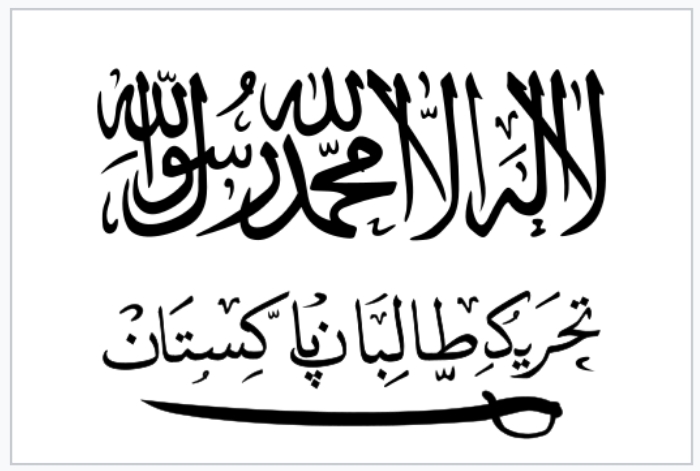
TTP Flag
Al Jazeera: The Pakistan Taliban says it is extending a ceasefire with the government until May 30, after the two sides held an initial round of talks hosted by Taliban rulers in neighbouring Afghanistan. The spokesman for the armed group, Mohammad Khurasani, on Wednesday said the talks between the Pakistani Taliban and the Islamabad government were facilitated by Afghanistan’s new Taliban rulers. Click here to read more (external link).