 8am: Taliban fighters are torturing residents of the Jaghuri district of Ghazni province for not giving them weapons. According to the sources, the Taliban forcefully and violently enter people’s houses in this district at night under the pretext of finding weapons. Click here to read more (external link).
Taliban Announce Public Holiday in Afghanistan to Mark Retaking of Power
 Ayaz Gul
VOA News
August 14, 2022
ISLAMABAD — Afghanistan’s Taliban have declared Monday a “national holiday” to mark one year since they retook power from the then international-backed government amid the precipitous withdrawal of the United States and NATO troops.
The Taliban takeover was swift, hardly facing any resistance from U.S.-trained security forces of the ousted Afghan government and enabling the insurgents to enter the capital, Kabul, on August 15 after overrunning the rest of the country.
“August 15 is a national holiday in the country to mark the first anniversary of the victory of the Afghan jihad [holy war] against the American and its allies’ occupation,” said a brief Taliban announcement Sunday.
U.S.-led foreign troops withdrew from the country after almost 20 years of war with the Taliban.
The Islamist group had agreed not to allow Afghanistan to be used by transnational terrorists, including al-Qaida, to target America and its allies. The group also pledged they would respect rights of all Afghans, including women, and not bring back the harsh polices of their previous government in Kabul from 1996-2001.
But since retaking power, the hardline group’s men-only government has significantly rolled back women’s right to work and education and placed restrictions on civil liberties, saying they are in line with Afghan culture and Sharia or Islamic law.
The killing of fugitive al-Qaida leader Aymen al-Zawahiri in a U.S. drone attack last month against his safe house in the heart of the Afghan capital has raised questions about the Taliban’s counterterrorism guarantees.
The Taliban condemned the strike, saying they were not aware of al-Zawahiri’s presence in Kabul and promised to conduct a “serious” and “comprehensive” investigation into the matter.
The human rights and terrorism-related concerns have so far kept the international community from recognizing the Taliban government and lifting economic sanctions on the group.
The curbs, aid groups say, have deepened an already bad humanitarian crisis in Afghanistan stemming from years of war and persistent drought.
Taliban defend policies
Taliban Foreign Ministry spokesman Abdul Qahar Balkhi said on the eve of the anniversary of their return to power that their “nascent government” has quickly brought security to the country and it “has begun treading the path of peace, stability and prosperity.”
Balkhi told VOA in a detailed interview that relevant ministries are making all possible efforts and have effectively addressed urgent domestic economic challenges like stabilizing the local currency, creating jobs through increased trade and transit activities.
“It is now for foreign countries, specifically the United States, to do their part in alleviating the pain of Afghans by lifting all unilateral economic sanctions to let the banking and economic sector function optimally,” he added.
Balkhi renewed the demand for Washington to unblock Afghan central bank’s foreign cash reserves, largely held in the U.S., to enable Kabul to stabilize the national economy and encourage foreign investments in the country.
U.S. President Joe Biden issued an executive order in February aimed at unfreezing half of the $7 billion for humanitarian aid to benefit the Afghan people. The rest would be held for ongoing terrorism-related lawsuits in U.S. courts against the Taliban.
Balkhi urged Muslim countries and the world at large to recognize the Taliban government “if they truly seek an Afghanistan that can realize its full potential as a partner in peace, stability and prosperity.”
He dismissed international criticism of restrictions the Taliban have placed on women and claimed no crackdown was underway against media or civil liberties in Afghanistan.
“Just as we do not interfere in the internal affairs of others, we also demand other states not interfere in the internal affairs of Afghanistan and to show respect for a people that are trying to heal organically after decades of foreign imposed prescriptions.”
Deteriorating human rights
The United Nations and global human rights groups in their repeated assessments concluded that the Taliban takeover has seen daily and continuous deterioration in every aspect of the rights of women and girls in Afghanistan.
On Saturday, Taliban security forces in Kabul fired shots into the air and beat women protesters demanding the right to education, work and political participation. The violence received strong condemnation from domestic and international rights activists.
The Taliban have barred most teenage girls from resuming secondary school and women employed in the public sector have been told to stay at home, except for those who work for the ministries of education, health and a few others. They have ordered women to use face coverings in public and banned them from traveling alone beyond 72 kilometers.
The hardline group after taking power in Afghanistan announced, “amnesty for all,” including foreign government and security officials. But critics remain skeptical whether the Taliban have upheld the pledge, citing targeted killings of former officials and other violence against civilians.
Balkhi argued the amnesty was being enforced across the country and noted, however, that “some cases of homicide” had been registered with the ministry of interior. He said “some culprits” had been brought to justice and others were still under investigation.
“These isolated cases have not deterred hundreds of thousands of former administration employees not only staying put but also being integrated into the workforce. Furthermore, hundreds of notorious figures that had earlier left the country have returned to resume their normal lives through the efforts of (a special) reconciliation and return committee,” he said.
Related
Taliban Exacerbated Afghan Humanitarian Crisis in Year 1 of Rule 2.0

Michael Hughes: Afghanistan’s Gross Domestic Product (GDP) plummeted by 40 percent overnight in the wake of the Taliban seizure of Kabul on August 15, 2021 because the international community cut off the foreign aid that had propped up the country’s economy for years. Such an earth-shattering loss of revenue no nation could survive, let alone one on the brink of utter collapse after decades of war. Click here to read more.
Afghan Economic Crisis Worsens as Taliban Mark Anniversary
 VOA News
August 13, 2022
Mirwais Rahmani
Roshan Noorzai
WASHINGTON — A year into the Taliban’s de facto government in Afghanistan, the war-torn country has experienced an economic crisis that has worsened the already dire humanitarian situation there.
The economy collapsed after the Taliban seized power in August 2021 and the international community placed sanctions on the Islamist group and suspended non-humanitarian assistance to Afghanistan.
“The sanctions and frozen assets, as well as drought, are contributing significantly, bringing hardships in the form of higher prices,” said Shah Mehrabi, a member of the Supreme Council of the Central Bank of Afghanistan and a professor of economics at Montgomery College in Maryland.
He added that the situation was compounded by increasing global energy and food prices that “are exacerbating the poverty for many ordinary Afghans.”
According to the United Nations, half of the Afghan population, about 19 million people, experience acute food insecurity. Ninety percent of the population faces insufficient food consumption.
The World Bank reported in July that the prices of consumer products such as diesel, flour, rice and sugar in Afghanistan increased 50% from the previous year.
Afghanistan’s humanitarian crisis has economic causes, Mehrabi said. “It all boils down to how the economy has been affected since the new regime came into power.”
Hundreds of thousands of people lost their jobs in Afghanistan after the Taliban took control. Many businesses were closed, and most of the social services were suspended.
Just two months after the fall of Kabul, the International Monetary Fund predicted the Afghan economy will contract up to 30% by the end of 2021, as nonhumanitarian aid was suspended and foreign assets were frozen.
“The resulting drop in living standards threatens to push millions into poverty and could lead to a humanitarian crisis,” IMF said in October 2021.
Humanitarian assistance
U.N. Secretary-General Antonio Guterres, addressing a virtual pledging conference in March 2022, said that “without immediate action, we face a starvation and malnutrition crisis in Afghanistan.”
International donors pledged more than $2.4 billion in humanitarian assistance to Afghanistan, in addition to $1.2 billion that was pledged in September 2021.
The U.S. Treasury Department issued two licenses in September 2021 to authorize humanitarian activities and the delivery of food and medicine to Afghanistan.
In February, U.S. President Joe Biden signed an executive order authorizing the use of $3.5 billion in Afghan central bank reserves for humanitarian purposes via a trust fund, while the remaining half was subject to ongoing litigation by U.S. victims of the September 11 attacks.
“We are urgently working to address concerns about the use of the licensed $3.5 billion in Afghan central bank reserves to ensure, to see to it, that they benefit the people of Afghanistan and not the Taliban,” Ned Price, U.S. State Department spokesperson, said in a news conference on July 19.
Banking crisis
About $9 billion in the Afghan Central Bank assets — $7 billion in the U.S. and $2 billion in Europe — were frozen as part of the sanctions on the Taliban.
The group has urged the U.S. to “unconditionally” release the frozen assets of Afghanistan held in the U.S.
Mehrabi said that not having access to the reserves hurt Afghan businesses, as it resulted in a liquidity crisis in the banking sector there.
“The commercial banks do not have adequate, again, USD and Afghanis to be able to disburse for import or other purposes that ordinary Afghans or businesses would like to go ahead and engage in,” Mehrabi said.
Ahmad Wali Haqmal, the Taliban’s spokesperson for the Ministry of Finance, told VOA the sanctions on the banking system are the country’s key economic issue.
“Our main problem is the sanctions on our banking system. Most businessmen and ordinary people suffer because they cannot send money in and out [of Afghanistan]. This is a major problem that has to be solved,” he said.
A former employee of the Afghan Ministry of Finance told VOA the Taliban do not have the technical staff to run the economy.
“Most of the educated and skilled Afghans working in the ministry left the country, and the Taliban brought their own people with no skills and even education,” said the former employee of the Afghan Ministry of Finance, who requested anonymity for his safety.
He noted the Taliban are thinking “it is the 1990s when they could run the government on their own.”
William Byrd, senior Afghanistan expert at the U.S. Institute of Peace, told VOA the situation is “completely” different from the 1990s when the Taliban were in power.
“The challenge for the Taliban in a way is much greater than it was in the 1990s, because the economy has developed in many ways. Social service is much developed since the ’90s, and there is a lot more room for decline and for things to go wrong,” Byrd emphasized.
International engagement
The donors are “facing a dilemma,” according to Roxanna Shapour of the Afghanistan Analysts Network, adding that they want to assist Afghanistan, but “they are not sure how to engage with the Taliban.”
Shapour noted that the international community does not recognize the Taliban as the legitimate government. This “has made the economic and development assistance to the country difficult, and to an extent, impossible,” she said.
She pointed out that many countries provide humanitarian assistance, but it “would not help in changing the economic conditions. … I do not think that the economy is going to get better in the future,” she said.
The World Bank’s latest report stated that “Afghanistan will face a smaller economy, significantly higher rates of poverty and more limited economic opportunities for the 600,000 Afghans reaching working age every year.”
“Afghanistan’s economic outlook is stark,” the World Bank report stated.
This story originated in VOA’s Afghan Service.
Afghan father whose teen fell from US cargo plane: ‘I blame the Americans’
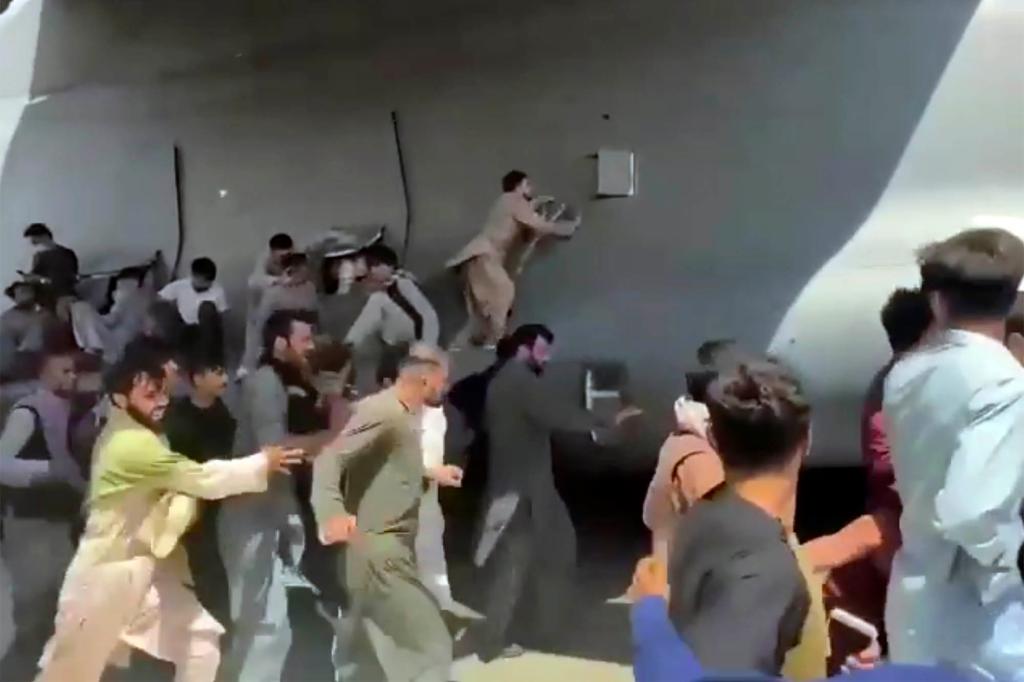
NYP: As the first anniversary of the disastrous US pullout from Afghanistan approaches, a victim of one of its most gruesome tragedies finally has a name. Zabi Rezayee, 17, was one of the desperate civilians who clung to the landing gear and wheel covers of a US Air Force C-17 as it taxied down the runway of Kabul’s Hamid Karzai International Airport on Aug. 16, 2021 — only to fall to his death on the tarmac, his father told the Sunday Times of London. Click here to read more (external link).
4 Taliban Killed, 6 Wounded in NRF Ambush in Baghlan’s Khost District
 8am: As a result of the ambush launched by the National Resistance Front (NRF) forces in the Khost district of Baghlan Province, 4 Taliban members have been killed and 6 others were injured. Local sources in Baghlan Province said on Saturday (August 13th) that the Taliban were trying to deploy their reinforcements from Landaki Kotal to Farzo Kotal in Panjshir when the NRF launched its offensive. Click here to read (external link).
1TV Afghanistan Dari News – August 13, 2022
Blast in West Kabul Leaves 3 Killed, 4 Wounded, Including 2 Taliban Members
 8am: A blast hit the Dasht-e Barchi neighborhood in the west of Kabul, leaving at least 3 civilians killed and 4 others, including 2 Taliban members injured. The west of Kabul, which is mainly a Hazara-dominated neighborhood, witnessed two deadly blasts last week on the eve of the Muharram ceremony, leaving dozens of civilians killed and injured. Click here to read more (external link).
Taliban Fire Shots, Beat Protesters as Women Rally in Kabul
Afghanistan: Amnesty international is concerned by the reports of the Taliban using excessive force to disperse women, who are peacefully protesting today to demand their human rights. https://t.co/fOn9Qrrw17
— Amnesty International South Asia (@amnestysasia) August 13, 2022
Ayaz Gul
VOA News
August 13, 2022
ISLAMABAD — Security forces in Kabul fired shots into the air and beat women protesting Taliban rule Saturday as dozens demanded the right to education, work and political participation on the eve of the first anniversary of the Islamist group’s takeover of Afghanistan.
Rally participants chanted “we want work, bread, and freedom” as they marched toward the Education Ministry in the Afghan capital before Taliban forces responded violently to the rare anti-government rally.
“August 15 is a black day,” read a banner protesters were carrying as they demanded the right to work and political participation, chanting “Justice, justice.”
Witness accounts and social media documented many women at the rally not wearing face veils.
Some of the female protesters who took refuge in nearby shops were chased and beaten by security forces with their rifle butts, witnesses said.
Heavy gunfire could be heard in social media video of the rally, with Taliban men assaulting female protesters. They also violently prevented Afghan journalists from covering the rally.
Amnesty international expressed concern on Twitter about reported use of “excessive force” by the Taliban to disperse women who were protesting peacefully.
Taliban officials did not immediately comment on the allegations.
The Taliban seized control of Afghanistan last August 15 from the internationally backed Afghan government as U.S.-led and NATO allies withdrew their troops from the country after almost 20 years of war with the Taliban.
The hardline group’s all-male interim government in Kabul has since significantly rolled back women’s rights to work and education, barring most teenage girls from resuming secondary school in a breach of promises the Taliban made to respect rights of all Afghans.
Women employed in the public sector have been told to stay at home, except for those who work for the ministries of education, health and a few others, and must use face coverings in public.
They have also banned women from traveling alone on long trips and require them to fully cover themselves, including their faces, in public.
The restrictions angered female activists and they initially staged small demonstrations against them, but the Taliban used violence and detained organizers, effectively deterring such rallies for months.
The Taliban defend their policies as being in line with Afghan culture and Shariah or Islamic law.
Related
Turkey’s Engagement With Afghanistan Has Grown Since Taliban Takeover
 Ezel Sahinkaya
VOA News
August 12, 2022
WASHINGTON — While many countries cut diplomatic ties with Afghanistan after the Taliban’s return to power last year, Turkey, the only NATO member with a diplomatic presence in the war-torn country, has been active on many fronts.
Recently, the second phase of the Kajaki hydroelectric dam in Helmand province was completed by the Turkish company 77 Construction, which has invested $160 million in the project.
Several senior Taliban officials attended the opening ceremonies for the dam, including Abdul Ghani Baradar and Abdul Salam Hanafi, acting deputy prime ministers of the Taliban government. Turkey’s ambassador in Kabul, Cihad Erginay, also was present.
“Although the Kajaki dam is an important investment in economic relations between our country and Afghanistan, our relations are more diverse and deeper,” Erginay said during the ceremony, adding that total trade volume between the countries increased 23% in the first six months of 2022.
‘Positive legacy’
Some experts think that Turkey’s engagement with Afghanistan derives from the countries’ shared diplomatic legacy, which dates back to modern Turkey’s founder Mustafa Kemal Ataturk and Afghanistan’s modernist king Amanullah Khan in the 1920s.
“That positive legacy has throughout all these years never been interrupted,” Alper Coskun, a senior fellow at the Carnegie Endowment for International Peace, told VOA.
From 2001 until the Taliban returned to power in August 2021, Turkey had taken part in NATO-led forces in Afghanistan.
“Turkey took a very deliberate position in ensuring that Turkish forces were not involved in [active warfare or lethal force] against the Afghan population in any way whatsoever,” Coskun said. “That, I believe, is something that the current regime in Afghanistan, the Taliban, are also cognizant of.”
Turkey withdrew its troops from Afghanistan before the Taliban’s August 2021 deadline for foreign forces to leave the country.
Kabul airport
According to Turkey’s Defense Ministry, one of the Turkish soldiers’ final assignments in Afghanistan was to provide “operational and force protection services” in Kabul at what was then known as the Hamid Karzai International Airport, since renamed the Kabul Airport.
Senior Turkish authorities have repeatedly shown interest in running the airport.
Last August, U.S. State Department spokesperson Ned Price said that “a secure, operational airport we feel is integral to our ability to have a functioning diplomatic presence on the ground. So, the safety, the security, the continuing operation of that airport — it is of high importance to us.”
“We are grateful that our Turkish partners have indicated a willingness to play a role in protecting that,” Price added.
Turkish President Recep Tayyip Erdogan said during a NATO summit in Madrid in June that Turkey had offered to operate the airport with Qatar and the United Arab Emirates but was awaiting the group’s response.
On July 7, however, Reuters quoted sources familiar with the negotiations saying the Taliban was close to handing all airport operations to the United Arab Emirates.
Some experts say Turkey’s proposal was significant even though the bid fell through.
“It’s no small matter that Turkey was one of just a few countries in a position to be negotiating an accord to provide security at the Kabul Airport,” said Michael Kugelman, the deputy director of the Asia Program at the Wilson Center.
“That accord didn’t work out, but the fact that Turkey was even involved was significant, especially as the Taliban have made clear that they won’t allow any foreign security presence on their soil,” he told VOA.
Recognition
Turkey has not formally recognized the Taliban, and Kugelman thinks that Turkey does not want to be the first to do so, considering “some reputational costs.”
On the other hand, Turkey hosted Amir Khan Muttaqi, the Taliban’s acting foreign minister, for high-level talks in October and the Antalya Diplomacy Forum, organized by the Turkish Foreign Ministry, in March.
On the sidelines of the forum, Thomas West, U.S. special representative for Afghanistan, met Muttaqi and Qatar’s Foreign Minister Sheikh Mohammed bin Abdulrahman Al Thani to talk about Washington’s Afghanistan policy.
West on Twitter thanked Turkey for hosting the event and said that “I look forward to discussions with important partners regarding international engagement with Afghanistan.”
Turkish Foreign Minister Mevlut Cavusoglu said after his meeting with Muttaqi, “We have told the international community about the importance of engagement with the Taliban administration. In fact, recognition and engagement are two different things.”
Turkey has advised the Taliban to form an inclusive government and ensure girls’ education under its rule. Ankara has also repeatedly talked about the importance of stability in Afghanistan to prevent additional refugee flow into Turkey.
“Our country, which is currently hosting around 5 million foreigners — 3.6 million of whom have come from Syria — cannot shoulder a new migration burden originating from Afghanistan,” Erdogan said at the G-20 meeting on Afghanistan in October.
According to figures from Turkey’s Presidency of Migration Management, Turkish authorities arrested around 70,000 irregular Afghan migrants in 2021.
Humanitarian aid
Speaking at the 15th annual summit of the Economic Cooperation Organization in November, Erdogan also said that the Afghan economy should be revitalized to prevent a refugee crisis, adding that Turkey supports “efforts aimed at keeping basic state structures, including critical sectors such as health care and education, functioning.”
Since the Taliban’s return to power a year ago, Turkey’s state-run Disaster and Emergency Management Authority has sent five charity trains with 5,570 tons of humanitarian aid to the war-torn country. The Turkish Red Crescent, which has been operating in Afghanistan, has delivered aid assistance to people affected by the 6.1 magnitude earthquake on June 22.
Active in Afghanistan since 2005 and with offices in Kabul, Herat and Mazar-e-Sharif, Turkey’s state-run Turkish Cooperation and Coordination Agency has recently delivered 2,000 aid kits to help malnourished Afghan children.
Turkey also exerts soft power in Afghanistan via the Yunus Emre Institute, a cultural center owned by the Turkish government; Diyanet, the Turkish Directorate of Religious Affairs; and at least 46 Afghan-Turk Maarif Schools in seven provinces.
Twelve of these schools had been owned by the Gulen movement, a group Turkey blames for a failed coup attempt in 2016, but the Afghan government transferred the schools to the Turkish government’s Maarif Foundation in 2018.
Azarakhsh Hafizi, former head of the international relations committee at Afghanistan’s Chamber of Commerce and Industries, calls the Turkey-run schools “near to international standards,” adding, “The youth of Afghanistan need these services.”
Some analysts say, however, that one of the reasons Ankara has active public diplomacy in Afghanistan is because it wants to boost its domestic popularity.
“Ankara likes to see itself as a world player, and so having its foundations and education apparatuses participating in Afghanistan is a good … domestic political checkmark to show that it has an active foreign policy,” said Aaron Stein, director of research at the Foreign Policy Research Institute.
But Stein thinks Ankara’s Afghanistan policy does not resonate with the Turkish public.
“They care about the cost of living rather than foreign policy in that sense,” he told VOA. “They are a lot like everybody else around the world, like, ‘Our cost of living is skyrocketing. Take care of that. We don’t care about what’s going on in Afghanistan.’”
This story originated in VOA’s Turkish Service.