
 Gizmodo: The Taliban wants to expand high-speed internet connectivity in Afghanistan despite a history of online censorship and internet blackouts to thwart protests against the militant group. Today, most people in Afghanistan rely on 2G network, but a few areas in the capital Kabul are already connected to 4G with plans to expand further, Najibullah Haqqani, the Taliban’s acting minister of telecommunications and information technology, told Bloomberg. Click here to read more (external link).
Afghanistan next in Abraham Accords? Taliban refuses to rule it out

Naeem
JP: “What problem do we have with Israel?” questioned a spokesman for the Taliban. A spokesman for the Taliban refused to rule out establishing relations with Israel during an interview with Al-Jazeera on Wednesday, despite earlier statements by the movement ruling this out, according to a clip shared by MEMRI. “Our policy is to resolve problems through dialogue and mutual understanding with everybody. Whoever has a problem and wants to resolve it, we are perfectly ready,” the spokesman of the Taliban’s Political Bureau, Dr. Muhammad Naeem, told Al-Jazeera. Click here to read more (external link).
The Taliban now guard Afghanistan’s National Museum, where they once smashed objects
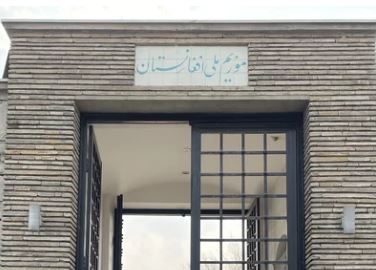 NPR: The last time the Taliban were in power, at the direction of then-leader Mullah Muhammad Omar, they smashed ancient statues and other objects in this museum that they deemed un-Islamic and idolatrous… “We used to show a film about the Taliban’s destruction of the Bamiyan Buddhas on that TV,” he says — adding that it’s been unplugged since last August. Click here to read more (external link).
‘We Are Left With Nothing’: Deadly Floods Aggravate Afghanistan’s Economic, Humanitarian Crisis
 By Abubakar Siddique
RFE/RL’s Radio Azadi
August 31, 2022
Mira Jan lost his home, crops, and livestock in the devastating floods that have struck large swaths of Afghanistan.
“Our house was swept away by the raging floods,” Jan, a farmer in the eastern province of Nangarhar, told RFE/RL’s Radio Azadi. “We were only able to save ourselves and our children. We have nothing to live off now.”
Jan is among the tens of thousands of Afghans affected by the deadly floods that have swept the country in recent weeks. Over 250 people have been killed and thousands of homes have been destroyed.
The floods have exacerbated the devastating economic and humanitarian crisis in Afghanistan that has been fueled by the Taliban’s seizure of power in August 2021.
Afghans are facing the largest humanitarian crisis in the world, with half of the around 40-million population threatened by starvation. Cut off from foreign aid and crippled by international sanctions, Afghanistan’s economy is on the verge of collapse.
The flooding comes as Afghanistan reels from a series of natural disasters. The country is in the midst of the worst drought for years. In June, a devastating earthquake killed at least 1,000 people in southeastern Afghanistan, where many are still relying on assistance to survive.
‘Terrible Suffering’
The United Nations’ humanitarian coordination organization, OCHA, estimated on August 30 that 256 people have been killed in the floods that have affected over 100,000 people in 32 out of the country’s 34 provinces. The worst hit areas are in eastern Afghanistan, including Nangarhar and Kunar provinces.
The UN agency said the floods have damaged 34,000 hectares of agricultural land and killed 7,500 livestock. The floods struck during the summer harvest season, hitting the livelihoods of thousands of farmers.
Philippe Kropf, the head of communications at the World Food Program (WFP) in Afghanistan, said the natural disasters in the South Asian country have added to the “unrelenting hardship for populations already in terrible suffering.”
Katherine Carey, the deputy head of OCHA, said that, with 75 percent of Afghanistan’s rural population dependent on agriculture, the loss of farmland, crops, and livestock will have a lasting economic impact on livelihoods.
“Critical civilian infrastructure, including roads and bridges, have also been either damaged or destroyed, cutting people off from areas and restricting access to markets,” she said.
Experts say unseasonal rains this summer triggered the floods. The heavy rains on land dried up by years of drought also caused landslides.
The 256 people killed by flooding in Afghanistan this summer represents a 75 percent increase from last year, when 147 people lost their lives.
Afghanistan has also lost much of its forest cover during the last four decades of war, magnifying the impact of climate change.
Carey said that Afghanistan is one of the world’s most vulnerable countries to the impacts of climate change. She said vulnerable Afghans need longer-term reconstruction and development support.
OCHA said 85,000 people have received humanitarian assistance, including food, tents, health-care services, water, sanitation, and hygiene kits.
But the WFP said it needs $172 million to preposition food in rugged and remote areas before winter sets in.
Aid groups are now in a battle against time to reach vulnerable Afghans affected by the floods.
“The floods destroyed everything that we had built or invested in during the last few decades,” said Abdul, a farmer who lives in Shahwali Kot, a district in the southern province of Kandahar.
The floods have damaged over 100 hectares of farmland in the rural district.
In Nangarhar Province, Bibi Jamala is unsure how she is going to survive. “We are left with nothing,” the widow told Radio Azadi. “The flood washed away our home and all our belongings.”
Copyright (c) 2022. RFE/RL, Inc. Reprinted with the permission of Radio Free Europe/Radio Liberty, 1201 Connecticut Ave NW, Ste 400, Washington DC 20036.
Compassion or cowardice: Why Ashraf Ghani left Afghanistan
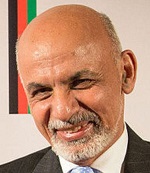
Ashraf Ghani
Fox News: “No power in the world could persuade me to get on a plane and leave this country. It is a country I love, and I will die defending,” Ghani infamously told Germany’s Der Spiegel in May 2021. However, Ghani broke that promise just a few months later, gathering his family and flying out of Afghanistan as Taliban forces overran Kabul. Click here to read more (external link).
Amnesty Accuses Iran, Turkey Of Firing At Afghans Trying To Reach Safety
 Radio Free Europe/Radio Liberty
August 31, 2022
Amnesty International has accused Iranian and Turkish forces of “repeatedly” pushing back Afghans who attempt to cross their borders and opening fire on men, women, and children trying to reach safety.
In a new report released on August 31, the London-based rights group said Afghans who manage to enter Iran or Turkey are detained and subjected to torture and other ill-treatment before being forcibly returned to Afghanistan, despite the poor human rights situation there.
Amnesty said it has documented the killing of 11 Afghans by Iranian security forces and three Afghans by Turkish security forces.
The rights group said none of those killed represented an “imminent threat of death or serious injury” to security forces or others that would meet the threshold for the use of firearms under international law and standards.
“We documented how Iranian security forces have unlawfully killed and injured dozens of Afghans since last August, including by firing repeatedly into packed cars. Turkish border guards have also unlawfully used live ammunition against Afghans, firing into the air to repel people, and also shooting at them in some cases,” Marie Forestier, researcher on refugee and migrants rights at Amnesty International, said in a statement.
The rights group called on Turkish and Iranian authorities to immediately end all pushbacks and deportations of Afghans, end torture and other ill-treatment, and ensure safe passage and access to asylum procedures for all Afghans seeking protection.
“Security forces must immediately end the unlawful use of firearms against Afghans at the borders, and perpetrators of human rights violations, including unlawful killing and torture, must be held accountable,” Amnesty International said.
Amnesty International said it is also calling on all countries not to forcibly return Afghans not only to Afghanistan, but also to Turkey or Iran, where Afghans would be at risk of deportation to Afghanistan.
The rights group also called on countries hosting Afghans to support safe passage and evacuations from Afghanistan for all those at risk of reprisals from the Taliban.
The hard-line group, which returned to power in August 2021, has been accused of serious human rights abuses, particularly against women whose rights have been crushed.
In past months, hundreds of thousands of Afghans have fled the country as the Taliban militants took power.
The United Nations Refugee Agency (UNHCR) says there are 2.6 million registered Afghan refugees in the world, of whom 2.2 million are registered in Iran and Pakistan alone.
Copyright (c) 2022. RFE/RL, Inc. Reprinted with the permission of Radio Free Europe/Radio Liberty, 1201 Connecticut Ave NW, Ste 400, Washington DC 20036.
NRF Fights Against the Taliban in Six Provinces of Afghanistan with 4,000 Forces: Nazary

Nazary
8am: Ali Maisam Nazary, head of foreign relations for the National Resistance Front of Afghanistan (NRF), says that NRF’s operations have expanded during the past year and is currently fighting against the Taliban in six provinces of the country with 4,000 well-equipped and trained forces. Nazary further said that they have called on the different countries to help the Resistance Front, adding that unfortunately except Tajikistan, other countries have not shown interest in Afghanistan issues. “Last winter, we had a military presence in six provinces in northern Afghanistan: Panjshir, Kapisa, Baghlan, Badakhshan, Takhar and Parwan,” he added. Click here to read more (external link).
Related
Tolo News in Dari – August 31, 2022
Taliban Marks Year Since Foreign Withdrawal At Former U.S. Base; Kabul Blast Kills At Least 2
Radio Free Europe/Radio Liberty
August 31, 2022
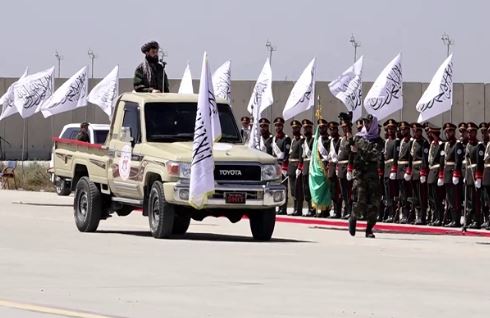
The Taliban on August 31 marked the first anniversary of the final withdrawal of U.S.-led international troops from Afghanistan with victory chants and a military parade showcasing equipment left behind by American forces.
The event was held at Bagram Air Base, north of Kabul, which was used for military planning by U.S. forces for two decades until the August 2021 pullout.
But a car bomb that reportedly struck a Taliban convoy in Kabul as it returned from the Bagram celebration was a powerful reminder that violence persists in Afghanistan.
The Taliban-led authorities said two people were killed and three others injured in the roadside explosion, reportedly in the Sar-e Kotal district of the capital.
The dpa news agency quoted other sources suggesting that the casualty numbers were higher from the blast.
No one initially claimed responsibility for the car bombing.
The Taliban has declared August 31 a national holiday and it marked the occasion in Kabul the previous night with fireworks and celebratory shots into the air.
The hard-line militia group’s government, which came to power a year ago, has not been recognized by any country. Its rule has been marked with human rights abuses, particularly the repression of women and minority groups.
Speaking on August 31 at Bagram, Taliban Prime Minister Mullah Mohammad Hassan Akhund said the militia had fought for 20 years for the day to come. However, he admitted that the country’s economy has been paralyzed due to sanctions.
The last American soldier left Kabul International Airport on August 30, 2021, capping off a sudden and chaotic evacuation.
Based on reporting by AFP, dpa and Reuters
Copyright (c) 2022. RFE/RL, Inc. Reprinted with the permission of Radio Free Europe/Radio Liberty, 1201 Connecticut Ave NW, Ste 400, Washington DC 20036.
Related
Former Security Personnel’s Daughters and Women Turned to Taliban Slaves and War Booty, Say Social Media Users

Khosti (left)
8am: The viral video in which a girl claims that Saeed Khosti, the former spokesperson of the Taliban-occupied Ministry of Interior, raped her, has spiked public outcry. The footage in which Elaha Delawarzi, 24, claims that Saeed Khosti raped her, has sparked strong reactions among social media users. One of the users posted that the Taliban, based on the “extreme interpretation” of religious texts, consider the women and girls of the former republic regime as their war booty and slaves. Click here to read more (external link).
Related