
 8am: The Taliban rebels have launched house-to-house search operations in this province over the last three days, local sources reported. The search operation is reportedly continuing in some areas of Herat city. Although the Taliban in Herat have stated that the purpose of this move is to ensure the safety of the people, the residents of Herat said that the Taliban are harassing the residents instead. Click here to read more (external link).
UAE firm to manage air traffic over Afghanistan
 AFP: A United Arab Emirates firm signed a contract with Afghanistan on Thursday to manage air traffic across the country as the Taliban authorities seek to expand international flights. While some flights are operating out of Kabul airport, significant extra support is needed for major foreign airlines to resume full service. Click here to read more (external link).
Related
Pakistan beats Afghanistan in thrilling last over
 Ariana: In a dramatic finish in Sharjah, No.10 batter Naseem Shah slammed two sixes off the first two balls of the final over to seal Pakistan a win against Afghanistan in the Asia Cup. The back-to-back sixes ensured Pakistan’s come-from-behind win, but also signalled the end of India and Afghanistan in the tournament. Click here to read more (external link).
Taliban Claim Media Reform as Journalists Decry Censorship
 Akmal Dawi
VOA News
September 7, 2022
Taliban leaders are touting the success of so-called media reforms which bar state and private TV channels in Afghanistan from showing programs considered indecent — such as foreign movies or songs by female singers — or any content that is critical of Islam or the Taliban themselves.
“Ninety-five percent of the visual and audio media outlets in the country have been reformed,” Hayatullah Mohajir Farahi, deputy information and culture minister in the Taliban’s caretaker Cabinet, told a press conference in Kabul Tuesday.
To implement its regulations, the Taliban leadership has set up a media monitoring office that screens every broadcast program for full compliance with strict Islamic and political preferences.
In practice, experts say, the so-called reforms amount to extensive censorship of a seriously weakened Afghan media. Among other restrictions, the Taliban have ordered female anchors to wear facemasks and headscarves when presenting TV programs.
Over the past year, at least 245 cases of censorship, detention and violence against media personnel have been reported, according to the Afghanistan Journalists Center (AFCJ), one of the few media support groups still left.
The Taliban say no journalist has died in the country since the group returned to power in August 2021. At least 10 journalists were killed in Afghanistan in 2020 and 2021, figures compiled by the Committee to Protect Journalists show, and the Taliban were blamed for some of the deaths.
“It’s good news that no journalist has been murdered in the past one year, but we should also know that more than 130 journalists and media personnel were detained and some were tortured by the Taliban in the same period,” said a representative from AFCJ who asked not to be identified for fear of reprisal.
At least three journalists, several video bloggers and a U.S. filmmaker and her producer are in Taliban detention right now.
Media law
The Taliban have annulled Afghanistan’s constitution, which modeled the country into an Islamic republic and offered protections for free media and equal rights for women. Instead, the group has declared the country an Islamic emirate with their unseen leader, Hibatullah Akhundzada, as an undisputed supreme ruler.
The dilution of the country’s media law, last amended in 2019 and which offered extensive press liberties, is all but certain.
“The media law was recently reviewed by the Ministry of Information and Culture … and some amendments were made in regard to religious and cultural issues and [the draft] has been sent to the leadership for approval,” said Zabihullah Mujahid, the Taliban’s spokesman.
It is not clear if or when the Taliban leadership will approve the amended media law and then how the leadership will implement it.
Thus far, the Taliban’s feared intelligence agency has directly dealt with alleged cases of media violations mostly by detaining, threatening and even torturing journalists, media advocacy groups have reported.
On Tuesday, Taliban officials also announced the establishment of a media violations commission that will handle media complaints.
Unlike the media commission under the former Afghan government, the Taliban’s media commission has no female members or journalists, and no representative from the Afghan human rights commission. The Taliban dissolved the country’s only human rights commission earlier this year without explanation.
The new media commission has several officials from the Ministry of Information and Culture, media support groups and an Islamic scholar, the AFJC said.
No protests, no coverage
Among other restrictions, the Taliban have instructed media outlets to stay away from peaceful protests.
Since taking power, the Taliban have faced sporadic protests, primarily by women’s rights activists, who call for the reopening of secondary schools for girls, work opportunities and political rights for women.
“Recent protests have been illegal and therefore filming and reporting on them is also illegal,” said Mujahid, adding that protesters must seek permits from Taliban authorities before marching in the streets.
The U.N. and human rights organizations have repeatedly condemned the Taliban’s policies toward women and the press.
“The de facto authorities have increasingly limited the freedom of peaceful assembly. To disperse protests, they often use excessive force, including live ammunition, batons, whips, pepper spray and tear gas, and house raids to target protesters, thereby heightening people’s fear of reprisals for publicly expressing dissent,” a U.N. special rapporteur on human rights in Afghanistan reported on Sept. 6.
Hundreds of journalists and media personnel have left Afghanistan over the past year and more than 80 percent of female journalists have lost their jobs, according to media advocacy groups.
“I think the media makers and TV producers are driven by a desire to serve the public with news, entertainment, and other programs that people crave and need, especially in their current extra-difficult circumstances,” said Wazhmah Osman, author of a book on Afghan television culture and associate professor at Klein College of Media and Communication at Temple University in Pennsylvania. She spoke to VOA.
Despite prevalent risks and challenges, some 210 TV and radio stations and more than 100 publications are active in Afghanistan.
Related
UN Report Details Taliban Abuses in Afghanistan

Taliban (file photo)
HRW: Under the Taliban, the rule of law has no meaning. It isn’t even clear what “the law” is. Since last year, when the Taliban revoked the country’s constitution and stated that all laws needed to comply with Sharia, or Islamic law, it hasn’t been clear which laws and regulations are in force or how crimes are to be handled. Instead, there are only “evolving and arbitrarily interpreted rules and decrees,” according to the UN report, and legal cases “are handled idiosyncratically across jurisdictions and venues,” while basic crimes are “often dealt with by security forces without involving prosecutors or judges.” In short, “the law” is whatever a Taliban official might say it is. A situation more threatening to human rights is hard to imagine. Click here to read more (external link).
A Taliban Member Abducts a 17-Year-Old Girl in Bamiyan
 8am: A local source in Bamiyan told Hasht-e Subh on Wednesday, September 7, that 40 year old Seyeed Taqi Alavi has abducted a 17-year-old girl from Solij village of Yekavalang District No. 2 for the purpose of marriage. After the Taliban took control of Afghanistan, incidents of forced marriages with measurable age differences have increased. Click here to read more (external link).
Tolo News in Dari – September 7, 2022
Coffee shops ordered to shut down in Nimroz

Ariana: Local authorities in Afghanistan’s southwestern province of Nimroz have decided to shut down coffee shops in the province in order to avoid the ruination of the younger generation. Local residents, however, said that dozens of people will become unemployed with the closure of coffee shops. “I invested $20,000 to establish a coffee shop. The Islamic Emirate is telling us to shut down, but we don’t have the capital to make a new investment. We already face dues on electricity and rent,” said Nisar Ahmad, a coffee shop owner. Click here to read more (external link).
The Real Winners Of The US War In Afghanistan
 Inkstick: A year after the US withdrawal from Afghanistan, the world is still coming to terms with the full extent of the costs of that war — not only the budgetary costs, but also the lost human lives, the destruction of health facilities and other infrastructure, and the impacts on the environment. At first glance, it seems like a war in which everyone lost. Yet, one small group did not: the contractors who received funding from the US Department of Defense. Click here to read more (external link).
Taliban foreign ministry calls on US to stop drones patrolling in Afghan airspace
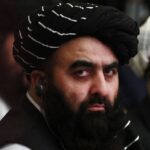
Muttaqi
Ariana: The Ministry of Foreign Affairs of the Islamic Emirate of Afghanistan (IEA) [Taliban] said Wednesday the United States’ practice of using drones to patrol Afghan airspace was in violation of the Doha Agreement and of international law and requested Washington to stop. According to Muttaqi, so far the world still does not have a clear definition of terrorism. The IEA also said a big achievement was the eradication of Daesh. Muttaqi said no proof has been provided by the US that Ayman al-Zawahiri, the leader of al-Qaeda, was in fact killed in a drone strike in Kabul in June. Click here to read more (external link).