
 Ariana: A mining contract for the extraction of lead and zinc in the province of Bamiyan has been signed between the Ministry of Mines and Petroleum (MoMP) and the Afghan Durrani Mine Extraction Company, according to a statement published by the ministry. The lead and zinc mines are in the Gandeh Kotal area of Yakawlang district of Bamiyan province. Click here to read more (external link).
Canada on Track to Host Largest Afghan Resettlement Program
 Akmal Dawi
VOA News
May 9, 2023
WASHINGTON — The government of Canada says it is determined to reach its target of admitting at least 40,000 Afghan refugees by the end of the year.
More than 30,600 Afghans have been resettled in Canada since August 2021 when Ottawa announced it would admit thousands of Afghans whose lives could be at risk under the new Taliban regime.
Canada “is firm in its commitment to resettle at least 40,000 Afghan nationals by the end of 2023, which remains one of the largest programs in the world,” a spokesperson for Immigration, Refugees and Citizenship Canada (IRCC) told VOA.
Among those resettled, over 10,000 are individuals who worked for Canadian agencies and programs in Afghanistan while more than 16,000, particularly women and civil society activists, have been admitted under humanitarian considerations.
More than 18,000 applications are still under review by Canadian and international nongovernment organizations and the U.N. Refugee Agency (UNHCR) for resettlement in the next several months.
Resettlement operations are executed via chartered and commercial flights from Afghanistan and third-party countries.
“The current situation is complex and the challenges are extraordinary,” the spokesperson said. “How quickly any Afghan arrives in Canada once their application is approved depends on a variety of factors, many of which are beyond our control, and often directly relate to where Afghans are located.
“There are significant challenges chartering flights in some regions and each country sets its own entry and exit requirements and determines when and if these requirements are changed,” the spokesperson said.
While Canada has no diplomatic presence in Afghanistan, a network of Canadian visa officers across the world are tasked with processing applications expeditiously to achieve the target by the end of the year.
Canada’s government allocated more than $80 million to fund its Afghan program in the 2022-2023 financial year, according to IRCC, which has a total annual budget of nearly $3 billion, a portion of which is also used to support various resettlement programs.
Women
Half of the Afghan refugees taken by Canada are women who are admitted primarily because of the Taliban’s systemic denial of basic rights for women.
Human rights groups say Afghanistan is suffering a gender apartheid under the hardline Islamist regime.
Women leaders, religious and ethnic minorities, journalists and LGBTI individuals are prioritized under Canada’s humanitarian resettlement program, which only accepts applicants referred by UNHCR and two European human rights organizations.
“It would actually be helpful if it was just women generally,” Lauryn Oates, executive director of a nongovernmental organization Canadian Women for Women in Afghanistan, told VOA.
“All women are at risk in Afghanistan,” Oates said, adding that Canada and other countries that admit Afghan refugees should accept women “on the basis of gender alone.”
The United States and European countries have also taken tens of thousands of Afghan refugees over the past 20 months.
In the immediate aftermath of the Taliban’s return to power, the U.S. military evacuated more than 124,000 individuals from Afghanistan. More than 77,000 of those evacuees were admitted into the United States for urgent humanitarian reasons and offered a two-year entry parole, according to the Department of Homeland Security (DHS).
A DHS spokesperson did not answer questions about the gender-based breakdown of the Afghans given paroled entry into the United States.
“For the average Afghan woman, there are no pathways to resettle to the U.S.,” Devon Cone, a women’s rights advocate at Refugees International, told VOA.
Cone said the U.S. Department of State’s P-1 and P-2 resettlement programs for Afghans do not specifically target women.
Managed through the U.S. Refugees Admission Program, the P-1 offers resettlement pathways for any individual of any nationality with compelling protection needs, while the P-2 program is for “qualified Afghans” who worked for U.S. agencies in Afghanistan.
“Even though these P-1 and P-2 programs exist, they are not really functioning, especially in places like Pakistan,” said Cone. “There are very few options for Afghan women at risk to resettle to the U.S. and the options that do exist are not working.”
Addressing a House of Representatives Appropriations subcommittee in March, U.S. Secretary of State Antony Blinken said he is “personally committed to keeping our promises to those who stood by us in Afghanistan.”
“The efficient processing and ultimate resettlement of these individuals continues apace and remains among the administration’s highest priorities,” a State Department spokesperson said.
VOA immigration reporter Aline Barros contributed to this report.
Tolo News in Dari – May 9, 2023
Missile Attack on Taliban Governor’s Office in Kapisa Province, Leaves Three Fighters Dead
 8am: The attack took place around 1:00 am on Tuesday, May 9, in the city of Mahmood Raqi, Kapisa’s center. Although the locals are not saying anything about the perpetrators and casualties of the attack, the Freedom Front has claimed responsibility for the event. In a statement, the Freedom Front claimed that as a result of the attack at least three Taliban fighters were killed and four others were wounded. Click here to read more (external link).
Tajikistan Calls For ‘Security Belt’ Around Afghanistan Over Drug Smuggling
 By RFE/RL’s Tajik Service
May 9, 2023
Tajikistan has asked member countries of the Shanghai Cooperation Organization (SCO) to establish an independent agency to combat drug trafficking from Afghanistan. Foreign Affairs Minister Sirojiddin Muhriddin says he also told a high-level meeting of officials from the SCO last week in India that it was important to establish a “safety belt” around Afghanistan. The proposal comes days after a Tajik soldier was killed in a clash between government forces and smugglers in Badakhshan Province. Tajikistan shares more than 1,300 kilometers of border with Afghanistan, a major producer of drugs.
Copyright (c) 2023. RFE/RL, Inc. Reprinted with the permission of Radio Free Europe/Radio Liberty, 1201 Connecticut Ave NW, Ste 400, Washington DC 20036.
Taliban’s Latest Atrocity: Arresting Schoolteachers and Young Civilians in Kapisa Province
8am: Sources spoke with Hasht-e Subh on Monday, May 8, stating that the Taliban had detained these individuals over the past month in the Hessa-2 Kohistan district and subjected them to severe torture. Sources did not provide any information about the identities of the teachers but emphasized that most of those arrested were young. According to sources, the Taliban is torturing these individuals to find members of the National Resistance Front and Freedom Front. Click here to read more (external link).
Sri Lanka announce schedule for Afghanistan series
 Ariana: Sri Lanka Cricket have announced the dates of a three-match ODI series at home against Afghanistan. The hosts will up their preparations for the ICC Men’s Cricket World Cup Qualifier matches in Zimbabwe in June and July by playing Afghanistan in a three-match ODI series. Afghanistan will arrive in Sri Lanka on May 29 and the three matches will be played on June 2, 4 and 7 respectively. All the matches will be played at the MRIC Stadium in Hambantota. Click here to read more (external link).
Ex-Pakistan PM Khan Arrested Amid Deepening Political Turmoil

Imran Khan
Ayaz Gul
VOA News
May 9, 2023
ISLAMABAD — Authorities in Pakistan Tuesday arrested former prime minister Imran Khan, the leader of the largest national political party, outside a court in the capital, Islamabad.
The 70-year-old politician was taken into custody as he prepared to attend a hearing on the dozens of charges against him ranging from alleged terrorism and corruption to treason and other criminal offenses.
Khan’s attorneys claimed that paramilitary forces physically assaulted him before taking him into custody and handing him over to anti-graft authorities accompanying them.
Khan’s party denounced their leader’s arrest.
“State terrorism – breaking into IHC (Islamabad High Court) premises to abduct Imran Khan from court premises. Law of the jungle in operation. Rangers beat the lawyers, used violence on Imran Khan, and abducted him,” tweeted Shireen Mazari, a close aide to the opposition leader, along with a purported video of security action.
Pakistan Interior Minister Rana Sanaullah confirmed Khan’s arrest, rejecting charges of physical assault and telling local media about a corruption case against the opposition politician.
The German ambassador in Pakistan had said he was “concerned about pictures circulating” of Khan’s arrest.
“Crucial to ensure highest standards of the rule of law in judicial cases & avoid over-exaggeration,” Alfred Grannas wrote on Twitter. “To all: Stay calm on all sides for the sake of #Pakistan & prioritize dialogue to work towards progress together!” the ambassador added.
He later deleted the post, saying in another tweet that it was removed “to avoid any misinterpretation that we take a side.”
Adam Weinstein, a researcher at Washington’s Quincy Institute, said, “The arrest of Imran Khan takes an already escalating political firestorm & douses it with petrol as the nation inches off an economic cliff.”
“It will harden negative views toward the military & PDM and unleash chaos in the streets. But it is also a blow to IK,” he wrote on Twitter.
The arrest came just hours after Khan added new details to his allegation that a senior general within the Pakistani military spy agency, the Inter-Services Intelligence or ISI, is plotting to kill him.
The opposition leader warned such an eventuality could plunge the South Asian nation of about 220 million people into a turmoil worse than Sri Lanka’s political unrest last year.
The head of his Pakistan Tehreek-e-Insaf (PTI) party first made the claims in a video statement a day after the powerful military warned Khan against making what it condemned as “fabricated and malicious” allegations.
Khan was injured in an assassination attempt last November while leading an anti-government protest march near Lahore, the capital of Punjab, Pakistan’s most populous province. The attack killed one person, while the PTI chief received bullet wounds in his legs.
Khan accused ISI’s Major-General Faisal Naseer of being one of the planners of the assassination attempt.
Government officials have said the assassination attempt was the work of a lone gunman, who is now in custody and confessed in a video controversially leaked to the media.
Former prime minister Khan was removed from office in a parliamentary vote of no-confidence in April 2022, a move he rejected as illegal and orchestrated by the now-retired chief of the Pakistani military, General Qamar Javed Bajwa.
His arrest is likely to worsen political turmoil in the nuclear-armed country. PTI supporters immediately took to the streets in Islamabad and other parts of the country to protest the arrest. Police in Islamabad dispersed protesters and detained dozens of them in the process.
Angry protests and demonstrations also erupted across the Khyber Pakhtunkhwa province abutting Afghanistan. A large group of them marched toward the residence of the regional military corps commander in central Peshawar, the provincial capital. Protesters also blocked parts of the busy main highway linking Pakistan to landlocked Afghanistan.
There was a complete media blackout of the protests on dozens of local news channels in and around Islamabad but officials were not immediately available to respond to opposition allegations the government was responsible.
Pakistan is mired in an economic and political crisis, with the Khan-led PTI pressuring Sharif’s embattled coalition government to hold early elections.
The military has a long history of direct and indirect political intervention, with political parties and independent analysts blaming the institution for the fragility of the country’s democracy. Army generals have staged several coups and arrested politically popular prime ministers on trumped-up treason and other charges, ruling the country for nearly half its 75 years.
“Today it appears the Pakistan army has reached an “enough is enough” moment re Khan. After several false starts/unsuccessful arrest attempts by the police, this time the mil took matters into its own hands. What a mess,” tweeted Michael Kugelman, the South Asia Institute director at the Wilson Center.
Maleeha Lodhi, the former Pakistani ambassador to the United States, while responding to Khan’s arrest, described the current crisis facing the country as unprecedented.
“Of total political chaos and economic breakdown. This is untenable, and the people of the country don’t deserve this. This must change,” Lodhi wrote on Twitter.
Related
Critiquing Hekmatyar’s Comments on Sahih Bukhari

Gulbuddin Hekmatyar
8am: Gulbuddin Hekmatyar has discussed a number of topics in his recent remarks concerning hadith books and particularly Sahih Bukhari. He asserted that those who are currently killing people in Afghanistan are adherents of Imam Bukhari and “Ahl al-Hadith”, which refers to the followers of Salafism. It appears that Hekmatyar is attempting to censure the actions of Islamic State-Khorasan (ISS-K) in order to gain the approval of the Taliban. Click here to read more (externa link).
Taliban Diplomat Defends Policies, Insists Afghan Women Education Ban Not ‘Permanent’
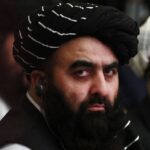
Muttaqi
Ayaz Gul
VOA News
May 8, 2023
ISLAMABAD — The chief diplomat of Afghanistan’s ruling Taliban insisted Monday that his government had not banned girls’ education “permanently,” while women continue to work in different sectors across the country.
Taliban Foreign Minister Amir Khan Muttaqi addressed a seminar in Pakistan’s capital, Islamabad, to wrap up a four-day official visit to the neighboring country, where he also attended a trilateral dialogue with his Chinese and Pakistani counterparts.
“We have 10 million students currently attending primary-level and university-level education [in Afghanistan]. Nine million can access all forms of education. They include girls up to grade six. Around 300,000 teachers, including 92,000 females, teach in these institutions,” he said.
The hardline Islamist group reclaimed control of the country in August 2021 when the United States and NATO withdrew their troops after almost two decades of involvement in the Afghan war. The Taliban have since imposed their strict version of Islamic law or Sharia to run the impoverished, war-torn South Asian nation.
Many Afghan women, including those working for the United Nations and non-governmental groups, have been blocked from accessing work and public places.
The Taliban have rejected international demands to remove restrictions on women as interference in Afghanistan’s internal affairs.
Still in his remarks Monday, Muttaqi insisted that thousands of female doctors and nurses are working in health business sectors. Girls and women are attending madrasas (Islamic seminaries) and even teaching there.
“We have never said that female education is un-Islamic or banned permanently in Afghanistan. The decree clearly stated that female education is suspended until further notice,” Muttaqi said.
He referred to the edict issued by the reclusive Taliban chief, Hibatullah Akhundzada, last year that prohibited young girls from attending schools beyond the sixth grade and subsequently suspended female students from accessing university classes.
“We have made progress on this issue to a large extent, and the government of Afghanistan will continue to make efforts to resolve the remaining problems about this issue amicably,” Muttaqi said without elaborating.
A team of U.N. experts on human rights concluded an eight-day mission to the country last Friday, reporting an unprecedented “extreme situation of institutionalized gender-based discrimination” in Afghanistan.
“We are deeply concerned about the apparent perpetration in Afghanistan of gender persecution — a systematic and grave human rights violation and a crime against humanity,” the mission said in its preliminary findings. It noted Taliban authorities, in meetings with the U.N. team, had reiterated that they were working on the reopening of girls’ schools but did not provide a clear timeline.
Trilateral talks
Muttaqi, who faces U.N. travel sanctions, was given a waiver to make the visit to Islamabad to attend on Saturday a trilateral meeting with Chinese Foreign Minister Qin Gang and Pakistani Foreign Minister Bilawal Bhutto Zardari.
Beijing and Islamabad urged the Taliban delegation to conduct counterterror actions against terrorist groups operating on Afghan soil and threatening regional security.
“We will not allow anyone to use the soil of Afghanistan against others. We have been successful in our resolve, and we will remain committed to this pledge in the future that Afghan soil is not used against anyone,” responded Muttaqi while speaking at Monday’s seminar in the Pakistani capital.
Pakistan issued a joint statement Monday about the three-nation talks, saying the participants resolved to deepen and expand their cooperation in the security, development, and political domains.
They also stressed the need for the Taliban to stop militant groups, including the outlawed Tehrik-e-Taliban Pakistan or TTP and the Eastern Turkistan Islamic Movement, or ETIM, from using Afghan soil to threaten neighboring countries.
TTP and ETIM have been waging deadly attacks, respectively, in Pakistan and China from their alleged sanctuaries in Afghanistan.
The Chinese and Pakistani delegates agreed at the meeting to enhance support for the Taliban government in the economic reconstruction of the war-torn country.
The joint statement said the three countries reaffirmed “their commitment to further the trilateral cooperation under the Belt and Road Initiative (BRI), and to jointly extend the China-Pakistan Economic Corridor (CPEC) to Afghanistan.”
The CPEC is a multibillion-dollar extension to Pakistan of China’s global BRI infrastructure development project.
Chinese investment of more than $20 billion has built new roads, power plants, and ports in Pakistan to help improve its economy, linking the two allied nations through the corridor to give China access to international markets through the Arabian Sea deep-water Pakistani port of Gwadar.
The Chinese-developed and run port is expected to further facilitate trade and transit activities to and through landlocked Afghanistan to Central Asian countries.