logo

Daily Updated Afghan News Service

  • Home
  • About
  • Opinion
  • Links to More News
  • Good Afghan News
  • Poll Results
  • Learn about Islam
  • Learn Dari (Afghan Persian/Farsi)

Recent Posts

  • Taliban Detain Several People After Clashes In Panjshir’s Paryan District May 9, 2026
  • Taliban-residents clashes in Badakhshan leave at least two dead May 9, 2026
  • Unidentified Aircraft, Gunfire Reported Across Kabul May 9, 2026
  • Afghanistan’s Ali Bilal wins New York Pro title May 9, 2026
  • Tolo News in Dari – May 9, 2026 May 9, 2026
  • Karzai: Pakistan seeking to legitimize Durand Line, authorities must clarify May 9, 2026
  • Sources report heavy clashes in Panjshir May 8, 2026
  • Pakistani Taliban Ordered To Relocate Inside Afghanistan, Sources Say May 8, 2026
  • Bost wins last-over thriller as Mis-e-Ainak defeats Amo in National T20 Cup May 8, 2026
  • Tolo News in Dari – May 8, 2026 May 8, 2026

Categories

  • Afghan Children
  • Afghan Sports News
  • Afghan Women
  • Afghanistan Freedom Front
  • Al-Qaeda
  • Anti-Government Militants
  • Anti-Taliban Resistance
  • AOP Reports
  • Arab-Afghan Relations
  • Art and Culture
  • Australia-Afghanistan Relations
  • Book Review
  • Britain-Afghanistan Relations
  • Canada-Afghanistan Relations
  • Censorship
  • Central Asia
  • China-Afghanistan Relations
  • Civilian Injuries and Deaths
  • Corruption
  • Crime and Punishment
  • Drone warfare
  • Drugs
  • Economic News
  • Education
  • Elections News
  • Entertainment News
  • Environmental News
  • Ethnic Issues
  • EU-Afghanistan Relations
  • Everyday Life
  • France-Afghanistan Relations
  • Germany-Afghanistan Relations
  • Haqqani Network
  • Health News
  • Heroism
  • History
  • Human Rights
  • India-Afghanistan Relations
  • Interviews
  • Iran-Afghanistan Relations
  • ISIS/DAESH
  • Islamophobia News
  • Japan-Afghanistan Relations
  • Landmines
  • Media
  • Misc.
  • Muslims and Islam
  • NATO-Afghanistan
  • News in Dari (Persian/Farsi)
  • NRF – National Resistance Front
  • Opinion/Editorial
  • Other News
  • Pakistan-Afghanistan Relations
  • Peace Talks
  • Photos
  • Political News
  • Reconstruction and Development
  • Refugees and Migrants
  • Russia-Afghanistan Relations
  • Science and Technology
  • Security
  • Society
  • Tajikistan-Afghanistan Relations
  • Taliban
  • Traffic accidents
  • Travel
  • Turkey-Afghanistan Relations
  • UN-Afghanistan Relations
  • Uncategorized
  • US-Afghanistan Relations
  • Uzbekistan-Afghanistan Relations

Archives

Dari/Pashto Services

  • Bakhtar News Agency
  • BBC Pashto
  • BBC Persian
  • DW Dari
  • DW Pashto
  • VOA Dari
  • VOA Pashto

Pakistan should seek its enemy on its own soil, says Fitrat

1st September, 2023 · admin

Qari Fasihuddin

Ariana: The [Taliban] Islamic Emirate of Afghanistan’s Chief of Army Staff Qari Fasihudin Fitrat says Tehreek-e-Taliban Pakistan (TTP) does not exist in Afghanistan and that Islamabad should seek its enemy on its own territory. n the meantime, Fitrat emphasized that outsiders exaggerate the presence of Daesh in Afghanistan, while this phenomenon does not have a front in the country and is always suppressed. Meanwhile, the Chief of Army Staff has also pointed out that the defense ministry plans to increase the number of the Islamic Army from 150,000 to more than 180,000 in this solar year. Click here to read more (external link).

Related

  • Can the Taliban contain Islamic State in Afghanistan? [Ever since the Taliban takeover of Afghanistan, Islamic State affiliates have increased attacks in the country…]
Posted in ISIS/DAESH, Pakistan-Afghanistan Relations, Security, Taliban | Tags: Qari Fasihuddin, Taliban Security Failure, Taliban vs. ISIS, Tehreek-e-Taliban Pakistan |

Internal Taliban Clash Erupts in Takhar Province; Two Fighters Killed

1st September, 2023 · admin

8am: Local sources in Takhar Province have reported a fatal clash resulting in the deaths of two Taliban fighters, with another wounded. This incident sheds light on simmering internal tensions within the group. The clash occurred on Thursday night, August 31st, within the confines of Qarildi village, situated in the Khaja Bahauddin district. It was rooted in disputes between two separate factions within the Taliban. This violent episode comes in the wake of a recent attack by Taliban fighters of Pashtun ethnicity on the residence of Nasrullah, a member of the Tajik ethnic group.  In a separate but related development, just a few days earlier, an internal clash between two Taliban factions in the Farkhar district of Takhar Province claimed the life of one Taliban member, leaving five others wounded, all hailing from Kandahar. Click here to read more (external link).

Posted in Ethnic Issues, Taliban | Tags: Takhar, Taliban infighting |

Taliban Sign Multibillion-Dollar Afghan Mining Deals

31st August, 2023 · admin

Shahabuddin Dilawar

Ayaz Gul
VOA News
August 31, 2023

ISLAMABAD — Afghanistan’s Taliban announced Thursday they have signed more than $6.5 billion worth of mining contracts with local and foreign companies from China, Iran, Turkey and Britain.

Shahabuddin Dilawar, the Taliban minister of mines and petroleum, said the seven contracts cover the extraction and processing of gold, copper, iron, lead and zinc in four Afghan provinces — Takhar, Ghor, Herat and Logar.

The nationally televised signing ceremony occurred as the de facto Afghan authorities marked the second anniversary of the withdrawal of all U.S.-led NATO troops from the country after nearly 20 years of war with the then-insurgent Taliban.

Dilawar said the seven contracts signed Thursday “will collectively bring a $6.557 billion investment” and create thousands of jobs in Afghanistan.

The minister said that an agreement awarded to a Chinese company for gold extraction in Takhar would bring the Taliban government a 65% share of the earnings over five years.

Dilawar said other contracts involving Turkish, Iranian and British investments for mining and processing iron ore in Herat would earn the government a 13% share over 30 years. “It will eventually turn Afghanistan into an exporter of iron,” he said.

Skeptics question the viability of the contracts, citing international economic sanctions imposed on the country after the Taliban reclaimed power in August 2021.

“The Afghan financial and banking sector is almost paralyzed and dysfunctional. Hence, no financial transactions or valuations,” Tamim Asey, a former official with the Afghan ministry of mines and petroleum, wrote on X, formerly known as Twitter.

He argued that the Afghan ministry “lacks technical-legal-police capacity” to manage and oversee such mining contracts.

“The legal-policy framework for the mining sector is not only vague but almost nonexistent. The regime doesn’t even have a constitution, let alone mining legal framework,” Asey said.

Earlier this year, a Chinese firm signed an oil extraction contract with the Taliban administration. Beijing lately has also shown interest in investing in lithium mining in Afghanistan.

The landlocked South Asian country reportedly has more than $1 trillion worth of precious minerals, including deposits of highly sought-after lithium used in rechargeable batteries.

The Taliban have stabilized Afghanistan’s economy and increased trade with neighboring and other countries, according to regional officials and independent monitors.

The World Bank said in its report last month that “the year-on-year inflation has been negative” for the past two months in Afghanistan.

“The supply of goods has been sufficient, but demand is low. Over 50% of Afghan households struggle to maintain their livelihoods and consumption,” the report said. It added that the local currency, the Afghani, appreciated against major trading currencies in the first seven months of 2023.

But the Taliban’s men-only government in Kabul remains under fire from the world because of its restrictions on women’s access to work and education.

Since seizing power from a U.S.-backed Afghan government on Aug. 15, 2021, the Taliban have imposed their strict interpretation of Islamic law, or Sharia, in the conflict-torn nation.

Edicts from reclusive Taliban supreme leader Hibatullah Akhundzada primarily set the policy guidelines for his government.

Akhundzada has banned girls from attending schools past the sixth grade and most women from working for the government and nongovernmental aid groups in a country where two-thirds of the population needs humanitarian assistance. The Taliban have closed thousands of women-run salons nationwide. Women are barred from visiting public parks and gyms and undertaking road trips without a male guardian.

The treatment of Afghan women has deterred foreign governments from recognizing the Taliban administration in Kabul, known as the Islamic Emirate of Afghanistan.

The last American soldier departed Afghanistan on Aug. 30, 2021, ending the longest war in U.S. history.

On Wednesday, President Joe Biden defended his troop exit decision in a statement marking the second anniversary of ending the Afghan war.

“We have demonstrated that we do not need a permanent troop presence on the ground in harm’s way to take action against terrorists and those who wish to do us harm,” Biden said.

The president referred to the July 30, 2022, drone strike that killed al-Qaida leader Ayman al-Zawahiri in his home in downtown Kabul.

Posted in China-Afghanistan Relations, Economic News, Taliban | Tags: Mining, Shahabuddin Dilawar, Taliban looting resources |

Over 62,000 security cameras installed in Kabul

31st August, 2023 · admin

Khaama: Abdul Matin Qani, the Ministry of Interior spokesperson, said in a video clip to the media that in collaboration with the public, more than 62,000 security cameras have been installed in different parts of Kabul city. Meanwhile, citizens of the country report that the Ministry of Interior has distributed information forms to households and warned homeowners and shopkeepers that failure to install cameras will result in penalties. Furthermore, the Taliban administration has stressed to homeowners and shopkeepers that the mandatory installation of security cameras is a requirement. Click here to read more (external link).

Posted in Taliban | Tags: Life under Taliban rule, Taliban Police State |

Tolo News in Dari – August 31, 2023

31st August, 2023 · admin

Posted in News in Dari (Persian/Farsi) |

‘Illogical And Inhumane’: Taliban’s Ban On Women Entering National Park Sparks Widespread Anger

31st August, 2023 · admin

Khujasta Kabiri
Mursalin Arsala
August 31, 2023

Radio Free Europe/Radio Liberty

Thousands of families flock every year to the crystal-blue lakes and soaring cliffs in Band-e Amir, one of the most popular national parks in Afghanistan.

Among them was the family of Zahra Qumbri, a young woman who lives in the central province of Bamiyan, where the park is located.

But Qumbri can no longer visit after the Taliban on August 26 banned all women from entering Band-e Amir, in a move that has triggered widespread condemnation.

“This is a cruel act that is both illogical and inhumane,” Qumbri told RFE/RL’s Radio Azadi. “In the past two years, women have been removed from all cultural, economic, and political activities.”

The ban is seen as the latest attempt to erase Afghan women from public life. Since seizing power in 2021, the Taliban has banned women from education and most forms of employment and imposed strict limitations on their freedom of movement and appearances.

“We are virtually under house arrest,” Qumbri said. “They are gradually increasing and tightening restrictions against Afghan women. They are burying us alive.”

‘Hijab Just An Excuse’

The ban came into effect shortly after Mohammad Khalid Hanafi, the Taliban’s minister for the promotion of virtue and the prevention of vice, claimed that women visiting Band-e Amir were not wearing the mandatory hijab, or Islamic head scarf, properly.

“Going sightseeing is not a must for women,” said Hanafi, who ordered Taliban fighters to prevent any women from entering the park.

Gul Bakht Nejati, a woman who lives in Bamiyan, said Taliban fighters were preventing some women from entering Band-e Amir even before the ban was announced.

“Everyone going there was being questioned,” she said, adding that women were ordered to prove their relationship with the men accompanying them. “If you are accompanying your husband, you must carry your marriage certificate because the Taliban will always question you.”

Taranum Saeedi, an Afghan women’s rights activist, says the Taliban is using women’s alleged violations of the hijab requirement as an excuse to further diminish their access to public places. In the past year, the Taliban has also banned women from using gyms and visiting public bathhouses and city parks.

“Afghan women have always worn the Islamic hijab,” Saeedi told Radio Azadi. “But the Taliban is a misogynistic and oppressive group.”

More Suffering

The Taliban ban is likely to see a significant drop in the number of people visiting Band-e Amir, a top tourist destination in Afghanistan. Local business owners who depend on tourism fear their livelihoods will suffer.

“Our shops will now have to be closed,” a woman who owns a shop near one of the six lakes in the national park told Radio Azadi. She spoke on condition of anonymity for security reasons.

In 2009, Band-e Amir became Afghanistan’s first official national park. Four years later, several female rangers were employed in the park, in a first for the country. The number of local tourists visiting the park was steadily growing until the Taliban takeover.

“This is just cruel,” Hogai Amil, an Afghan writer and women’s rights activist, told Radio Azadi. “This is a betrayal of our culture and human values.”

Written by Abubakar Siddique based on reporting by Khujasta Kabiri and Mursalin Arsala of RFE/RL’s Radio Azadi

Copyright (c) 2023. RFE/RL, Inc. Reprinted with the permission of Radio Free Europe/Radio Liberty, 1201 Connecticut Ave NW, Ste 400, Washington DC 20036.
Posted in Afghan Women, Human Rights, Taliban | Tags: Bamiyan, Band-e Amir, Life under Taliban rule, Taliban war on women |

Institutional Purge Continues: Taliban Are Removing, Demoting or Coercively Transforming Employees in Selected Revenue Offices

30th August, 2023 · admin

Taliban militants dancing (file photo)

8am: Sources continue to cite another motive behind the Taliban’s actions as the dismissal of non-Pashtun individuals and the relocation of “trustworthy” members of the group. A source added, “The goal in this regard is to move individuals deemed more trustworthy. It’s the path toward becoming a mafia-like accumulation of wealth. Specific individuals, perhaps in exchange for bribes, are hired, and are meant to be placed in key positions.” According to them, this process has been executed in many provinces previously, but it has recently commenced in the provinces of Panjshir, Kunduz, and Parwan. Meanwhile, sources in the provinces of Parwan and Kunduz also reveal that approximately 60% of employees from other ethnicities in these two provinces have been dismissed by the Taliban. Click here to read more (external link).

Posted in Corruption, Ethnic Issues, Taliban | Tags: Ethnic descrimination, Life under Taliban rule, Pashtun Taliban, Pashtunization |

Afghan Refugees In Iran Say Camps Filled With Misery As They Await Fate

30th August, 2023 · admin

By RFE/RL’s Radio Azadi
August 30, 2023

Hundreds of Afghan migrants who fled to Iran say they are living in squalid camps located in the southeastern city of Zahedan, battling hunger and dehydration under relentless summer conditions as they wait for news about their return to Afghanistan.

Hundreds of thousands of Afghans are said to have migrated across the border since Taliban militants seized power in August 2021 following the hasty departure of international peacekeeping forces. The influx has come at a time when Tehran is already struggling with economic woes sparked by the imposition of drastic international sanctions over its nuclear program.

Taliban officials have said they seek the safe return of the refugees, but little movement on the issue has been made to address the situation as more and more people cross the border.

One pregnant woman in the Zahedan camp told RFERL’s Radio Azadi that, after a week in the camp, she is without steady access to water, food, or health services.

She and her family fled soon after the Taliban took power, and they have been moving around trying to find some stability. But a lack of legal documents and the harassment of her husband by Iranian police have left her with little hope other than to eventually return home.

“We are stuck inside the camp in Zahedan, and now we can’t leave. There is no food, no water, we are about 500 people, young, old, and children, we are all stuck here in this hot weather and there is no one to help us,” she said.

“We say we are going to Afghanistan and they [Iranian authorities] say go, but how? How? There is no solution, there is no hotel to stay at and we don’t have a bus to go to Afghanistan.”

While the refugees say conditions were never good at camps like the one in Zahedan, they have deteriorated in recent months and their treatment by local officials has also worsened, with many complaining of constant harassment.

International human rights groups have documented years of violations against Afghan refugees and migrants in Iran, including physical abuse, detention in unsanitary and inhumane conditions, forced payment for transportation and accommodation in camps, slave labor, and the separation of families.

In 2015, Iranian Supreme Leader Ayatollah Ali Khamenei issued a decree allowing all Afghan children to go to school. But Afghans are still denied many other basic services, including access to medical care, jobs, and housing.

Written by Ardeshir Tayebi based on an original story in Persian by RFE/RL’s Radio Farda

Copyright (c) 2023. RFE/RL, Inc. Reprinted with the permission of Radio Free Europe/Radio Liberty, 1201 Connecticut Ave NW, Ste 400, Washington DC 20036.
Posted in Iran-Afghanistan Relations, Refugees and Migrants |

Female Afghan Journalists Describe Life Under Taliban Misogyny

30th August, 2023 · admin

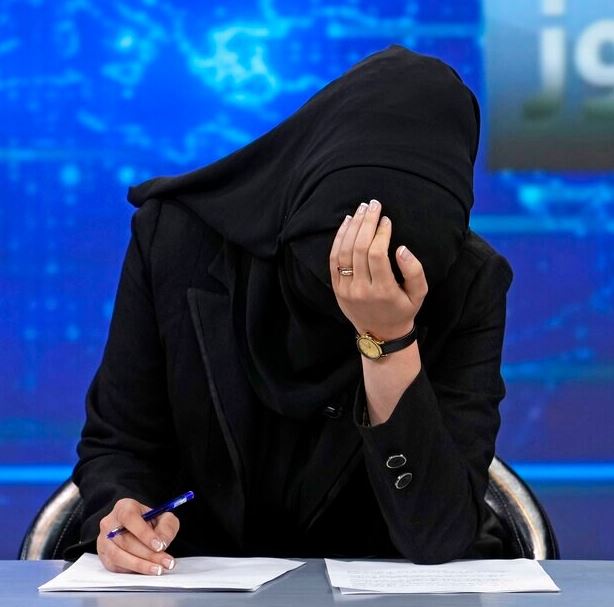
FILE – TV anchor Khatereh Ahmadi bows her head while wearing a face covering as she reads the news on TOLO NEWS, in Kabul, Afghanistan, May 22, 2022, after Taliban rulers required all female TV news anchors in the country to cover their faces while on-air.

Akmal Dawi
VOA News
August 30, 2023

In 2016, a young girl, whom we will call Zarghona to protect her identity, embarked on a remarkable journey in central-south Afghanistan. At just 14 years old, she joined a local radio station in Ghazni province, eager to make her voice heard. Initially entrusted with a daily entertainment program for young people, Zarghona’s charisma and talent soon led her to more challenging assignments.

“I presented a culinary program, as well as a cultural awareness program,” she said, her voice tinged with nostalgia.

By 2021, Zarghona’s career was soaring, and she had dreams of pursuing higher education in journalism in Kabul and working for the national media in the capital city.

Before the year’s end, though, everything changed dramatically.

As the Taliban swept into power in August of that year, one of their first acts was to indefinitely suspend secondary education for girls, extinguishing the hopes of countless young women like Zarghona. The new Islamist regime also terminated the employment of almost all female public servants, with few exceptions, in the education and health sectors.

The national broadcasting agency, Radio and Television Afghanistan, saw all of its female journalists dismissed, and private TV channel anchors were compelled to wear face masks.

Under the Taliban’s gender-based discriminatory regime, female journalists are barred from interviewing male government officials, forbidden from participating in press conferences without a male chaperone, and restricted from traveling for reporting purposes.

These rules, unapologetically designed to push women out of journalism, paint a grim picture for Zarghona and many other young women who desperately want to work as journalists.

Despite this bleak reality, for about two years, Zarghona has waited anxiously for an announcement from the Taliban that schools and universities would reopen for girls, and women would be allowed to return to work.

Others hold no such hope.

“I see the future even darker. The restrictions [against women] are increasing day after day, and the Taliban do not care how we suffer,” said Madina Bamyani (not her real name), a journalist in the central Bamyan province.

The three journalists who spoke with VOA for this article still reside in Afghanistan, but they all asked to remain anonymous, fearing reprisals from the Taliban.

Targeted persecution

Earlier this year, Bamyani received a job offer from a U.S.-based Afghan media outlet to produce video reports about alleged Taliban atrocities in Bamyan and nearby provinces.

The private media sector — once a thriving industry thanks to the international support it received — has been crushed as Taliban restrictions force hundreds of journalists and media professionals to seek asylum in countries around the world.

Outside their homeland, some Afghan journalists have managed to secure funding and launch digital news and analysis outlets aimed at Afghan audiences. But working for those outlets is perilous in Taliban-ruled Afghanistan.

“After I produced a report about the ban on women’s beauty salons, the Taliban investigated and discovered my identity,” Bamyani said. Fearing detention, she fled to Kabul after her employers warned her they would not be able to help if the Taliban found out about her work for them.

The United States has played a significant role in supporting Afghan media development over the past two decades, spending more than $220 million on media support programs, according to the Special Inspector General for Afghanistan Reconstruction.

In September 2022, a year after the Taliban seized power, the U.S. Agency for International Development allocated $20 million for projects supporting Afghan media, including $5 million in grants and a nearly $12 million award that aims to deliver news and educational content for Afghans until mid-2026.

“The United States remains committed to supporting the fundamental right of freedom of expression, including for journalists and human rights defenders, and supports their ability to operate freely without fear of violence against them,” said a spokesperson for the U.S. State Department.

Taliban officials accuse media organizations from abroad that produce content for Afghans of spreading lies and propaganda, and they have targeted reporters and producers working for such outlets.

Parwiz Shamal, an Afghan journalist and founder of Chalawsaf, an Afghan media observer organization, said the Taliban have detained several reporters on charges that they worked for media entities that are not permitted to operate in Afghanistan.

“Nobody is there to defend those reporters because the Taliban consider these outlets illegal, and like in any other country, work for a disallowed organization bears legal responsibilities,” Shamal said.

Information blackout

When the Taliban announced the closure of beauty salons for women in July, there was no public debate or critical media coverage about it.

“We are forced to comply with their misogynistic orders knowing well that those orders are against us,” said Yagana Niekhandish, a female journalist in Herat province.

“If I refuse to comply, the Taliban’s intelligence agency will throw me in jail overnight,” she said.

The Taliban’s intelligence agency has been accused of detaining, and in some cases torturing, about 50 journalists during the past two years, free press groups have reported.

In rural areas, the suppression of women’s voices is even more severe, with local Taliban and religious leaders banning women from radio broadcasts, effectively silencing them from public conversations.

Human rights groups say the Taliban’s anti-women policies are aimed at erasing women from all public spheres, but Taliban officials maintain they are committed to women’s rights — as long as they are within the confines of Islamic Sharia and local traditions.

As Afghan women vanish from public life, access to credible information about their living conditions, from health to income to education, becomes increasingly unavailable.

The Taliban have dissolved the two state institutions — the Ministry of Women’s Affairs and the Afghanistan Independent Human Rights Commission — that monitored and reported on women’s issues and proposed policies to empower them.

“I guess everybody knows what’s happening in Afghanistan, it is an official femicide,” Zarghona said.

“What pains me more is that I’m not able to report it to the world.”

Posted in Afghan Women, Censorship, Media, Taliban | Tags: Afghan Journalists, Life under Taliban rule, Press Freedom, Taliban war on women |

Tolo News in Dari – August 30, 2023

30th August, 2023 · admin

Posted in News in Dari (Persian/Farsi) |
Previous Posts
Next Posts

Subscribe to the Afghanistan Online YouTube Channel

---

---

---

Get Yours!

Peace be with you

Afghan Dresses

© Afghan Online Press
  • About
  • Links To More News
  • Opinion
  • Poll