
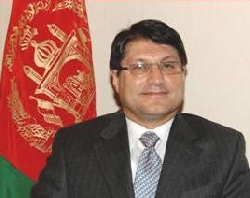
Ahadi (file photo)
Akmal Dawi
VOA News
February 21, 2024
Sixteen months after its establishment, the U.S.-backed Fund for the Afghan People has yet to release any payments for its intended purposes, a board member reveals.
The fund, created using half of Afghanistan’s frozen assets in the United States, aims to help stabilize the Afghan economy without benefiting the de facto Taliban authorities.
Established in the wake of the Taliban’s takeover in 2021, the Switzerland-based fund holds $3.5 billion that formerly belonged to the Afghan Central Bank. It is authorized to support activities such as paying Afghanistan’s debts to international organizations, funding electricity imports and even printing currency.
“I’m surprised that they [the Taliban] have not asked for any payment so far,” Anwar ul-Haq Ahady, a co-chair of the fund’s board of trustees, told VOA.
Ahady emphasized his willingness to facilitate the funding of authorized activities.
Taliban officials declined to comment.
Despite the fund’s inaction, the Taliban recently announced payment of outstanding electricity bills using domestic funds.
Additionally, a European donor helped settle Afghanistan’s World Bank debt last year, unlocking new bank aid.
Last week, the World Bank announced it had approved a new approach to Afghanistan aimed at supporting income-generating activities. Under the new approach, work will be resumed on a $1.2 billion project that will bring clean energy from Tajikistan and Kyrgyzstan to Pakistan via Afghanistan.
Afghanistan is also in arrears to the Asian Development Bank, resulting in a hold on the ADB’s regular assistance programs since 2021.
Ahady said the fund would consider paying the ADB debt.
“But we are the last resort,” he added.
Saving the assets
Over $9 billion in Afghan assets remain frozen in the U.S., Europe and the United Arab Emirates, inaccessible to the Taliban.
In the U.S., $3.5 billion face claims from 9/11 victims’ families. It is unclear if that frozen portion generates interest like the funds in Switzerland.
The fund has already accrued more than $200 million in interest in less than two years, according to Ahady.
“Afghans see this as their national treasure,” said Masuda Sultan of Unfreeze Afghanistan, an organization advocating the release of the frozen assets. “Afghans believe the funds should not be used to pay for consumption of goods and services.”
Despite dire poverty in Afghanistan, the fund in Switzerland is not earmarked for immediate humanitarian needs — a deliberate choice, according to Ahady.
“Humanitarian needs are so huge at this juncture that [if used], this amount of money [the fund] will disappear quickly,” he said.
The United States and other donors have given billions in humanitarian assistance to Afghans over the past two years.
As the Taliban remain a pariah regime widely condemned for their repressive policies, the future of the frozen assets remains uncertain.
“The funds belong to Da Afghanistan Bank,” said Ahady, referring to the Afghan Central Bank, now governed by the Taliban.
The now $3.74 billion fund can only be released if the Afghan Central Bank demonstrably acts independently from the Taliban and complies with anti-terrorism safeguards.
 The Independent (UK): A minister repeatedly raised concerns about potential war crimes committed by UK special forces in Afghanistan with senior figures within the Ministry of Defence – telling Ben Wallace “something stinks” – and was unable to disprove an alleged cover-up of killings when he investigated. Veterans minister Johnny Mercer was speaking to an inquiry into dozens of killings of Afghan civilians by the SAS between 2010 and 2013. He told the inquiry on Tuesday that he did not want to believe reports that the elite British soldiers had killed unarmed Afghans, but he was “unable” to find “something to disprove these allegations”. He said that when he investigated the matter with the senior figures within UK special forces (UKSF) they were “unable to answer basic questions” and he “did not believe them”.
  8am: In the latest development, the United Nations hosted a meeting of special representatives from countries, along with some prominent Afghan women and civil society figures. In this meeting, the Secretary-General of the United Nations sought to create international consensus and coherence among the global community in dealing with the Taliban. On the eve of this meeting, the United Nations Committee on the Elimination of Discrimination against Women (CEDAW) has labeled the Taliban’s discriminatory behaviors, systematic violence, and systematic elimination of women as crimes against humanity. This entity has called on the International Criminal Court (ICC) to comprehensively investigate these Taliban crimes.
  Khaama: The head of the Public Invitation and Guidance Department of the de facto administration stated that many media employees still commit a major sin by shaving their beards. Mohammad Hashem Shahid Wror, the head of the Public Invitation and Guidance Department of the Taliban, said on Tuesday, February 20th in a meeting, that growing a beard is obligatory and should not be trimmed. He said, “Media employees should also keep their beards and refrain from shaving.” Earlier, the governor of the Taliban in Kandahar recently issued a written directive to all institutions and authorities of the Taliban in this province, prohibiting any photography of formal and informal meetings and ceremonies.
  FP: Afghanistan’s government doesn’t recognize a 130-year-old border—and its local affiliates are causing havoc in the Pakistani borderlands… Dawar said the turning of the Taliban tables on Pakistan “was predictable.” The Taliban “are now a threat to Central Asia. They are now a threat to Iran, to Pakistan, and to even China. All of them thought we will control the Taliban after the takeover. The problem is it didn’t happen,” he said.
  Abubakar Siddique
 Ayaz Gul