
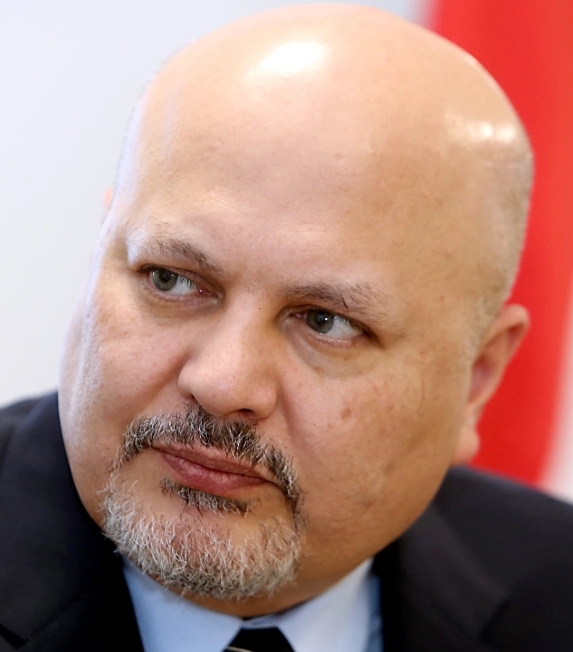
Karim Khan
By RFE/RL’s Radio Mashaal and RFE/RL’s Radio Azadi
January 24, 2025
Afghan rights groups have applauded the International Criminal Court’s announcement that it is seeking arrest warrants for two top Taliban officials for allegedly persecuting Afghan women and girls, an accusation the Taliban-run Foreign Ministry called “baseless.”
ICC prosecutor Karim Khan said in a statement on January 23 that he has requested warrants for the Taliban’s supreme leader, Mullah Haibatullah Akhundzada, and the head of Afghanistan’s Supreme Court, Abdul Hakim Haqqani.
Khan said based on evidence collected thus far in an investigation reopened in October 2022 there are reasonable grounds to believe Akhundzada and Haqqani “bear criminal responsibility for the crime against humanity of persecution on gender grounds.”
He said his office had concluded that they are “criminally responsible for persecuting Afghan girls and women, as well as persons whom the Taliban perceived as not conforming with their ideological expectations of gender identity or expression, and persons whom the Taliban perceived as allies of girls and women.”
“This is a prestigious international institution, and their decisions and actions have strong consequences…. This is a big threat to the Taliban,” Mir Abdul Wahid Sadat, head of the Afghan Lawyers Association, told RFE/RL’s Radio Azadi.
The alleged crimes were committed from August 15, 2021, when the Taliban seized power as U.S.-led international forces withdrew from the country, until the present day.
The Taliban-run Foreign Ministry said in a statement that the arrest warrants lacked a “legal foundation” and that it “strongly condemns and rejects these baseless accusations.”
“This is a major step. The people of Afghanistan have been facing a culture of impunity for over five decades,” according to Shaharzad Akbar, an Afghan rights campaigner who headed the former Afghanistan Independent Human Rights Commission and now runs the independent advocacy organization Rawadari.
The government has previously said it was working on a strategy and creating a suitable environment for girls’ education. But it has not reported how much progress has been made or said when girls would be allowed to go to school beyond grade six.
After returning to power, the Taliban banned teenage girls from education. Since then, the Islamist group has imposed draconian bans on women’s work, education, and mobility despite domestic opposition and a global outcry.
The arrest warrants came a day before International Education Day, which the United Nations Assistance Mission in Afghanistan (UNAMA) said should be noted with “a profound sense of regret and deep concern for the millions of Afghan girls who continue to be denied their fundamental right to education.”
“It is a travesty and tragedy that millions of Afghan girls have been stripped of their right to education. No country has ever thrived by disempowering and leaving behind half its population. The de facto authorities must end this ban immediately and allow all Afghan girls to return to school,” added Roza Otunbayeva, the UN secretary-general’s special representative for Afghanistan.
Khan said in the statement that the applications for arrest warrants “recognize that Afghan women and girls as well as the LGBTQI+ community are facing an unprecedented, unconscionable, and ongoing persecution by the Taliban.”
The alleged persecution entails “numerous severe deprivations of victims’ fundamental rights” that are contrary to international law, the statement said. This includes the right to “physical integrity and autonomy,” free movement, free expression, free assembly, and education.
Human rights groups applauded the ICC move.
Liz Evenson, international justice director at Human Rights Watch, said the Taliban’s “systematic violations of women and girls’ rights, including education bans, and the suppression of those speaking up for women’s rights, have accelerated with complete impunity.”
The warrant requests offer a pathway to accountability, Evenson said in a statement.
Khan said the requests were the first applications for arrest warrants to arise out of the investigation into the situation in Afghanistan, adding that his office soon will file further applications for other senior members of the Taliban.
A decision on whether to issue arrest warrants following requests from the prosecutor typically takes around four months.
Copyright (c) 2025. RFE/RL, Inc. Reprinted with the permission of Radio Free Europe/Radio Liberty, 1201 Connecticut Ave NW, Ste 400, Washington DC 20036.
Related
 Afghanistan International: Hayatullah Mohajir Farahi, the Taliban’s Deputy Minister of Information and Culture, defended the group’s ban on the distribution and publication of dozens of books, saying that banning books is a “common practice” in many countries. Farahi added that the Taliban has banned some books in order to build a “single nation” in Afghanistan.
  DW: Wild poliovirus was almost eradicated globally two years ago, but poor conditions are causing cases to rise in Afghanistan and spill into Pakistan. Before the development of the first poliovirus vaccine in 1955, poliomyelitis paralysed and killed up to half a million people every year.
  Ariana: The International Cricket Council (ICC) on Friday announced the ODI team of 2024, with three Afghans namely Rahmanullah Gurbaz, Azmatullah Omarzai and Allah Mohammad Ghazanfar making the cut to the list. Other players in the list are from Sri Lanka (4), Pakistan (3) and West Indies (1).
  Amu: Afghanistan’s Ali Reza Asahi, a two-time world bodybuilding champion, on Thursday died due to an illness. He was 49. The National Bodybuilding Federation confirmed Asahi’s death in a statement, adding that his funeral is scheduled for Friday in the Omid Sabz township in Kabul. A celebrated figure in the sport, Asahi won back-to-back gold medals in 2023 and 2024 in the global bodybuilding championships, competing in the Masters category.
 Ayaz Gul
 Ayaz Gul