
UN Says More Than 100,000 Afghans Displaced By Conflict This Year
 Radio Free Europe/Radio Liberty
July 30, 2020
The United Nations says that more than 100,000 people fled conflict inside Afghanistan’s borders so far this year amid continued violence, despite an agreement between the United States and the Taliban intended to pave the way for intra-Afghan peace talks.
The UN Office of Coordination of Humanitarian Affairs (UNOCHA) also reported on July 30 that nearly 10,000 people were displaced due to heavy fighting between government forces and Taliban militants in the northeastern provinces of the country last week, while another 600 people were displaced in the south for the same reason.
The United States and Taliban struck an agreement in February intended to pave the way for intra-Afghan peace talks between the militants and the U.S.-backed government in Kabul to end nearly 18 years of war.
Although the Taliban has refrained from attacking U.S. and NATO forces, militants continue to stage near daily attacks on Afghan security forces.
Afghan President Ashraf Ghani said on July 28 that more than 10,000 government troops had been killed or wounded since the U.S.-Taliban deal was signed.
The UN has documented more than 1,200 civilian deaths in the first half of 2020.
The Taliban has announced a three-day cease-fire for the upcoming Eid al-Adha holiday, which will start early on July 31. The government has said it will reciprocate.
U.S. special envoy Zalmay Khalilzad, who arrived in Kabul on July 29 as part of a regional tour to push the peace process, hailed the development in a tweet, saying “our hope is this Eid brings all Afghans together in understanding & mutual respect and one step closer to a sustainable peace.”
Under the U.S.-Taliban deal, Kabul was to release around 5,000 Taliban in exchange for the militants freeing 1,000 government and military personnel.
To date, Kabul has freed about 4,000 militants and the Taliban nearly 800 government forces. The Taliban has accused Afghan security forces of rearresting insurgents who had been released.
But Ghani on July 28 signaled progress in the prisoner exchange, saying Kabul would “soon” finish the swap.
Late on July 29, the Taliban said it would complete the release of government prisoners by Eid as a “goodwill gesture.”
With reporting by AP, AFP, Reuters and dpa
Copyright (c) 2020. RFE/RL, Inc. Reprinted with the permission of Radio Free Europe/Radio Liberty, 1201 Connecticut Ave NW, Ste 400, Washington DC 20036.
Khost governor calls Jalaluddin Haqqani ‘a great hero’
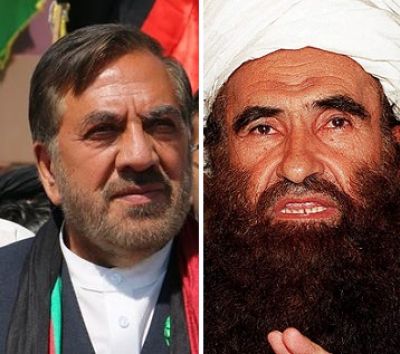
Khost Governor Sediq Patman (L), founder of Haqqani network Jalaluddin Haqqani (R).
1TV: Sediq Patman, who was recently appointed by President Ashraf Ghani as the governor of Afghanistan’s eastern Khost province, has called Jalaluddin Haqqani, founder of the militant Haqqani network, as a great hero. Click here to read more (external link).
COVID-19: Afghanistan’s total number of cases is now 36,538
 Tolo News: The Ministry of Public Health on Thursday reported 65 new positive cases of the coronavirus from 300 samples tested over the last 24 hours. So far, 88,502 samples have been tested in government centers and there are 9,834 known active COVID-19 cases in the country, according to data by the Ministry of Public Health. In the last 24 hours, the ministry also reported 10 new deaths from COVID-19 and 155 recoveries. The number of total cases is now 36,538, the total reported deaths is 1,281, and the total recoveries is 25,544. Click here to read more (external link).
1TV Afghanistan Dari News – July 29, 2020
Trump Says He Didn’t Discuss Russia-Taliban Bounty Allegations with Putin

Putin (left) and Trump (right) – file photo
VOA News
July 29, 2020
U.S. President Donald Trump told the Axios news site that he did not discuss with Russian President Vladimir Putin an alleged Russian plot to pay militants for attacks on American and coalition forces in Afghanistan.
Trump, in an excerpt of the interview released Wednesday, said he discussed “other things” with Putin in a phone call last week and reiterated his dismissal of the bounty allegations.
“It never reached my desk. You know why? Intelligence, they didn’t think it was real. They didn’t think it was worthy. If it reached my desk I would have done something about it,” Trump said.
U.S. defense and intelligence officials have long been concerned about Russian interference in Afghanistan, complaining repeatedly that Moscow has been providing the Taliban with weapons and training.
A Pentagon report released July 1, while making no mention of the alleged bounties, warned Russian involvement is growing.
In his interview with Axios, Trump claimed “the last thing that Russia wants to do is to get too much involved with Afghanistan.”
U.S. Officials Hail Afghan Cease-Fire Amid Renewed Hopes For Peace
 Radio Free Europe/Radio Liberty
July 29, 2020
Top U.S. officials have hailed a three-day cease-fire proposed by the Taliban and agreed by the Afghan government, raising hopes that the long-delayed intra-Afghan peace talks could begin next week.
The two foes announced a halt in hostilities for the Muslim Eid al-Adha holiday starting on July 31, as the United States presses for the start of long-awaited talks.
The announcements come as U.S. special envoy to Afghanistan Zalmay Khalilzad is trying to revive peace talks with visits to Pakistan and the Afghan capital, Kabul, as well as Qatar, where the Taliban maintain a political office.
“We welcome the Taliban announcement of an Eid cease-fire and the Afghan government’s reciprocal announcement,” Khalilzad said on Twitter on July 29.
“Our hope is this Eid brings all Afghans together in understanding & mutual respect and one step closer to a sustainable peace.”
The top U.S. diplomat in Kabul, Ross Wilson, also voiced hope that the two sides would move quickly to the negotiating table, saying Afghans “deserve to celebrate the holiday in peace.”
“I look forward to both sides fulfilling their commitments and moving quickly to intra-Afghan negotiations,” tweeted Wilson, who is charge d’affaires at the U.S. Embassy in Kabul.
The United States and the Taliban struck an agreement in February intended to pave the way for intra-Afghan peace talks between the militants and the U.S.-backed government in Kabul to end nearly 18 years of war.
Major Hurdle
Although the Taliban have refrained from attacking U.S. and NATO forces, militants continue to stage near daily attacks on Afghan security forces.
But in a July 28 statement, the militants announced the conditional three-day cease-fire.
“All mujahideen (Taliban fighters) are instructed not to carry out any operation against the enemy during the three days and nights of Eid,” the Taliban said in a July 28 statement, adding that if the Taliban are attacked, they should “respond strongly.”
The Afghan government said it had ordered its security forces to observe the cease-fire.
However, a major hurdle in launching intra-Afghan talks is the completion of prisoner exchanges.
Both the Afghan government and the Taliban have suggested that direct talks may finally occur after Eid al-Adha, provided the prisoner swap has been completed.
Afghan President Ashraf Ghani said on July 28 that peace talks with the Taliban could begin “in a week’s time,” following a prisoner exchange.
“To demonstrate the government’s commitment to peace, the Islamic republic will soon complete the release of 5,000 Taliban prisoners,” Ghani said at the presidential palace.
Under the U.S.-Taliban deal, Kabul was to release around 5,000 Taliban in exchange for the militants freeing 1,000 government and military personnel.
To date, Kabul has freed about 4,000 militants and the Taliban nearly 800 government forces. The Taliban has accused Afghan security forces of rearresting insurgents who had been released.
Ghani urged the Taliban to agree to a “permanent and comprehensive cease-fire” during any peace talks. He said Taliban attacks have killed 3,560 government forces and wounded 6,781 others since the U.S.-Taliban deal was signed in February.
Ghani’s spokesman, Sediq Sediqqi, told the media that Kabul would observe the cease-fire, but cautioned it did not go far enough.
“The people of Afghanistan demand a lasting ceasefire and the start of direct talks between the Taliban and the government of Afghanistan,” Sediqqi said.
With reporting by AFP, AP, dpa, and Reuters
Copyright (c) 2020. RFE/RL, Inc. Reprinted with the permission of Radio Free Europe/Radio Liberty, 1201 Connecticut Ave NW, Ste 400, Washington DC 20036.
Related
Dostum’s Continued Absence from Kabul Raises Questions

Dostum
Tolo News: Almost two months after receiving marshal rank, Abdul Rashid Dostum has yet to return to Kabul to start his work as a member of the National Security Council and as a member of the newly formed High Council of Government, which has raised questions among critics who say political rifts between government leaders have prevented Dostum from returning to the capital city. The decree to promote Dostum to marshal was signed by the president on June 10, but the news broke on July 3. He received the rank at a ceremony in his hometown in Jawzjan on July 15. Click here to read more (external link).
1TV Afghanistan Dari News – July 28, 2020
Taliban leader says group is on the verge of establishing “pure Islamic government”

Mullah Hibatullah Akhundzada
Ariana: The Taliban’s leader Mawlawi Hibatullah Akhundzada stated Tuesday that the group is on the threshold of “establishing a pure Islamic government” and warned the United States and the international community to take the Doha-agreement seriously and “stop creating further problems”. He said in his Eid ul-Adha message: “Our Jihad was and continues to be for ending the occupation and establishing a pure Islamic government, therefore, we reassure our Mujahid and persecuted nation that their aspirations will not be betrayed.” Click here to read more (external link).
Related